IRS Deadline: February 1, 2027

The form your client sends you is a 1099-NEC; the form your payment processor sends you is a 1099-K. If you received both, your first three steps are: (1) identify which payments came through direct channels like check, ACH, or wire versus which went through a card processor or third-party app; (2) match each amount to your bank deposits and invoices; and (3) report the total once on Schedule C, not twice. Before filing or disputing any amount, confirm the current-year thresholds at IRS.gov, because the rules have changed more than once in recent years.
Key Takeaways
Form 1099-NEC and Form 1099-K report different payment channels, and reporting both on Schedule C without deducting fees or removing duplicates is the most common filing error freelancers make.
| Point | Details |
|---|---|
| Identify the payment channel first | Whether the payer or the processor reports the payment depends on how the funds were settled, not who hired you. |
| 1099-K reports gross amounts | Deduct processor fees, refunds, and chargebacks on Schedule C to arrive at net taxable income. |
| Report all income regardless of 1099s | The IRS requires reporting all business income even when no 1099 was issued because amounts fell below the threshold. |
| Reconcile monthly, not in January | Grouping payments by channel each month prevents double-counting and makes year-end filing straightforward. |
| TaxFormHero for e-filing and corrections | TaxFormHero’s IRS-authorized platform supports bulk 1099-NEC filing, TIN verification, corrections, and encrypted e-delivery from a single dashboard. |
TaxFormHero is an IRS-authorized e-filing platform, so you can e-file Form 1099-K online without paper or a subscription.
What is Form 1099-NEC and when does a payer issue it?
Form 1099-NEC reports nonemployee compensation. The business that paid you files it, not a payment processor. If a client wired $4,000 to your bank account for consulting work, that client is responsible for issuing the 1099-NEC and reporting the amount in Box 1.
The payer files a 1099-NEC when they made direct payments by check, ACH, wire, or cash. Typical examples include a marketing agency paying a freelance designer, a law firm paying a contract paralegal, or a construction company paying a subcontractor. The IRS instructions for Forms 1099-MISC and 1099-NEC confirm that payments already reportable on Form 1099-K should not be duplicated on a 1099-NEC by the same payer.
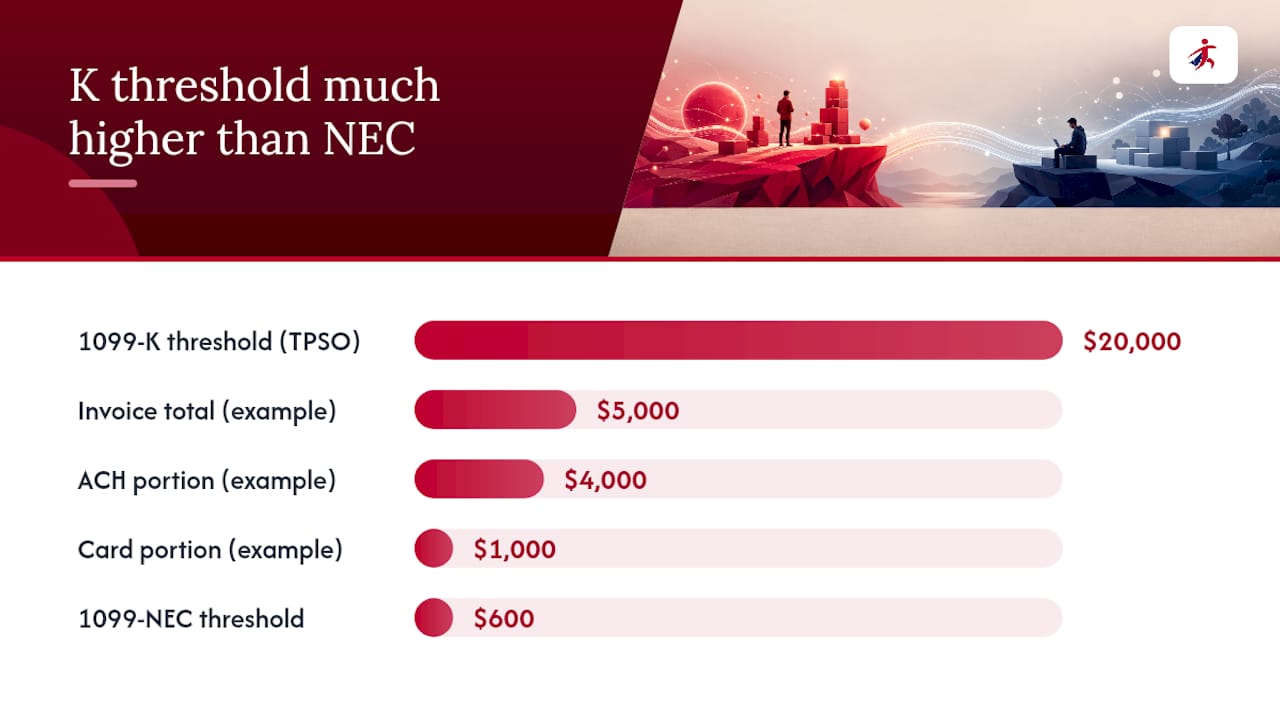
The filing threshold for 1099-NEC has historically been $600 in nonemployee compensation paid to a single recipient in a calendar year. The threshold for the 2026 tax year is higher, so filers should verify the current tax year’s threshold at IRS.gov before filing or disputing a form, since Congress and the IRS have adjusted these figures through legislation and administrative guidance.
A practical example: A contractor receives $3,000 via ACH directly from a client and $500 via PayPal from the same client. The client should report only the $3,000 ACH payment on a 1099-NEC. The $500 PayPal payment may appear on a 1099-K issued by PayPal as the payment settlement entity. Reporting both on a 1099-NEC would create a duplicate.
What is Form 1099-K and how does it report gross amounts?
Form 1099-K is filed by the payment settlement entity (PSE), which is the bank, card processor, payment app, or marketplace that actually settles the funds. The business that hired you does not file this form. PayPal, Stripe, Square, and marketplace platforms that hold and disburse funds all qualify as PSEs under IRS rules.
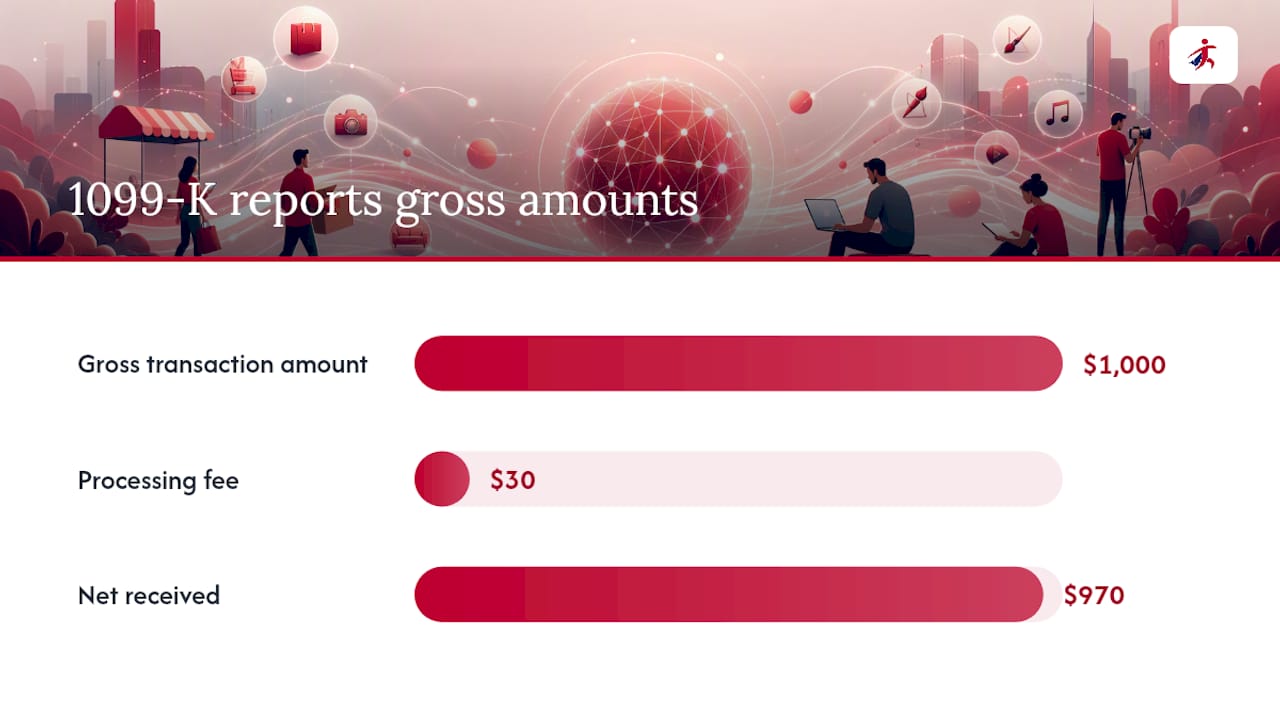
The critical distinction with 1099-K is that it reports gross amounts, meaning the total transaction value before any fees, refunds, or adjustments are subtracted. The IRS instructions for Form 1099-K require the PSE to report the gross amount of all reportable payment transactions in Box 1a. If a client paid you $1,000 through a card processor that charged a $30 processing fee, your 1099-K will show $1,000, not $970. You claim the $30 fee as a business deduction on Schedule C.
The threshold rules for 1099-K have been revised multiple times. The IRS has documented a history of phased changes and delays to the lower thresholds originally introduced by the American Rescue Plan Act. Per current IRS guidance, the threshold for third-party network transactions (TPSOs) has been restored to the pre-ARPA standard: gross payments exceeding $20,000 AND more than 200 transactions. Payment card transactions have separate reporting rules. Confirm the threshold for your filing year directly at IRS.gov before acting.
| Scenario | Who files the 1099-K | What is reported |
|---|---|---|
| Customer pays by credit card via Stripe | Stripe (merchant acquirer) | Gross card transaction amount |
| Freelancer receives marketplace payout from Etsy | Etsy (TPSO) | Gross payout amount before fees |
| Client pays via PayPal Friends & Family | Generally not reportable as a business transaction | Depends on platform classification |
Some platforms issue a 1099-K even when federal thresholds are not met, due to state-specific rules or internal platform policies. The IRS explains that recipients may receive a Form 1099-K below federal thresholds for these reasons, and recommends verifying the reason for issuance directly with the processor.
How do 1099-K and 1099-NEC compare side by side?
The difference between 1099-K and 1099-NEC comes down to who files the form and what type of payment channel was used.
| Dimension | Form 1099-NEC | Form 1099-K |
|---|---|---|
| Who files it | The business that paid you directly | The payment settlement entity (PSE) |
| Reporting threshold | $600 historically; the threshold for the 2026 tax year is higher, so filers should verify the current tax year’s threshold at IRS.gov before filing or disputing a form | $20,000 and 200+ transactions for TPSOs (confirm at IRS.gov) |
| Payment types reported | Direct payments: check, ACH, wire, cash | Card transactions and third-party network payouts |
| How amounts appear | Net compensation in Box 1 | Gross receipts in Box 1a (before fees/refunds) |
| Typical recipients | Freelancers, independent contractors, service providers | Marketplace sellers, card-accepting businesses, app-based earners |
| Where it goes on your return | Schedule C, gross receipts | Schedule C, gross receipts (then deduct fees) |
A single contractor can legitimately receive both forms without any double-counting. For example: a web developer invoices a client $5,000, with $4,000 paid by ACH and $1,000 charged to the client’s business card. The client issues a 1099-NEC for the $4,000 ACH portion. The card processor issues a 1099-K for the $1,000 card transaction. Total reported income: $5,000, matching the invoice. The payer should not include the $1,000 card payment on the 1099-NEC, because the PSE is already reporting it.
Pro Tip: If you receive a 1099-NEC and a 1099-K that together exceed your total invoiced revenue, the most likely cause is a payer who included card-processed payments on the NEC in addition to the K. Request a corrected 1099-NEC from the payer before filing.
Why you might receive both forms and how to reconcile them
Receiving both a 1099-NEC and a 1099-K for the same tax year is common for freelancers who accept payments through multiple channels. Three situations produce this most often: a client pays some invoices by ACH and others by card; a marketplace issues a 1099-K for all platform payouts while a direct client also issues a 1099-NEC; or a client uses a mass-payment tool that the IRS classifies as a TPSO, generating a 1099-K even though the payer thought they controlled the payment.
How do you report 1099-NEC and 1099-K amounts on your tax return?
Report all business income on Schedule C (Form 1040). A 1099-K is not a separate tax; it is an informational document telling the IRS what a processor reported on your behalf. Your obligation is to report your actual net business income accurately, regardless of what the forms show.
- Total your gross receipts — Add all income from all channels, including amounts below any 1099 threshold. The IRS requires you to report all business income even when no 1099 was issued.
Self-employment tax applies to net self-employment income above $400. Even if a client did not issue a 1099-NEC because your payments fell below the filing threshold, you still owe tax on that income.
Pro Tip: Retain processor fee reports, monthly merchant statements, and your invoice register. If your gross 1099-K is substantially larger than your net deposits, these documents substantiate the deductions that explain the difference.
What should businesses do before issuing a 1099-NEC?
The payer who made a direct payment by check, ACH, or wire files the 1099-NEC when the payment meets filing requirements. If the payer routed payments through a TPSO that settled the funds on its own balance sheet, the TPSO files the 1099-K instead, and the payer should exclude those amounts from the 1099-NEC.
The operational confusion arises when businesses use mass-payment tools. Some tools act as agent disbursement services (the payer controls the funds and the tool is just a delivery mechanism), while others qualify as TPSOs (the platform holds and settles funds). The payment channel’s contractual structure, not the vendor’s marketing label, determines reporting ownership.
Pre-year-end checklist for payers
- Collect a completed W-9 from every contractor before the first payment.
- Confirm which payment channels you control directly versus which platforms settle funds independently.
- Run TIN matching against your contractor list before filing to catch mismatches early.
- Reconcile your accounts payable records against payment-platform reports to identify any overlap.
- Confirm the current-year 1099-NEC threshold at IRS.gov before deciding which contractors require a form.
Filing deadlines matter. The 1099-NEC deadline for both recipient copies and IRS filing is January 31. Missing this date can trigger penalties. Electronic filing removes the requirement for a separate Form 1096 paper transmittal, which is required only for paper submissions.
The IRS Guide to Information Returns covers current form changes, threshold rules, and the transition from the FIRE system to IRIS for electronic filing. Payers filing electronically should confirm their software vendor supports IRIS, which becomes the required intake system beginning with the 2027 filing season.
Pro Tip: Use e-file with TIN verification before submitting. A TIN mismatch triggers a B-notice from the IRS and can require backup withholding at 24% on future payments to that contractor.
What should you do if a 1099 amount is wrong?
Request a corrected form from the issuer in writing. For a 1099-NEC, contact the payer directly. For a 1099-K, contact the payment settlement entity. Document every communication with a date and a summary of what was discussed.
Compare the issuer’s records to your own invoices and bank statements before making the request. A specific, documented discrepancy is far more persuasive than a general objection. If the issuer agrees, they file a corrected form with the IRS and send you a copy.
Do not delay filing your return while waiting for a correction. File using your reconciled figures and attach a brief written explanation if the amount you report differs materially from what the 1099 states. The IRS matches 1099 totals to returns, so an unexplained gap can generate a notice.
If an issuer refuses to correct a form that is materially wrong, the IRS guidance on Form 1099-K provides context on why forms are issued and what steps recipients can take. For complex disputes involving significant income misstatement, consulting a tax professional is the most direct path to resolution.
Monthly reconciliation habits that prevent January headaches
Reconciling monthly rather than scrambling in January is the single most effective way to keep your 1099s aligned with your books.
Monthly reconciliation checklist:
- Group all income by payment channel: direct deposits, card transactions, and platform payouts.
- Match each transaction to an invoice by date and amount.
- Reconcile merchant statements to bank deposits and flag any discrepancy above $10.
- Log processor fees separately so they are ready to deduct at year-end.
- Note any refunds or chargebacks and confirm they are reflected in your records.
The IRS generally recommends retaining business records for at least three years from the date you filed the return, though records supporting a loss carryback or a claim for credit may need to be kept longer. Keep invoices, bank statements, and processor reports together in a single folder per tax year.
Pro Tip: Reconcile your processor fee reports every month, not just in December. Fees accumulate quickly, and a year-end total that differs from your running estimate is a sign that some transactions were miscategorized.
A simple ledger that maps each invoice number to the deposit date, the payment channel, and the net amount received will cut your year-end reconciliation time significantly. Spreadsheet tools like Microsoft Excel or Google Sheets handle this well for most freelancers and small businesses.
Why IRS authorization, TIN verification, and secure e-filing matter for 1099 filers
E-filing with TIN verification reduces misfiled forms and the follow-up corrections they generate. A form filed with a mismatched TIN triggers a B-notice from the IRS, which requires the payer to begin backup withholding at 24% on future payments to that contractor until the issue is resolved.
When evaluating a filing platform, prioritize these features:
- IRS authorization: — The platform must be an IRS-authorized e-file provider.
The IRS Guide to Information Returns notes that the FIRE system is being replaced by IRIS as the IRS’s electronic intake system. Payers filing electronically should confirm their vendor supports IRIS for filings beginning with the 2027 filing season. Vendors that have not updated their systems will be unable to submit electronically after FIRE shuts down.
SOC 2 certification and 256-bit data encryption are the baseline security standards for any platform handling 1099 data. These certifications reduce organizational risk when transmitting sensitive taxpayer identification numbers and compensation figures.
The mistake most filers make with these two forms
The conventional wisdom says the hard part of 1099s is understanding the thresholds. That is wrong. The hard part is recognizing that the same dollar can appear on two different forms and knowing exactly why that is not a problem, as long as you report it once.
The most common error is treating the gross 1099-K amount as taxable income without adjusting for fees and refunds. A freelancer who received $12,000 in card payments but paid $360 in Stripe fees and issued $500 in refunds has $11,140 in net income from that channel, not $12,000. Filing without those deductions overstates income and overpays tax. The fix is straightforward: keep a monthly fee log and a refund register, and reconcile both before you open Schedule C.
The second most common error is payers issuing a 1099-NEC that includes card-processed payments the PSE already reported on a 1099-K. This happens when a business uses a payment tool without understanding whether it qualifies as a TPSO. The operational fix is simple: before year-end, confirm with each payment platform whether it will issue a 1099-K for your contractor payouts. If yes, exclude those amounts from your 1099-NEC. Mandatory W-9 collection at the start of every contractor relationship and a payment-channel log updated monthly eliminate most of these problems before they reach January.
TaxFormHero makes 1099 filing and corrections straightforward
Filing 1099-NEC forms for a roster of contractors, correcting a misfiled form, or verifying TINs before submission are exactly the tasks where an IRS-authorized platform pays for itself. TaxFormHero handles all three without a subscription or signup fee; you pay only for the forms you file, starting at $1.99 per form.
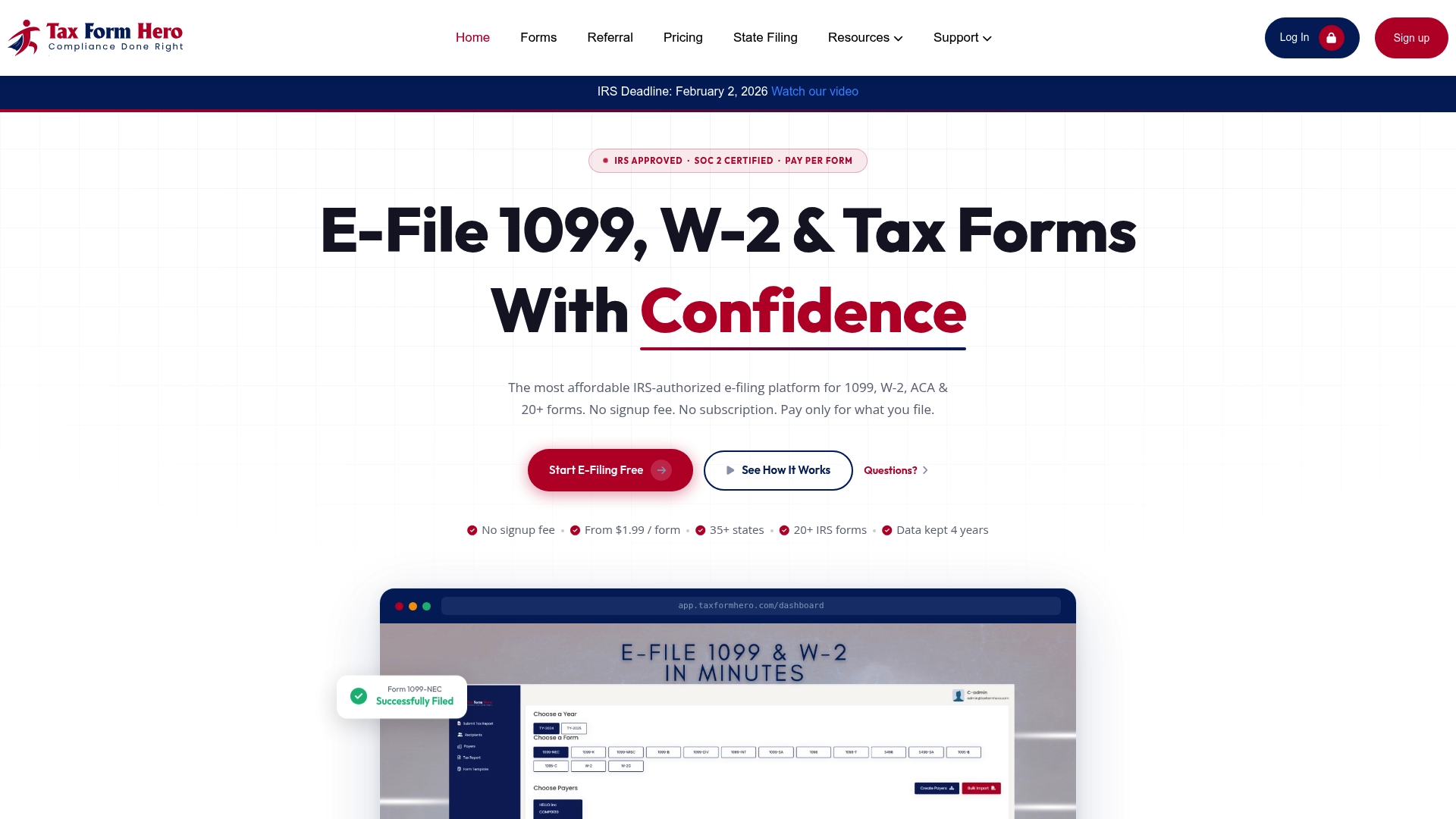
The platform supports bulk import for businesses filing multiple 1099-NEC forms, automated TIN matching against IRS records, electronic corrections, state filing for 35+ states, and 256-bit encrypted e-delivery so recipients receive their copies securely. SOC 2 certification and IRS authorization back every transaction. There is no Form 1096 to prepare when you e-file, which removes one more administrative step from your year-end process.
If you need to e-file 1099 forms, correct a previously filed form, or run TIN verification before your January 31 deadline, start a one-off filing at TaxFormHero today.
This article provides general information about IRS tax forms and is not professional tax or legal advice. Confirm current thresholds, deadlines, and rules at IRS.gov or with a qualified tax professional before filing.
Authoritative sources for thresholds, instructions, and corrections
Use the resources below to confirm year-specific rules before filing or disputing a 1099.
| Resource | What it covers |
|---|---|
| IRS Instructions for Form 1099-K | Gross reporting rules, PSE definitions, and recipient guidance for 1099-K |
| Understanding Your Form 1099-K | Why you may receive a 1099-K below federal thresholds and how to respond |
| IRS Guide to Information Returns (Publication 1099) | Current thresholds, 2026 form changes, IRIS transition timeline, and filing deadlines |
| IRS 1099-K Threshold Announcement | History of threshold changes and phased implementation context |
| TaxFormHero | IRS-authorized e-filing for 1099-NEC, 1099-K, and 20+ form types with TIN verification and corrections |
Always check year-specific IRS instructions before acting on any threshold or deadline. Rules for 1099-K in particular have changed multiple times, and the version that applied in a prior year may not apply to your current filing. For disputes involving material income misstatement, a qualified tax professional is the most reliable resource.