IRS Deadline: February 1, 2027

For tax year 2025 returns filed in 2026, the critical dates are: Form 1099-NEC must be furnished to recipients and filed with the IRS by February 2, 2026; recipient copies for Forms 1099-B, 1099-S, and 1099-MISC (when reporting amounts in boxes 8 or 10) are due February 17, 2026; and the e-file deadline for most other 1099 forms falls on March 31, 2026. These dates come directly from IRS Publication 1099 and the General Instructions for Certain Information Returns.
Three things to know before you read further:
- January 31 falls on a Saturday in 2026, which shifts the 1099-NEC deadline to Monday, February 2, 2026, under the IRS next-business-day rule.
- Penalties begin the day after a deadline passes — there is no grace period beyond the calendar shift.
- The practical checklist in Section 11 gives you a month-by-month action plan from year-end through March.
What are the 2026 1099 deadlines at a glance?
The table below covers the most common 1099 forms filed in 2026 for tax year 2025. Dates reflect weekend and federal holiday adjustments already applied.
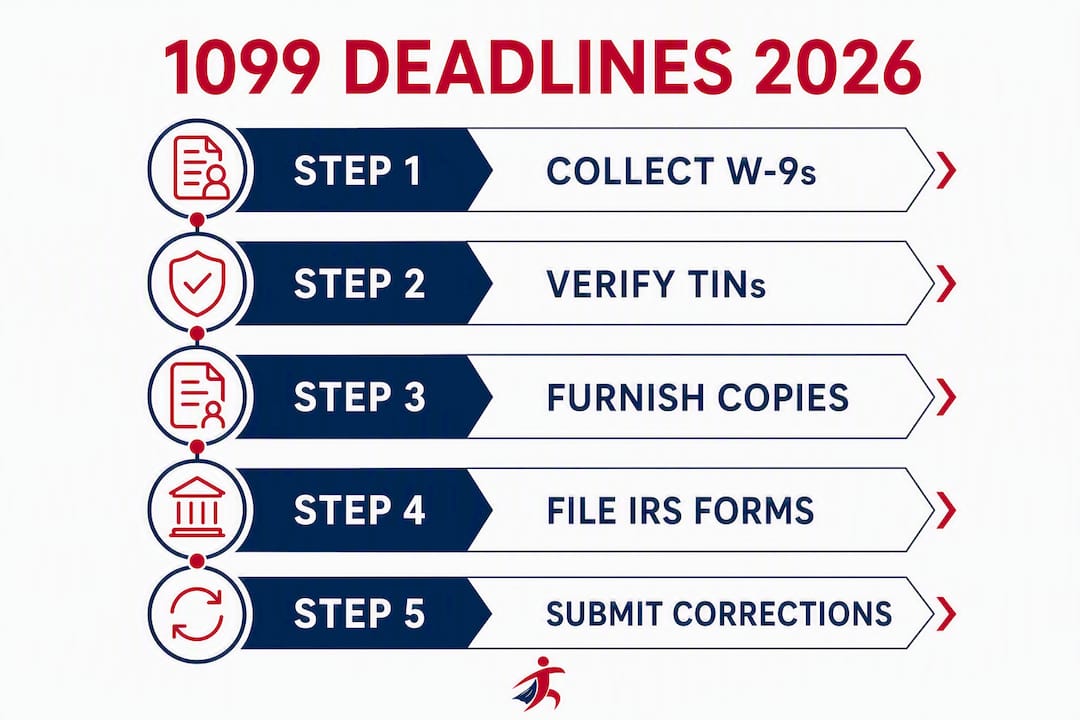
| Form | Recipient copy due | Paper filing due | E-file due | Notes |
|---|---|---|---|---|
| 1099-NEC | February 2, 2026 | February 2, 2026 | February 2, 2026 | Jan 31 falls on Saturday; shifted to next business day |
| 1099-MISC (general) | February 2, 2026 | March 2, 2026 | March 31, 2026 | Standard recipient date aligns with NEC |
| 1099-MISC (boxes 8 or 10) | February 17, 2026 | March 2, 2026 | March 31, 2026 | Feb 15 falls on Sunday; Feb 16 is Presidents’ Day |
| 1099-B | February 17, 2026 | March 2, 2026 | March 31, 2026 | Same holiday shift as MISC boxes 8/10 |
| 1099-S | February 17, 2026 | March 2, 2026 | March 31, 2026 | Same holiday shift applies |
| 1099-INT | February 2, 2026 | March 2, 2026 | March 31, 2026 | Standard furnishing date |
| 1099-DIV | February 2, 2026 | March 2, 2026 | March 31, 2026 | Standard furnishing date |
| 1099-R | February 2, 2026 | March 2, 2026 | March 31, 2026 | Standard furnishing date |
| 1099-K | February 2, 2026 | March 2, 2026 | March 31, 2026 | Confirm threshold rules with IRS guidance |
Key distinctions:
- Recipient furnishing means the copy delivered to the payee. IRS filing means the return submitted to the IRS, and the method (paper vs. electronic) determines which deadline applies.
- Forms 1099-B, 1099-S, and 1099-MISC with boxes 8 or 10 have a later recipient-furnishing date because the underlying statutory date of February 15 shifted to February 17 in 2026 due to the weekend and Presidents’ Day holiday.
- Paper filers for most forms face a March 2, 2026 deadline (the standard February 28 date shifts because February 28 falls on a Saturday in 2026).
Need to get this filed? You can e-file Form 1099-NEC online with TaxFormHero, which is IRS-authorized and charges per form, not per month.
Form-by-form deadlines: what you need to know for each type
1099-NEC
The 1099-NEC deadline is the one that catches the most filers off guard. Both the recipient copy and the IRS filing share the same date: February 2, 2026. That applies whether you file on paper or electronically. There is no split deadline here, unlike most other 1099 forms.
Critically, Form 1099-NEC does not qualify for the same automatic 30-day extension available to many other information returns. Per the Instructions for Form 8809, filers who miss the NEC deadline typically face immediate penalty exposure unless a hardship application is accepted. If you realize you cannot meet February 2, file what you have and correct it rather than waiting.
1099-MISC
The 1099-MISC has two different recipient-furnishing dates depending on what you are reporting. For most amounts, the recipient copy is due February 2, 2026, matching the standard furnishing window. If you are reporting amounts in box 8 (substitute payments) or box 10 (gross proceeds paid to an attorney), the recipient copy is due February 17, 2026.
Paper filing with the IRS is due March 2, 2026. E-filing extends that to March 31, 2026, giving you nearly a full month of additional time to transmit the IRS copy.
1099-B and 1099-S
Both forms share the February 17, 2026 recipient-furnishing date, per the General Instructions for Certain Information Returns. Brokers and financial institutions that issue consolidated reporting statements (which bundle 1099-B data with other information) also fall under this February 17 date. The IRS filing deadline for both is March 31, 2026 for e-filers and March 2, 2026 for paper filers.
1099-INT, 1099-DIV, 1099-R, and 1099-K
These forms follow the standard pattern: recipient copies due February 2, 2026; paper IRS filing due March 2, 2026; e-file due March 31, 2026. For 1099-K, confirm the applicable reporting threshold with current IRS guidance, as the threshold has been subject to phased implementation.

Pro Tip: If you issue multiple form types, batch your 1099-NEC filings separately and process them first. The NEC’s single shared deadline for both recipient furnishing and IRS filing means any delay in that batch affects your IRS submission simultaneously, unlike MISC or B where the furnishing and filing windows are staggered.
IRS filing rules: e-file vs. paper, thresholds, and transmittals
The e-file threshold
The IRS lowered the aggregate e-file threshold to 10 information returns effective for returns required to be filed on or after January 1, 2024. If you are filing 10 or more information returns in aggregate across all form types, you are generally required to e-file. This is not a per-form-type count; it is the total across all 1099s, W-2s, and other information returns combined.
Filers who cannot e-file due to a genuine hardship may request a waiver, but the IRS grants these narrowly. The safer path is to use an IRS-authorized e-file transmitter.
Paper filing and Form 1096
Paper filers must attach Form 1096 as a transmittal cover sheet for each form type submitted. A separate Form 1096 is required for each type of 1099 (one for 1099-NEC, a separate one for 1099-MISC, and so on). Postmark rules apply: a return postmarked by the deadline and mailed to the correct IRS address is considered timely. The IRS also accepts submissions via approved private delivery services (PDS), such as FedEx and UPS, using designated street addresses rather than P.O. boxes.
IRIS and e-file timing
The IRS Information Returns Intake System (IRIS) is the primary portal for e-filing 1099s directly with the IRS. E-filers using IRIS are considered timely if they submit by 11:59 p.m. on the applicable due date. Do not wait until the final hour on a deadline day; transmission queues can create delays, and a submission that begins before midnight but is not accepted until after counts as late.
Extensions via Form 8809
Form 8809 can provide an automatic 30-day extension for many information returns when filed by the original due date. The critical exception: 1099-NEC has stricter rules. Per the Instructions for Form 8809, an automatic extension is generally not available for 1099-NEC, and filers needing more time must demonstrate hardship. For all other forms, filing Form 8809 on time buys 30 additional days for the IRS submission, but it does not extend the recipient-furnishing deadline.
Key rule: An approved extension to file with the IRS does not move the recipient-furnishing deadline. You must still deliver recipient copies by the original furnishing date unless you separately request and receive an extension to furnish statements. These are two distinct processes.
Pro Tip: File Form 8809 electronically through IRIS before the original deadline if you need an extension for eligible forms. Paper Form 8809 submissions take longer to process, and a late or unprocessed 8809 provides no protection.
How do weekend and federal holiday shifts work for 2026 deadlines?
The IRS rule is straightforward: when a due date falls on a Saturday, Sunday, or legal holiday in the District of Columbia or where the return is to be filed, the deadline moves to the next business day. Two 2026 deadlines are directly affected.
The two 2026 calendar shifts:
- January 31 → February 2, 2026: — January 31 falls on a Saturday. The next business day is Monday, February 2, 2026. This affects the 1099-NEC recipient and IRS filing deadline, as well as the standard recipient-furnishing date for most other 1099 forms.
One detail that surprises many filers: the holiday that triggers a shift is determined by the holiday calendar of the District of Columbia or the jurisdiction where the return is filed, not necessarily the filer’s home state. A state holiday in your state does not automatically extend a federal filing deadline unless it also falls in D.C. or the applicable filing jurisdiction. For filers navigating cross-border or expat situations, the IRS compliance calendar logic for calendar effects applies the next-business-day principle equally.
Leap years do not extend deadlines. IRS Publication 509 explicitly states that February 28 remains a fixed date where referenced in instructions, regardless of whether the year has 29 days in February.
Pro Tip: Build your internal deadlines three to five business days before the IRS deadline. Electronic submissions can sit in a processing queue, and an acceptance confirmation received after 11:59 p.m. on the due date is a late filing regardless of when you clicked “submit.”
How should you furnish recipient copies: mail, electronic consent, and delivery rules?
Mailing rules
A recipient copy mailed by the due date is considered timely furnished, provided it is addressed correctly and postmarked on or before the deadline. Keep a record of the mailing date: a USPS Certificate of Mailing (not Certified Mail, which requires a signature) is a low-cost way to document timely furnishing for each batch. For large volumes, a postage meter tape or bulk mailing receipt from the post office serves the same purpose.
Private delivery services approved by the IRS can also be used for recipient copies, though the IRS’s PDS guidance is primarily written for IRS submissions. Confirm the applicable rules for recipient furnishing before using a PDS for payee copies.
Electronic delivery and consent requirements
You may furnish recipient copies electronically, but only if the recipient has affirmatively consented in writing (or electronically) before the statement is furnished. Consent obtained after the fact does not satisfy the requirement retroactively. The consent must:
- Be made in a way that demonstrates the recipient can access the electronic format (typically by confirming they have the necessary software).
- Include a disclosure that the recipient will receive the statement electronically rather than on paper.
- Allow the recipient to withdraw consent at any time.
Once consent is obtained, the statement is considered furnished when it is posted to a secure, accessible location and the recipient is notified. A recipient PDF download through an encrypted portal, such as the e-delivery feature offered by authorized platforms, satisfies this requirement when the notification and access steps are documented.
Documentation checklist to retain:
- Dated consent records for each recipient (name, date of consent, method)
- Notification records showing when recipients were informed the statement was available
- Proof of posting or transmission (timestamped system logs)
- Returned mail records for paper copies that were undeliverable
Pro Tip: Electronic consent obtained for one tax year carries forward to subsequent years unless the recipient withdraws it, but you must notify recipients annually of their right to withdraw. Build this annual notice into your January workflow.
How do you correct a 1099 after it has been filed?
Errors happen. The IRS process for corrected returns is well-defined, and acting quickly reduces penalty exposure.
Step-by-step correction process:
- Identify the error type — The IRS distinguishes between Type 1 errors (incorrect money amounts, codes, or checkboxes) and Type 2 errors (incorrect payee TIN, payee name, or filing as the wrong form type). Each requires a different correction approach.
Timing matters. A corrected return filed within 30 days of the original deadline may qualify for a lower penalty tier than one filed later. If the error involves a wrong TIN, correcting it promptly and documenting your TIN-matching efforts can support a reasonable-cause argument.
When a corrected return changes the form type entirely (for example, amounts originally reported on 1099-MISC that should have been on 1099-NEC), treat it as a new filing obligation, not just a correction. The original incorrect form should be voided.
What are the penalties for missing 1099 deadlines in 2026?
Penalty tiers
The IRS applies escalating penalties based on how late a return is filed or furnished. The tiers below reflect the standard penalty structure for information returns.
| How late | Penalty per form (general filers) | Penalty per form (small businesses) | Annual cap |
|---|---|---|---|
| Filed within 30 days of deadline | $60 | $60 | Lower cap applies for small businesses |
| Filed more than 30 days late but by August 1 | — | — | Mid-tier cap applies |
| Filed after August 1 or not filed | $330 | $330 | Higher cap applies |
| Intentional disregard | — | — | No annual cap |
These figures reflect the penalty tiers for late 1099 filing as historically applied by the IRS, with amounts that can range from approximately $60 to $330 per form depending on lateness and filer size. Separate penalties apply for failure to furnish recipient copies, and both can stack for the same form.
Reasonable-cause relief
The IRS may waive penalties if you can demonstrate reasonable cause and that the failure was not due to willful neglect. Supporting documentation typically includes:
- Records showing you made a good-faith effort to obtain the payee’s correct TIN (W-9 requests, TIN-matching results).
- Evidence of a system failure or other event outside your control, with documentation of when it occurred and how you responded.
- Proof that you corrected the error as soon as you identified it.
Reasonable cause is evaluated on a facts-and-circumstances basis. A pattern of late filings in prior years weakens any reasonable-cause argument significantly.
Pro Tip: If you discover a missing or incorrect 1099 before August 1, file the correction immediately. Filing within 30 days of the original deadline costs $60 per form; waiting past August 1 costs $330. On a batch of 50 forms, that difference is $13,500.
What state-level 1099 filing requirements should you check for 2026?
State 1099 filing obligations are separate from federal requirements, and the rules vary considerably by state. Some states participate in the IRS Combined Federal/State Filing (CF/SF) program, which allows certain 1099 data to flow automatically from the federal filing to the state. Others require a direct submission to the state tax authority, sometimes on a different schedule and through a separate portal.
Key action items for multi-state filers:
- Confirm whether each state where you have payees participates in the CF/SF program. Participation does not cover all form types, so verify form-by-form.
- Check each state’s reporting threshold. Several states have thresholds lower than the federal $600 minimum, meaning you may owe state 1099 reporting on payments that fall below the federal threshold.
- Review state-specific deadlines. Some states align with federal dates; others set their own January or February deadlines that may be earlier than the federal schedule.
- Determine whether state income tax was withheld. Most states require a 1099 submission whenever state income tax is withheld, regardless of the payment amount.
- For states not in CF/SF, prepare separate state transmittals and confirm the required format (some states require their own transmittal forms equivalent to Form 1096).
States that have historically required direct 1099 filing outside the CF/SF program include California, New York, Pennsylvania, and several others. Check each state’s department of revenue website for 2026-specific guidance, as thresholds and portal requirements can change annually.
TIN matching, backup withholding, and how to avoid CP2100 notices
The TIN-matching service
The IRS TIN-matching program allows authorized payers to verify that a payee’s name and Taxpayer Identification Number (TIN) match IRS records before filing. You can access the service through the IRS e-Services portal. Run TIN matches on new payees before the first payment and on existing payees whenever their information changes.

A mismatch identified through TIN matching before filing gives you time to request a corrected W-9 from the payee. A mismatch discovered after filing triggers a different, more costly process.
Backup withholding triggers
Backup withholding at the current IRS prescribed rate applies when:
- A payee fails to provide a TIN.
- The IRS notifies you (via a CP2100 or CP2100A notice) that the TIN provided is incorrect.
- A payee fails to certify that they are not subject to backup withholding when required.
Once backup withholding is triggered, you must begin withholding on subsequent payments immediately. You cannot retroactively withhold on payments already made.
The CP2100 process
The IRS sends CP2100 and CP2100A notices to payers whose filed 1099s contain name/TIN combinations that do not match IRS records. When you receive one:
- Compare the notice against your payee records.
- Send a B-Notice (first or second, depending on history) to the affected payee within 15 business days of receiving the CP2100.
- Request a new W-9 or W-8 from the payee.
- Begin backup withholding if the payee does not respond within the required timeframe.
Pro Tip: Run TIN matches in October or November, before year-end payments are finalized. Catching mismatches then gives you time to resolve them before the 1099 filing window opens, rather than scrambling in January with a CP2100 notice already in hand.
Action steps to reduce TIN-related exposure:
- Collect a W-9 from every new vendor before the first payment, not after.
- Store W-9s in a centralized, secure location with the date received.
- Document every TIN-match attempt, including the date and result.
- Retain B-Notice correspondence and payee responses for at least four years.
A practical small-business timeline to meet 2026 1099 deadlines
October through December (pre-year-end)
- Collect W-9s from any new vendors or contractors paid during the year.
- Confirm mailing addresses for all payees who will receive a 1099.
- Run TIN-match checks on new payees and any payees whose information changed.
- Review your accounts payable records to identify all payments of $600 or more to non-corporate payees.
- Confirm which states require separate 1099 filings and whether you have state withholding to report.
January 2026
- Finalize payment totals for all payees by January 15.
- Prepare the 1099-NEC batch first; this form has the earliest combined recipient and IRS filing deadline.
- Schedule recipient copy mailing or e-delivery for 1099-NEC no later than January 28 to allow for postal transit time before February 2.
- For electronic delivery, confirm that recipient consent is on file before posting statements.
- File Form 8809 by January 31 if you need an extension for eligible forms (not 1099-NEC).
February 2026
- February 2: — Furnish 1099-NEC recipient copies and file with the IRS (paper or e-file).
March 2026
- March 2: — Paper-file remaining 1099s with the IRS (with Form 1096 transmittals).
Post-filing follow-up
- Retain copies of all filed returns, recipient furnishing records, and acceptance notices for at least four years.
- Monitor for CP2100 notices (typically issued mid-year) and respond within the required timeframe.
- File corrected returns promptly for any errors identified after submission.
Pro Tip: A pay-per-form e-filing service eliminates the need to manage IRIS credentials, Form 1096 transmittals, and paper mailing logistics separately. For small businesses filing fewer than 100 forms, the per-form cost is typically lower than the staff time required to manage paper submissions.
How do you e-file 1099s correctly and stay compliant?
Step-by-step e-file workflow
- Confirm IRS acceptance — Do not assume a successful transmission equals acceptance. Retrieve and save the IRS acknowledgment file or acceptance notice.
Verification checks before transmission
- Confirm that all TINs are nine digits with no spaces or dashes in the data file.
- Verify that total amounts on your transmittal reconcile with the sum of individual returns.
- Check that the correct tax year is populated on every form.
- Confirm the correct form type is assigned to each payee record (NEC vs. MISC is a common mix-up).
Security and privacy best practices
Handling payee data requires protecting Social Security Numbers and Employer Identification Numbers throughout the filing process. Use platforms that offer 256-bit encryption for data storage and transmission. Limit access to payee PII to staff who need it for filing purposes, and use role-based access controls where available.
Tax Form Hero is an IRS-authorized, SOC 2-certified platform that handles 1099, W-2, ACA, and 20+ form types with 256-bit encrypted data storage, TIN verification, and encrypted e-delivery. For businesses filing 10 or more returns, it removes the need to manage IRIS credentials directly while maintaining full compliance.
Pro Tip: Save timestamped IRS acceptance notices in a dedicated folder organized by tax year and form type. If a payee later disputes receiving a 1099, or the IRS questions a filing, the acceptance notice is your primary proof of timely submission.
The IRS e-file mandate now covers most businesses: with the aggregate threshold set at 10 returns, the vast majority of small businesses filing 1099s are required to e-file rather than paper-file. Platforms that automate bulk import, TIN validation, and acceptance confirmation reduce the manual workload and the risk of transmission errors that trigger penalties.
Key Takeaways
The single most important fact for 2026: Form 1099-NEC must be furnished to recipients and filed with the IRS by February 2, 2026, with no automatic extension available and penalties starting immediately after that date.
| Point | Details |
|---|---|
| 1099-NEC deadline | February 2, 2026 for both recipient furnishing and IRS filing; no automatic extension applies. |
| February 17 recipient date | Forms 1099-B, 1099-S, and 1099-MISC (boxes 8 or 10) must reach recipients by February 17, 2026. |
| E-file deadline for most forms | March 31, 2026 is the e-file deadline for most 1099 forms; paper filers face March 2, 2026. |
| Penalty exposure | Late penalties vary depending on how late the filing is; intentional disregard penalties are significantly higher. |
| Tax Form Hero | Pay-per-form e-filing with TIN verification, encrypted e-delivery, and direct state filing for 35+ states helps meet every 2026 deadline. |
The case for treating 1099 deadlines as a year-round discipline
The conventional approach to 1099 compliance treats it as a January problem. Collect W-9s in December, scramble to file in January, and move on. That approach works until it does not, and when it fails, it fails expensively.
The February 2 deadline for 1099-NEC is unforgiving precisely because the form has no automatic extension. Most other information returns give filers a safety valve: file Form 8809, buy 30 days, correct course. The NEC does not. That asymmetry means a business that treats all 1099s as interchangeable is one missed deadline away from immediate penalty exposure on its most common filing obligation.
The more useful frame is to treat TIN verification as a vendor onboarding step, not a year-end task. A W-9 collected before the first payment eliminates the single largest source of CP2100 notices. A TIN match run in October, rather than January, gives you three months to resolve mismatches instead of three days. The businesses that consistently avoid 1099 penalties are not the ones with the best January workflows; they are the ones that built the compliance steps into their accounts payable process throughout the year.
There is also an underappreciated risk in the recipient-furnishing rules for electronic delivery. Many businesses assume that posting a PDF to a payroll portal satisfies the furnishing requirement. It does not, unless the payee previously consented in writing to electronic delivery. Undocumented electronic furnishing is treated as non-furnishing, which carries the same penalty as not sending the form at all. The consent requirement is not a technicality; it is the entire legal basis for electronic delivery.
The practical implication: build consent collection into your onboarding process for contractors and vendors, document it centrally, and confirm annually that consent has not been withdrawn. That single step eliminates one of the most common and avoidable furnishing penalties.
File your 1099s this year without the manual overhead
Meeting 2026 1099 filing deadlines requires accurate data, verified TINs, and confirmed IRS acceptance, all within tight windows that leave little room for manual errors. Tax Form Hero gives businesses and tax professionals a direct path to compliance without subscriptions or setup fees.
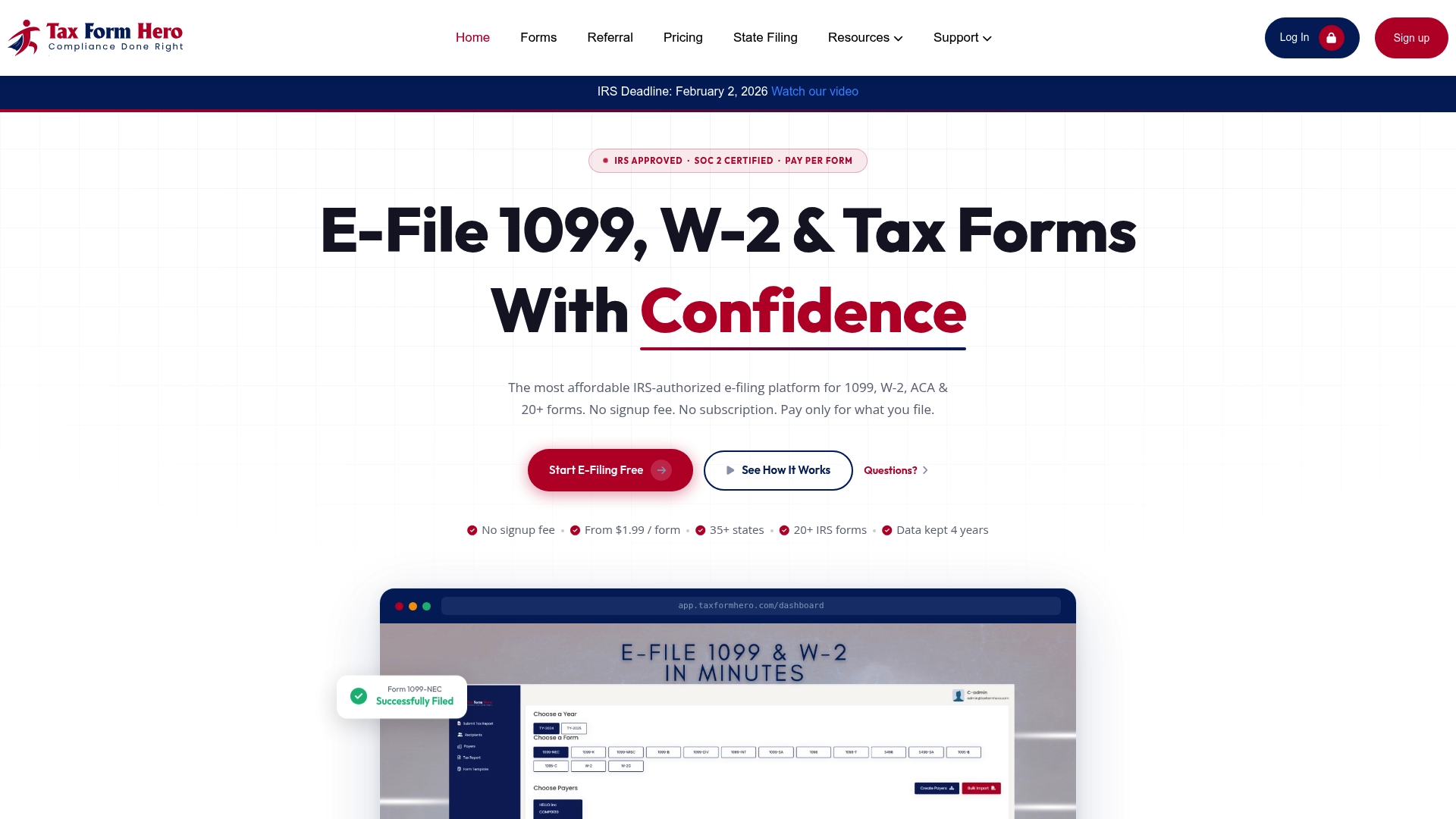
The platform handles e-filing for 1099-NEC, 1099-MISC, 1099-B, and 20+ other IRS form types, with pay-per-form pricing starting at $1.99 per form. Built-in TIN verification catches mismatches before transmission. Encrypted e-delivery with documented consent tracking satisfies the recipient-furnishing rules. Bulk import handles large payee lists in minutes, and direct state filing covers 35+ states so you do not need a separate workflow for state submissions.
For businesses required to e-file under the 10-return threshold, Tax Form Hero’s IRS-authorized, SOC 2-certified platform removes the complexity of managing IRIS credentials and paper transmittals. Start filing your 1099s at Tax Form Hero and meet every February and March deadline with a confirmed acceptance notice on file.
Useful sources and links
- Instructions for Forms 1099-MISC and 1099-NEC (Rev. December 2026) — primary IRS instructions for filing 1099-NEC and 1099-MISC for tax year 2025.
- General Instructions for Certain Information Returns (2025) — covers due dates, e-file thresholds, recipient-furnishing rules, and the Guide to Information Returns for all form types.
- Publication 1099 (2026), General Instructions for Certain Information Returns — authoritative source for the next-business-day rule, weekend/holiday shifts, and furnishing requirements.
- IRS Publication 509 (Tax Calendars) — timely filing rules, leap-year clarifications, and the next-business-day rule by jurisdiction.
- Instructions for Form 8809 — extension rules for information returns, including the special treatment of 1099-NEC and W-2.
- IRS IRIS e-filing portal — guidance on e-filing through IRIS, submission timing rules, and acceptance confirmation procedures.
This article provides general information about IRS 1099 filing deadlines and is not legal or tax advice. Confirm current rules with the IRS directly or consult a qualified tax professional for your specific situation.