IRS Deadline: February 1, 2027
File 10+ 1099s? Skip Form 1096 in 2026 for U.S. Payers

No. Form 1096 is a paper transmittal cover sheet, and the IRS does not use it for electronically filed returns. If you’re required to e-file (10 or more information returns for the year) or you simply choose to, skip Form 1096 entirely. Your first move: confirm whether your total information return count puts you over the e-file threshold, or whether you’re paper-filing by choice.
TL;DR:
- Form 1096 is only required for mailing paper information returns; it is not used for electronic filings.
- You need a separate Form 1096 for each type of paper form submitted, with totals and signatures, by the applicable deadline.
- Once your total information returns reach 10 or more, you must e-file, and Form 1096 is no longer necessary.
- Ordering official, scannable copies is essential for processing, and using non-IRS stock can cause delays or rejection.
- Platforms like TaxFormHero enable direct electronic filing, bypassing the need for Form 1096 and reducing errors and duplicate submissions.
When Form 1096 Is Required for Paper Transmittals
Form 1096 exists for one purpose: summarizing and transmitting paper information returns to the IRS. If you’re mailing paper copies, Form 1096 acts as the cover sheet the IRS scans to log what’s inside the envelope. According to the IRS’s own guidance on Form 1096, it transmits paper Forms 1097, 1098, 1099, 3921, 3922, 5498, and W-2G. It does not apply to Forms W-2 (those route through the Social Security Administration) or to any return filed electronically.
The grouping rule trips up a lot of first-time filers: you need a separate Form 1096 for each type of form you’re submitting on paper, not one blanket form for everything.
- If you’re paper-filing 15 Forms 1099-NEC and 8 Forms 1099-MISC, that’s two separate Form 1096 transmittals, one per form type.
- Each Form 1096 reports the total number of forms attached and the total dollar amounts reported on those forms.
- You cannot combine 1099-NEC and 1099-MISC totals under a single 1096, even though both are “1099s” in casual conversation.
Deadlines follow the underlying form, not Form 1096 itself. Paper Forms 1099-NEC and their accompanying 1096 are generally due to the IRS by January 31, while most other 1099 series forms and their 1096 transmittals are due by the end of February when paper-filed (the e-file deadline is later, typically March 31).
Ordering the right paper stock matters more than most filers realize. You cannot print Copy A of Form 1096 or the attached information returns from a downloaded PDF and mail them in. Copy A must be the official, IRS-scannable version, ordered directly from the IRS or purchased from an approved forms vendor. The Form 1096 instructions spell this out clearly because non-scannable copies get flagged during IRS processing.

Signature requirements are straightforward but often overlooked. A mismatch here, even a minor one like a truncated business name, can delay processing or trigger a notice asking you to reconcile the discrepancy.
Filing one yourself? You can e-file Form 1099-NEC online with TaxFormHero, an IRS-authorized e-filing platform.
When You Don’t Need Form 1096: E-File Rules and Exceptions
Form 1096 has no role once you cross into electronic filing. The IRS states plainly that Form 1096 transmits paper returns only and was never designed as, nor should be treated as, a companion document for e-filed submissions. If your software or platform submits data directly to the IRS through IRIS or another approved electronic channel, there’s no transmittal form to prepare, sign, or mail.
There are a few edge cases worth knowing about:
- Certain low-volume filers use online fillable PDF versions of specific information returns when paper-filing small quantities, but those fillable versions still require attachment to a paper Form 1096 if mailed rather than submitted electronically.
- Black-and-white, non-scannable Copy A forms are sometimes acceptable for these lower-volume, fillable-PDF scenarios, but the rules differ by form type, so check the specific form’s instructions before assuming this applies to you.
- None of these exceptions change the core rule that e-filed returns never need a 1096, regardless of volume.
One number matters more than any other here: 10. Once your aggregate information returns for the year hit 10 or more, you’re required to e-file, and Form 1096 drops out of the picture completely.
The riskiest mistake filers make isn’t forgetting Form 1096. It’s submitting both a paper filing with Form 1096 and an electronic filing for the same returns, usually because a bookkeeper or a second employee didn’t realize the other had already filed. Duplicate filings can trigger IRS notices, mismatched totals on your account transcript, and in some cases, penalty assessments for incorrect information returns. If you discover a duplicate has gone out, don’t file a second correction on top of it; contact the IRS directly to sort out which submission is authoritative before taking further action.
E-File Requirements, IRIS, A2A, and Transmitter Control Codes
The threshold that decides whether Form 1096 is even relevant to you comes down to simple math. Treasury Decision 9972 lowered the mandatory e-file threshold to 10 aggregated information returns, effective for returns required to be filed on or after January 1, 2024, and that threshold remains in place for the 2026 filing season. That count aggregates across most information return types, meaning five 1099-NEC forms and five 1099-K forms together push you past the line, not just five of one kind.
Once you’re required to e-file, you have two main technical paths through the IRS’s e-file information returns program:
- IRIS Taxpayer Portal. This is the IRS’s free, browser-based system for eligible filers, built to let smaller businesses submit returns manually without third-party software. Publication 5717 covers the portal’s setup and use.
- IRIS Application-to-Application (A2A). This method lets tax software and platforms transmit data directly to the IRS at scale, which is how most e-filing platforms, including TaxFormHero, handle bulk submissions. Publication 5718 documents the technical specifications for A2A transmitters.
Either path requires a Transmitter Control Code, a five-character identifier the IRS assigns to approved filers and software transmitters. You’ll need an active EIN to apply, and the IRS notes that processing can take up to 45 days. That’s not a same-week turnaround, which is exactly why waiting until January to apply for a TCC is one of the most common reasons small filers miss their e-file deadline entirely.
Pro Tip: Apply for your TCC in the fall, well before the filing season crunch. A 45-day processing window means a November application clears with room to spare, while a January application can leave you scrambling past your deadline with no electronic filing option available yet.
Hardship exists for filers who genuinely can’t e-file. Form 8508 lets you request a waiver from the electronic filing requirement, but approval isn’t automatic and the IRS expects a documented reason, not simple preference for paper. Filers who are required to e-file and don’t, without an approved waiver, face penalties for failing to file electronically, separate from any penalties tied to late or incorrect returns. If you’re near the 10-return threshold and unsure which side you land on, planning your electronic filing strategy ahead of time avoids that penalty exposure altogether.
How to Paper-File Form 1096: A Step-by-Step Checklist
If you’re under the e-file threshold and choosing to paper-file, follow this sequence to avoid the errors that cause the most processing delays.
- Order official scannable Copy A forms from the IRS or an approved vendor well before your deadline. Never print Copy A from a downloaded PDF.
- Complete Form 1096 with your business’s exact legal name, address, and EIN, matching what’s on file with your 941 or other employment tax returns.
- Group your attachments by form type. Every Form 1099-NEC goes under its own 1096; every Form 1099-MISC goes under a separate one.
- Total the amounts reported across all attached forms and enter that figure, along with the form count, on the 1096.
- Sign and date the form, using an authorized signer: the payer, an agent, or a corporate officer.
- Mail to the correct IRS processing center for your state, confirmed against the current Form 1096 instructions, since addresses can shift from year to year.
A few mistakes account for most of the rejected or delayed paper filings TaxFormHero customers describe when they switch from paper to electronic submission:
- Mismatched name or TIN between Form 1096 and your business’s other IRS filings.
- Incorrect totals that don’t reconcile with the sum of the attached forms.
- Filing a paper 1096 after already e-filing the same returns, creating a duplicate.
- Using non-scannable, home-printed Copy A forms instead of official IRS stock.
Low-volume filers sometimes qualify to use online fillable PDF versions of certain forms, but those still require a paper Form 1096 if the return is ultimately mailed rather than transmitted electronically. If you’re unsure whether your form and volume qualify, the general filing guide walks through form-by-form requirements in more detail.
Corrections and Amended Returns: Does Form 1096 Still Apply?
Corrections follow the same fork in the road as original returns. If you e-filed your original 1099s, your corrections should generally be e-filed too, through the same IRIS or A2A channel you used the first time. There’s no Form 1096 involved anywhere in that process.
If your original filing was on paper with a Form 1096 attached, corrected paper returns typically need their own new Form 1096, filed separately from the original transmittal, marked and totaled to reflect only the corrected forms.
- Corrections to e-filed originals stay electronic; don’t switch to paper mid-course.
- Corrections to paper-filed originals require a fresh Form 1096, not an amendment to the one you already mailed.
- Bulk correction scenarios, especially where duplicate filings have already happened, are worth a direct call to IRS information reporting customer service rather than guessing at the right sequence.
Filers managing high correction volumes, or juggling both original and amended batches across multiple form types, often find that a platform built for handling 1099 corrections directly removes the guesswork around which submission supersedes which. TaxFormHero’s e-filing workflow tracks original and corrected batches separately, so resubmissions route through IRIS without the risk of an accidental duplicate paper filing layered on top of an electronic one.
What Filers Consistently Get Wrong About Form 1096
Most confusion around Form 1096 doesn’t come from the rule itself. It comes from treating a paper-era form as if it still shadows every filing, e-filed or not. The IRS built Form 1096 for a mail-based system, and once you’re transmitting electronically, it simply has no function to perform.
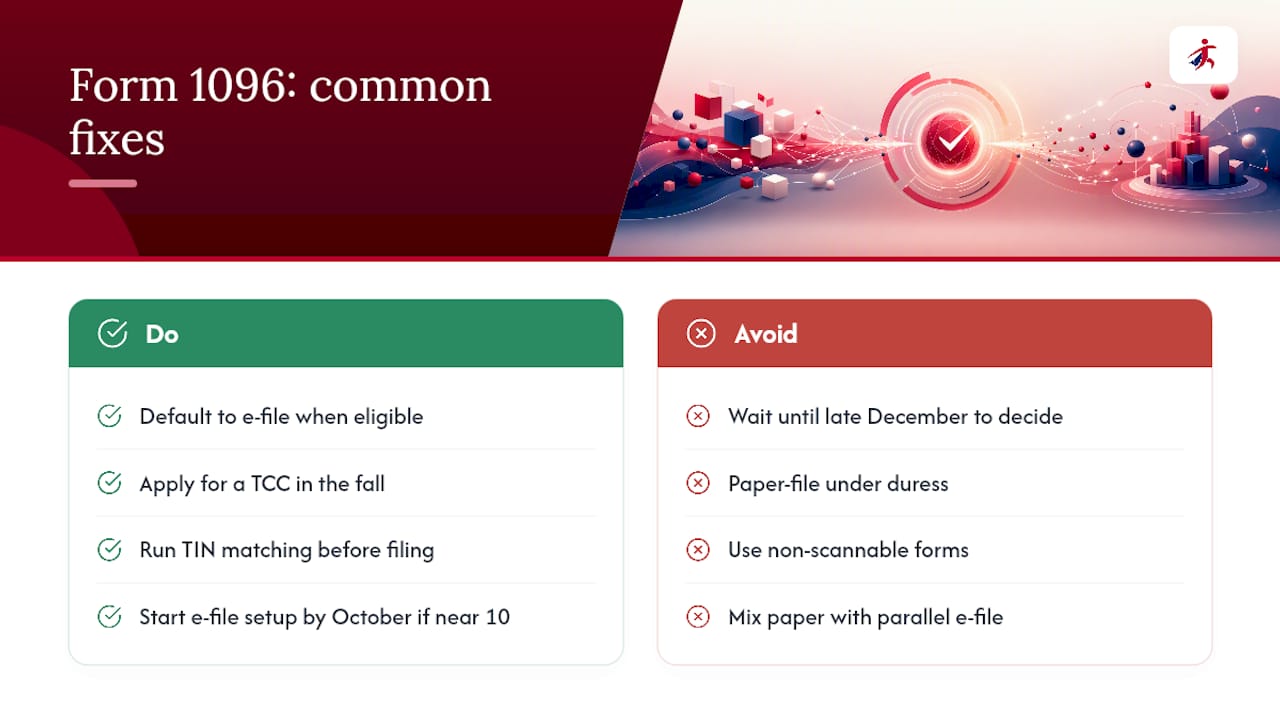
The bigger blind spot is timing, not paperwork. Businesses that wait until late December to figure out whether they’ve crossed the 10-return threshold, or to apply for a TCC, are the ones who end up paper-filing under duress, using non-scannable forms, or missing deadlines outright. The math is simple enough to check in October: count your total information returns across all types, and if you’re anywhere near 10, start your e-file setup now rather than in January.
My practical recommendations for small businesses and tax professionals heading into the next filing season: default to e-filing whenever you’re eligible, even below the threshold, since it removes Form 1096 and mailing risk entirely. Apply for a TCC in the fall. Run TIN matching on your recipient data before you file, not after the IRS sends back a notice. And if you paper-file by choice, keep your scannable Copy A forms and 1096 as your only paper trail, never mixed with a parallel electronic submission.
— Nazrul
File 1099s Through TaxFormHero and Skip the Form 1096 Question Entirely
TaxFormHero is the practical alternative to juggling scannable paper stock, mailing addresses, and Form 1096 grouping rules by hand. Every return you file through the platform transmits electronically over IRIS A2A, so there’s no transmittal cover sheet to prepare, sign, or mail, and no risk of the duplicate paper-plus-electronic filing that triggers IRS notices.
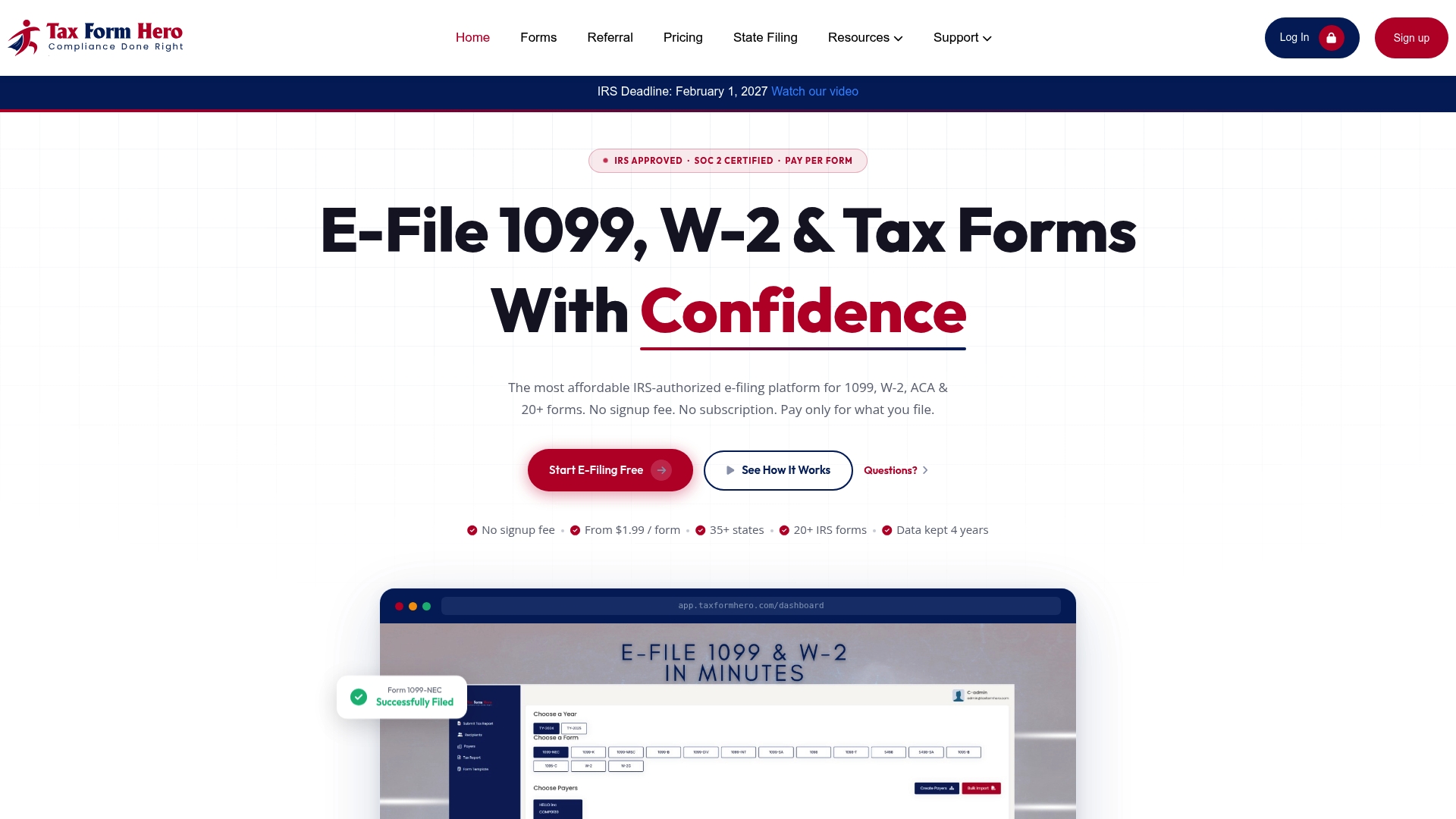
The platform handles 1099-NEC, 1099-MISC, 1099-K, W-2, 1095-B, 1095-C, and more than 20 other IRS forms, with recipients entered by hand or bulk-imported by the thousands from an Excel template. Built-in TIN matching catches name and taxpayer ID mismatches before they become IRS correspondence, and recipient copies go out by encrypted email or USPS first-class mail. Pricing is pay-per-form with no subscription; current prices are available on the TaxFormHero pricing page. State filing, print-and-mail, and e-delivery are available as optional add-ons at checkout.
If you’re approaching the 10-return e-file threshold or simply want the process off your desk, start filing your 1099-NEC forms online and see your total before you commit to a single form.
FAQ
Is Form 1096 Still Required?
Yes, but only for paper-filed information returns. It’s required whenever you mail paper copies of Forms 1099, 1098, 1097, 3921, 3922, 5498, or W-2G to the IRS, but it plays no role in electronic filing.
Who Needs to File the IRS Form 1096?
Any business or filer submitting paper information returns to the IRS needs a Form 1096 as the transmittal cover sheet, grouped separately by form type. Filers who e-file, whether by choice or because they’ve hit the 10-return mandatory threshold, skip Form 1096 entirely.
What Is the Difference Between 1096 and 1099?
Form 1099 reports specific income paid to a recipient, such as nonemployee compensation or interest. Form 1096 is simply a summary cover sheet that accompanies paper 1099s (and several other form types) when mailed to the IRS. It carries no income detail of its own.
What Information Is Required on Form 1096?
Form 1096 requires the filer’s name, address, and EIN matching your other IRS filings, the total number of forms being transmitted, the total dollar amount reported across those forms, and an authorized signature. Each form type filed on paper needs its own separate Form 1096, and TaxFormHero customers who move to electronic filing eliminate this step altogether since e-filed returns transmit directly through IRIS without any 1096.