Avoid the $340 1099 Penalty for U.S. Payers: 2026 Tiers & Checklist

Missing a 1099 deadline puts you into one of three IRS penalty tiers based on how fast you correct it: a low penalty per form if corrected soon after the deadline, a moderate penalty per form if corrected between about one month and August 1, or a higher penalty per form after August 1 or if you never file. Intentional disregard carries a substantially higher flat penalty per form with no annual cap. The immediate best practice is to file or correct the return promptly, and keep records of when the action was taken.
TL;DR:
- Correcting or filing late forms after August 1 or not at all results in the highest penalty of $340 per form, while correction within 30 days costs only $60.
- Filing on time or correcting forms with a small number of errors before August 1 can avoid penalties through a de minimis rule, but TIN mismatches often trigger late penalties regardless of timing.
- Intentional disregard, such as knowingly ignoring filing obligations, incurs a flat penalty of $680 per form with no annual cap, unlike standard tiers.
- Large businesses can face unlimited penalties for recurring violations if they demonstrate intentional disregard, especially beyond the small-business gross receipts threshold of $5 million.
- Immediate filing and documentation, including timestamped proof of corrections and reasons for delays, are crucial for reducing penalties and securing reasonable cause relief.
What Happens If You Miss the 1099 Filing Deadline: Penalty Tiers Explained
Every day that passes after the 1099 deadline moves you closer to a higher penalty bracket. The IRS structures information return penalties around three windows, and the dollar amount attached to your form depends entirely on which window you land in when you correct the error.
For 2026, the per-form penalty amounts are officially set by the IRS and include three tiers depending on correction timing: a low amount if filed or corrected within 30 days of the deadline, a higher amount if corrected between 31 days after the deadline and August 1, and the highest standard amount if corrected after August 1 or never filed.
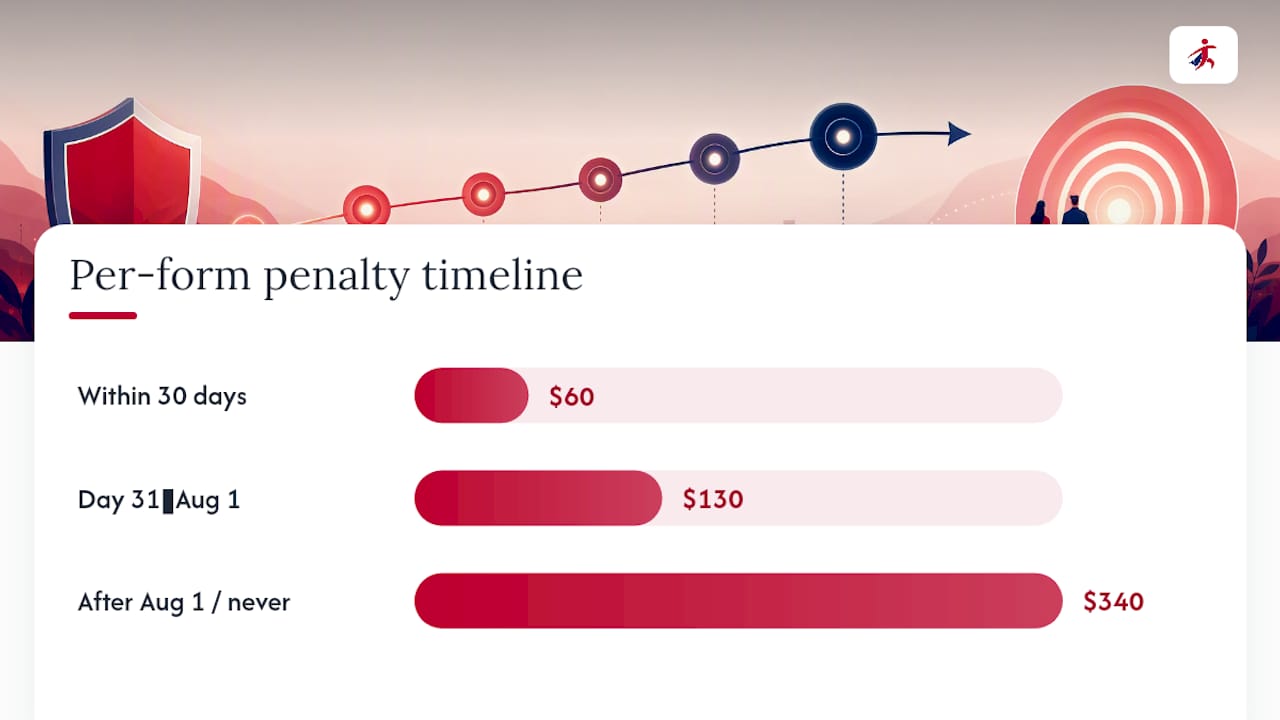
Pro Tip: Mark August 1 on your calendar the same way you mark the original filing deadline. It’s the single date that determines whether you pay $130 or $340 per form.
These numbers apply per form, not per business. If large numbers of forms are corrected late, the per-form penalties accumulate quickly, increasing the total amount owed accordingly. A payroll company that misses 200 1099-NEC forms and doesn’t catch the error until September faces $68,000 in 6721 penalties alone, calculated at $340 per form.
The $60, $130, and $340 figures aren’t fixed forever. Congress built an inflation adjustment into IRC 6721(f), so the IRS revises these amounts most years. The rates cited here reflect the official 2026 penalty table, and you should always check that page before calculating exposure for a prior or future tax year, since the amounts shift annually.
One detail trips up a lot of filers: correcting a form doesn’t reset the clock to zero. The penalty tier is locked in based on how many days elapsed between the original deadline and the date you actually filed the correct information. File on day 29 after the deadline, and you’re in the $60 bracket. File on day 31, and you’ve jumped to $130. There’s no partial credit for being close.
Need to get this filed? You can e-file Form 1099-NEC online with TaxFormHero, which is IRS-authorized and charges per form, not per month.
What Triggers a 1099 Penalty Under IRC 6721 and 6722?
Five distinct failures can trigger a penalty under IRC 6721, and understanding which one applies to your situation determines how much room you have to negotiate relief.
- Failing to file the information return at all.
- Filing with a missing or incorrect taxpayer identification number (TIN).
- Filing after the deadline (untimely filing).
- Filing on incorrect media or in the wrong format (paper when e-filing was required, for instance).
- Failing to include all required information or including incorrect information.
Here’s the part that surprises a lot of small business owners: even if a single 1099 return has three or four of these problems at once, say it’s late, has a wrong TIN, and was filed on paper when e-filing was mandatory, the IRS only assesses one 6721 penalty per return, and it’s the highest applicable amount. You don’t get stacked separately for each error on the same form.
Pro Tip: If you’re triaging a batch of problem forms, prioritize the fixes that push a form from one tier to the next, not the ones that just clean up cosmetic errors that wouldn’t change the penalty amount anyway.
That single-penalty rule has a limit, though. IRC 6722 covers a separate obligation: furnishing a correct copy of the 1099 to the payee. Miss that, and you’re exposed to a second penalty that runs on the same tier structure, independent of whatever you owe under 6721. A business that files a form late with the IRS and also never sends the payee their copy can rack up both the $340 filing penalty and a $340 furnishing penalty on the exact same return. Publication 1586 walks through this interplay in detail, and it’s worth reading before you assume one fix covers both exposures.
The IRS’s own enforcement guidance frames these penalties as compliance tools, not punitive measures for their own sake. Filers who correct proactively tend to see different treatment than those who simply never respond, which matters a great deal once you’re deciding whether to self-correct or wait for a notice.
What Counts as Intentional Disregard for 1099 Filing?
Intentional disregard is the IRS’s term for a filer who knew about the requirement and chose not to comply, rather than someone who made an honest mistake or missed a date under pressure. The agency looks at patterns: repeated late filings across multiple years, ignoring prior notices, or filing incomplete returns despite having the correct information on hand.
The consequences are steep and structurally different from the standard tiers.
- The 2026 intentional disregard penalty is $680 per form, more than double the standard $340 rate.
- The IRS can also apply a statutory alternative calculated as a percentage of the aggregate dollar amounts on the return, when that produces a higher figure.
- There is no annual cap on intentional disregard penalties, unlike the standard tiers.
That last point is the one that should get your attention. The standard penalty tiers come with annual maximums that limit total exposure, which is discussed in the next section. Intentional disregard has none. A business found to have knowingly ignored its filing obligation across hundreds of forms could face a penalty bill with no ceiling, calculated form by form at $680 each or the percentage alternative, whichever the IRS determines is higher.
How Do Annual Caps and Small-Business Rules Work?
Annual maximums exist to keep the standard penalty tiers from becoming ruinous for filers who make good-faith errors, but they only apply outside the intentional disregard category, and eligibility depends on your business size.
The IRS defines a small business, for this purpose, as one with average annual gross receipts of $5 million or less over the three preceding tax years. Small businesses that qualify get a lower annual maximum penalty than larger filers, according to Publication 1586, which lays out the specific caps and thresholds for each tier.
Consider two businesses that both miss the deadline on 150 forms and correct after August 1, landing in the $340 tier. Uncapped, that’s $51,000 in exposure. A qualifying small business hits its lower annual maximum well before reaching that full amount, while a larger company without the small-business designation could be liable for the entire uncapped total, subject to whatever ceiling applies at its size.
The caveat that matters most: none of these caps apply if the IRS determines the failures were intentional disregard. Size doesn’t protect you once the agency concludes you knew about the obligation and ignored it. That’s one more reason the distinction between an honest late filing and a pattern of disregard carries so much financial weight.
How Does the Correction Date Change Your Penalty Tier?
The date you file a correction, not the date you realized there was a problem, is what determines your tier. Three windows govern the outcome, and mapping your own timeline against them takes about five minutes.
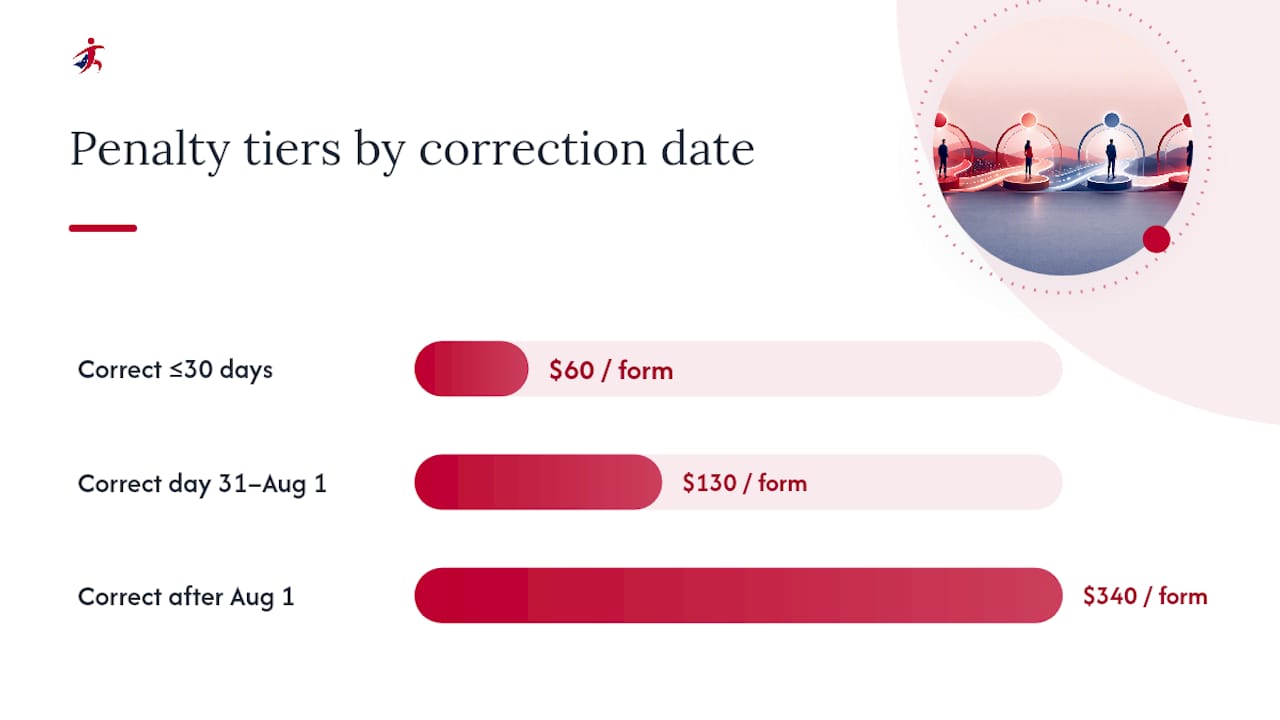
- Correct within 30 days of the original deadline. You land in the $60-per-form tier, the lightest exposure available short of avoiding the error entirely.
- Correct between day 31 and August 1. You’re in the $130-per-form tier, roughly double the first bracket.
- Correct after August 1, or never correct at all. You’re at $340 per form, the maximum standard-tier penalty, and this is also where most TIN-mismatch cases end up landing.
The August 1 pivot is the single most important date on this timeline, and it’s the one filers most often miss because errors surface through an IRS notice that arrives well after that date has passed.
Here’s a concrete example. A payroll processor discovers on July 15 that 12 1099-NEC forms went out with incorrect box amounts. Correcting them by July 31 keeps those 12 forms in the $130 tier, a total of $1,560. Wait until August 5 to file the same corrections, and the same 12 forms jump to $340 each, a total of $4,080, a difference of $2,520 for a two-week delay.
There’s a narrow escape hatch worth knowing about. Publication 1586 outlines a de minimis rule for corrections: if you filed your original returns on time and correct a small number of them, generally the greater of 10 returns or 0.5% of your total returns filed, by August 1, those specific corrected returns may avoid the penalty entirely. It’s a meaningful break for businesses running large volumes where a handful of errors are almost inevitable, but it only protects you if the originals went out on time and the fix happens before that August 1 cutoff.
How Do You Request Reasonable Cause Penalty Relief?
Reasonable cause relief exists for filers who can show the failure resulted from circumstances beyond their control, not from carelessness or a decision to skip the requirement. The IRS standard requires you to demonstrate you acted responsibly before the failure occurred and took corrective steps once you discovered it.
Acceptable reasons typically include events like a fire or natural disaster that destroyed records, a death in the immediate family or business ownership, a serious illness that prevented timely action, or documented system failures outside your control. Vague claims of being “too busy” or “short-staffed” rarely succeed on their own.
- Submit a written statement, signed under penalty of perjury, describing the specific facts and circumstances.
- Include dates, names, and a clear timeline connecting the event to the missed deadline.
- Attach supporting documentation: insurance claims, death certificates, IT system logs, or correspondence showing you tried to comply.
- Explain the corrective steps taken once the obstacle was resolved.
Pro Tip: Write your reasonable cause statement as if a stranger with no context will read it. Vague language like “we had some issues” gets denied. Specific language like “our filing vendor’s system was down from March 3 to March 9, confirmed by the attached vendor incident report” gets reviewed seriously.
One pitfall catches more filers than any other: blaming your tax preparer or software alone almost never works as a standalone justification. The IRS generally holds that reliance on an agent doesn’t excuse the underlying business, since you retain responsibility for timely, accurate filing regardless of who handles the mechanics. Document your own oversight efforts, not just your vendor’s failure, if you want a request to hold up.
What Should You Do Right Now If You Missed the Deadline?
- File or correct the return immediately, whether through paper or e-filing, since every day of delay pushes you toward the next penalty tier.
- Furnish the corrected payee statement at the same time you file with the IRS, since a missing furnishing step triggers a separate 6722 penalty even after you fix the 6721 issue.
- Run TIN matching on any forms flagged for name or number mismatches before you refile, since mismatches often surface late and push filers straight into the after August 1 tier.
- Preserve time-stamped evidence of when you attempted to solicit correct TINs, mailed originals, or filed electronically, since this documentation becomes essential if you later request relief.
Pro Tip: Screenshot your e-filing confirmation the moment you submit corrections. IRS Notice 972CG cases often come down to proving exactly when a return went in, and a confirmation timestamp is far stronger evidence than a memory of “sometime in early August.”
If you’ve already received an IRS Notice 972CG proposing a penalty for missing or incorrect TINs, or if your exposure runs into the tens of thousands of dollars across multiple forms, that’s the point to bring in a CPA or tax attorney rather than handling the response alone.
What’s the Recommended Sequence After Missing a 1099 Deadline?
The priority order is straightforward: correct the return now, document your reasonable cause case while the facts are fresh, then respond to whatever notice the IRS eventually sends.
IRS notices for information return penalties typically arrive months after the filing season closes, since the agency needs time to match returns against payee records. Once a notice arrives, it comes with a specific response deadline, usually 30 days, so don’t sit on it.
If the notice seems wrong, or if you have a legitimate reasonable cause argument, submit your abatement request in writing before that deadline passes. Missing the response window on the notice itself creates a second problem stacked on top of the original one.
What Nazrul Sees After Reviewing Hundreds of 1099 Penalty Cases
The conventional advice on 1099 penalties treats every late filing as roughly the same problem with the same fix: correct it and hope for the best. That framing misses the most important variable, which is timing precision. The gap between a $60 penalty and a $340 penalty on the same form isn’t about how wrong the original filing was. It’s about whether someone tracked the calendar closely enough to beat August 1.
What gets underestimated is how often TIN mismatches, not late filing itself, push businesses into the worst tier. A form filed on time with a transposed digit in a TIN can sit undetected for months until an IRS notice surfaces it, by which point the correction window has already closed on the cheaper tiers. Filers who assume “on time” means “done” are the ones who get blindsided later.
The businesses that avoid this mess aren’t the ones with the fewest errors. They’re the ones with systems that catch errors before the IRS does, through TIN verification at intake and bulk-import checks that flag mismatches before submission rather than after.
— Nazrul
File Your 1099 Corrections Before the Next Tier Hits
TaxFormHero exists for exactly this moment: when you’ve discovered a missed or incorrect 1099 and every day of delay costs more. The platform is IRS-authorized, runs built-in TIN matching before you submit, and covers direct state filing across 35 or more states, so a single correction handles both federal and state exposure at once.
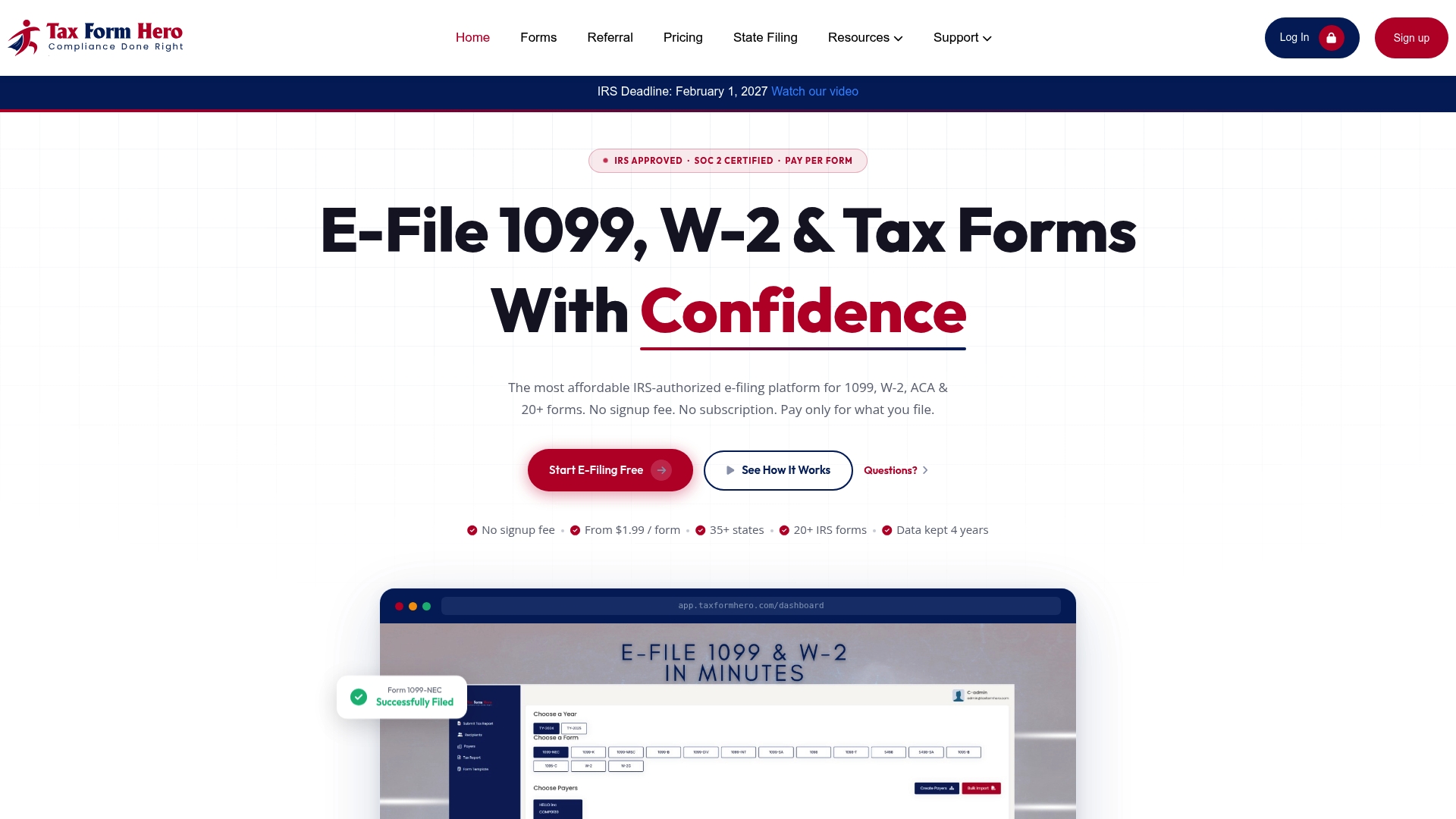
Pricing runs per form, with no sign-up fees or subscriptions attached. That structure matters most right now: you’re not paying for a plan you don’t need, you’re paying to get corrected forms out the door before the next penalty tier locks in. Bulk import handles the multi-form corrections most filers are dealing with after a missed deadline, and encrypted e-delivery gets payee statements out the same day to satisfy your 6722 furnishing obligation.
If you’re staring down a correction deadline right now, the practical move is to e-file your corrected 1099 forms today rather than waiting for a cleaner batch. Every day you wait is a day closer to the next tier.
Where to Verify These 1099 Penalty Figures
- IRS information return penalties page: the official 2026 per-form amounts and inflation adjustment rules.
- Publication 1586: full legal detail on IRC 6721/6722, de minimis corrections, and small-business caps.
- Penalty relief for reasonable cause: documentation standards for abatement requests.
- IRM 20.1.7: IRS field procedures for assessing and waiving these penalties.
This article is general information, not a substitute for advice from a qualified financial advisor. Consult a qualified financial professional about your own circumstances before acting on anything here.
Sources
- Information return penalties | Internal Revenue Service
- Publication 1586 (Rev. 8-2026)
- Penalty relief for reasonable cause | Internal Revenue Service
- 20.1.7 Information Return Penalties | Internal Revenue Service
FAQ
What Is the Penalty for Missing the 1099 Deadline?
For 2026, the penalty is $60 per form if corrected within 30 days, $130 per form if corrected between day 31 and August 1, and $340 per form if corrected after August 1 or never filed, according to the IRS penalty table.
What Happens if You File 1099 Forms Late?
You move into whichever penalty tier matches the number of days between the original deadline and your actual filing date, and the amount is charged per form, so filing a batch late can add up quickly.
Can a 1099 Be Filed After the Deadline?
Yes, you can and should file a late 1099 as soon as possible, since filing late still triggers a lower penalty tier than never filing at all, and platforms like TaxFormHero support e-filing corrections immediately.
What Is the Penalty for Not Reporting 1099 Income to the IRS?
This article addresses the payer’s obligation to file and furnish 1099 forms; a recipient’s failure to report 1099 income on their own tax return falls under separate IRS underreporting penalties, not the information return penalties covered here.
Does Correcting a TIN Mismatch Change My Penalty Tier?
Yes. TIN mismatches often surface through an IRS notice after August 1, which pushes the correction into the $340 tier even if the original form was filed on time, making pre-filing TIN matching one of the most effective ways to avoid that outcome.
Recommended
- 1099-K Threshold 2026: What Small Businesses Need to Know
- 1099 Deadlines 2026: What Small Businesses Must Know
- Attorney 1099 Reporting: The Complete Compliance Guide
- The 1099 Compliance Checklist Every Business Needs

File Information Returns With Confidence
TaxFormHero supports 20+ IRS information returns, including 1099 and W-2 forms, with bulk Excel import, name/TIN matching and encrypted recipient delivery.
Explore TaxFormHero