
Collect a completed Form W-9 from every vendor before the first payment clears; then run IRS TIN matching to confirm the name and taxpayer identification number match IRS records. Those two steps, done at onboarding rather than in January, eliminate the root cause of most 1099 filing failures. For payments to U.S. contractors and service providers, Form 1099-NEC is the standard reporting vehicle; failure to file triggers per-form penalties under IRC §6721 (filing) and §6722 (furnishing) that compound quickly across a vendor list.
Three actions to run right now:
- Run a W-9 status report. Pull every active vendor in your accounts payable system and flag anyone missing a current, signed W-9. Send a collection request today, not in December.
- Tag 1099-eligible vendors and exclude card/processor payments. Mark each vendor as 1099-reportable or not in your AP system, and note which payments were processed through a third-party network. Those processor-reported amounts belong on Form 1099-K (issued by the processor), not your 1099-NEC, so double-counting them is a common and avoidable error.
- Confirm your e-file status. If you expect to file 10 or more information returns combined this year, you are required to e-file. If you do not yet have a Transmitter Control Code (TCC) through the IRS Information Returns Intake System (IRIS), apply now. The approval process takes several weeks.
Pro Tip: Set a calendar reminder for the first week of October to run a TIN-matching batch. Resolving mismatches before December gives you time to request corrected W-9s without the January deadline pressure.
Key Takeaways
Collecting Form W-9 at vendor onboarding and running IRS TIN matching in December eliminates the majority of 1099 filing errors before the January deadline arrives.
| Point | Details |
|---|---|
| W-9 first, always | Require a completed W-9 before any vendor is activated; no W-9 means no payment. |
| TIN match in December | Run a batch TIN-matching check in October or December to catch mismatches before the filing window. |
| Tag payment methods correctly | Exclude credit card and processor payments from 1099-NEC totals; the processor reports those on 1099-K. |
| E-file if you file 10 or more | The 10-or-more rule counts all information return types combined; apply for a TCC well before January. |
| TaxFormHero for execution | TaxFormHero’s IRS-authorized platform handles bulk import, TIN verification, e-filing, and state filing starting at $1.99 per form. |
Need to get this filed? You can e-file Form 1099-NEC online with TaxFormHero, which is IRS-authorized and charges per form, not per month.
What does a complete 1099 compliance checklist look like?
A 1099 compliance checklist is most useful when it is organized by when each task must happen, not just what must happen. The following structure covers year-round controls, pre-filing preparation, and January execution.
Year-round controls
- Require a completed W-9 before any new vendor is activated in your AP system. No W-9, no setup. This single policy, recommended by CPA practitioners as the highest-ROI compliance control, preserves your leverage before money changes hands.
- Tag each vendor record with a 1099-eligible flag and the applicable form type (NEC, MISC, etc.) at setup.
- Record the payment method for every transaction. Payments made by credit card, debit card, or through a third-party payment processor are excluded from 1099-NEC reporting because the processor handles the 1099-K.
- Store W-9s in a centralized, secure repository, not in individual email inboxes. A shared drive with access controls and a naming convention (VendorName_W9_YYYY) is the minimum standard.
October through December tasks
- Run an IRS TIN-matching batch for all 1099-eligible vendors. The IRS TIN Matching program is free and flags name/TIN discrepancies before you file.
- Request updated W-9s from any vendor whose information has changed or whose form is more than three years old.
- Reconcile year-to-date payments by vendor against your AP ledger. Identify any payments that crossed the applicable reporting threshold.
- Exclude payments processed through third-party networks from your 1099-NEC totals.
- Confirm your TCC is active and your e-file credentials are current.
January filing tasks
- Generate draft 1099 forms and review them for accuracy before submission.
- Furnish recipient copies by January 31 for both 1099-NEC and most 1099-MISC forms.
- File 1099-NEC with the IRS by January 31 (paper or e-file). For 1099-MISC with amounts in Box 8 or Box 10, the IRS filing deadline extends to February 15 for recipient copies and February 28 (paper) or March 31 (e-file) for IRS submission.
- Submit Form 1096 as a transmittal cover if filing paper returns.
- Have a corrections plan ready before you file. Identify who owns the correction workflow if a recipient reports an error.
Pro Tip: Add a “1099-eligible” custom field to your vendor master record at the point of onboarding, not at year-end. In most AP platforms, this field can trigger automated reminders and filter vendors for bulk export at filing time, cutting manual reconciliation by hours.
Who must file, which 1099 form applies, and when
The IRS requires businesses to file information returns when they make payments in the course of a trade or business that meet the applicable reporting threshold for that form and payment type. Payments to corporations are generally exempt, with notable exceptions for medical and healthcare payments and attorney fees.
Commonly used forms and when each applies
- Form 1099-NEC: Nonemployee compensation paid to individuals, partnerships, or LLCs taxed as partnerships or sole proprietors. The classic example is a freelance designer or independent contractor paid $600 or more in a calendar year. For payments made after December 31, 2025, the reporting threshold rises to $2,000 under the One Big Beautiful Bill Act.
- Form 1099-MISC: Rent, royalties, prizes, awards, and other income categories not covered by 1099-NEC. Attorney gross proceeds (Box 10) have special reporting rules regardless of entity type.
- Form 1099-K: Issued by payment settlement entities (credit card processors, PayPal, Venmo for Business) when a payee’s transactions meet the applicable threshold. You do not issue this form; the processor does.
- Form 1099-INT: Interest income of $10 or more paid by banks and financial institutions.
- Form 1099-DIV: Dividends and distributions paid to shareholders.
- Form W-9: Not a filing form, but the foundational document. It captures the payee’s legal name, TIN, and entity type, which determines whether a 1099 is required at all.
- Form 1096: The paper transmittal cover sheet sent with paper 1099s to the IRS. Not required for e-filed returns.
- Form 1042-S: Used for payments to foreign persons subject to withholding; a separate reporting regime from the 1099 series.
The instructions for Forms 1099-MISC and 1099-NEC spell out which payments belong in which box and flag the attorney gross-proceeds rule, which requires reporting regardless of whether the attorney is incorporated.
One critical nuance: the $2,000 threshold change affects whether a form must be issued, not whether the income is taxable. A contractor paid $1,800 in 2026 owes tax on that income even if no 1099-NEC is filed. Recipients should not assume a missing form means the IRS is unaware of the payment.
Payments made through a third-party settlement organization, such as a credit card processor, are excluded from your 1099-NEC totals because the processor reports them on Form 1099-K. Including them on your 1099-NEC creates a double-reporting problem that triggers IRS notices for the recipient.
What are the key deadlines and e-filing rules for 1099s?
Missing a deadline costs money on a per-form basis, so the timeline below is worth printing and posting near your AP calendar.
The 10-or-more e-file rule counts all information return types combined. If you file 6 Forms 1099-NEC and 5 Forms W-2, that is 11 returns total, and e-filing is mandatory for all of them.
To e-file through the IRS IRIS portal or the legacy FIRE system, you need a Transmitter Control Code. Apply through the IRS e-Services portal well before January. The application review typically takes several weeks, and there is no expedited option. If you miss the window, you may need to use an IRS-authorized e-file provider.
Form 8809 grants a 30-day extension for most information returns. File it before the original due date. Extensions are not automatic for 1099-NEC when the amounts are in Box 1, and a second extension is rarely granted. General Instructions for Certain Information Returns (i1099gi) covers the extension process, paper format requirements, and the corrected-return procedure in detail.
Key action items before January:
- Confirm TCC status and IRIS login credentials in December.
- Run TIN matching and resolve mismatches before the filing window opens.
- Request corrected W-9s from any vendor with a name/TIN mismatch.
- Set a hard internal deadline of January 25 for draft 1099 review, leaving six days to correct errors before the January 31 deadline.
How should you handle vendor onboarding, W-9 collection, and TIN matching?
The “no W-9, no vendor setup” policy is the single most effective control in a 1099 compliance program. Once a payment is made without a W-9 on file, you lose negotiating leverage. The vendor has already been paid, and chasing a W-9 in January, under deadline pressure, is far less reliable than requiring it before activation.
A valid W-9 provides the vendor’s legal name, TIN, and entity classification, which together determine whether a 1099 is required and which form applies. The IRS Form W-9 page is the authoritative reference for what constitutes a complete and valid form.
Secure storage and retention
Store W-9s in a centralized repository with role-based access controls. Email is not an acceptable storage location because it creates version-control problems and audit trail gaps. A cloud-based document management system with a consistent naming convention and a retention policy of at least seven years covers most audit scenarios.
TIN matching workflow
Run TIN matching at two points: at onboarding, before the first payment, and again in a December batch for all active 1099-eligible vendors. The IRS TIN Matching program is free and available through IRS e-Services. It compares the name and TIN you submit against IRS records and returns a match or mismatch result. Catching mismatches in October or November gives you time to request a corrected W-9 before the January filing window.

When a mismatch appears, send the vendor a written request for a corrected W-9 and document the date and method of the request. If the vendor does not respond or provides an invalid TIN, backup withholding applies.
Backup withholding mechanics
Withheld amounts are remitted to the IRS using Form 945, the annual return for withheld federal income tax. Keep a log of every vendor for whom backup withholding was applied, including the dates, amounts, and the triggering event.
Pro Tip: Build the TIN-matching step into your vendor activation checklist as a required field, not an optional one. In practice, this means the AP team cannot mark a vendor “active” in the system until TIN matching returns a confirmed result.
What are the most common 1099 mistakes and how do you fix them?
Most 1099 errors fall into a small number of categories, and most are preventable with the controls described above.
Common errors:
- Missing W-9s, leading to incorrect or missing TINs on filed returns
- Name/TIN mismatches that trigger CP2100 or CP2100A notices
- Double-reporting contractor payments that were also processed through a third-party network (1099-NEC and 1099-K for the same amount)
- Using the wrong form or box (for example, reporting rent in Box 1 of 1099-NEC instead of Box 1 of 1099-MISC)
- Filing duplicate returns for the same payee and payment
- Missing the January 31 deadline for 1099-NEC
Penalty exposure:
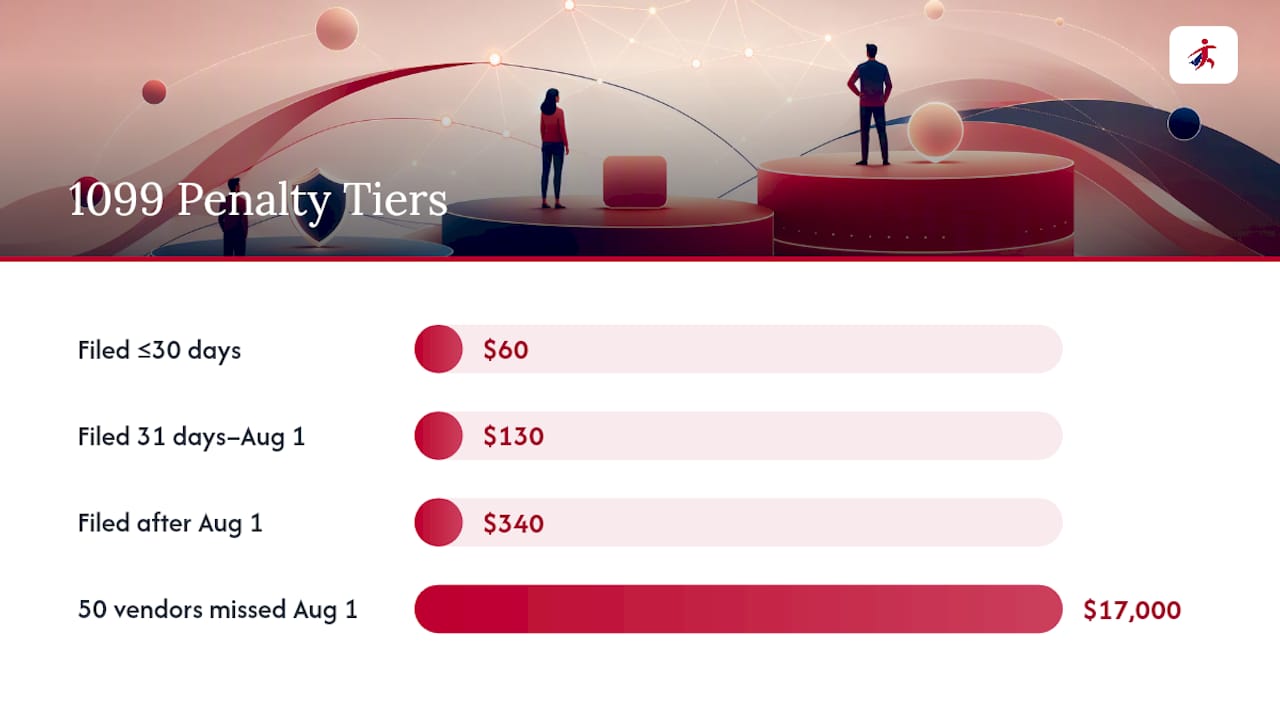
Per-form penalties escalate with time. Based on the current penalty schedule, the tiers are:
- $60 per form if filed correctly within 30 days of the due date
- $130 per form if filed correctly between 31 days late and August 1
- $340 per form if filed after August 1 or not filed at all
- Intentional disregard: penalty of $680 per form with no annual cap
A business with 50 vendors that misses the August 1 deadline on all returns faces up to $17,000 in penalties before intentional disregard is even considered. The per-form structure means errors aggregate fast.
Remediation steps:
- File corrected returns as soon as the error is discovered. Earlier filing means a lower penalty tier.
- Furnish a corrected recipient copy at the same time.
- If the error resulted from reasonable cause rather than willful neglect, attach a written reasonable-cause statement to the corrected filing.
- For CP2100/CP2100A notices, respond within the timeframe specified in the notice, typically 45 days. Provide documentation of your TIN-matching efforts and any backup withholding applied.
- Document every step. A clean paper trail supports penalty abatement requests and demonstrates good-faith compliance.
The instructions for Forms 1099-MISC and 1099-NEC identify the most common box-placement errors and are worth reviewing before filing season to confirm you are using the correct form and box for each payment type.
How do you file a corrected 1099 and notify the recipient?
A corrected return is required whenever a filed 1099 contains an error in the payee’s name, TIN, amount, or form type. Filing a corrected return promptly reduces penalty exposure and prevents the recipient from filing an incorrect tax return.
- Obtain the original filed return. Confirm the exact data that was submitted to the IRS, including the form type, box number, and amount.
- Prepare the corrected form. Check the “Corrected” box at the top of the form. Enter the correct information in the applicable boxes. Do not leave the incorrect boxes blank; enter zero where the original amount should be removed.
- For paper corrections: Attach a corrected Form 1096 transmittal, checking the “Corrected” box on that form as well. General Instructions for Certain Information Returns (i1099gi) details the paper format requirements, including machine-readable standards for scanned submissions.
- For e-file corrections: Submit the corrected return through IRIS or your authorized e-file provider. Most platforms handle the correction flag automatically when you mark the return as corrected in the system.
- Furnish the corrected recipient copy on the same day you submit the correction to the IRS, or as soon as practicable. Send it to the same address on file and note that it supersedes the original.
- Document the correction. Record the date of the original filing, the date of the correction, the nature of the error, and the method of recipient notification. This log is your first line of defense if the IRS or the recipient raises a question later.
For two-transaction corrections (where the original form type was wrong, not just the amount), the IRS requires a specific two-step process: first file a corrected return with zero amounts to void the original, then file a new original return with the correct information. Skipping this two-step process is a common pitfall when correcting form-type errors.
What records should you keep and for how long?
Retaining the right documents in an organized format is what separates a business that responds to an IRS notice in two days from one that spends weeks reconstructing records under pressure.
Documents to retain:
- Signed Form W-9 for every vendor paid during the year
- Contracts and statements of work that establish the nature of the payment
- Invoices and payment records (ACH confirmations, check copies, credit card settlement reports)
- E-file submission confirmations and acknowledgment receipts from IRIS or your e-file provider
- Copies of all 1099 forms filed, including corrected returns
- TIN-matching logs with dates, vendor names, and match/mismatch results
- Backup withholding records and Form 945 filings
- Any IRS notices received (CP2100, CP2000) and your written responses
Retention timeframe:
The IRS generally has three years from the filing date to audit an information return, but that window extends to six years if the IRS suspects a substantial understatement of income. Retaining records for seven years covers both scenarios and aligns with common CPA guidance. For amended returns or CP2000 responses, retain all related documentation for at least three years from the date of resolution.
Audit packet structure:
When an IRS notice arrives, a pre-organized audit packet saves hours. A practical packet includes a cover letter summarizing the filing, a vendor summary listing each payee, TIN, form type, and amount reported, copies of the relevant W-9s, a payment reconciliation tying AP records to the 1099 amounts, evidence of any backup withholding applied, and e-file acknowledgment receipts. Organizing this packet annually, immediately after the January filing, means it is ready before a notice ever arrives.
What features should you look for in a 1099 e-file or automation tool?
The right tool handles the operational steps that are most error-prone when done manually: W-9 collection, TIN matching, payment-method tagging, and bulk e-filing. The wrong tool adds a layer of complexity but does not reduce the compliance risk.
Feature checklist for evaluating an e-file or 1099 automation platform:
- Bulk W-9 collection with a secure, trackable request link (not email)
- Centralized, encrypted storage for completed W-9s with an audit log
- Integrated IRS TIN matching, ideally with batch processing for December runs
- Payment-method tagging to flag and exclude processor-reported payments from 1099-NEC totals
- Bulk import of vendor payment data from AP systems or CSV files
- IRS-authorized e-filing for all major 1099 form types
- State filing support for states that require separate information return submissions
- Print-and-mail and encrypted e-delivery options for recipient copies
- Corrected return workflow with the “Corrected” flag handled automatically
- Audit log of all submissions, corrections, and delivery confirmations
Implementation priorities:
Start with vendor onboarding and the W-9 collection workflow before automating the January filing. A tool that files 1099s quickly but is fed bad data from missing or mismatched W-9s creates more work, not less. Pilot the platform with your highest-risk vendors first: those with high payment volumes, recent TIN mismatches, or incomplete records.
Build vs. buy decision:
For most small businesses and accounting firms, building an in-house TIN-matching and e-file workflow is not practical. The IRS IRIS portal handles e-filing directly, but it requires manual data entry for each return and does not manage W-9 collection or TIN matching. An IRS-authorized e-file provider handles the transmission, format compliance, and acknowledgment tracking, and typically integrates with existing AP or accounting software. The decision comes down to volume, staffing, and risk tolerance. At 50 or more 1099s per year, the time savings from an authorized provider typically outweigh the per-form cost.
Why most 1099 problems start long before January
The conventional wisdom treats 1099 compliance as a January task. Pull the numbers, generate the forms, file by the 31st. That framing is why so many businesses spend the first two weeks of February correcting errors, chasing missing W-9s, and responding to notices that could have been avoided in October.
The real compliance problem is a data quality problem, and data quality is determined at onboarding, not at filing. A vendor who was set up in March without a W-9 does not become easier to reach in January. A TIN mismatch that existed all year does not resolve itself when the deadline arrives. The businesses that file cleanly in January are the ones that treated vendor onboarding as a compliance checkpoint, not a paperwork formality.
The threshold change to $2,000 for many 1099 categories in 2026 will cause some businesses to reduce their filing volume, but it will not reduce the underlying compliance obligation. Payments below the new threshold are still taxable income for the recipient. And the businesses most likely to misread the threshold change as a compliance reduction are the same ones already operating without consistent W-9 collection and TIN-matching controls.
One practical reframe: assign a specific person, not a team, ownership of the W-9 collection workflow. When everyone is responsible, no one is. A single owner with a clear escalation path for non-responsive vendors, and a hard rule that no payment is released without a W-9 on file, resolves the majority of January filing problems before they start.
TaxFormHero covers every step on your checklist
Filing 1099s correctly requires more than generating a form in January. It requires clean vendor data, verified TINs, accurate payment totals, and a reliable submission path. TaxFormHero is an IRS-authorized e-file platform built to handle each of those steps without a subscription or long-term commitment.
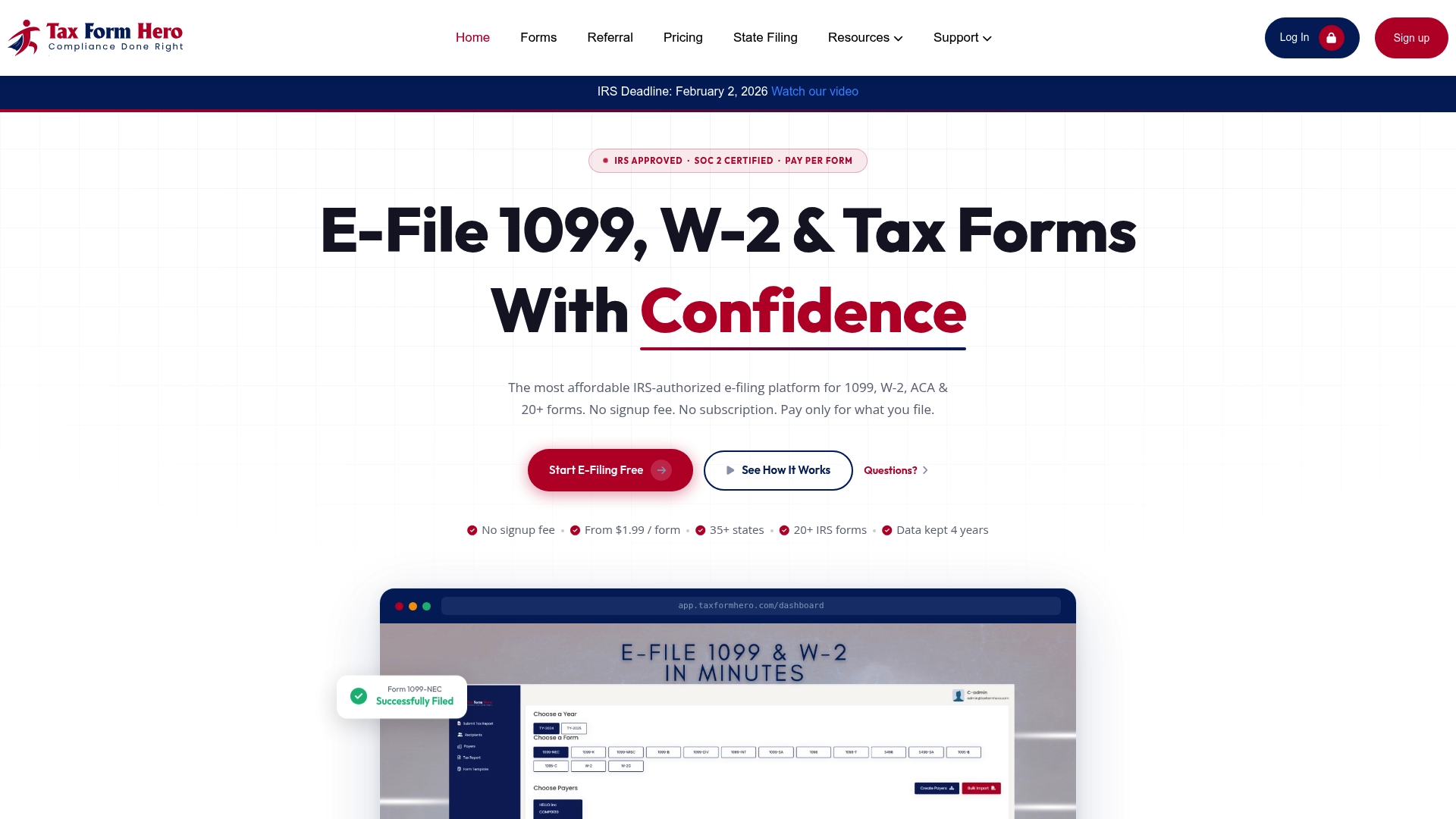
The platform supports bulk import of vendor payment data, integrated TIN verification, and e-filing for 1099-NEC, 1099-MISC, 1099-K, and more than 20 other IRS form types. State filing is available for 35+ states, recipient copies can be delivered via encrypted e-delivery or print-and-mail, and every submission generates an audit log with e-file confirmation receipts. Pricing starts at $1.99 per form with no signup fee, so you pay only for what you file. To get started, import your vendor list, run TIN verification, and file your first batch at Taxformhero.
Sources
The following IRS publications and practitioner resources are the primary references for 1099 compliance. Keep them accessible during filing season.
- About Form W-9 | Internal Revenue Service
- The 1099 rules are changing, but the compliance problem remains — CPA Practice Advisor
This article is general information, not a substitute for advice from a qualified financial advisor. Consult a qualified financial professional about your own circumstances before acting on anything here.
Recommended

File Information Returns With Confidence
TaxFormHero supports 20+ IRS information returns, including 1099 and W-2 forms, with bulk Excel import, name/TIN matching and encrypted recipient delivery.
Explore TaxFormHero