IRS Deadline: February 1, 2027
Payroll Teams: Map 3 2026 W-2 Codes TT/TP/TA by Feb 1 2027

The IRS has released a revised 2026 Form W-2 that requires employers to separately report qualified tips, qualified overtime, and Trump-account employer contributions under the One Big Beautiful Bill Act. Payroll teams must update field mapping for new box 12 codes TT, TP, and TA, plus box 14b, and test their export files before wages paid in 2026 hit the January 2027 furnishing deadline. The general W-2 and W-3 instructions and IRS Q&A guidance are the two documents to read first.
TL;DR:
- Employers must update payroll systems to include new box 12 codes TT, TP, and TA, and create a new box 14b for tipped occupation codes by the next pay cycle.
- Accurate reporting of qualified overtime with code TT requires capturing only the FLSA-mandated premium, not total overtime wages, to avoid overstatement.
- W-2s issued in January 2027 will include these new codes, with a threshold change causing some payments over $2,000 to require reporting, up from $600.
- Errors in reporting TT or other codes require immediate correction with W-2c, and failure to test export files early can lead to costly mistakes and penalties.
- Clear communication with employees about new codes and potential impacts on deductions is essential to prevent confusion and errors during tax season.
IRS Releases 2026 Form W-2 With Changes Due to OBBBA: What’s New
The 2026 form carries the most substantive box-level changes payroll teams have seen in years. The IRS instructions for Forms W-2 and W-3 lay out three new box 12 codes and a restructured box 14, all tied directly to OBBBA’s new deductions.
Here’s what changed on the form itself:
- Code TT: reports qualified overtime compensation, the FLSA-mandated premium portion of overtime pay, not total overtime wages.
- Code TP: reports total cash tips the employee reported to the employer during the year.
- Code TA: reports employer contributions made to Trump accounts on the employee’s behalf.
- Box 14 split: now divided into 14a (Other, the familiar catch-all) and 14b, a new Treasury Tipped Occupation Code field for employees in tipped roles.
- Box 9 layout: resized under a two-up printing format that the IRS confirmed went live on IRS.gov in early 2026.
- Reporting threshold: certain no-withholding payments now trigger reporting at $2,000, up from the long-standing $600 threshold.
None of these are cosmetic. Each one maps to a deduction or account type that didn’t exist on prior W-2s, which means your payroll software’s field list is now out of date if it hasn’t been touched since last filing season.
Filing one yourself? You can e-file Form W-2 online with TaxFormHero, an IRS-authorized e-filing platform.
What This Means for Employers and Payroll Teams
The practical clock starts with wages paid in 2026. Those wages get reported on W-2s issued in January 2027, with the SSA filing deadline landing on February 1, 2027. That gives payroll teams roughly the rest of this year to get systems ready, which sounds like plenty of time until you count how many pay cycles actually touch tipped and overtime-eligible employees.
Work through these steps in order:
- Map the new fields. Add TT, TP, and TA to your payroll system’s box 12 configuration, and build the 14b occupation code field for tipped staff.
- Update export templates. If you use CSV or Excel exports to feed a filing platform, refresh the template before your next payroll run touches 2026 wages.
- Schedule end-to-end e-file tests. Run a full test file through your transmission path, whether that’s IRIS A2A or a third-party platform, well before January.
- Train the team. Anyone who touches payroll data entry needs to know what TT and TP actually capture, since the two are easy to confuse.
- Update employee-facing guidance. Let staff know why their W-2 looks different this year, especially tipped employees who will see a new occupation code.
- Retain a testing audit trail. Document every test run and correction so you have a paper trail if the IRS asks questions later.
Extensions to furnish employee copies still run through Form 15397, but that only buys time on delivery, not on getting the mapping right. Our W-2 deadline checklist walks through the full calendar if you want a week-by-week view.
Pro Tip: Run your test file with a handful of tipped and overtime-heavy employees included on purpose. A clean test with only salaried, non-tipped staff will pass and tell you nothing about whether TT and 14b are actually wired correctly.

Payroll System Updates and Common Reporting Errors
Qualified overtime is the field most likely to get reported wrong. Code TT should capture only the FLSA-required premium portion of overtime, the extra half-time employers must legally pay, not the full overtime wage amount. That distinction lives in the IRS’s general instructions, and payroll systems that sum “all overtime pay” into TT will overstate the deduction employees can claim.
Before you trust any bulk import template, run these checks:
- Confirm numeric field lengths for box 12 entries match the new code formats.
- Validate that TT, TP, and TA codes are spelled and positioned correctly in your export file.
- Check that every tipped employee record includes a Treasury Tipped Occupation Code in box 14b.
- Verify your Copy A format is SSA-compliant for electronic submission. Copy A pulled directly from IRS.gov remains a controlled document and isn’t valid for filing on its own.
One classification wrinkle worth flagging to your tax advisor: the IRS Q&A notes that in rare cases, workers classified differently under FLSA than under the Internal Revenue Code may see qualified overtime reported on a 1099 instead of a W-2. For nearly every standard employer, though, the W-2 is the correct form. Our W-2 filing workflow guide covers exception-queue handling for records that fail validation before they ever reach the SSA.
Corrections, Penalties, and the 2025 Transition Relief
Errors in the new fields, particularly an overstated code TT amount, require a Form W-2c and a corrected copy furnished to the employee. The IRS Q&A confirms employers must file the correction directly once an error in TT reporting is discovered rather than waiting for the next filing cycle.
Here’s the sequence that keeps penalty exposure low:
- Correct promptly. File the W-2c as soon as the error surfaces, rather than batching corrections for later.
- Document the fix. Keep a record of what changed, when, and why, tied back to your testing audit trail.
- Use an exception queue. Flag records that fail validation before submission instead of discovering the problem after the SSA rejects the file.
Notice 2025-69 granted transition penalty relief for tax year 2025 while employers adjusted to the new OBBBA reporting rules. That relief was explicitly transitional. Employers should treat 2026 as the first year the IRS enforces separate TT, TP, and TA reporting at full strength, with no assumption that a similar waiver applies twice.
Employee-Facing Implications: Schedule 1-A and Communications
Amounts reported under codes TT and TP don’t stop at the W-2. They flow directly into the employee’s Schedule 1-A, where qualified tips and qualified overtime deductions carry their own limits and phaseouts based on income. An employee whose W-2 misreports either figure risks claiming the wrong deduction amount on their return, which usually means they’ll come back to you asking for a corrected form.
When you furnish 2026 W-2s, give employees a short heads-up covering:
- Why their form has new codes (TT, TP, TA) that weren’t there last year.
- That box 14b reflects their tipped occupation code, not an error.
- Who to contact if a reported tip or overtime figure looks wrong, and how quickly you can issue a W-2c.
A brief note included with the W-2 mailing saves your team a wave of confused calls in February.
Authoritative Resources Worth Bookmarking
Payroll teams handling this transition need a short list of primary sources, not a search engine’s best guess.
- General Instructions for Forms W-2 and W-3 (2026) for the definitive field-by-field breakdown.
- FS-2026-13, updates to qualified overtime Q&A for code TT reporting and correction rules.
- Notice 2025-69 for the 2025 transition relief terms.
- Publication 6133 for how W-2 entries map to Schedule 1-A.
- The IRS’s posted changes to 2026 W-2 variants for layout and printing caveats.
Test your IRIS A2A transmission path and bulk-import template against these standards before you touch live 2026 payroll data.
A Practitioner’s Note on Getting This Right the First Time
The teams that handle this transition smoothly all do the same two things early: map the new fields, then test an export file that actually includes tipped and overtime employees. The most common misstep is treating TT as “all overtime pay” instead of just the premium portion, which quietly overstates the deduction on every affected employee’s return. If that happens, a W-2c and a documented correction trail fix it cleanly. Waiting until January to find out is the expensive version of the same mistake.
— Nazrul
File 2026 W-2s Without Rebuilding Your Payroll Stack
You don’t need to overhaul your payroll system to handle codes TT, TP, and TA correctly. TaxFormHero is built for exactly this kind of mid-year field change: bulk-import your existing payroll export, and the platform handles the IRIS A2A transmission to the IRS on the back end.
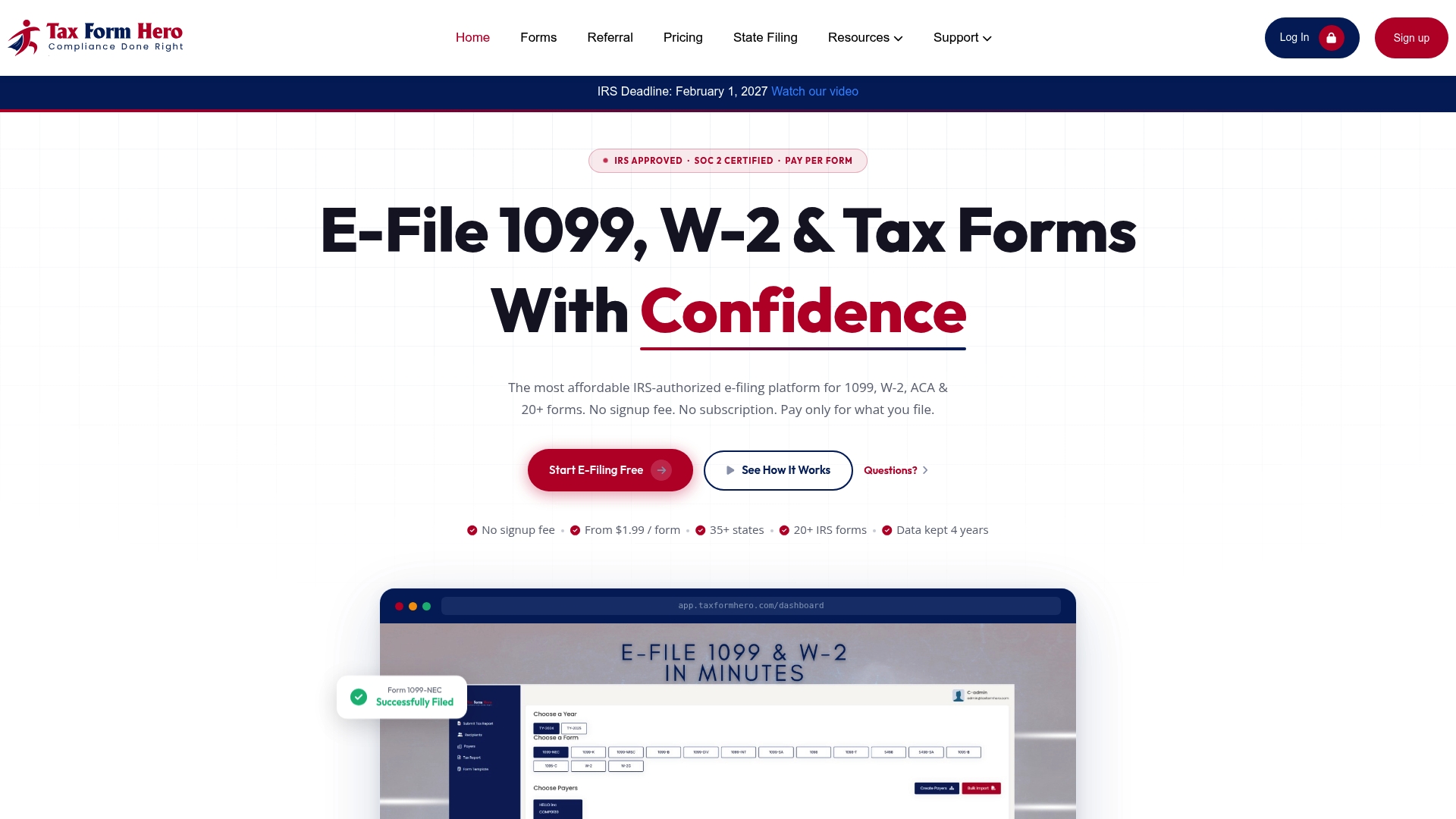
TaxFormHero is IRS-authorized for W-2 e-filing and holds a SOC 2 Type I attestation, so your data stays controlled through import, transmission, and delivery. Pricing runs pay-per-form with no subscription or signup fee, starting at $2.99 per form for the first 50 W-2s and stepping down from there, which suits a small filer testing the new fields just as well as a high-volume payroll operation. If you need to issue a correction later, the platform supports W-2c filing the same way. Add-ons cover what most teams need beyond the base filing: state filing, encrypted e-delivery, print and mail, and TIN matching, each priced per form. Start by running a test import through the W-2 e-filing page with a handful of TT- and TP-affected employees before your next real payroll run.
This article is general information, not a substitute for advice from a qualified financial advisor. Consult a qualified financial professional about your own circumstances before acting on anything here.
Sources
- General Instructions for Forms W-2 and W-3 (2026) | Internal Revenue Service
- Updates to questions and answers about the new deduction for qualified overtime compensation | IRS
- Notice 2025-69 | IRS
- Publication 6133: Schedule 1‑A and Form 1040 instructions | IRS
FAQ
What Is the New $6,000 Deduction for Seniors Under OBBBA?
OBBBA created an additional deduction available to certain taxpayers, on top of the existing standard deduction, subject to income phaseouts. It’s a separate provision from the qualified tips and overtime deductions that drive the new W-2 box 12 codes, though all three trace back to the same legislation.
Will Tax Refunds Be Bigger in 2026?
Refunds depend on individual withholding and deduction claims, so there’s no single answer for every filer. Employees who qualify for the new tips or overtime deductions under Schedule 1-A could see a larger refund if their W-2 correctly reports codes TP and TT, but a misreported box 12 entry can just as easily shrink one.
Will My Social Security Benefits Be Taxed in 2026?
Social Security benefit taxation rules haven’t changed under OBBBA’s Form W-2 provisions. The new reporting requirements affect qualified tips, qualified overtime, and Trump-account contributions to wage income, not the separate rules governing benefit taxation.
What Is the $600 Rule, and Did It Change?
The traditional $600 threshold triggered reporting requirements for certain payments. For 2026, certain no-withholding payments now trigger reporting at a $2,000 threshold instead, a change worth reviewing alongside your 1099 filing checklist if you issue both W-2s and 1099s.
Do I Need to File a W-2c if I Reported Code TT Incorrectly?
Yes. The IRS Q&A confirms that errors in code TT reporting require a Form W-2c and a corrected copy furnished to the employee as soon as the mistake is discovered.