IRS Deadline: February 1, 2027
Avoid 1099 Penalties: E Filing for Small Businesses & Tax Pros
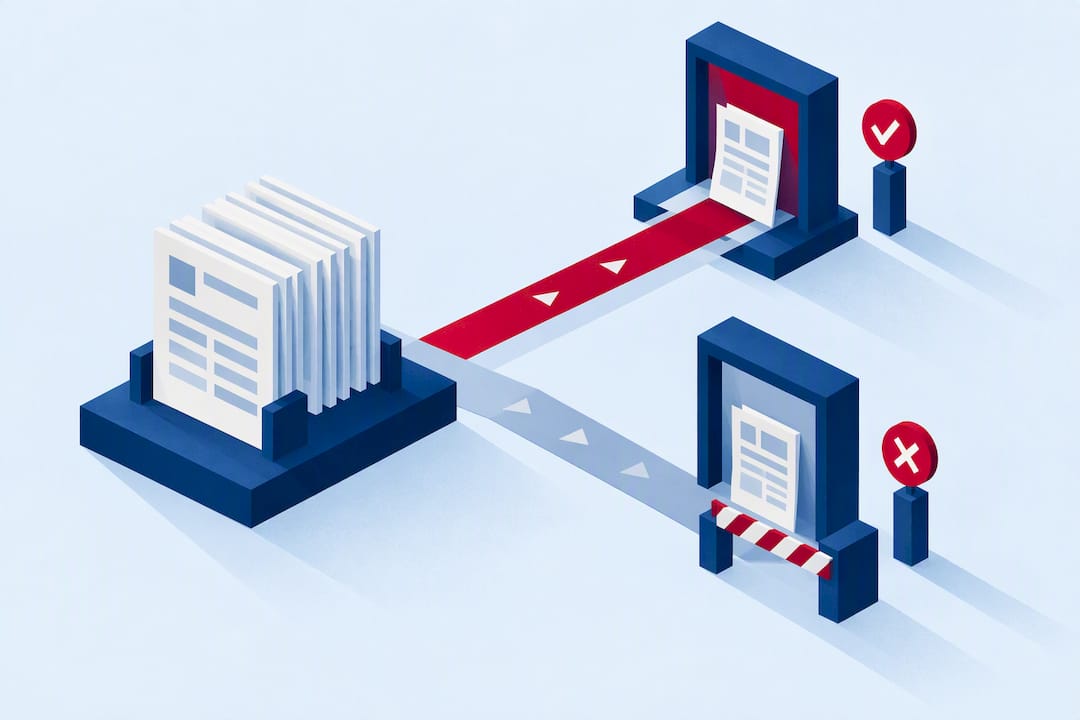
If you file 10 or more information returns in a calendar year, counting all 1099-series and related forms together, the IRS requires you to file them electronically. You can e-file through IRIS, the no-cost IRS portal, or through FIRE, the legacy system built for high-volume transmitters. A handful of filers can request a waiver on Form 8508, but that’s the exception, not the plan. If you expect to hit 10 returns, apply for your Transmitter Control Code now.
TL;DR:
- Filing 10 or more combined information returns in a year requires e-filing through IRS systems, including Form 1099-NEC, 1099-MISC, 1099-DIV, 1099-INT, 1099-K, and certain W-2s and ACA forms.
- Small filers under 100 forms can use IRIS Taxpayer Portal for free, but high-volume filers need IRIS A2A or FIRE-compatible software, with no risk of duplicate submissions.
- Obtaining separate Transmitter Control Codes for IRIS and FIRE systems is critical, and applying early is essential to avoid processing delays or penalties.
- The deadline for e-filing 1099s is January 31, with no extension for the IRS but a strict recipient deadline; electronic filing reduces penalties and handling errors.
- Using specialized, authorized platforms simplifies compliance, recordkeeping, and bulk submissions and avoids common pitfalls of manual or amateur approaches.
What Counts Toward the 1099 E-Filing Requirements Threshold
The 10-return threshold isn’t per form. It’s an aggregate across every information return type you file for the year, a rule set by final Treasury regulations that dropped the old 250-form cutoff to just 10 starting with tax year 2023. That change swept a huge number of small filers into mandatory e-filing overnight.
Here’s what typically counts toward that total:
- Form 1099-NEC (nonemployee compensation)
- Form 1099-MISC (rents, royalties, prizes) —
- Form 1099-K (payment card and third-party network transactions)
- Form 1099-DIV and 1099-INT (dividends and interest)
- W-2s and certain ACA forms (1095-B, 1095-C).
The aggregation rule is where filers get tripped up. If you issue 4 Forms 1099-NEC and 6 Forms 1099-DIV, that’s 10 total returns. You must e-file every one of them, not just the batch that pushed you over. Check T.D. 9972 directly if you’re unsure whether a specific form series counts for your situation, since the IRS updates form-specific guidance by tax year.
If you would rather not do this on paper, e-file Form 1099-NEC online with TaxFormHero instead.
IRIS vs. FIRE: How to File Your 1099s Electronically
Two IRS systems handle 1099 e-filing, and picking the wrong one wastes time. IRIS (Information Returns Intake System) is the newer, no-cost option built for filers who want a straightforward web interface. FIRE (Filing Information Returns Electronically) is the older system built around strict file specifications for software developers and service bureaus.
IRIS comes in two flavors:
- IRIS Taxpayer Portal: manual entry or CSV upload, free to use, and capped at 100 forms per submission.
- IRIS A2A (Application-to-Application): XML-based bulk transmission for software platforms and high-volume filers, but it requires passing IRS assurance testing before you can send production files.
FIRE runs on the technical layouts in Publication 1220, which spell out exact file formats for transmission. FIRE is where most third-party payroll and tax software plugs in behind the scenes.
If you’re filing under 100 forms a year, the IRIS portal handles it without any software purchase. If you’re filing hundreds or thousands, you need A2A or a FIRE-compatible platform.
Pro Tip: Never submit the same return through both IRIS and FIRE “just to be safe.” The IRS treats duplicate submissions as errors, which can trigger correction notices and penalty letters you didn’t need to deal with.
How to Get a Transmitter Control Code for E-Filing
You can’t transmit returns to the IRS without a Transmitter Control Code, and the IRIS-TCC and FIRE-TCC are separate credentials. Getting one doesn’t automatically get you the other, so confirm which system you’ll actually use before you apply.
- Determine your filing channel first. Applying for the wrong TCC wastes the processing window.
- Gather your EIN, legal business name, and physical address (a PO box alone won’t work).
- Designate a Responsible Official who will hold a PIN and be accountable for the account.
- Submit the application and expect roughly 45 days for processing. Apply early in the filing season, not the week before deadlines hit.
- Check your application status online rather than waiting on a mailed notice.
- Reapply if your TCC goes unused for three consecutive years. The IRS deactivates dormant credentials.
Firms handling multiple clients often underestimate this lead time. A step-by-step IRIS registration walkthrough can help you avoid the most common application rejections before they cost you weeks.
1099 Filing Deadlines and Recipient Copy Due Dates
Two dates matter for every 1099 you file: when it’s due to the IRS, and when the recipient must have their copy. They don’t always land on the same day, and the form type changes the math.
When a due date lands on a weekend or federal holiday, it pushes to the next business day. Note that 1099-NEC is the outlier: both the recipient copy and the IRS filing land on the same January 31 deadline, with no grace period like other 1099 types get for electronic filing. Paper filers face the same recipient deadline but often face earlier IRS due dates than electronic filers, which is one more reason e-filing is the more forgiving path. A deadline checklist built for small teams can help you track which forms need attention first.
Corrections, Waivers, and Penalties for Missing the E-File Mandate
Filed a return with a wrong TIN or dollar amount? You must correct it, and if the original was required to be e-filed, the correction has to go electronically too. Corrected returns don’t count toward your 10-return threshold calculation, but they still carry the same transmission rules as the originals.
- Corrections follow the same channel as the original filing. Mixing systems between original and correction invites duplicate-filing flags.
- Waivers are requested on Form 8508 and must be submitted at least 45 days before your filing due date. Grounds include undue financial hardship, a natural disaster, or religious objection.
- Penalties apply per return, and only returns above your 10-return threshold are subject to e-file penalty exposure. Filing on paper when you were required to e-file can trigger penalties on every return past that line.
A detailed correction filing guide walks through the specific steps for amending a return you already transmitted.
Recordkeeping and a Compliance Checklist for 1099 Filers
Retention rules are simple but easy to overlook once filing season ends. Keep copies of every return, or be able to reconstruct the data, for a multi-year period from the reporting due date. Returns involving federal withholding need four years of retention, matching the heavier documentation the IRS expects for withheld amounts.
What to keep on file:
- IRS acceptance receipts for every transmission batch.
- TIN matching results, if you ran them before filing.
- Proof that recipient copies were furnished, whether by mail or electronic delivery.
- The exact CSV or data file submitted, not just a summary spreadsheet.
Pro Tip: A successful upload confirmation isn’t the same as full compliance. Save the acceptance record itself, since that’s what actually proves you filed on time if a notice ever shows up.
Why a Dedicated E-Filing Platform Beats Piecing It Together
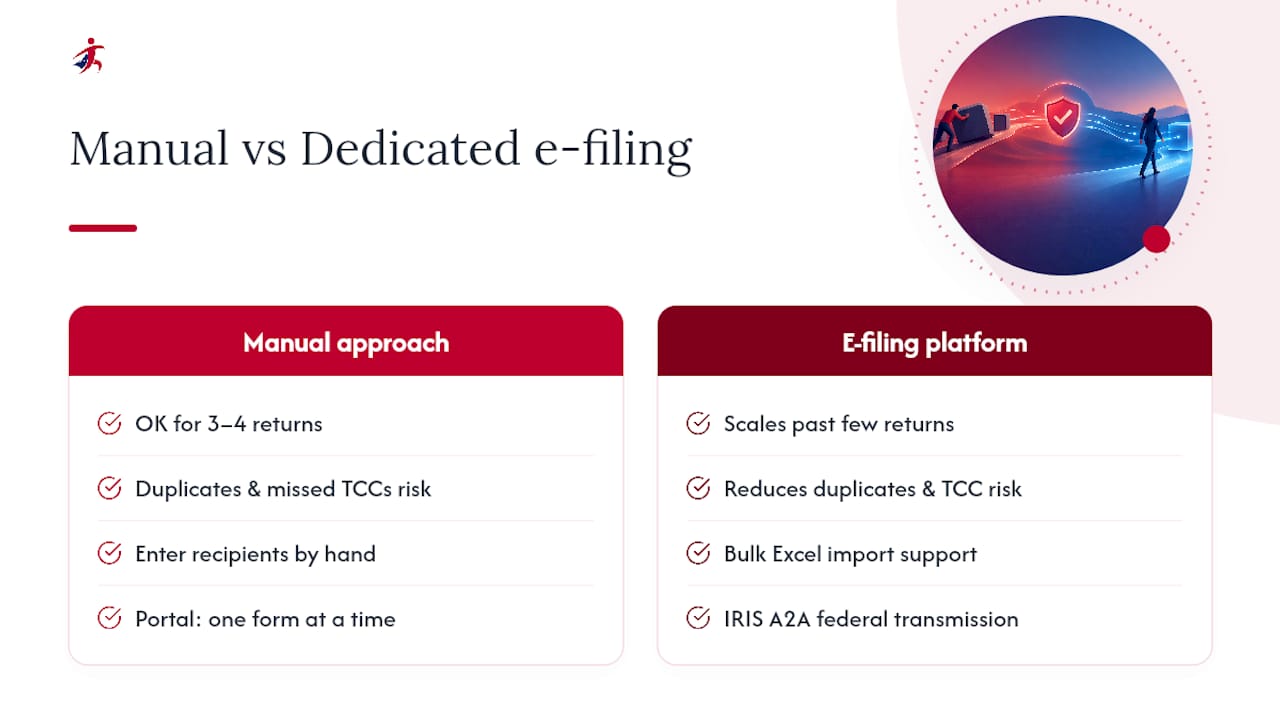
Meeting these requirements by hand works fine when you’re filing three or four returns. Past that, the manual approach starts creating the exact problems this article just walked through: duplicate submissions, missed TCC lead times, and no clean record of what you actually sent.
There are IRS-authorized e-filing platforms that hold SOC 2 Type I attestations and transmit federal returns over IRIS A2A rather than routing you through a manual portal one form at a time. Pricing often runs pay-per-form with no subscription fees, which matters if your filing volume swings by season. Bulk import from an Excel template can handle the aggregation problem directly: enter recipients by hand for a handful of forms, or upload thousands of rows at once when volume climbs past the IRIS Taxpayer Portal’s 100-form submission cap.
The platform also covers what the recordkeeping checklist above demands: it can deliver recipient copies by encrypted email or USPS mail, and it stores your filing records in one system instead of scattering acceptance receipts across separate tools.
The Real Cost of Treating E-Filing as an Afterthought
The 10-return threshold sounds like a footnote until you actually count your forms and realize you crossed it without noticing. That’s the gap most conventional advice glosses over: guides explain the rule, then leave filers to figure out the mechanics of TCC applications, submission caps, and duplicate-filing traps on their own.
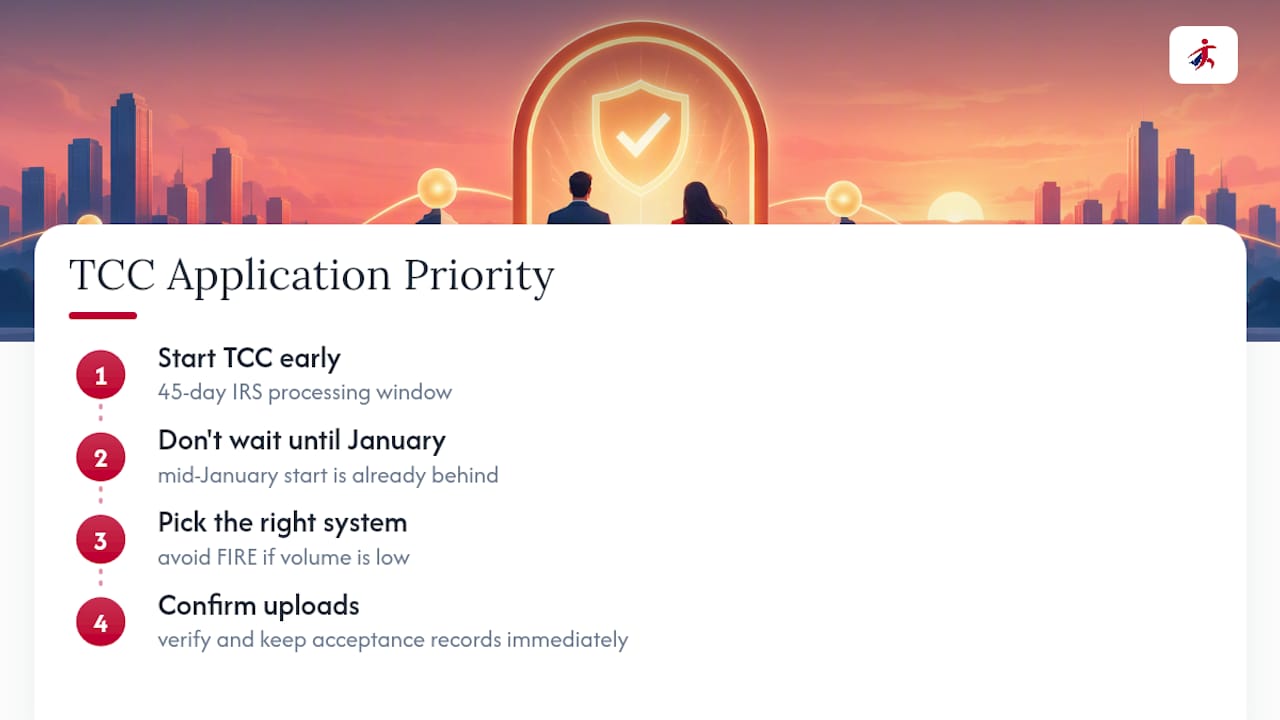
The bigger misconception is that e-filing itself is the hard part. It isn’t. The IRIS Taxpayer Portal is genuinely simple for small batches. What trips people up is sequencing: applying for a TCC too late, choosing FIRE when their volume never justified the technical overhead, or discovering in February that their “successful” upload never actually generated an acceptance record worth keeping.
If you take one thing from this, prioritize the TCC application timeline over everything else. A 45-day processing window means a business that waits until mid-January to start is already behind. Everything downstream, corrections, waivers, penalty exposure, gets easier when you’ve built in that lead time from the start rather than treating registration as a formality you’ll handle later.
— Nazrul
File Your 1099s Without the Registration Headaches
Some IRS-authorized platforms exist to help users who need a filing channel that avoids a rushed application process every January. Their pricing is often pay-per-form with no subscription or signup fees, allowing businesses to pay for what they file each season, not a flat annual cost regardless of volume.
Bulk import from Excel can handle the aggregation math automatically, whether filing a few or thousands of forms, and recipient copies can be delivered by encrypted email or USPS mail without a separate mailing step. Federal returns transmit over IRIS A2A, bypassing the 100-form manual submission cap entirely.
Start with File 1099-NEC Online to see the per-form rate for your volume, or check the full pricing breakdown for state filing, print and mail, and e-delivery add-ons before your next deadline hits.
Sources
For the primary rules behind everything above, go straight to the source:
- E-file information returns | Internal Revenue Service
Businesses evaluating what payments qualify as reportable compensation versus deductible contributions can also check this overview of tax treatment for donated goods for a related edge case.
FAQ
Is E-Filing Mandatory for 1099 Forms?
Yes, if you file 10 or more information returns in a calendar year, combined across all 1099-series and related forms, the IRS requires electronic filing. Filers below that threshold may still choose to e-file voluntarily, and most find it faster than paper regardless.
What Are the Current 1099 Reporting Requirements For Small Filers?
The aggregate threshold applies uniformly: 10 or more combined information returns triggers mandatory e-filing through IRIS or FIRE. There’s no separate, lower or higher carve-out for small businesses specifically, so a sole proprietor issuing 4 NEC forms and 6 MISC forms must e-file just like a larger firm.
What Is the Minimum Number of 1099s That Requires Electronic Filing?
Ten information returns, aggregated across all form types, is the threshold that triggers the mandatory e-file requirement. Below that count, paper filing remains an option, though a waiver isn’t needed since the mandate simply doesn’t apply yet.
How Do I E-File 1099s With the IRS?
You can file through the IRIS Taxpayer Portal for free using manual entry or CSV upload, capped at 100 forms per submission, or through IRIS A2A or FIRE for higher volumes using compatible software. Platforms like TaxFormHero handle the transmission through IRIS A2A directly, which removes the manual submission cap for filers with larger batches.