IRS Deadline: February 1, 2027
1099 Deadlines 2027: Feb 1 & Mar 31, IRIS/TCC Checklist for Small Teams

For tax year 2026, most recipient statements are due by February 1, 2027, since January 31 lands on a Sunday. Form 1099-NEC is due to both recipients and the IRS that same day, while most other 1099s must reach the IRS by March 31, 2027 if e-filed, or March 1, 2027 on paper. Add the IRIS transition and the 10-return e-file threshold to your checklist now.
TL;DR:
- The February 1, 2027 deadline applies to all 1099-NEC recipient and IRS copies, with no e-file extension available for this form.
- The 1099-MISC, 1099-INT, 1099-DIV, and 1099-B deadlines differ by filing method, with paper filings due March 1, 2027, and electronic filings by March 31, 2027.
- The new $2,000 reporting threshold reduces the volume of required forms for nonemployee wages and miscellaneous income, but vendors must still be tracked precisely.
- Transitioning to IRIS as the sole e-file system requires early planning, including applying for a Transmitter Control Code and testing submissions before deadlines.
- State filing requirements vary, necessitating early review of individual state regulations and calendar integration to avoid compliance gaps.
1099 Deadlines 2027: Form-by-Form Breakdown
The 2027 filing season runs on a compressed calendar because several fixed dates fall on weekends. Under IRS rules, any due date landing on a Saturday, Sunday, or legal holiday shifts to the next business day, which explains most of the moves below.
1099-NEC stands apart from every other form on this list. Both the recipient copy and the IRS copy are due on the same day, February 1, 2027, whether you file on paper or electronically. There’s no separate e-file grace period here, which trips up filers who assume every 1099 follows the March e-file pattern.
1099-MISC, 1099-INT, 1099-DIV, and 1099-B follow a two-track calendar: recipients get their copies by February 1, 2027, but the IRS deadline splits by filing method. Paper filers must submit by March 1, 2027 (shifted from the usual February 28 because that date falls on a Sunday), while electronic filers get until March 31, 2027.

1099-MISC with amounts in boxes 8 or 10 (substitute payments and gross proceeds to attorneys) gets a slightly later recipient deadline of February 16, 2027, since the standard February 15 cutoff falls on a federal holiday (Washington’s Birthday observed).
1099-S and 1099-K, where applicable, follow the standard track: recipient copies by February 1, 2027, paper filing by March 1, 2027, e-filing by March 31, 2027.
A few notes worth keeping next to this table:
- 1099-B recipient statements often align with the February 15/16 rule because brokers frequently report proceeds subject to that extended timeline.
- Filing 10 or more information returns in aggregate, including W-2s, triggers mandatory e-filing — you no longer get to choose paper once you hit that count.
- Every date above assumes no additional disaster-relief postponements, which the IRS occasionally issues for specific regions.
How to Get Ready for the IRIS Transition
The Filing Information Returns Electronically (FIRE) system is retiring, and the Information Returns Intake System (IRIS) becomes the only intake option for the 2027 filing season. FIRE stopped accepting new submissions in late 2026, so any filer still relying on it needs a new plan before year-end.
Getting operational on IRIS takes more lead time than most teams expect; for example, executors can learn more about the taxable estate reporting process to ensure all filings are complete on time. A Transmitter Control Code (TCC) application can take up to 45 business days to process, and a Responsible Official has to sign off before the account is active.
- Apply for your TCC through the IRIS application well before January.
- Choose the Taxpayer Portal if you file roughly 100 returns or fewer; use Application-to-Application (A2A) integration for higher volumes.
- Run a test submission before the real filing window opens.
- Subscribe to IRIS QuickAlerts so you catch system updates or outages before they cost you a deadline.
Pro Tip: Don’t wait until January to request your TCC. Between the Responsible Official sign-off and IRS processing time, teams that apply in November or earlier avoid the scramble filers who apply in December routinely hit.
The New $2,000 Threshold and Form Changes to Watch
Certain 1099 reporting thresholds move from $600 to $2,000, with inflation adjustments starting in 2027. That change reduces the volume of nonemployee compensation and miscellaneous income payments that require a form, but it doesn’t eliminate your obligation to track every vendor payment against the new line.
Before you finalize year-end books, check for:
- New boxes on 1099-NEC and 1099-MISC covering items like tips or overtime pay that previously landed elsewhere.
- Payment categories that moved between forms in the December 2026 revision cycle.
- Vendor records that need reclassifying now that the threshold sits at $2,000 instead of $600.
Reconcile every vendor payment type against the correct form and box before you run your final 1099 batch.
Requesting Extensions and Filing Corrections
Form 8809 grants an automatic 30-day extension for many information returns, but 1099-NEC is the exception. Recipient copies of 1099-NEC have no automatic extension, which means that February 1 date is effectively fixed for most filers.
- File Form 8809 on paper or through IRIS on or before the original due date. A late request won’t be honored.
- For 1099-NEC, only request an extension for the IRS filing copy in narrow circumstances; the recipient copy deadline stands regardless.
- When correcting an already-filed return, follow the correction procedures in Publication 1099 rather than checking the VOID box on paper forms, since VOID causes IRS scanning equipment to skip the form entirely.
- Reissue corrected copies to recipients as soon as the error is confirmed, not after your next filing batch.
Penalties and the Mistakes That Trigger Them
Late 1099 filing penalties escalate the longer a return stays outstanding, and correcting an error weeks after the deadline costs more than catching it before you submit. Filers that miss the February 1 recipient deadline or the March e-file window face penalties that increase again after August 1, and intentional disregard of filing requirements carries the steepest tier.
The mistakes that generate most penalty notices are avoidable:
- Incorrect or mismatched Taxpayer Identification Numbers (TINs), often caught only after the IRS sends a notice.
- Using the wrong form or box for a payment type, especially with the new $2,000 threshold reshuffling categories.
- Filing on paper when the 10-return e-file threshold applies, which the IRS treats as a separate violation from lateness.
- Delaying recipient copies past February 1 because the IRS filing felt like the priority.
If you catch an error, file the correction immediately, run TIN Matching before your next batch, and document what you fixed and when. That documentation matters if the IRS questions your good-faith effort later.
Don’t Forget Your State Filing Requirements
Federal compliance doesn’t guarantee you’ve met your state’s rules. Some states accept the federal e-file transmittal through the Combined Federal/State Filing Program, while others require a completely separate submission with its own deadline.
- Check your state revenue department’s site early, not the week returns are due.
- Assign one person to own state filings and track state portals the same way you track IRIS.
- Add every state deadline to the same calendar holding your federal dates so nothing falls through a gap between systems.
A Compliance Checklist Before You File
Six steps cover most of what stands between you and a clean 2027 filing season:
- Collect and verify W-9s from every vendor now, not in January.
- Run TIN Matching before you generate final forms.
- Apply for an IRIS TCC if you haven’t already, given the 45-business-day processing window.
- Map every vendor payment to its correct form and box under the new $2,000 threshold.
- Schedule your e-file submission date with buffer time before March 31, 2027.
- Send recipient copies early rather than waiting until February 1.
TaxFormHero is IRS-authorized and SOC 2 ready, with pay-per-form pricing starting at $1.99, bulk import, TIN verification, and state filing add-ons built for exactly this checklist.
A Practitioner’s View on Scheduling 2027 Filing Work
Build your calendar around five fixed points: TCC application, W-9 collection, TIN Matching, a test e-file run, and early recipient copies. Testing before the real submission window is what separates a smooth February from a scramble against IRIS on deadline day.
— Nazrul
File Faster With TaxFormHero This Season
The platform offers a route to hitting every date on the table above without building your own IRIS integration from scratch. The platform includes features like TIN verification and bulk import to help check vendor data before filing deadlines.
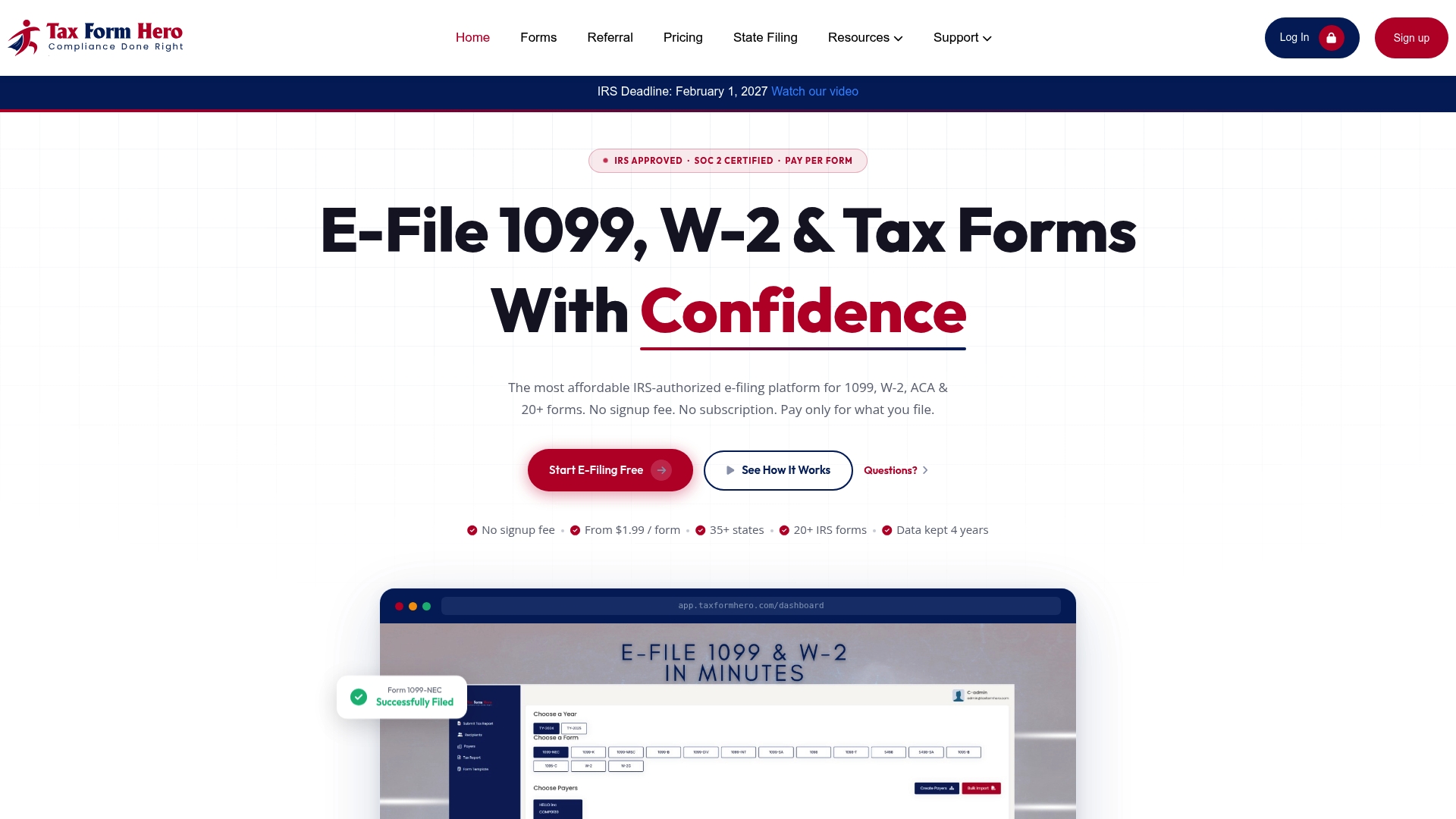
Pricing details and add-ons are available on the platform’s website, including options for state filing where required. If your 1099-NEC batch is due February 1 or your other forms need to clear IRS review by March 31, start filing with TaxFormHero today and get your recipient copies out ahead of schedule.
This article is general information, not a substitute for advice from a qualified financial advisor. Consult a qualified financial professional about your own circumstances before acting on anything here.
FAQ
What is the legal deadline for sending out 1099s?
For tax year 2026, most 1099 recipient statements are due by February 1, 2027, since January 31 falls on a Sunday; 1099-NEC follows this same date for both recipients and the IRS.
What are the new 1099 filing requirements for 2027?
IRIS becomes the mandatory e-file system as FIRE retires, the e-file threshold stays at 10 aggregate returns, and certain reporting thresholds rise from $600 to $2,000 with inflation adjustments.
When must 1099s be issued in 2026?
If you mean the forms covering the prior tax year, those followed the previous filing season calendar; the 2027 dates in this guide apply to payments made during 2026, reported in early 2027.
Are 1099 deadlines the same date every year?
No. Fixed dates like January 31 and February 28 shift to the next business day whenever they fall on a weekend or federal holiday, which is why 2027 moves several deadlines to February 1 and March 1.
Does TaxFormHero help with state 1099 filing requirements?
Yes. TaxFormHero offers state filing add-ons for jurisdictions that require separate transmittals beyond the federal e-file submission.
Looking for 1099-NEC software? TaxFormHero is IRS-authorized and charges per form, not per month.