Avoid $680 per Form: 1099-NEC Deadline, IRIS TCC Steps for Payers

Recipients must receive their 1099-NEC copies by the end of January 2027, and that same date is your IRS filing deadline whether you file on paper or electronically. There is no automatic extension for this form. The most urgent action right now is securing your Transmitter Control Code (TCC) through the IRS’s IRIS system, or lining up an authorized e-file provider, since TCC processing can eat weeks you don’t have.
TL;DR:
- The 2027 1099-NEC deadline is February 1, which applies to both recipient copies and IRS filings, with no grace period for paper or electronic submissions.
- Businesses paying nonemployees over $600 must file 1099-NEC forms, with the requirement applying to a wide range of service payments and most payers, except most corporations and personal payments.
- To e-file in 2027, filers must obtain a Transmitter Control Code through the IRS’s IRIS system, a process that can take up to six weeks, so early application is essential.
- Penalties for late filing can reach $680 per form for willful disregard, with speed and immediate correction reducing total exposure.
- Assigning a dedicated person to manage 1099-NEC compliance and testing filing methods early can prevent last-minute errors and deadline crises.
When Is the 1099-NEC Deadline in 2027?
January 31, 2027 falls on a Sunday. Under the IRS’s standard rule, when a due date lands on a weekend or legal holiday, the deadline shifts to the next business day. That pushes the 2027 1099-NEC filing and furnishing deadline to Monday, February 1, 2027.
This is what makes 1099-NEC unusual among information returns: the recipient copy deadline and the IRS filing deadline are the same date, regardless of whether you file on paper or electronically. Most other 1099 forms give paper filers until the end of February and electronic filers until the end of March. Form 1099-NEC skips that grace period entirely. The Instructions for Forms 1099-MISC and 1099-NEC make this explicit: payee statements are due by January 31, and IRS filing follows the same date, no matter your filing method.
Mail matters here too. If you’re filing on paper, the IRS accepts a postmark on or before the due date, and the same logic extends to designated private delivery services. If you’re transmitting through the IRIS portal, your submission needs to be accepted, not just started, by the deadline.
Here’s how 1099-NEC compares to the forms payers commonly confuse it with:
| Form | Recipient copy due | IRS filing due (paper) | IRS filing due (e-file) |
|---|---|---|---|
| 1099-NEC | Feb. 1, 2027* | Feb. 1, 2027* | Feb. 1, 2027* |
| 1099-MISC (no data in certain boxes) | Feb. 1, 2027* | March 1, 2027 | March 31, 2027 |
| 1099-MISC (certain boxes populated) | February 28, 2027 | March 1, 2027 | March 31, 2027 |
| W-2 | Feb. 1, 2027* | Feb. 1, 2027* | Feb. 1, 2027* |
*Adjusted from January 31, which falls on a Sunday in 2027.
That single-date structure for 1099-NEC is exactly why so many small businesses get tripped up. Teams accustomed to the staggered W-2 and 1099-MISC timelines assume they have until March. They don’t, and the IRS treats the recipient copy and the government copy as two separate compliance obligations that happen to share a due date.
Filing one yourself? You can e-file Form 1099-NEC online with TaxFormHero, an IRS-authorized e-filing platform.
Who Has To File a 1099-NEC and Furnish Copies?
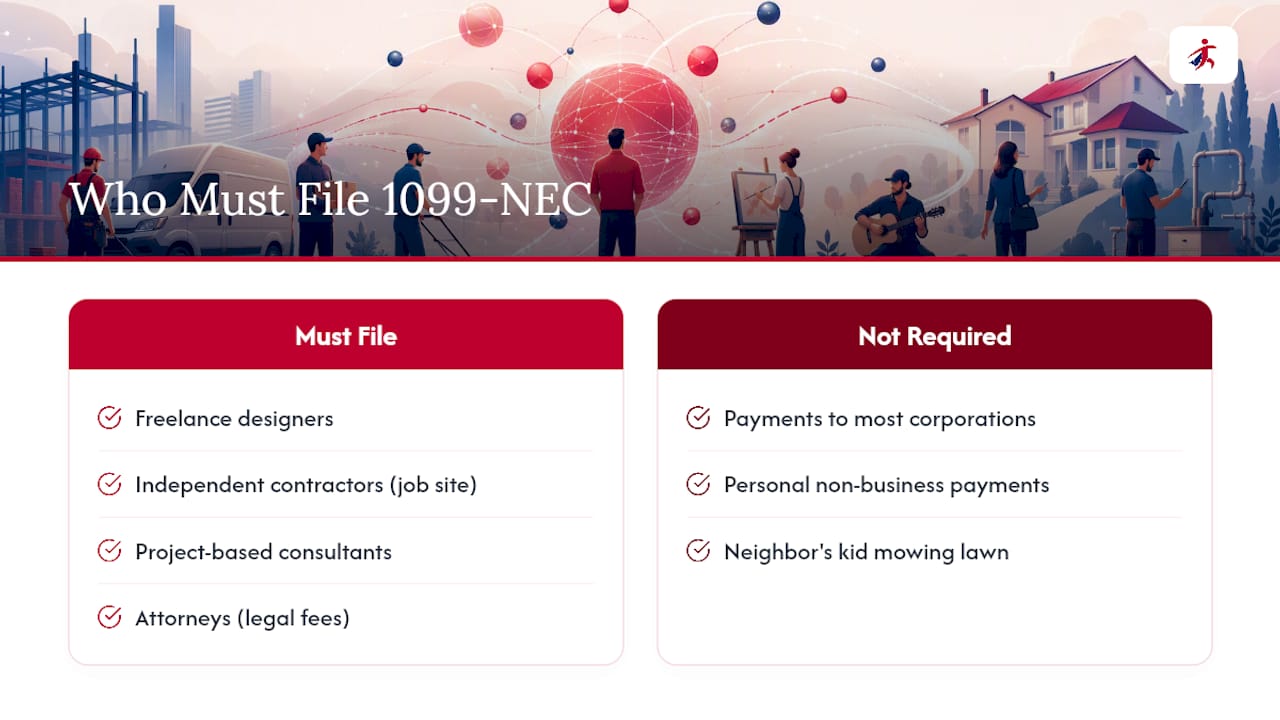
If your business paid a nonemployee an amount above the IRS threshold for reporting during the year for services, you generally owe that person a 1099-NEC. This covers a wide swath of everyday business spending: freelance designers, independent contractors on a job site, consultants billing by the project, attorneys paid legal fees, and even cash payments to a sole proprietor for repair work. The trigger is nonemployee compensation, not the payment method or how the relationship is structured.
Any person or entity operating a trade or business is generally required to file, including sole proprietors, partnerships, corporations, nonprofit organizations, property managers, and businesses paying attorneys. Payments to most corporations are typically exempt, and personal, non-business payments generally don’t trigger a filing obligation. If you paid your neighbor’s kid to mow your personal lawn, that’s not a 1099-NEC situation. If your landscaping company paid a subcontractor to mow client lawns, it is.
The instructions also allow truncated TINs on the payee’s copy, showing only the last four digits of a Social Security number or EIN, though the full number must still appear on the copy filed with the IRS. This protects recipients from identity exposure on a document that may pass through several hands before it’s filed away.
One point trips up more payers than any other: furnishing the recipient copy by January 31 (or the adjusted 2027 date) is a distinct legal obligation from filing with the IRS. Getting your IRS submission in on time doesn’t excuse a late recipient copy, and vice versa. Treat them as two deadlines that happen to fall on the same day, not one task.
Do I Need a TCC to E-File 1099-NEC in 2027?
Yes, and this is the biggest operational shift for the 2027 filing season. The IRS has moved information return e-filing to the Information Returns Intake System (IRIS), retiring the older FIRE system for new submissions. Every filer transmitting returns electronically needs a Transmitter Control Code, and the IRS has been explicit that filers should apply well ahead of the season rather than waiting for January.
Here’s the practical sequence for getting IRIS-ready:
- Confirm your EIN is active and correctly associated with your business. The TCC application ties directly to it, and mismatches cause delays.
- Submit your IRIS Application for TCC through the IRS portal, providing responsible party information for identity verification.
- Expect processing to take weeks, not days. Filers have reported approvals extending toward six weeks during peak demand, so applying in the fall for a February deadline isn’t early. It’s on time.
- Test portal access once approved, including a small sample submission if the system allows, before you’re staring down deadline week.
- Confirm your file format matches IRIS specifications if you’re transmitting through the A2A (Application-to-Application) channel rather than manual portal entry.
If you file 10 or more information returns in a calendar year, aggregated across all return types (not just 1099-NEC), electronic filing is mandatory. That threshold catches more small businesses than people expect, since it counts 1099-NECs, W-2s, and other information returns together, not each form type separately.
Pro Tip: If your TCC application is still pending in December, don’t gamble on approval landing before February. Route your filing through an IRS-authorized e-file provider that already holds IRIS access. You keep your deadline without betting your compliance on a government processing queue.
How Much Are the Penalties for a Late 1099-NEC?
The penalty structure escalates in four tiers, and the IRS penalty schedule applies these amounts per form, not per business:
- $60 per form if you file within 30 days of the due date
- $130 per form if you file between 31 days late and August 1
- $340 per form if you file after August 1 or don’t file at all
- $680 per form for intentional disregard of the filing requirement, with no maximum cap
The highest penalty tier has no maximum cap and is applied when a business knowingly skips filing rather than simply missing a date. Other penalty tiers have annual maximums that may differ for small businesses.
Businesses face penalties escalating by tiers based on how late the filing is, so delays can significantly increase total penalties, especially for many forms filed late. The math rewards speed even when perfection isn’t possible right away.
Three moves genuinely reduce your exposure:
- File whatever you have ready immediately, even if some forms are still incomplete. Partial, prompt filing beats a complete filing weeks later.
- Correct errors the moment you spot them rather than waiting for a rejection notice. Correcting a return inside the 30-day window keeps you at the lowest tier.
- Document your timeline. If you plan to request penalty abatement for reasonable cause, dated records of when you discovered an issue and how fast you acted carry real weight with the IRS.
What Should I Do If My 1099-NEC Gets Rejected?
A rejected submission and a corrected return are not the same thing, and mixing them up wastes time you don’t have during filing season. A rejection means the IRS never accepted your original file, usually because of a formatting or matching error, and you resubmit as an original once it’s fixed. A correction means the IRS accepted your original, but the data on it was wrong, and you now file a separate corrected return referencing the original.
Most rejections trace back to a handful of recurring problems:
- TIN and name mismatches. The recipient’s name doesn’t match IRS records for that Taxpayer Identification Number. Run every new vendor through the IRS TIN Matching Program before filing season starts, not during it.
- Formatting errors in the electronic file. IRIS expects specific field structures, and a misaligned amount field or invalid character can bounce an entire batch.
- Duplicate submissions. Filing the same form twice, often because a first attempt’s status wasn’t confirmed, triggers a rejection or a correction cycle you didn’t need.
- Missing or malformed EINs on the payer side. Double-check your own business information matches what’s on file with the IRS.
When you discover an error after the IRS has already accepted the original, the order of operations matters. Notify the payee first so they’re not filing their personal return with bad information. File the corrected return promptly, since corrected returns generally must be e-filed whenever the original was required to be filed electronically. Then document what happened and when, because that record becomes your evidence if penalty exposure ever needs explaining.
TIN Matching before you file, rather than after a rejection, is the single highest-leverage habit in this entire process. It costs a few minutes per vendor and prevents a scramble that costs hours per form.
What If I Already Missed the 1099-NEC Deadline?
Stop trying to fix everything before you fix anything. Get recipient copies out the door first, since that’s the obligation most likely to trigger a complaint that draws IRS attention. Then move to IRS filing.
- Deliver recipient copies immediately, even if IRS filing is still in progress. A late recipient copy and a late IRS filing are two separate violations, and closing one gap reduces your total exposure.
- Submit through IRIS or an authorized e-file provider the same day you’re ready, rather than waiting to batch everything perfectly.
- Calculate your likely penalty tier honestly. Count days from the February 1, 2027 deadline to your actual filing date, and check that figure against the $60, $130, or $340 per-form tiers.
- Gather a reasonable-cause narrative if circumstances genuinely warranted delay (a documented system outage, a serious illness, a natural disaster affecting your records). The IRS wants specific facts and dates, not general hardship claims.
- Bring in a tax professional once penalty exposure crosses into the thousands of dollars, particularly if intentional disregard could plausibly be alleged and you need someone experienced in abatement requests.
Pro Tip: Form 8809 requests an automatic 30-day extension for many information returns if filed by the original due date, but it generally does not apply to 1099-NEC. If you’re reading this after February 1, 2027, Form 8809 is not your lifeline. Move straight to filing and mitigation.
Building a 1099-NEC Filing Timeline That Actually Works
The businesses that never scramble in January share one habit: they treat 1099-NEC prep as a fourth-quarter task, not a January fire drill.
In October and November, confirm every vendor who might cross the $600 threshold has a completed Form W-9 on file. Chasing a W-9 from a contractor who’s gone quiet in late January is a genuinely bad position to be in.
In early December, run every vendor TIN through the TIN Matching Program so mismatches surface while you still have time to call someone and fix it. Confirm whether your total information return count for the year crosses the 10-form threshold that makes e-filing mandatory. Export your accounting data into whatever format your filing method requires.
In the first two weeks of January, finalize form counts, confirm dollar amounts against your books, and if you haven’t already secured IRIS access, arrange with an authorized e-file provider now rather than gambling on a last-minute TCC approval.
By January 25 or so, submit your batch. This gives you a buffer if IRIS returns a rejection you need to fix before the actual deadline.
After filing, confirm your transmission status shows accepted, not just submitted, and hold onto that confirmation. If a correction becomes necessary later, that record of your original timely filing matters for penalty purposes.
A practical technical checklist for the IRIS submission itself:
- Confirm your file format matches current IRIS specifications before transmitting a full batch.
- Submit early enough to receive and act on a rejection notice before the deadline.
- Keep a log of submission timestamps and confirmation numbers for every batch.
- If handling a mix of forms, review the differences between 1099-NEC and 1099-MISC so nonemployee compensation and other income aren’t misclassified before they ever reach the IRS.
For a broader look at the full filing process from data collection through submission, TaxFormHero’s guide on how to file 1099 forms walks through the sequence in more detail, and the 1099 compliance checklist is worth keeping open while you work through your own list.
How TaxFormHero Simplifies 1099-NEC Filing for 2027
Some e-file providers are built for exactly the pressure points this article covers: the IRIS transition, the TIN mismatch risk, and the compressed timeline that gives 1099-NEC filers no room for error. Authorized providers handle the technical submission through IRIS on your behalf, which means you’re not the one waiting on a TCC approval clock during peak season.
The platform’s features map directly onto the friction points payers hit every January:
- Built-in TIN verification catches mismatches before submission, not after a rejection notice.
- Bulk import handles large contractor rosters in one pass instead of manual entry form by form.
- State filing support covers 35+ states for payers who owe both a federal and state copy.
- Print and mail and encrypted e-delivery options meet the recipient-furnishing deadline without you personally stuffing envelopes on January 30.
- Pay-per-form pricing, starting at $1.99 per form with no subscription or signup fee, means you’re not paying for capacity you don’t use in a light filing year.
For a business filing at the last minute with corrections still pending from a prior batch, having access to a platform with active IRIS access removes significant bottlenecks in the 2027 filing season, including delays from waiting for individual TCC approval.
Nazrul’s Practical Tips: Small Habits That Prevent Deadline Crises
Every filing season, the businesses that struggle are rarely the ones with complicated tax situations. They’re the ones without a designated owner for the task. Somebody assumes somebody else is handling it, and nobody discovers the gap until a contractor calls asking where their form is.
Assign one person, by name, to own 1099-NEC compliance for the year. Not “accounting,” a specific human being with the authority to chase down a missing W-9 in November instead of January.
Test your filing method before you need it. If you’re new to IRIS, or new to a filing platform, submit a small batch or a single form early in the season to confirm everything works. Discovering a formatting problem on January 28 is a very different experience than discovering it in early December.
Schedule TIN matching as a calendar event, not an afterthought squeezed in during crunch time. I’ve watched businesses lose entire days to a rejection cycle that a five-minute TIN check would have prevented weeks earlier.
The pattern holds across nearly every filing season: the deadline itself rarely causes the crisis. The absence of a plan for the six weeks before it does.
— Nazrul
File Your 1099-NEC Forms Before the 2027 Deadline
TaxFormHero exists for exactly this moment: the point where you know your deadline, understand your penalty exposure, and need a filing path that doesn’t depend on your own TCC application clearing in time. Rather than waiting on IRIS approval or wrestling with file format specifications yourself, you file through a provider that already holds that access.
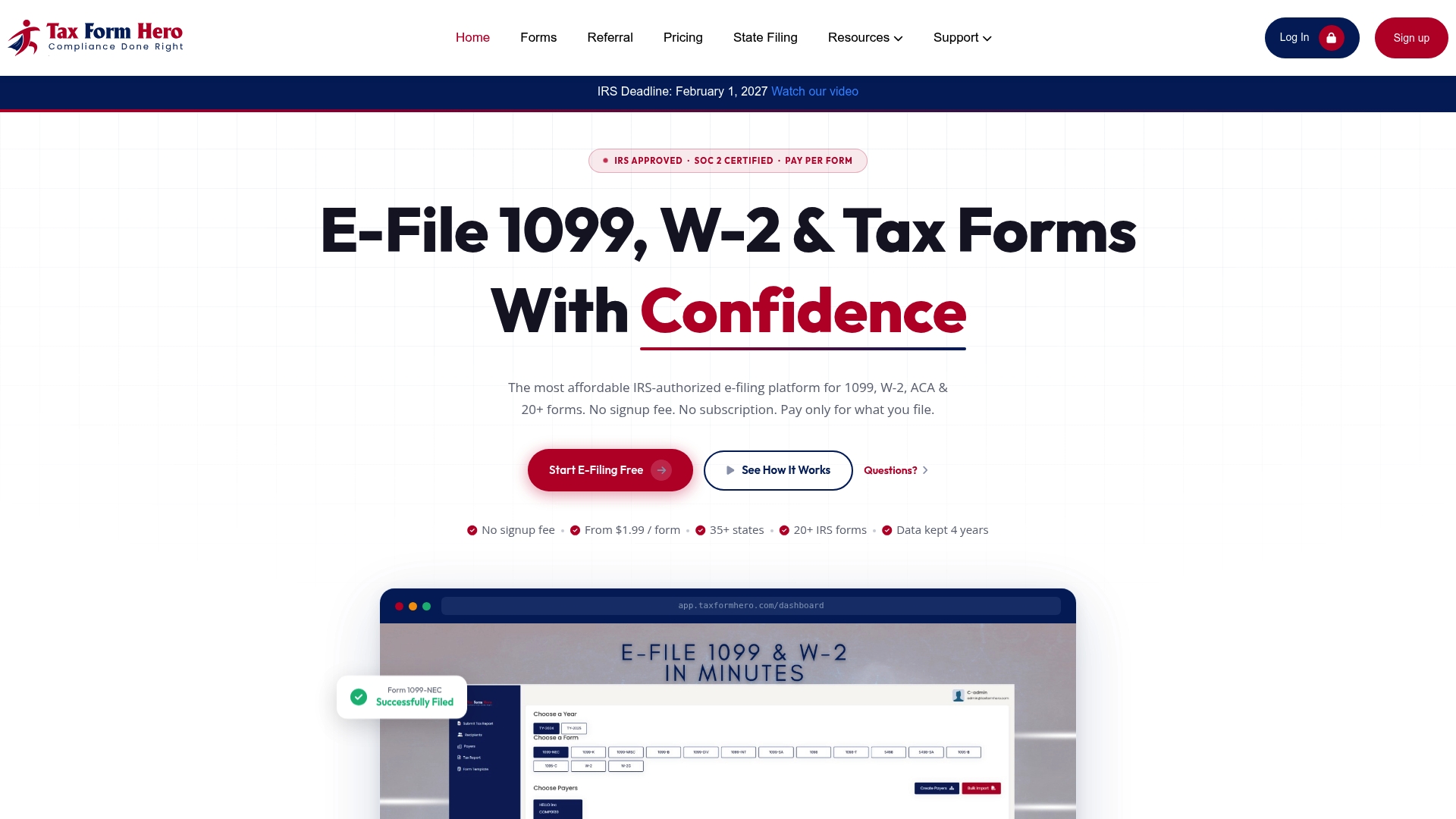
Pricing starts at $1.99 per form with rates dropping as your volume increases, and there’s no subscription fee sitting on your books between filing seasons. Add TIN verification, state filing, or encrypted e-delivery to your recipient copies as needed, all billed per form rather than bundled into a package you might not use. If your 1099-NEC batch is ready, or even mostly ready, start your filing at TaxFormHero now and get it off your list before February 1, 2027 arrives.
FAQ
What is the deadline for filing Form 1099-NEC in 2027?
Both the recipient copy and the IRS filing are due by January 31, 2027, but since that date falls on a Sunday, the deadline shifts to Monday, February 1, 2027.
What is the penalty for filing a 1099-NEC late?
Penalties run $60 per form within 30 days late, $130 per form from 31 days up to August 1, $340 per form after August 1 or if never filed, and $680 per form for intentional disregard with no maximum.
Do I need a Transmitter Control Code to e-file 1099-NEC in 2027?
Yes. The IRS now requires filers to submit information returns through IRIS, and you need a TCC to transmit, or you can file through an authorized e-file provider like TaxFormHero that already holds IRIS access.
What are the new 1099 filing requirements for 2027?
The main shift is the mandatory move to IRIS for electronic submissions, since the older FIRE system is retired for new filings, alongside the existing rule that 10 or more information returns in aggregate require e-filing.
Can I get an extension for filing Form 1099-NEC?
Form 8809 can extend many information returns by 30 days if filed by the original due date, but it generally does not apply to 1099-NEC, so plan to file on time rather than counting on an extension.
Recommended
- E-file 1099-NEC in 2026: Guide for Small Businesses
- 1099-NEC vs 1099-MISC: Which Form Do You File?
- 1099-K vs 1099-NEC: What Freelancers Must Know
- 1099 Deadlines 2026: What Small Businesses Must Know

File Information Returns With Confidence
TaxFormHero supports 20+ IRS information returns, including 1099 and W-2 forms, with bulk Excel import, name/TIN matching and encrypted recipient delivery.
Explore TaxFormHero