IRS Deadline: February 1, 2027

Use Form 1099-NEC when you paid a nonemployee at or above the reportable payment threshold for services performed in the course of your trade or business. Use Form 1099-MISC for everything else reportable: rents, royalties, prizes, medical payments, and attorney gross proceeds. That single distinction covers the vast majority of classification decisions payers face each year.
Quick payment-to-form reference:
- Contractor or freelancer services → Form 1099-NEC, Box 1a
- Rent paid to a landlord → Form 1099-MISC, Box 1 (the applicable reportable threshold)
- Royalties → Form 1099-MISC, Box 2 (the applicable reportable threshold)
- Prizes and awards → Form 1099-MISC, Box 3 (the applicable reportable threshold)
- Attorney gross proceeds → Form 1099-MISC, Box 10
- Attorney service fees → Form 1099-NEC, Box 1a
Deadline callouts: Recipient copies for both forms are due by January 31. IRS copies of Form 1099-NEC are also due January 31. IRS copies of Form 1099-MISC are due February 28 (paper) or March 31 (e-file) when no payments appear in Box 8 or Box 10.
Key Takeaways
The single most important rule: use Form 1099-NEC for nonemployee service payments of $600 or more and Form 1099-MISC for rents, royalties, prizes, and attorney gross proceeds at their applicable thresholds.
| Point | Details |
|---|---|
| NEC vs. MISC core rule | 1099-NEC covers service payments to contractors; 1099-MISC covers rents, royalties, prizes, and attorney gross proceeds. |
| Recipient copy deadline | Both forms require recipient copies delivered by January 31, with no exceptions. |
| IRS filing deadlines differ | 1099-NEC IRS copy is due January 31; 1099-MISC IRS copy is due February 28 (paper) or March 31 (e-file). |
| Backup withholding applies below threshold | If you withheld federal income tax, you must file a 1099 even when the payment is under $600. |
| TaxFormHero for e-filing | TaxFormHero provides IRS-authorized e-filing, automated TIN matching, and state filing add-ons starting at $1.99 per form. |
If you would rather not do this on paper, e-file Form 1099-MISC online with TaxFormHero instead.
What is the difference between 1099-NEC and 1099-MISC?
The core difference comes down to payment type, not payee type. Form 1099-NEC covers nonemployee compensation — payments for services. Form 1099-MISC covers a defined list of nonservice payments. Getting this wrong shifts tax burdens and creates audit risk for both payer and recipient, as the IRS income treatment scenarios make clear.
| Dimension | Form 1099-NEC | Form 1099-MISC |
|---|---|---|
| Primary purpose | Report nonemployee compensation for services | Report miscellaneous nonservice payments |
| Common payments | Contractor fees, freelancer invoices, attorney service fees | Rents, royalties, prizes, medical payments, attorney gross proceeds |
| Key box | Box 1a (nonemployee compensation) | Box 1 (rents), Box 2 (royalties), Box 3 (prizes), Box 10 (attorney gross proceeds) |
| General threshold | the applicable IRS reportable threshold | the applicable IRS reportable threshold |
| Who receives it | Independent contractors, sole proprietors, partnerships providing services | Landlords, prize recipients, royalty recipients, attorneys receiving gross proceeds |
| Recipient copy deadline | January 31 | January 31 |
| IRS filing deadline | January 31 (paper and e-file) | February 28 (paper) / March 31 (e-file) when no Box 8 or Box 10 amounts |
| Paper transmittal | Form 1096 required with paper filing | Form 1096 required with paper filing |
| E-file threshold | Required at 10 or more returns | Required at 10 or more returns |
The Instructions for Forms 1099-MISC and 1099-NEC provide the box-level rules and thresholds that govern every row above. Attorney payments deserve special attention: gross proceeds paid to an attorney go on Form 1099-MISC, Box 10, while fees paid to an attorney for legal services rendered to your business go on Form 1099-NEC, Box 1a.
Before you prepare either form:
- Collect a completed Form W-9 from every payee before the first payment clears.
- If you are unsure which form applies, run the payment through the decision checklist in the next section.
Who must file, and when do deadlines apply?
Any person or business that makes reportable payments in the course of a trade or business must file the appropriate 1099 form. The IRS guidance on reporting payments to independent contractors covers the filing requirements in full, including Form 1096 transmittal rules and e-file thresholds.
Who must file:
- Businesses, sole proprietors, partnerships, and nonprofits that paid $600 or more to a nonemployee for services during the tax year
- Payers who made any of the MISC-reportable payments listed in the instructions (rents, royalties, prizes, etc.) at or above the applicable threshold
- Any payer who withheld federal income tax under backup withholding rules, regardless of payment amount
Payments generally exempt from 1099 reporting:
- Payments made to a C corporation or S corporation (with limited exceptions, such as attorney gross proceeds and medical payments)
- Payments for merchandise, freight, storage, or similar items
- Wages paid to employees (those go on Form W-2)
Deadlines at a glance:
- January 31: Recipient copies for both Form 1099-NEC and Form 1099-MISC must be delivered.
- January 31: IRS copy of Form 1099-NEC is due, whether filed on paper or electronically.
- February 28 / March 31: IRS copy of Form 1099-MISC is due on paper by February 28 and electronically by March 31, provided no amounts appear in Box 8 or Box 10. When Box 8 or Box 10 has amounts, the IRS copy is due February 15.
Paper vs. e-file: Payers who file 10 or more information returns in a calendar year must e-file. Paper filers must attach Form 1096 as a transmittal cover for each form type submitted. A separate Form 1096 is required for each type of 1099 filed on paper.
How do you decide which form to use?
Work through these four questions in order. The first “yes” that applies determines the correct form.
- Is the payee your employee? If yes, issue a W-2, not a 1099.
- Did you pay $600 or more for services performed for your trade or business? If yes, use Form 1099-NEC, Box 1a.
- Is the payment a rent, royalty, prize, medical payment, or attorney gross proceeds? If yes, use Form 1099-MISC and select the correct box per the instructions.
- Did you withhold federal income tax under backup withholding? If yes, file the appropriate 1099 regardless of payment amount.
Five quick examples:
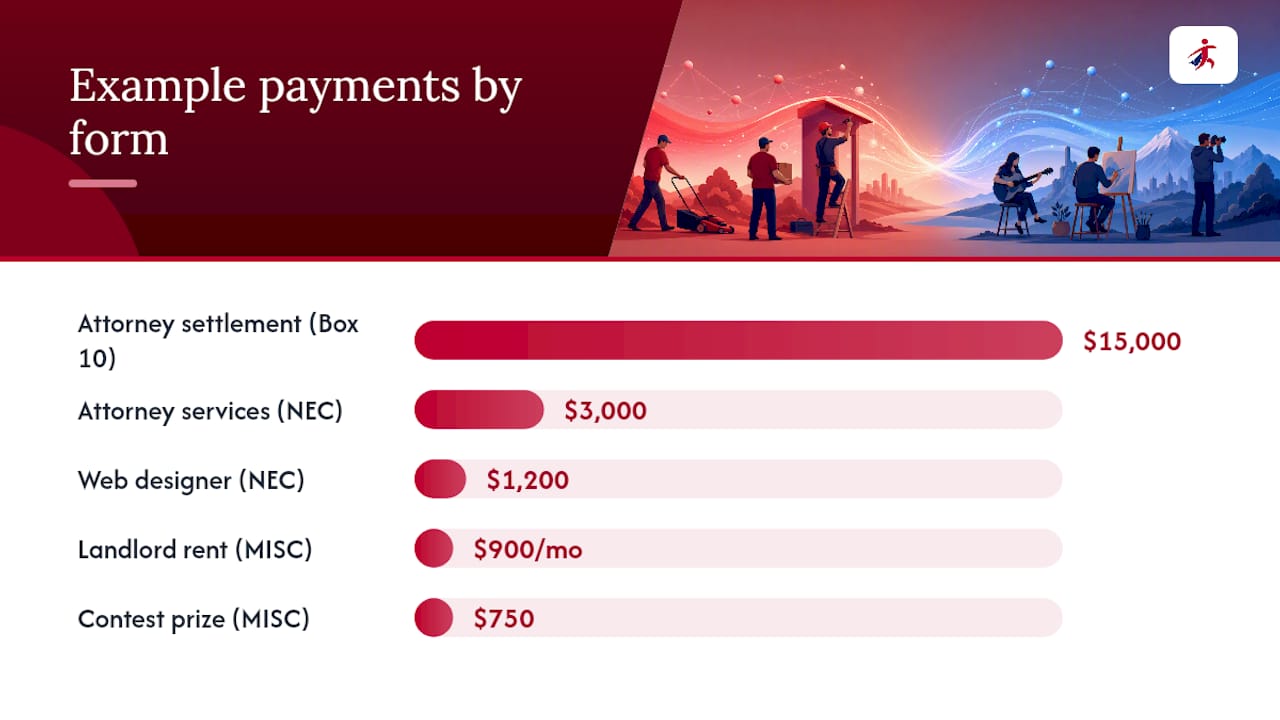
- Web designer invoices $1,200 for a new site: Form 1099-NEC, Box 1a.
- You pay $900/month rent to an individual landlord: Form 1099-MISC, Box 1.
- A contest winner receives a $750 prize: Form 1099-MISC, Box 3.
- Your attorney receives $15,000 in settlement proceeds on your behalf: Form 1099-MISC, Box 10.
- Your attorney bills $3,000 for drafting contracts: Form 1099-NEC, Box 1a.
The IRS income treatment scenarios show how misclassification plays out in practice — for instance, a prize incorrectly reported on Form 1099-NEC instead of Form 1099-MISC creates a mismatch that can trigger notices for both payer and recipient.
Pro Tip: Document the business purpose of every payment at the time you make it. A brief note in your accounting software (“contract design services, invoice #204”) gives you a defensible record if the IRS questions the form choice later.
TIN verification, backup withholding, and common payer mistakes
Missing or incorrect Taxpayer Identification Numbers (TINs) are the most common operational error in 1099 filing. Critically, IRS rules for independent contractor forms confirm that payers must file a 1099 and report withheld amounts even when the payment falls below the normal $600 threshold.
What triggers backup withholding:
- Payee fails to provide a TIN before payment
- TIN provided does not match IRS records
- IRS sends a “B-notice” (CP2100 or CP2100A) indicating a prior-year mismatch
- Payee is notified by the IRS that they are subject to backup withholding
The B-notice process: When the IRS sends a CP2100 or CP2100A notice, the payer must send a first B-notice to the payee within 15 business days. The payee then has 30 business days to respond with a corrected TIN or a signed certification. A second B-notice within three years requires the payee to obtain IRS certification directly.
Common payer mistakes:
- Collecting a W-9 after payment instead of before
- Accepting a W-9 with a name/TIN combination that has never been verified against IRS records
- Ignoring CP2100 notices and continuing to pay without withholding
- Reporting contractor service fees on Form 1099-MISC instead of Form 1099-NEC
- Assuming payments to LLCs are exempt because the payee “looks like a corporation”
Pro Tip: Store every W-9 in a secure, searchable repository and run TIN matching through the IRS TIN Matching Program before filing season. Catching a mismatch in November costs nothing. Catching it in February costs penalties and a corrected return.
How to file Form 1099-NEC and 1099-MISC step by step
Follow these steps in order. Skipping step one is the single most common reason payers end up in backup withholding territory.
- Collect Form W-9 from each payee before the first payment. Verify the name, TIN, and entity type. Confirm whether the payee is a corporation (which generally exempts the payment from 1099 reporting, with noted exceptions).
- Aggregate payments by payee at year-end. Total all payments made to each vendor or contractor during the calendar year. Apply the applicable threshold ($600 for most NEC and MISC boxes; $10 for royalties).
- Select the correct form and box. Use the decision checklist above. Refer to the Instructions for Forms 1099-MISC and 1099-NEC for any payment type not covered by the checklist.
- Prepare the recipient copy. Complete all required boxes accurately. Include your payer TIN, the payee’s TIN, and the correct dollar amount.
- Deliver the recipient copy by January 31. Mail or, with payee consent, deliver electronically via encrypted e-delivery.
- Decide paper or e-file. If you are filing 10 or more information returns, e-file is mandatory. The IRS e-file information returns page lists approved transmission methods and specifications.
- File with the IRS. For paper filers, attach a separate Form 1096 for each form type. For e-filers, transmit through an IRS-authorized provider. Meet the January 31 deadline for Form 1099-NEC and the February 28 or March 31 deadline for Form 1099-MISC.
- Address state filing obligations. Many states require separate 1099 filings or participate in the IRS Combined Federal/State Filing program. Check your state’s requirements and add state copies where needed.
What are the penalties, and how do you correct a mistake?
The IRS structures 1099 penalties by how late the correction arrives. Filing within 30 days of the deadline carries a lower per-form penalty than filing after August 1 or not filing at all. Intentional disregard carries the highest penalty tier with no cap. The exact penalty amounts are set by the IRS and adjusted periodically, so confirm current figures in the General Instructions for Certain Information Returns before filing.
Common penalty triggers:
- Filing after the applicable deadline (January 31 for NEC; February 28 or March 31 for MISC)
- Reporting an incorrect TIN or payee name
- Failing to furnish the recipient copy by January 31
- Filing on paper when e-file is required
- Reporting a payment on the wrong form type (e.g., contractor fees on MISC instead of NEC)
Correction workflow:
- Step 1: Identify the error type. A wrong dollar amount, wrong payee name, or wrong TIN each follows a slightly different correction path.
- Step 2: Prepare a corrected return. Check the “CORRECTED” box at the top of the form. Enter the correct information.
- Step 3: File the corrected return with the IRS. Paper filers attach a new Form 1096 marked “CORRECTED.” E-filers transmit a corrected file through their authorized provider.
- Step 4: Send the corrected copy to the recipient. Do not wait for the IRS to process the correction before notifying the payee.
- Step 5: Retain all documentation, including the original form, the corrected form, and the reason for the change.
The IRS income treatment scenarios walk through common correction workflows, including how to handle a payment reported on the wrong form entirely. For complex errors, litigation-related payments, or situations involving large aggregated amounts, consult a qualified tax professional before filing the correction.
The mistake that costs payers the most
The classification error that generates the most downstream problems is not the contractor-vs.-rent confusion. It is the assumption that collecting a W-9 is optional or can wait until filing season. Payers who skip that step at the start of a vendor relationship often discover in January that they have no valid TIN, no basis for backup withholding compliance, and no clean path to a correct 1099. By then, the payment is already made and the leverage to obtain documentation is gone.
The practical recommendation is straightforward: treat W-9 collection as a prerequisite to cutting any check, not as a year-end accounting task. Pair that with TIN matching before filing, and the vast majority of 1099 errors become preventable. The IRS recommends consulting the Instructions for Forms 1099-MISC and 1099-NEC for any threshold or rule change before each filing season, because thresholds and deadlines do shift.
TaxFormHero makes 1099 e-filing faster and more accurate
Filing 1099-NEC and 1099-MISC forms correctly requires the right form, the right box, a verified TIN, and a deadline that does not move. TaxFormHero is built specifically for that workflow: IRS-authorized e-filing for 1099-NEC, 1099-MISC, and 20+ other form types, with no subscription and no signup fee. You pay per form filed, starting at $1.99.
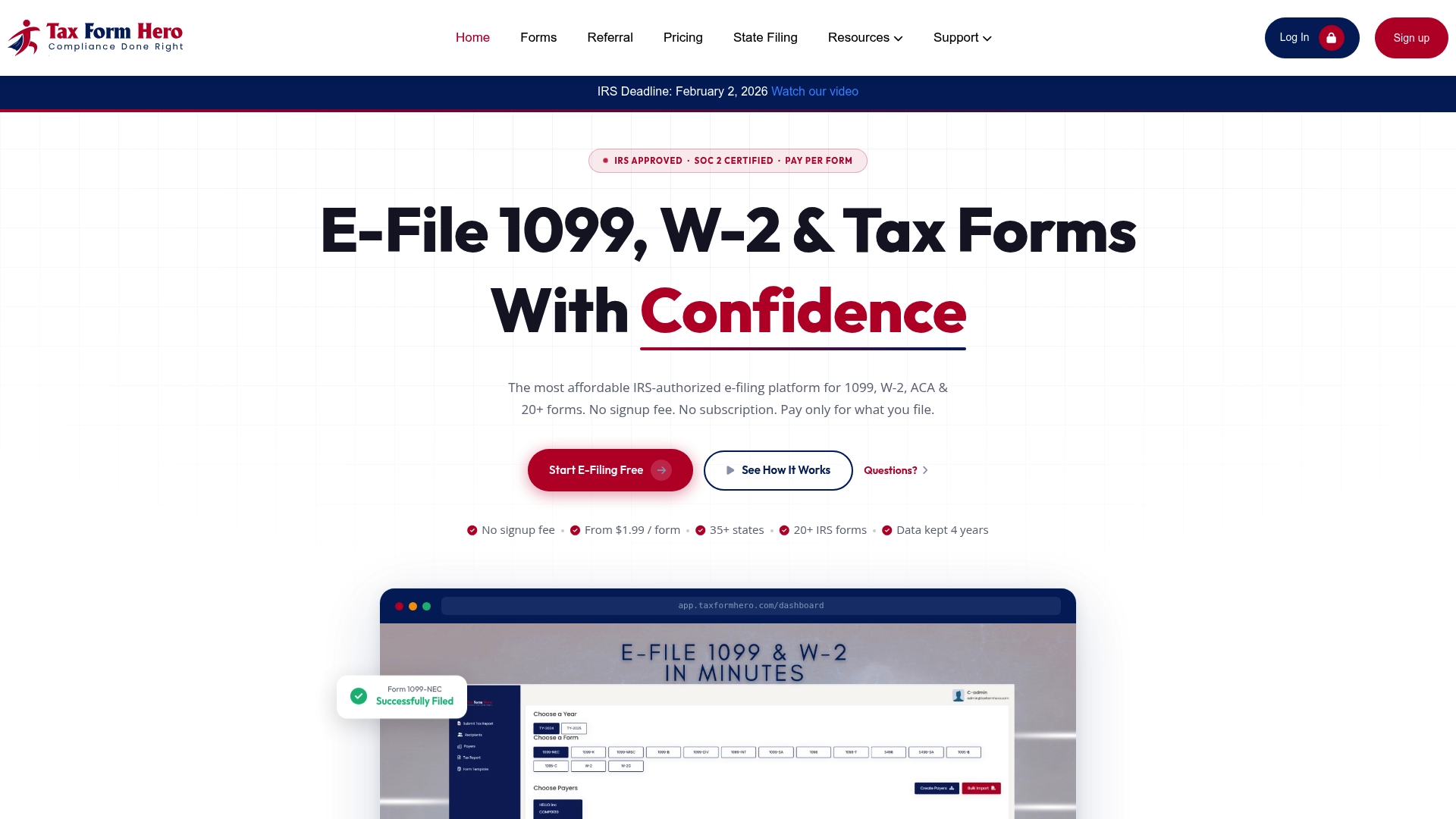
For small businesses and accounting firms handling multiple payees, the platform’s bulk import cuts data entry time significantly. Automated TIN matching flags mismatches before you file, not after the IRS sends a notice. Form 1096 handling is built in for paper filers, and state filing add-ons cover direct filing to 35+ states. Encrypted e-delivery gets recipient copies to payees securely, with a documented delivery record.
Start e-filing your 1099s at TaxFormHero and have your forms submitted, delivered, and archived before the January 31 deadline.
Sources
The rules in this article are drawn from the following IRS publications and pages. Check each source directly before filing, as thresholds and deadlines are subject to change.
- Instructions for Forms 1099-MISC and 1099-NEC (12/2026)
- About Form 1099-NEC, Nonemployee Compensation | Internal Revenue Service
For the most current thresholds and any mid-year updates, visit IRS.gov/Form1099MISC and IRS.gov/Form1099NEC directly.
This article provides general information about IRS filing requirements and is not a substitute for professional tax advice. Confirm current rules with IRS.gov or a qualified tax professional before filing.