IRS Deadline: February 1, 2027
Stop a $40,000 Interest Mismatch: A Lender’s Form 1098 Playbook

File Form 1098 if you received $600 or more in mortgage interest on a mortgage during the tax year. The $600 test applies separately to each mortgage. Furnish the recipient’s copy by January 31, and file with the IRS by March 31 if you e-file (early March for paper). If you find an error after filing, correct it through the standard IRS correction process. Never rewrite the original record.
TL;DR:
- Filing is required for each mortgage interest paid of $600 or more, with separate forms needed for multiple loans tied to the same borrower.
- Accurate data collection from loan systems and careful mapping into form boxes are essential to prevent common mistakes like origination date and transfer balance errors.
- Using an authorized e-filing platform with bulk import and TIN checks reduces manual errors and streamlines the submission process significantly.
- Correcting errors involves submitting a new, marked correction return and maintaining detailed documentation to avoid repeat mistakes.
- Small-volume filers can still use official scannable forms and must order them directly from the IRS to avoid delays or penalties.
Quick Compliance Checklist for Filing Form 1098
Before you build a single form, confirm these basics. This checklist keeps operations teams from missing a deadline or misjudging who owes a filing.
- Who files: Anyone engaged in a trade or business who received $600 or more in mortgage interest on a mortgage from an individual during the year files a Form 1098. The $600 threshold applies per mortgage, not per borrower relationship, so a lender servicing multiple loans for the same borrower may need to file more than one form.
- Recipient copies: Furnish Copy B to the recipient of record by January 31.
- TIN handling: You can truncate the payer’s TIN on the recipient’s copy, but the copy you send the IRS must show the full TIN.
- IRS deadline: File electronically by March 31. Paper filers face an earlier deadline, typically around the beginning of March, and must include a completed Form 1096 transmittal.
- Scannable forms: If filing on paper, order official scannable Copy A rather than printing it from a PDF viewer.
- Voluntary reporting: If you choose to report interest below $600, the same box instructions and deadlines still apply to that voluntary filing.
Run through this list at the start of every filing season, not just once at onboarding. Loan portfolios change, servicing rights get sold, and the payer identity on file in March isn’t always the one you had in January.
Filing one yourself? You can e-file Form 1098 online with TaxFormHero, an IRS-authorized e-filing platform.
How to Complete and Submit Form 1098, Step by Step
Filing Form 1098 correctly comes down to clean data going in and disciplined batching going out. Here’s the sequence that keeps both intact.
1. Gather your source data before you touch a single box
Pull these fields from your loan servicing system before you open the form:
- Borrower and co-borrower TINs, names, and mailing addresses
- Your own TIN, name, and address as the lender/recipient of the interest
- Account or loan number (required if you file more than one Form 1098 for the same payer)
- Total mortgage interest received for the year
- Outstanding principal balance as of January 1 (or the loan’s origination or acquisition date if later)
- Loan origination date and, separately, any acquisition date if you bought the loan mid-stream
- Property address and, for some transactions, number of properties securing the mortgage
- Points paid at closing, if applicable, and any refunds of prior-year interest
- Mortgage insurance premiums (MIP) paid during the year, if you report them
2. Map the data to Boxes 1 through 11
Each box carries a specific reporting rule, and the Form 1098 instructions are unambiguous about what belongs where.
- Box 1 reports mortgage interest received from the payer, excluding certain government mortgage subsidy payments and seller-paid amounts on some transactions.
- Box 2 reports the outstanding principal balance as of January 1 of the reporting year, or on the date the mortgage originated or was acquired by you if that date falls within the year.
- Box 3 reports the mortgage origination date.
- Box 4 reports refunds of overpaid interest from a prior year.
- Box 5 reports mortgage insurance premiums, when applicable.
- Box 6 reports points paid on purchase of the payer’s principal residence, subject to specific deductibility rules the payer’s tax preparer will apply.
- Boxes 7 through 11 cover property address, number of properties, other relevant details, and the mortgage acquisition date, which matters when servicing rights or the loan itself changed hands.
3. Batch and group before you transmit
Group forms by form number if you’re filing multiple return types. If you’re filing on paper, each Form 1096 transmittal covers only one type of form, so a batch of 1098s needs its own 1096 separate from any 1099s or W-2s you’re also filing that season.
4. Run pre-transmission quality checks
Reconcile total reported interest against your general ledger before you submit anything. Run a TIN match against IRS records if you have that capability. Build in time to review your acceptance report once you transmit, because that report is your proof of timely, accepted filing if a question ever comes up.

Pro Tip: Build your reconciliation step into your calendar as its own task, not a rider on “finish the forms.” Teams that treat reconciliation as an afterthought are the ones who discover a $40,000 interest mismatch on January 30, with one day left to fix it.
E-Filing Form 1098: IRIS, FIRE, TCC, and Pub. 1220

The IRS counts all your information returns together when it applies the e-file threshold. That means a lender filing six Form 1098s, three 1099-INTs, and two W-2s has filed 11 returns, not three separate counts under 10. Publication 1099 sets the mandatory e-file line at 10 or more aggregated information returns across all types. Most mortgage lenders of any real size clear that bar without noticing, which is why manual paper filing is increasingly a small-shop exception rather than the default.
Two systems handle electronic transmission: IRIS, including the IRIS Application to Application (A2A) channel for higher-volume filers, and the older FIRE system. Both require a Transmitter Control Code (TCC) before you can transmit anything. Pub. 1220 lays out the technical file specifications for filers using system-to-system transmission, including record layouts and field-level formatting the IRS expects.
- Apply for your TCC well ahead of filing season. Processing can take time, and a delayed TCC is one of the most preventable causes of a missed March deadline.
- Submit a test file if your system supports it, rather than transmitting production data cold on your first attempt.
- Review your acceptance report line by line once you transmit. An “accepted with errors” status still needs your attention.
- Keep a manual paper-filing fallback plan documented, even if you never expect to need it.
The TCC application itself needs your EIN and can take several weeks to process, which is the single biggest reason lenders miss their own internal deadlines. Apply during onboarding, not during the first week of tax season.
Filing Form 1098 on Paper: Copy A and Scannability
Paper filing still works, but the IRS enforces a rule that trips up more filers than any other part of the process: Copy A printed from a PDF is not valid for submission. The official Form 1098 PDF states plainly that Copy A on the website version is for informational purposes only. It isn’t scannable, and submitting a printed version invites processing delays or penalty notices, even when every box is filled out correctly.
If you’re filing on paper, follow this sequence:
- Order official scannable Copy A forms directly from the IRS rather than printing them yourself.
- Complete Form 1096 as your paper transmittal, and group your 1098s separately from any other information return types you’re also filing on paper that season.
- Submit early enough to account for postmark rules; a form postmarked by the deadline generally counts as timely filed, but cutting it to the literal last day leaves no room for a mail delay.
- Consult IRS Publications 1141, 1167, and 1179 for specifications on substitute forms, printed formats, and general rules for paper filing, if your organization prints any of its own substitute statements.
Most lenders processing more than a handful of mortgages find it faster and cheaper to e-file than to manage scannable form inventory, but if your volume is genuinely small, paper filing with the correct official forms remains a legitimate path.
Correcting a Filed Form 1098: The Right Way to Fix Errors
Errors happen. What matters is how you fix them.
- Classify the error first. An incorrect dollar amount is a different correction path than a wrong recipient TIN or an error in your own payer identification. The IRS correction procedures treat these as distinct categories, and using the wrong correction type can create a second error on top of the first.
- Never overwrite the original filed record. Submit a corrected return following the IRS’s process for that error class, and mark it clearly as a correction rather than a duplicate original.
- Furnish a corrected statement to the recipient. The borrower needs the corrected numbers just as much as the IRS does, and their tax preparer may already be mid-return when your correction lands.
- Document everything. Retain your original acceptance report, the corrected filing’s acceptance report, and proof that the corrected recipient statement was delivered. If an inquiry comes in eighteen months later, this is the paper trail that closes it fast.
- Log the correction internally. A simple corrections log linking each fix to its original filing and its resolution shortens remediation time significantly the next time a similar error surfaces.
Teams that handle corrections reactively, one email at a time, tend to repeat the same mistakes because nobody documented what went wrong the first time. A standard operating procedure for each common error type, amount corrections, TIN corrections, and payer ID corrections, removes the guesswork on the third or fourth occurrence. For a deeper walkthrough of the mechanics, see this guide to correcting a filed information return.
Common Data Pitfalls That Trigger Form 1098 Errors
Most Form 1098 problems trace back to a handful of recurring data issues, and nearly all of them are catchable before filing if you know where to look.
- Box 3 versus Box 11 confusion. Box 3 is the mortgage’s origination date. Box 11 is the date you acquired the mortgage, which only applies if you bought the loan rather than originated it. Servicing transfers are the number one source of mixing these two up.
- Box 2 mid-year transfer errors. Box 2 reports the outstanding principal as of January 1, or as of the origination or acquisition date if that falls later in the year. A loan that changed hands mid-year needs the acquiring lender to report the balance as of the acquisition date, not January 1, and this detail gets missed constantly during bulk transfers.
- Co-borrower allocation. When a mortgage has multiple borrowers, lenders typically issue one Form 1098 to a single payer of record. The other borrowers still claim their share of the interest, but they report it by listing the payee who actually received the Form 1098 rather than expecting their own copy.
- Escrow and interest reconciliation gaps. Interest actually received doesn’t always match what a loan accounting system shows as accrued, particularly around year-end payment timing.
Pro Tip: Run a three-way reconciliation between your loan accounting system, your escrow records, and your Form 1098 output before transmission. A mismatch usually shows up in one of these three places first, and catching it there is far cheaper than catching it in a correction cycle three months later.
Portfolio transfers deserve extra scrutiny. When servicing rights move between institutions, someone has to decide who files for the months before the transfer and who files for the months after. Build that decision into your transfer checklist rather than discovering the gap in February.
Furnishing Recipient Copies and Recordkeeping Rules
The borrower needs their copy by January 31, full stop. Beyond that hard date, a few rules govern how you handle the paperwork on both sides of the transaction.
- Furnish Copy B, or an acceptable substitute statement, to the payer of record by January 31.
- You may truncate the payer’s TIN on the recipient copy for privacy, but the version you file with the IRS must carry the complete, untruncated TIN.
- Copy B is fillable and commonly delivered as a PDF, which many lenders use for recipient delivery even while transmitting the IRS copy through a separate e-file channel.
- If only one borrower on a multi-borrower loan receives Form 1098, the others still need to report their share of interest paid and must identify the recipient who did receive the form.
- Retain your acceptance reports and underlying filing records for at least three years, in line with standard IRS recordkeeping guidance, and keep proof of recipient delivery alongside them.
Archiving matters more than most teams expect until the year they need it. An acceptance report from three tax seasons ago, paired with a delivery confirmation, ends most borrower disputes in a single email rather than a week of back-and-forth.
How an Authorized E-File Platform Reduces Filing Risk
An IRS-authorized platform doesn’t change the rules above. It changes how much manual work stands between your data and a filed, accepted return. TaxFormHero, for example, holds SOC 2 Type I attestation for its security controls and transmits federal returns to the IRS over IRIS A2A, which removes the need for your team to manage its own TCC application and system-to-system testing.
Bulk import from an Excel template replaces manual entry across large loan portfolios, which matters most for servicers filing hundreds or thousands of 1098s in a single season. Built-in TIN checks catch a mismatched borrower TIN before transmission rather than after an IRS notice arrives. Recipient delivery runs through encrypted e-delivery or first-class mail, with an acceptance report archived for each batch, so the documentation trail described earlier in this article exists automatically rather than by manual effort.
None of this replaces knowing the rules. It just means fewer of those rules depend on someone remembering them correctly at 4:45 p.m. on January 30.
A Tax Team’s View on Timing and Resourcing
Get your TCC application in early. Waiting until January for a step that can take thirty to forty-five days is the single most preventable filing failure I see in this process. Run your reconciliation cycle 30 to 45 days ahead of the recipient furnish date, not the week before, so data problems surface while you still have room to fix them. And keep a corrections log from day one. The lenders who scramble every February aren’t dealing with harder problems than everyone else. They’re dealing with the same problems, just without a system for catching them early.
— Nazrul
File Form 1098 Without the Manual Bottleneck
Some IRS-authorized e-filing platforms give lenders and tax professionals a direct path to filing Form 1098 without building an in-house IRIS connection or managing scannable paper inventory. These platforms may hold SOC 2 Type I attestation and transmit returns electronically rather than routing your team through a manual TCC setup.
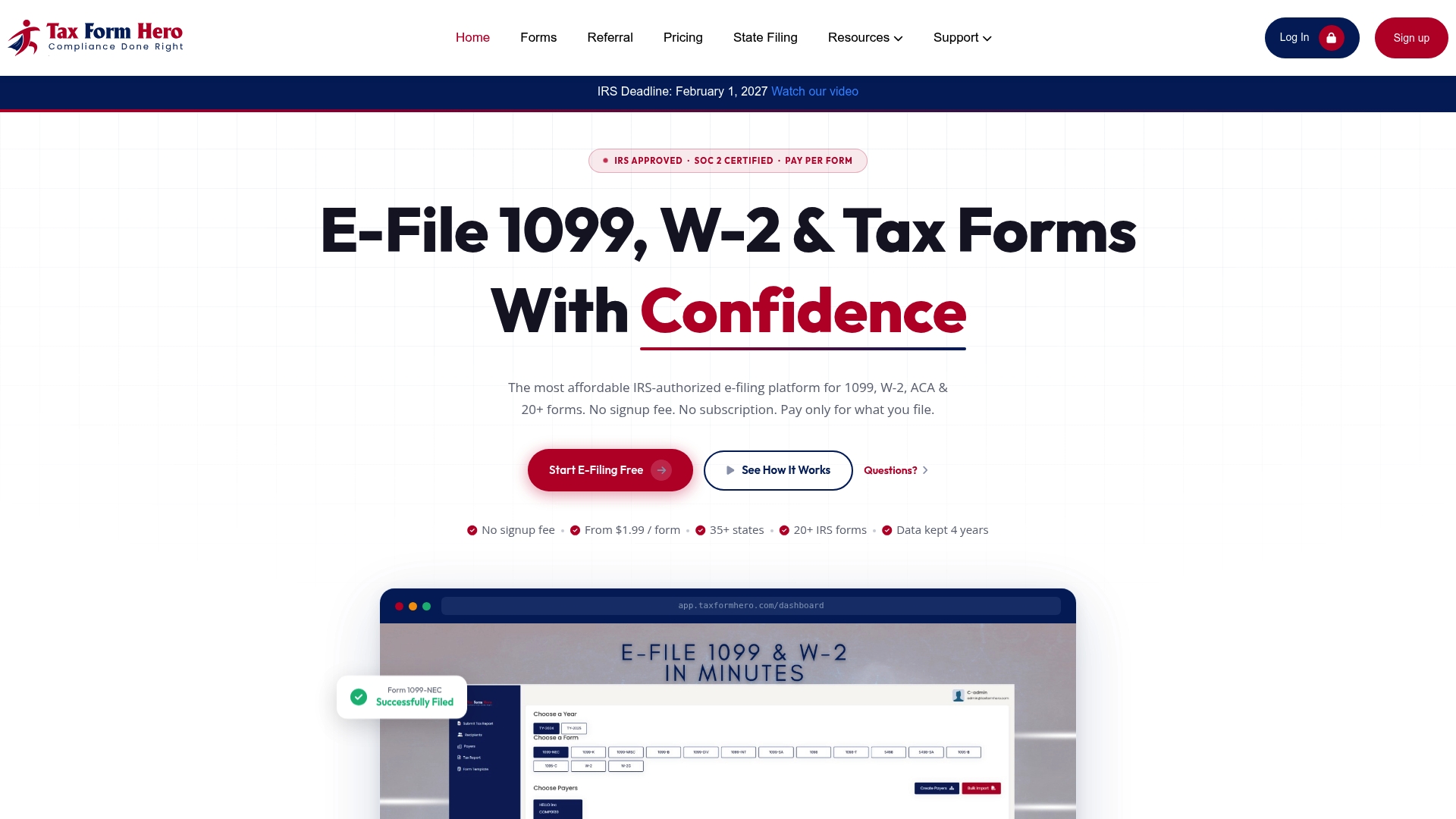
Pricing runs pay-per-form with no subscription or signup fee, and the rate steps down as volume increases, which matters for servicers filing large batches once a year rather than a steady monthly trickle. Bulk import lets you load an entire loan portfolio from an Excel template instead of entering accounts one at a time. Add-ons cover what most compliance teams need anyway: TIN checks at $0.49 per check to catch mismatches before submission, print and mail at $1.69 per form, encrypted e-delivery at $0.19 per form, and state filing at $0.99 per form across 41-plus states plus DC. TaxFormHero also files 1099-NEC and 20-plus other information return types, so the same platform can cover your full filing season rather than just one form. Review current pricing tiers and start a test file before your next filing deadline.
Where to Verify the Rules Yourself
Every rule in this article traces back to a small set of IRS documents, and it’s worth bookmarking all four. The Instructions for Form 1098 cover box-by-box reporting rules and the current-year thresholds. The Form 1098 PDF itself shows the layout, including the scannable Copy A warning. The About Form 1098 page tracks revision history and links to prior-year versions if you need them for an amended filing. Publication 1099 covers e-file thresholds, TCC and IRIS specifications, and general correction procedures that apply across information return types. Check these pages each fall, since box definitions and deadlines get revised almost every year.
Sources
- Instructions for Form 1098 (12/2026) | Internal Revenue Service
- Publication 1099 (General Instructions for Certain Information Returns) | Internal Revenue Service
FAQ
Can You File Form 1098 as Part of Your Tax Return?
Lenders and businesses file Form 1098 with the IRS to report mortgage interest received; borrowers don’t file it themselves. Borrowers instead use the interest amount shown on their Form 1098 to claim the mortgage interest deduction on their own return.
Where Do I Enter Form 1098 on My Tax Return?
Borrowers report the mortgage interest shown in Box 1 of Form 1098 on Schedule A if they itemize deductions, rather than taking the standard deduction. The form itself isn’t attached to the return; the taxpayer just uses the figures it reports.
What Happens if a Lender Forgets to File a Form 1098?
A missed filing should be corrected as soon as it’s discovered by submitting the return late and furnishing the recipient’s copy immediately, since the IRS treats a late-filed information return differently from a correction to an already-filed one. Filing late still carries a penalty risk, so the priority is closing the gap quickly rather than waiting for the next filing season.
How Do Borrowers Claim the Mortgage Interest Deduction Without Their Own Form 1098?
If only one co-borrower received the Form 1098, the other borrowers claim their share of interest on Schedule A and must list the payee who actually received the Form 1098 rather than expecting a separate copy of their own.
Is E-Filing Required for Form 1098?
E-filing becomes mandatory once you have 10 or more information returns in total across all form types, not just Form 1098s on their own, under the aggregation rule in Publication 1099. Most institutional lenders exceed that threshold easily, which makes e-filing the default rather than the exception.