
The federal reporting threshold for Forms 1099-NEC and 1099-MISC increases to $2,000 per payee for payments made in calendar year 2026 and beyond. The change comes from the One Big Beautiful Bill Act (OBBBA) and is confirmed in IRS guidance under IRB 2026-19. The practical result: businesses will file fewer information returns, but the $2,000 figure is measured per payee, per calendar year, which means aggregation and recordkeeping still matter as much as ever.
TL;DR:
- Businesses will need to track cumulative payments to each payee across the calendar year, as exceeding $2,000 now triggers reporting requirements.
- The new threshold applies to payments made on or after January 1, 2026, with the $2,000 figure adjusted for inflation starting after 2026.
- Payments to contractors or vendors under $2,000 in total, even if a single payment exceeds that amount, do not require a 1099 form.
- Proper vendor onboarding, W-9 collection, and real-time threshold tracking are crucial to avoid missing reporting obligations.
- Federal e-filing rules remain unchanged, but small businesses should prepare early for the shift to IRIS and updated recordkeeping practices.
What the 1099-NEC threshold increase to $2,000 means for 2026
Congress raised the bar for information reporting for the first time since the $600 threshold was set in 1954. Under OBBBA, section 6041(a) of the tax code now sets the base reporting threshold at $2,000 for payments made after December 31, 2025. The IRS confirmed the mechanics in IRB 2026-19, which states that the $2,000 threshold applies to Forms 1099-NEC and 1099-MISC for payments made on or after January 1, 2026, and that the amount is measured on a calendar-year basis, not per invoice or per project.
That calendar-year framing matters more than the dollar figure itself. A business that pays a freelance designer $1,200 in March and another $900 in October has crossed the $2,000 mark for the year, even though neither individual payment looks reportable on its own. The IRS instructions reinforce this: cumulative payments to the same payee within the same tax year trigger the filing requirement once the total clears the threshold.
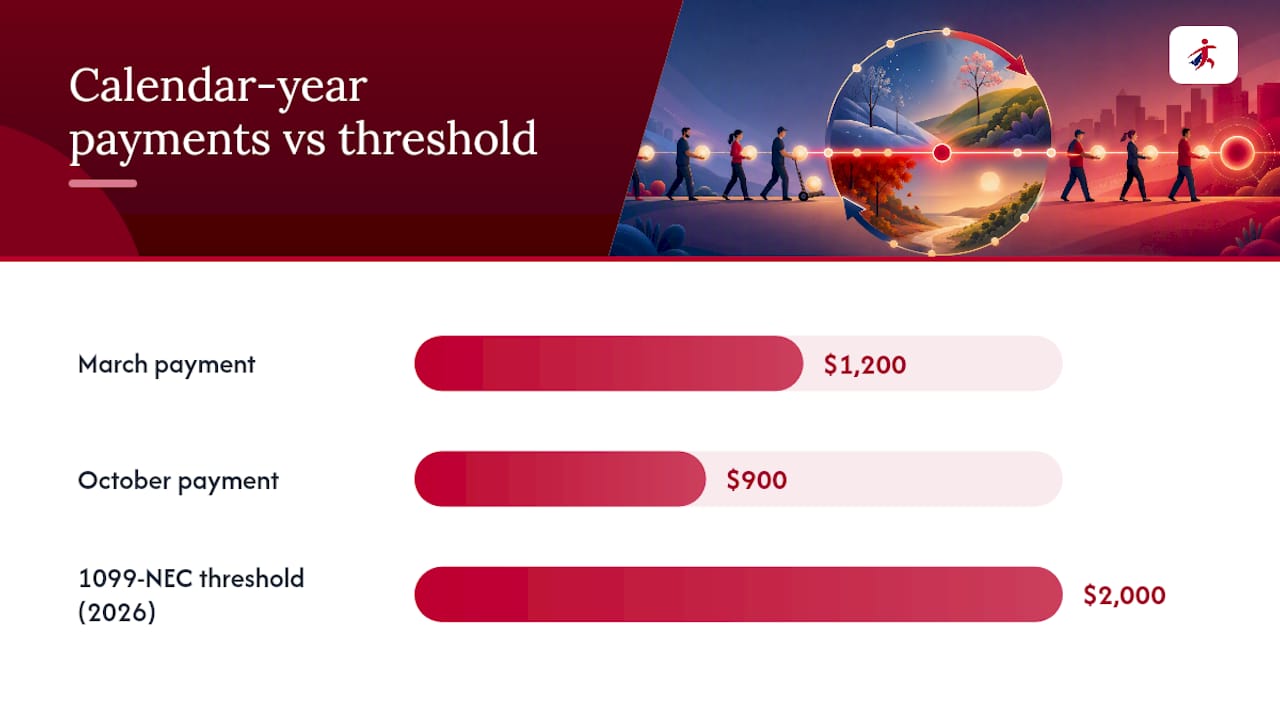
The Instructions for Forms 1099-MISC and 1099-NEC confirm the $2,000 threshold applies to tax years beginning after 2025 and flag related form updates, including revised boxes and address fields tied to the new statutory language. Treasury and the IRS also built in future-proofing: the threshold will be indexed for inflation starting after calendar year 2026, so $2,000 won’t stay fixed forever the way $600 did for seven decades.
Here’s what changed at the statutory level:
- Old threshold: $600 per payee, unchanged since it was set decades ago.
- New threshold: $2,000 per payee for payments made on or after January 1, 2026.
- Legal basis: OBBBA amendment to Internal Revenue Code section 6041(a).
- Inflation indexing: Begins after calendar year 2026, so the number will rise over time.
- Measurement period: Calendar year, aggregated per payee, not per transaction or invoice.
The Federal Register notice on the threshold increase lays out the administrative rationale behind the change. Treasury and the IRS project a substantial drop in the total number of information returns filed each year, along with a meaningful reduction in the monetized compliance burden that small businesses and payroll teams absorb every filing season. That’s the policy story behind the number: fewer low-dollar contractor payments will need a form at all, freeing up staff time for higher-value compliance work.
One nuance worth flagging for anyone reading the proposed regulations directly: their function is mostly to align existing regulatory text with the statute Congress already passed. Practitioners can rely on the $2,000 figure for 2026 filings now, without waiting for final regulations to be published, because the statutory change and the IRS’s own guidance already establish the operative rule.
Filing one yourself? You can e-file Form 1099-NEC online with TaxFormHero, an IRS-authorized e-filing platform.
Which payments still require a 1099-NEC or 1099-MISC?
The trade-or-business test hasn’t changed. If you pay someone $2,000 or more during the calendar year for services performed in the course of your trade or business, and that person isn’t your employee, you generally owe them (and the IRS) a Form 1099-NEC. Payments for rent, prizes, awards, and certain other categories still fall under Form 1099-MISC, subject to the same new $2,000 threshold.
Aggregation is where most compliance mistakes happen. Consider these common scenarios:
- Single large payment. You pay a contractor $2,500 for one project completed in June. That single payment exceeds $2,000, so a 1099-NEC is required.
- Multiple small payments that add up. You pay a bookkeeper $400 per month across the year, totaling $4,800. Even though no single payment crosses $2,000, the calendar-year total does, so reporting is required.
- Payments that stay under the line. You hire a graphic designer for a one-time $1,500 logo project and never use them again that year. No 1099-NEC is required because the annual total stays below $2,000.
- Mid-year threshold crossing. A landscaper invoices you $600 in April and $1,700 in September, for a $2,300 annual total. The obligation to report kicks in once the cumulative total clears $2,000, even though the April payment alone looked exempt.
Backup withholding rules ride along with these thresholds. If a payee refuses to provide a valid Taxpayer Identification Number (TIN) or the IRS notifies you that a TIN doesn’t match its records, you’re required to withhold at the backup withholding rate on future payments, regardless of whether the payment total sits above or below $2,000. The threshold change doesn’t touch backup withholding obligations; it only affects when a form is required for accurate TIN reporting.
Several exceptions remain untouched by the new threshold. Payments to corporations are generally exempt from 1099-NEC reporting (with exceptions for attorney fees and medical payments). Payments made via credit card or third-party payment network are excluded from 1099-NEC or 1099-MISC reporting because they fall under 1099-K rules instead. Merchandise purchases and certain scholarship or fellowship payments also sit outside the scope of these forms.
The safest practice, even with a higher threshold, is to keep collecting Form W-9 from every new vendor before the first payment goes out. You won’t always know in January whether a contractor relationship will cross $2,000 by December, and chasing a W-9 after the fact, especially near a filing deadline, is far harder than collecting it up front. TIN verification at intake also reduces your backup withholding exposure later in the year.
What should your compliance checklist look like for 2026?
Waiting until January to sort out who crossed $2,000 is the single most common mistake payroll and accounts payable teams make every filing season. The fix is a running, per-payee ledger that updates with every payment run, not a year-end scramble through twelve months of invoices.
Start with how your systems track spend. Most accounting software already has a “1099 vendor” flag, but that flag typically triggers reporting per transaction, not per cumulative total. You need your AP or payroll platform to sum payments by payee across the calendar year and alert you the moment a vendor crosses $2,000. If your current software doesn’t do this automatically, a manual tracking spreadsheet, updated after every payment cycle, is a reasonable stopgap for smaller operations.
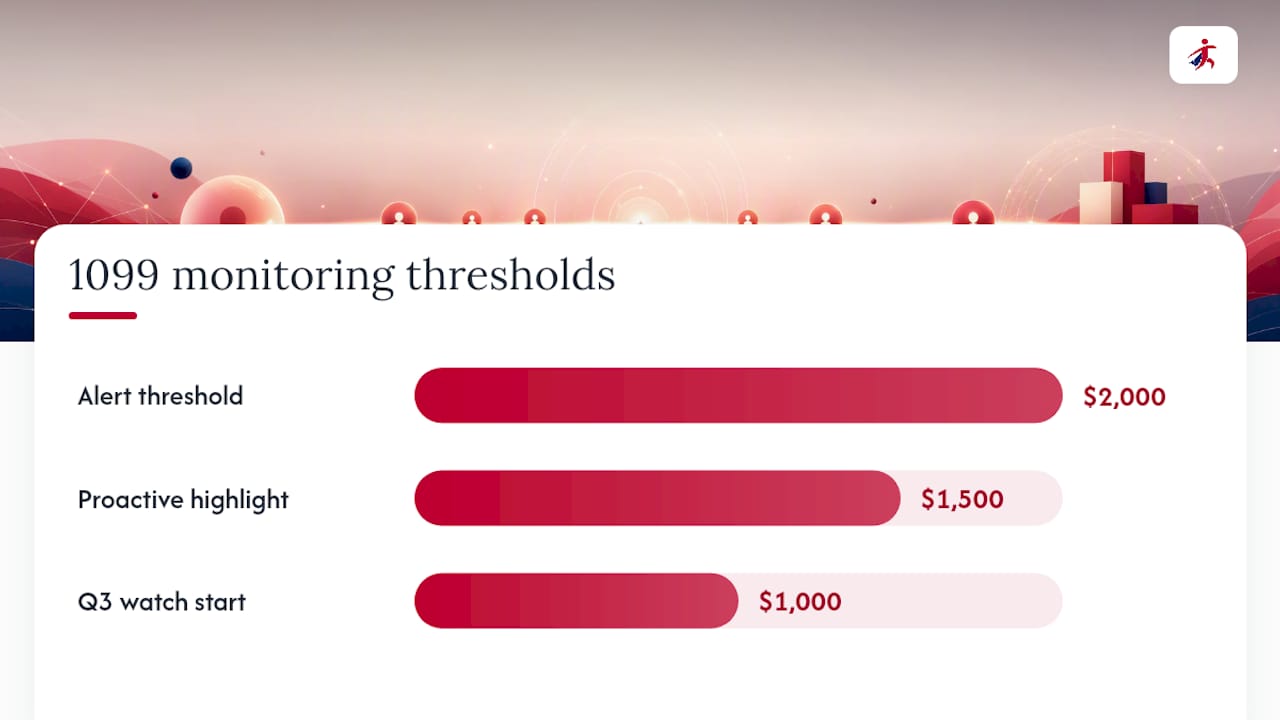
Pro Tip: Build your vendor tracking sheet with a running total column and a conditional highlight at $1,500, not $2,000. That gives you a buffer to request a missing W-9 before the payment that actually triggers the filing requirement goes out the door.
Here’s a practical sequence for the rest of 2026:
- Now through Q2: Audit your vendor master file. Flag every contractor, freelancer, or service provider paid so far this year and check running totals against $2,000.
- W-9 collection cadence: Require a completed W-9 before the first payment to any new vendor, not after. Retroactive collection is the leading cause of missing or incorrect TINs at filing time.
- TIN matching: Run collected TINs through IRS TIN matching or a vendor-provided matching tool before year-end, so mismatches surface while there’s still time to correct them.
- Vendor onboarding update: Add a required field in your onboarding form or AP intake process asking whether the vendor expects to exceed $2,000 in aggregate payments this year.
- Q3 checkpoint: Run a mid-year report of every payee between $1,000 and $2,000. These are the accounts most likely to cross the threshold before December 31.
- Q4 checkpoint: Reconcile final totals against the vendor master file no later than the second week of January, before you start preparing forms.
- Assign ownership: Name one person, whether that’s a bookkeeper, controller, or outside accountant, who owns the year-end 1099 reconciliation process and signs off before forms go out.
Accountants and tax professionals managing multiple clients should build this checklist into a standard year-end engagement letter or checklist template, rather than relying on each client’s internal bookkeeping to catch aggregation issues. Clients who ran under the old $600 threshold for years often assume the new $2,000 line means less recordkeeping is needed. It’s actually the opposite: because fewer, larger payments now trigger reporting, a single overlooked invoice can flip a vendor from “no filing needed” to “reportable” without anyone noticing until the deadline is close.
How do IRIS, FIRE, and e-filing deadlines change for 2026?
The IRS has been transitioning filers from the legacy FIRE (Filing Information Returns Electronically) system to the newer IRIS (Information Returns Intake System) platform, and the threshold change doesn’t alter that migration timeline. If you haven’t applied for IRIS credentials yet, plan ahead: obtaining a Transmitter Control Code (TCC) through the IRIS application typically takes around 45 business days to process, so applying in November or later for a January filing deadline is cutting it close.
The mandatory e-filing rule hasn’t shifted with the new threshold. Businesses filing 10 or more information returns of any type, combined across forms like 1099-NEC, 1099-MISC, and W-2, must file electronically rather than on paper. That aggregate 10-return rule, lowered from 250 in recent years, still applies regardless of how many individual payees you report under the new $2,000 line.
Key filing deadlines to calendar for tax year 2026:
- January 31, 2027: Deadline to furnish Form 1099-NEC to recipients and to file with the IRS, whether on paper or electronically.
- February 28, 2027 (paper) / March 31, 2027 (electronic): Deadlines for Form 1099-MISC, which has different due dates than 1099-NEC.
- Form 8809 caveat: Automatic extensions are largely unavailable for Form 1099-NEC; the IRS grants extensions only in limited hardship circumstances, so don’t count on Form 8809 as a safety net the way you might for other information returns.
Treasury’s own estimates give a sense of scale here. The Federal Register notice projects the higher threshold will eliminate millions of information returns annually and produce a large reduction in the monetized paperwork burden shouldered by small businesses. That’s a meaningful signal about where IRS enforcement attention is likely to shift: with fewer low-dollar forms cluttering the system, examiners can focus more scrutiny on payees who should have crossed $2,000 and didn’t get reported.
Backup withholding mechanics stay the same under the new rule, but the bookkeeping trigger point shifts. If a vendor without a valid TIN crosses $2,000 mid-year, you’re required to begin backup withholding at the statutory rate on subsequent payments and remit those withheld amounts using Form 945. Practically, that means your AP system needs the same real-time threshold monitoring for backup withholding purposes as it does for 1099 filing purposes, since the two obligations now track the identical dollar line.
Do state filing rules match the new federal threshold?
Federal relief doesn’t automatically translate to state relief. States set their own information-reporting thresholds, and many haven’t adjusted, or announced any intent to adjust, their own dollar figures to match the new $2,000 federal line. A business operating in multiple states needs to check each state’s revenue department guidance individually rather than assume the federal change trickles down. The 1099-NEC vs 1099-MISC breakdown is a useful starting point for sorting which form applies before you layer state rules on top.
A few edge cases deserve specific attention because they trip up payors every filing season:
- Form 1099-K threshold: The 1099-K reporting threshold was restored to more than $20,000 in payments and more than 200 transactions for third-party network payments. This is entirely separate from the $2,000 1099-NEC/1099-MISC threshold, and payments made through platforms like payment apps or online marketplaces generally fall under 1099-K rules, not 1099-NEC, even if the dollar amount is far lower.
- Gambling winnings: Reporting thresholds for gambling winnings on Form W-2G follow their own separate rules and are untouched by the OBBBA change.
- Digital asset sales: Broker reporting requirements for digital asset transactions operate under distinct statutory provisions and shouldn’t be confused with the contractor-payment threshold covered here.
- Narrow W-2 exceptions: Household employers and certain small-scale employment arrangements have their own reporting thresholds that don’t move with the 1099-NEC change.
When a payment scenario doesn’t cleanly match any of the categories above, the safer move is checking with your state’s department of revenue or a qualified tax professional before assuming the federal $2,000 line applies universally. Practitioner guidance from firms tracking the OBBBA rollout consistently makes the same point: state rules require their own inventory, and multi-state employers should not treat the federal change as a one-size-fits-all update.
How does an e-file workflow handle the new threshold in practice?
Picture a mid-size accounting firm managing 1099 filings for a dozen small-business clients. Before the threshold change, nearly every contractor payment above $600 needed tracking. Now, with $2,000 as the line, the firm’s actual workload shrinks, but the accuracy bar on the remaining filings goes up, because missing one payee who crossed the new threshold is a bigger relative miss than it used to be.
A typical workflow using an IRS-authorized e-file provider looks like this:
- Export from AP or payroll software. Pull year-end vendor payment totals directly from QuickBooks, Xero, or a payroll system into a CSV file.
- Bulk import. Upload that file into an e-file platform capable of bulk import, rather than entering each payee’s information by hand.
- TIN verification. Run the imported vendor list through built-in TIN matching to catch mismatches before submission, reducing the odds of a backup withholding notice later.
- IRIS-ready transmission. Submit the batch electronically to the IRS through the platform’s IRIS-compliant transmission, satisfying the mandatory e-file rule for filers with 10 or more returns.
- State filing. Route applicable forms to state revenue departments automatically for states with their own filing requirements, rather than filing federally and then separately tracking state obligations.
- Recipient delivery. Send completed forms to payees through encrypted e-delivery or, for recipients who need paper, a print-and-mail add-on.
Pro Tip: If any of your vendors crossed $2,000 mid-year after you’d already assumed they wouldn’t need a form, a bulk-import workflow catches that discrepancy faster than manually re-checking spreadsheets one contractor at a time.
TaxFormHero operates as an IRS-authorized e-file provider built around exactly this kind of workflow. The platform’s IRS authorization and SOC 2-ready data handling give payroll teams and accounting firms a documented compliance trail, which matters when a client or auditor asks how a filing decision was made.
An accountant’s take on what actually matters right now
The panic response to a threshold change like this is to assume you need new software, new processes, and a new filing strategy immediately. You don’t. What you need is better tracking of what you’re already doing.
Most small businesses I’d expect to struggle with this change aren’t going to struggle because the rule is complicated. They’ll struggle because their bookkeeping never aggregated payments by payee in the first place, and now a $2,000 cumulative line exposes that gap in a way a $600 line never quite did, since fewer vendors cleared $600 without anyone noticing.
Weigh the tradeoff honestly. If you have five or six 1099 vendors, a spreadsheet and disciplined W-9 collection will serve you fine. If you’re managing forty or more, particularly across a firm handling several clients, the manual approach breaks down fast, and the marginal cost of an affordable per-form e-file service is trivial next to the risk of a missed filing. Accountants should update client checklists now, not in December, and communicate the new threshold and its aggregation trap clearly, because clients who hear “the threshold went up” often assume that means less work rather than the same tracking discipline applied to a different number.
— Nazrul
Simplify 1099 Filing Under the New $2,000 Threshold With TaxFormHero
TaxFormHero gives you a faster path to compliance than tracking every payee crossing $2,000 by hand across spreadsheets and disconnected software. The platform is IRS-authorized, SOC 2 ready, and built specifically for the workflow described above: bulk import your vendor payment data, run built-in TIN verification to catch mismatches before you file, and transmit electronically without juggling separate state filing logins.
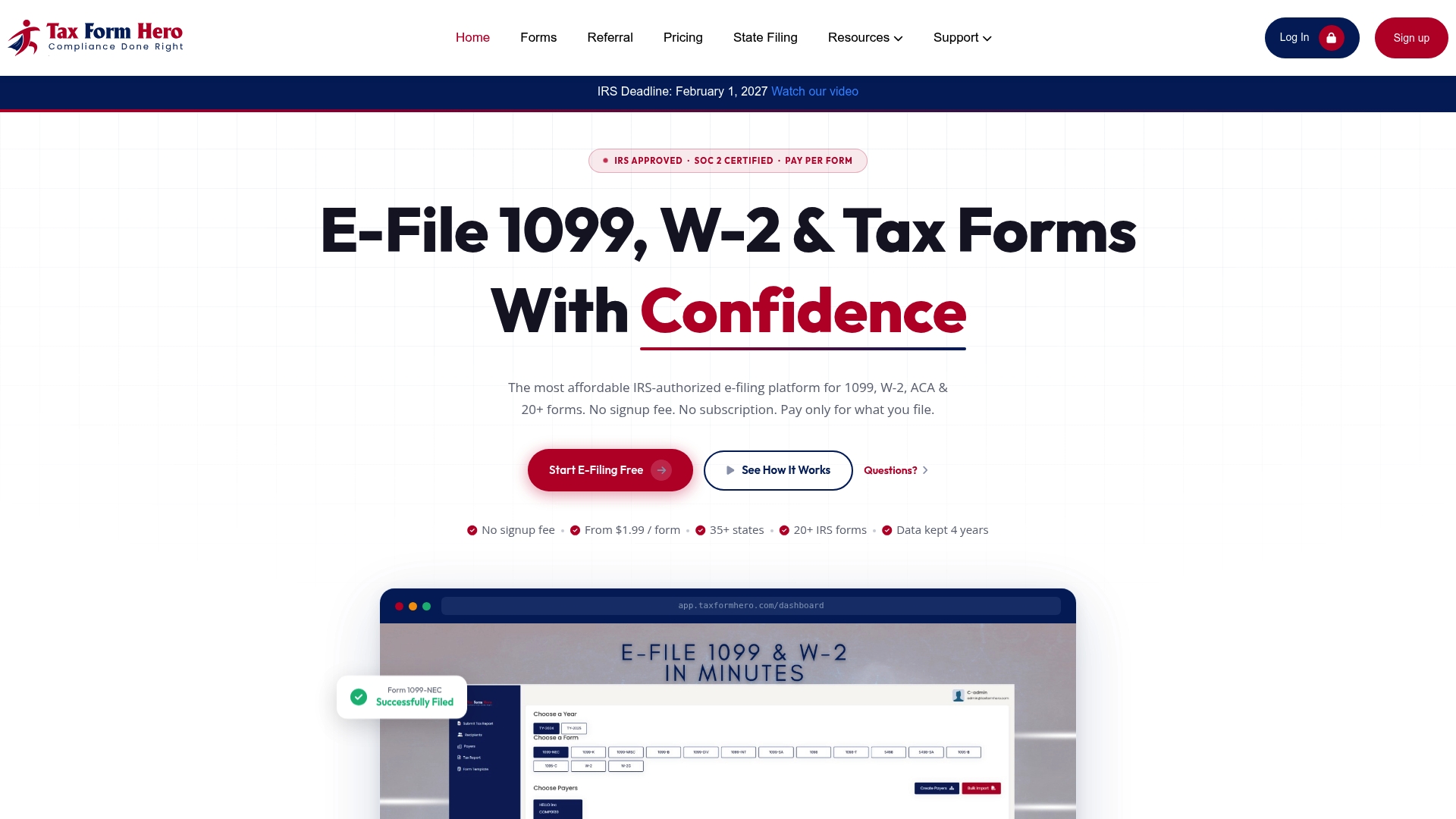
When a contractor you didn’t expect to cross $2,000 does exactly that in November, you need a system that catches it, not one that requires re-entering data by hand under deadline pressure. TaxFormHero’s print and mail and encrypted e-delivery options cover recipients who need paper copies and those who don’t, and direct state filing across 35-plus states removes the guesswork of tracking each state’s own rules separately. Pricing runs per form, starting at $1.99, with no signup fees or subscriptions attached.
Check the pricing page to see per-form rates for your filing volume, and get your vendor list ready to import before your first 2026 filing deadline arrives.
Where to verify the details yourself
The primary sources behind this threshold change are public and worth bookmarking if you handle filings for multiple clients or a growing vendor list.
- IRS IRB 2026-19: the IRS’s own guidance confirming the $2,000 threshold, effective date, and calendar-year measurement rule.
- Instructions for Forms 1099-MISC and 1099-NEC: the operational reference for form changes, boxes, and backup withholding mechanics.
- Federal Register notice on the threshold increase: the statutory and administrative rationale, including Treasury’s burden-reduction estimates.
- Withum’s OBBBA explainer: practitioner-level guidance on W-9 collection and state-level considerations.
- For businesses evaluating outside support beyond filing mechanics, the CDC New England SBA resource covers related small-business policy changes worth tracking alongside this one.
- Review the 1099 filing deadlines for 2026 and the step-by-step e-file guide before your first filing cycle under the new threshold.
This article is general information, not a substitute for advice from a qualified financial advisor. Consult a qualified financial professional about your own circumstances before acting on anything here.
Sources
- IRS IRB 2026-19 (proposed regulations)
- Increase in Threshold for Requiring Information Reporting (Federal Register)
- Instructions for Forms 1099-MISC and 1099-NEC (IRS)
- Big Relief for Small Payments: One Big Beautiful Bill Act (Withum)
Recommended
- E-file 1099-NEC in 2026: Guide for Small Businesses
- 1099 Deadlines 2026: What Small Businesses Must Know
- How to File 1099 Forms: A 2026 Small Business Guide
- The 1099 Compliance Checklist Every Business Needs

File Information Returns With Confidence
TaxFormHero supports 20+ IRS information returns, including 1099 and W-2 forms, with bulk Excel import, name/TIN matching and encrypted recipient delivery.
Explore TaxFormHero