IRS Deadline: February 1, 2027

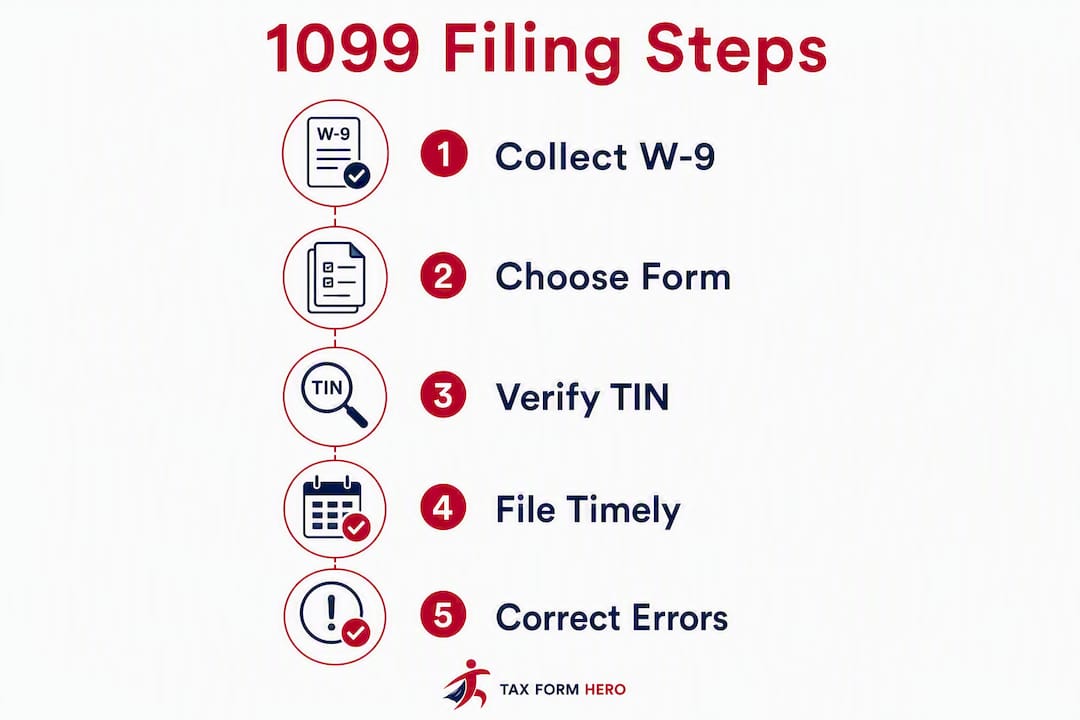
To file 1099s, collect a completed W-9 before the first payment, determine which form applies (1099-NEC or 1099-MISC), and submit Copy A to the IRS by the applicable due date. For payments made in 2026, the federal reporting threshold for nonemployee compensation on Form 1099-NEC increases from lower amounts. Recipient copies must be furnished by January 31. IRS Copy A is due January 31 for 1099-NEC (paper or electronic) and February 28 (paper) or March 31 (electronic) for 1099-MISC.
Start now with these three steps:
- Collect W-9s from every contractor or vendor before the first payment clears.
- Reconcile payments by vendor for the full calendar year and flag anyone who meets the reporting threshold.
- Confirm TINs against IRS records before you file. If a payee has not provided a valid Taxpayer Identification Number (TIN), you may be required to withhold 24% of payments as backup withholding until a correct TIN is received.
Which 1099 form do you actually need?
Choosing the right form is the first decision in the 1099 filing process. Use Form 1099-NEC for nonemployee compensation paid to independent contractors, freelancers, and other self-employed individuals. Use Form 1099-MISC for rents, royalties, prizes, medical payments, and other miscellaneous income that does not qualify as nonemployee compensation.
For payments made on or after January 1, 2026, the federal threshold for 1099-NEC reporting has increased. States such as California and Massachusetts may retain lower thresholds, so always verify your state’s rules separately.
| Form | What it reports | Federal threshold |
|---|---|---|
| 1099-NEC | Nonemployee compensation (contractors, freelancers) | Federal reporting threshold updated for 2026 payments |
| 1099-MISC | Rents, royalties, prizes, medical payments, other misc. | $600 |
| 1099-K | Payment card and third-party network transactions | Varies by year |
| 1099-INT | Interest income | $10 |
| 1099-DIV | Dividends and distributions | $10 |
| 1099-R | Retirement distributions | $10 |
The $2,000 threshold for 1099-NEC applies only at the federal level. Many states have not adopted the change, so a contractor paid $1,200 may still require a state-level 1099 even if no federal form is due.
TaxFormHero is an IRS-authorized e-filing platform, so you can e-file Form 1099-NEC online without paper or a subscription.
Who must receive a 1099?
Most payments to unincorporated individuals and businesses for services trigger a 1099 requirement. The list of common payees includes:
- Independent contractors and freelancers paid amounts meeting or exceeding the federal threshold in 2026.
- Sole proprietors and single-member LLCs paid for services
- Partnerships paid for services (regardless of corporate status)
- Attorneys paid $600 or more, even if incorporated
- Landlords paid $600 or more in rent (if you are in a trade or business)
- Recipients of prizes, awards, or other income meeting the applicable threshold
Common exceptions: Payments to C corporations and S corporations are generally excluded from 1099-NEC reporting. Payments to employees go on Form W-2, not a 1099. Payments for merchandise, freight, storage, or similar items are also excluded.
The employee-versus-contractor distinction matters more than most small business owners realize. Misclassifying an employee as an independent contractor can trigger back taxes, penalties, and interest. The IRS uses a behavioral control, financial control, and relationship-type framework to evaluate classification.
Pro Tip: If you are uncertain whether a worker is an employee or an independent contractor, file IRS Form SS-8 to request a formal determination before issuing either a W-2 or a 1099-NEC. Acting on a formal ruling protects you from misclassification penalties.
What information do you need to collect before filing?
Form W-9 is the primary document that gives you everything needed to complete a 1099 accurately: the payee’s legal name, business classification, address, and TIN (either a Social Security Number or Employer Identification Number). Collect it before the first payment, not at year-end when contractors may be unreachable.

| W-9 field | Why you need it |
|---|---|
| Legal name | Must match IRS records exactly to avoid TIN mismatch |
| Business name / DBA | Identifies the entity receiving payment |
| Federal tax classification | Determines whether a 1099 is required |
| Address | Required for recipient copy delivery |
| TIN (SSN or EIN) | Core identifier for IRS matching |
| Signature and date | Certifies accuracy under penalty of perjury |
Retain completed W-9s for at least four years after the filing date. The IRS can request them during an audit.
TIN matching before you file. The IRS offers a free TIN Matching program through its e-Services portal. Running your vendor list through TIN Matching before submission catches name-TIN mismatches that would otherwise generate IRS CP2100 notices and potential backup withholding obligations. If a payee refuses to provide a TIN or provides one that does not match IRS records, begin backup withholding at 24% immediately and continue until a correct TIN is on file.
Pro Tip: Build W-9 collection into your contractor onboarding checklist as a condition of first payment. Treat a missing W-9 the same way you treat a missing direct-deposit form: payment does not process until the document is received.
What are the filing deadlines and where do you file?
Deadlines differ by form type and filing method. Missing them triggers a tiered penalty structure, so knowing the exact dates is non-negotiable.

| Milestone | 1099-NEC | 1099-MISC |
|---|---|---|
| Furnish recipient copy | January 31 | January 31 |
| IRS paper filing deadline | January 31 | February 28 |
| IRS e-file deadline | January 31 | March 31 |
Form 1099-NEC is due January 31 regardless of filing method, paper or electronic. Form 1099-MISC gives electronic filers an extra month, with a March 31 deadline. When a due date falls on a weekend or federal holiday, the next business day becomes the deadline.
Paper filing vs. electronic filing
Paper filers must attach a Form 1096 transmittal for each group of the same form type. If you file both 1099-NEC and 1099-MISC on paper, you need two separate Form 1096s. Grouping errors cause processing delays and can result in rejected submissions.
Electronic filing is required when you file 10 or more information returns across all form types combined. This threshold counts W-2s and 1099s together, so a business filing six W-2s and five 1099-NECs has already crossed the mandatory e-file line.
IRIS and FIRE: the two IRS e-file systems
The IRS operates two electronic filing systems. The Information Returns Intake System (IRIS) is a free taxpayer portal that accepts manual entry or CSV uploads and returns confirmation notices within approximately 48 hours. IRIS also lets you download payee copies for distribution and file corrections.
To access IRIS, you must obtain a five-digit Transmitter Control Code (TCC). The TCC application can take up to 45 days, so apply well before the filing season. The FIRE (Filing Information Returns Electronically) system is the older transmission channel, used primarily by high-volume filers and software providers connecting via Application-to-Application (A2A).
How do you prepare, file, and furnish 1099s step by step?
The full 1099 filing process runs from payment reconciliation through recipient delivery. Here is the complete sequence.
- Run TIN matching — Submit your vendor TIN list through the IRS TIN Matching program before filing. Resolve any mismatches before transmitting.
Comparing filing methods
- IRS IRIS (free): — No cost, CSV upload accepted, confirmation in roughly 48 hours. Requires a TCC (up to 45 days to obtain). Does not automate state filing or recipient e-delivery.
Pro Tip: If you plan to use IRIS for the first time, apply for your TCC no later than November. A 45-day processing window means a December application may not clear before the January 31 deadline.
How do you correct a 1099 and what are the penalties?
Errors happen. The IRS provides a formal correction process, and using it promptly limits penalty exposure.
To correct a paper 1099, file a new form with the “CORRECTED” box checked at the top. Include a corrected Form 1096. For electronic corrections, IRIS accepts amended returns directly through the portal. Submit corrections as soon as you identify an error; the penalty structure rewards speed.
Penalty tiers for late or incorrect filings
The IRS applies a tiered penalty based on how late the correction or original filing is:
- Within 30 days of the due date: $60 per return
- After 30 days but by August 1: $130 per return
- After August 1 or not filed at all: $330 per return
- Intentional disregard: $680 per return, with no cap
These amounts apply per form, per violation. A business that files 20 incorrect 1099-NECs after August 1 faces up to $6,600 in penalties before any intentional-disregard determination.
Penalty note: The IRS may waive penalties for reasonable cause. A written explanation citing specific circumstances (natural disaster, serious illness, reliance on incorrect IRS guidance) submitted with the return or in response to a notice can reduce or eliminate the penalty. Document everything and respond promptly to any IRS correspondence.
To minimize penalty risk, file on time even if some data is incomplete, then file a corrected return. A timely-but-imperfect filing almost always results in a lower penalty than a late-but-perfect one.
What are the best practices for reducing 1099 filing errors?
The single most effective practice is collecting W-9s before the first payment, not at year-end. Contractors who completed a project in March may be unreachable by December, and a missing TIN forces backup withholding at 24% on all future payments until the situation is resolved.
Contractor onboarding checklist
Add these steps to your new-contractor onboarding process:
- Send a blank W-9 with the contract or engagement letter.
- Require a signed W-9 before releasing the first payment.
- Enter the TIN into your accounting system and flag it for TIN matching before year-end.
- Set a calendar reminder for Q4 to reconcile all vendor payments and identify anyone approaching the reporting threshold.
Beyond onboarding, batching your TIN verification in October or November gives you time to resolve mismatches before the filing window opens. Waiting until January compresses the timeline and increases the risk of filing with bad data.
Tax Form Hero supports this workflow directly. The platform’s TIN verification tool checks your vendor list against IRS records before submission, and its bulk import feature accepts CSV files so you can move from a spreadsheet to filed returns without manual re-entry. State filing for 35+ states, encrypted e-delivery with recipient consent tracking, and 256-bit data encryption are built into the same workflow. For accounting firms and payroll departments managing multiple clients, the pay-per-form model means you pay only for what you file, with no subscription or annual commitment.
Key Takeaways
Filing 1099s correctly requires collecting W-9s before the first payment, selecting the right form, meeting the January 31 recipient deadline, and filing electronically when you have 10 or more information returns.
| Point | Details |
|---|---|
| Collect W-9s at onboarding | Request a signed W-9 before the first payment to avoid missing TINs and backup withholding. |
| Know the 2026 threshold | The federal 1099-NEC threshold rises to $2,000 for 2026 payments; state thresholds may still be $600. |
| January 31 is the key date | Recipient copies and 1099-NEC IRS filings are both due January 31, paper or electronic. |
| E-file is mandatory at 10+ returns | Combining W-2s and 1099s counts toward the 10-return threshold for mandatory electronic filing. |
| Tax Form Hero simplifies the process | Tax Form Hero’s IRS-authorized platform handles bulk import, TIN verification, state filing, and encrypted e-delivery starting at $1.99 per form. |
The case for getting 1099 compliance right from the start
Most small business owners treat 1099 filing as a January scramble. That framing is the root cause of most errors. By the time January arrives, contractors have moved, TINs are missing, and payment records have gaps that take hours to reconcile. The businesses that file cleanly every year are the ones that built compliance into their vendor onboarding process months earlier.
The 2026 federal threshold change to $2,000 for 1099-NEC will reduce the number of federal forms some businesses need to file, but it creates a new compliance trap: assuming that a contractor paid $1,500 requires no reporting at all. State thresholds have not uniformly followed the federal change, and filing nothing when a state form is still required is a penalty-generating mistake. The threshold change simplifies federal compliance for some filers while adding a layer of state-by-state analysis that did not exist before.
Electronic filing through IRIS is genuinely useful for businesses filing a small number of returns and willing to invest the time to obtain a TCC and learn the portal. For businesses managing dozens or hundreds of returns across multiple states, the administrative overhead of IRIS adds up quickly. An IRS-authorized commercial platform that handles state filing, TIN verification, and recipient e-delivery in one submission is not a luxury at that volume; it is the more practical choice.
The penalty structure reinforces this point. At $330 per return after August 1, a modest filing error across 20 returns costs $6,600. The cost of a reliable filing platform is a fraction of a single penalty notice.
Tax Form Hero: IRS-authorized 1099 e-filing without the overhead
Filing 1099s accurately under a January 31 deadline is a real operational pressure, especially when you are managing multiple contractors, multiple states, and a year’s worth of payment data. Tax Form Hero is built for exactly that situation.
The platform is IRS-authorized and SOC 2 certified, with no subscription fees and no annual commitment. You pay per form filed, starting at $1.99, which means a business filing 15 returns pays for 15 returns. Core features map directly to the compliance steps covered in this guide: bulk CSV import for payment data, IRS TIN Matching to catch mismatches before submission, direct state filing for 35+ states, encrypted e-delivery with recipient consent tracking, and print-and-mail service for recipients who require paper copies. Every filed return generates a confirmation receipt you can retain for your records.
To get started, upload your contractor data at Tax Form Hero, select your form type, verify TINs, and submit. No software to install, no subscription to cancel.
Useful sources and official IRS links
- General Instructions for Certain Information Returns (2025) | IRS
- Instructions for Forms 1099-MISC and 1099-NEC | IRS
- Publication 1099, General Instructions for Certain Information Returns | IRS
- E-file information returns with IRIS | IRS
- E-file information returns | IRS
- Am I required to file a Form 1099 or other information return? | IRS
- Reporting payments to independent contractors | IRS
- Tax Form Hero — IRS-authorized 1099 and W-2 e-filing
This article provides general information about U.S. federal and state 1099 filing requirements and is not legal, tax, or accounting advice. Confirm current thresholds, deadlines, and state rules with the IRS, your state tax authority, or a qualified tax professional before filing.