IRS Deadline: February 1, 2027
U.S. Payers: 1099 State Requirements for 2026 and IRIS Playbook

For tax year 2026, the federal reporting threshold for many 1099 payments rose to $2,000, but that change does not settle your state obligations. Several states still require filings below that amount, and some require direct filing regardless of what the IRS collects. Check each recipient’s state rules now, before you build your 2026 filing calendar.
TL;DR:
- Many states still require 1099 filings below the federal $2,000 threshold, making it essential to verify each state’s specific rules before filing.
- States can have different triggers such as withholding, work location, or residency, which may require filings regardless of the federal payment amount.
- For 2026, only 1099-NEC and 1099-MISC thresholds increased to $2,000, while 1099-K and interest or dividend forms follow separate rules.
- Ensure your payee data includes state of residence, work location, and withholding information to avoid misfiling or penalties in multiple states.
- Confirm participation, format, and deadlines with each state’s revenue department annually, as state filing rules change independently from federal updates.
What 1099 State Requirements Look Like for 2026
The federal threshold jump is real, but it only governs your obligation to the IRS. State departments of revenue set their own rules, and many have not matched the new federal number. That gap is the entire story of 1099 compliance for 2026: one federal form, potentially different filing triggers in every state where you have a payee.
Payroll teams and accounting firms who treat the $2,000 threshold as a blanket rule risk under filing in states that never adopted it. The safest posture is to assume a state filing obligation exists until you confirm otherwise with that state’s Department of Revenue. That single habit prevents most of the penalty exposure discussed later in this guide.
If you would rather not do this on paper, e-file Form 1099-NEC online with TaxFormHero instead.
Exactly What Changed at the Federal Level for 2026
The One Big Beautiful Bill Act (OBBBA) raised the federal reporting threshold for Forms 1099-NEC and 1099-MISC to $2,000, up from the long-standing $600 floor. The new threshold applies to payments made during calendar year 2026, meaning it governs the forms you file in early 2027.
The change affects a specific set of forms and payment types, not every information return you file. Here’s what moved and what didn’t:
- 1099-NEC and 1099-MISC: the reporting trigger is now $2,000 in aggregate payments per recipient for the calendar year.
- 1099-K: this form follows its own separate federal rule, restored to $20,000 and 200 transactions in applicable years, and is not tied to the OBBBA $2,000 change.
- Interest, dividends, and other information returns: thresholds for these forms remain governed by their own existing statutory rules and did not shift under OBBBA.
- Withholding-related forms: any form tied to back up withholding or state withholding still triggers a filing obligation regardless of the payment total.
Starting in 2027, the $2,000 threshold will be adjusted for inflation, so the number you use this year will not necessarily hold next year. Build that expectation into your compliance calendar rather than assuming $2,000 is a fixed line for future tax years. Payroll teams tracking multiple vendor categories should also confirm which form applies to each payment type; the differences between 1099-NEC and 1099-MISC matter more than ever now that the thresholds have diverged.
Why States Still Matter Even After the Federal Threshold Rose
States fall into a handful of predictable patterns, and knowing which pattern a state follows tells you almost everything about your filing exposure there. Some states automatically conform to federal thresholds by statute. Others set their own floor and ignore federal changes entirely. A third group requires direct filing outside any federal forwarding arrangement, and a small number don’t require 1099 filing at all because they have no personal income tax.
That last category matters more than it sounds. States without an income tax, such as Texas, Florida, and Washington, generally have no 1099 filing requirement at the state level, which simplifies your obligation there considerably. Everywhere else, you need to know which of the other three patterns applies.
The two triggers that override any threshold conversation are withholding and sourcing:
- State withholding: if you withheld any state income tax from a payment, most states require a filing regardless of the payment amount.
- Income sourced to that state: payment for work physically performed in a state, or income sourced there under that state’s rules, can create a filing obligation even for a nonresident recipient.
- Recipient residency: a contractor’s home state often expects a copy of the 1099 even when the work was performed elsewhere, depending on that state’s sourcing rules.
- Registered business presence: if your business is registered or has nexus in a state, that state may require filings for any payee connected to that operation.
None of these triggers care about the federal $2,000 threshold. A $700 payment to a contractor with $50 in state tax withheld can create a state filing obligation in a state that would otherwise have no interest in that payment at all.
The practical fix is to build payee tracking that captures state of residence and state of service delivery at onboarding, not at year-end scramble time. A 5-step state filing checklist built around this data collection saves far more time in January than any last-minute cleanup effort. When you collect a completed Form W-9, capture the address field and cross-reference it against where the work was actually performed. Those two data points, tracked consistently across your vendor file, answer most state filing questions before you ever open a state’s tax code.

Representative State Examples for 2026
These examples illustrate common patterns. State rules change, so confirm current guidance directly with each state’s Department of Revenue before filing.
Several states have historically retained filing thresholds well below the new federal $2,000 mark, and nothing in the OBBBA change compels states to match it:
- Massachusetts has generally required reporting on payments that fall well under the federal threshold, making it a state where the $600 mindset never really went away.
- Vermont applies its own lower filing trigger independent of federal changes, which surprises payers who assume a single national standard.
- Oregon has maintained state-specific filing requirements that do not automatically track federal threshold adjustments.
- New Jersey has historically used a $1,000 threshold for certain 1099 reporting, well under the new federal number.
- Rhode Island has applied an especially low historical threshold, in the range of $100, for particular reporting scenarios, making it one of the strictest examples of state divergence.
Direct-filing requirements add another layer. Some states expect you to submit files directly through a state portal even when you also participate in the IRS’s forwarding program, particularly when your return includes state withholding data or forms outside the standard CF/SF form list. If you withheld state income tax anywhere, treat that state as a direct-filing state until its Department of Revenue guidance says otherwise.
The lesson from these examples isn’t that five specific states are the only ones to worry about. It’s that state conformity to federal thresholds is the exception, not the rule, for lower-volume 1099 filers. A business paying contractors in fifteen states should expect at least a handful of those states to require filings the federal government would now consider unnecessary. Treat every state on your payee map as a possible outlier and confirm rather than assume, because state guidance updates on its own timeline and rarely announces changes with the same visibility as a federal law change.
How the Combined Federal/State Filing Program Actually Works
The Combined Federal/State Filing (CF/SF) program lets the IRS forward qualifying information returns to participating states on your behalf, but the mechanics matter more than the concept. The IRS acts strictly as a forwarding agent: it forwards exactly the data you submitted, and nothing more. If your file is missing a required state box or a state-specific field, that gap travels with the forwarded data and the state may never register the filing as complete.
This is where good-faith federal filers get caught. Three pitfalls account for most of the missed state filings TaxFormHero sees discussed in payroll forums and DOR notices:
- Missing state identification boxes. Forms 1099-NEC and 1099-MISC include state information boxes (generally Boxes 16 through 18) that must be populated correctly for CF/SF forwarding to register with the destination state. Leave them blank and the state has nothing to match against your return.
- State-specific data elements the federal form doesn’t ask for. Some states want an account number, a state ID number, or a specific withholding breakdown that a standard federal submission doesn’t include by default.
- Corrections that never reach the state. A federal correction filed through CF/SF does not always trigger a corresponding state-level correction. If the error affects a state’s data, you may need to file that correction directly with the state, separate from your federal correction.
Before you rely on CF/SF for any state, confirm that state currently participates and verify the technical specifications in IRS Publication 1220, which lists participating states and the exact data format each expects. Participation lists change from year to year, and a state that accepted forwarded data last season isn’t guaranteed to do so again.
Pro Tip: Run a test file through your e-filing platform’s validation check before the real submission, and specifically confirm that every payee record with state withholding has a populated state ID and box 16 amount. That single check catches the majority of CF/SF forwarding failures before they become a state notice six months later.
Deadlines, Formats, and E-Filing Rules to Calendar Now
Federal deadlines for 1099-NEC generally require recipient copies and IRS filing by January 31, while other 1099 forms often carry a February or March e-filing deadline depending on form type. The instructions for Forms 1099-MISC and 1099-NEC lay out the exact due dates by form and filing method, and those dates differ enough between forms that a single “1099 deadline” mental model will trip you up.
State deadlines follow two broad patterns:
- CF/SF participating states generally align their due dates with the federal e-filing deadline, since they’re relying on the IRS to forward the data on the federal timeline.
- Direct-filing states frequently set their own deadlines, independent of the federal calendar, and some require submission before the federal date to give the state processing time.
Format requirements vary just as much. Most states now mandate electronic filing above a certain volume threshold, and several have dropped paper filing entirely regardless of volume. A handful still accept paper for very small filers, but that exception is shrinking every year as state revenue departments modernize their intake systems.
Practical scheduling points to lock in now:
- Calendar the federal recipient furnish date and the federal e-file date separately. They are not the same date for every form.
- For every direct-filing state on your payee map, check that state’s specific due date rather than assuming it matches the federal calendar.
- Confirm whether your filing volume crosses that state’s electronic filing mandate threshold, since crossing it without switching formats can trigger a format-based penalty on top of any late-filing penalty.
- Reconfirm state deadlines annually. States adjust these dates more often than most filers expect, and a due date that held for three years can shift with little notice.
Practical 8-Step Compliance Checklist for 2026 State 1099 Filing
Run this sequence once per filing season, and refine it as your vendor file grows:
- Onboard with state data captured. Record each payee’s state of residence and where the work was physically performed at the point of contract, not at year-end.
- Collect and validate Form W-9 early. Confirm the TIN matches the name on file and run TIN matching before you build your filing batch, not after you’ve already submitted.
- Segment recipients by state and form type. Group your payee file by destination state, then apply that state’s specific threshold and withholding rules to each group.
- Decide CF/SF versus direct filing per state. For every state that participates in CF/SF, confirm you’re populating the required state boxes; for every direct-filing state, prepare a separate state-specific data file.
- Complete IRIS transmitter readiness if filing electronically. Apply for your IRIS Transmitter Control Code (TCC) well ahead of season and complete assurance testing before your first production submission.
- Confirm each state’s portal and format specs. Some states require a specific file format or a separate state login distinct from the federal IRIS system.
- Retain records on the correct schedule. Keep copies and supporting documentation for at least three years, longer for specific record types under IRS guidance.
- Run an end-to-end test and document the trail. File a test batch, confirm acceptance status for both federal and state components, and keep a written record of what was submitted, when, and to which state.
Pro Tip: Treat step 5 as a separate project with its own deadline, not a task you fold into January’s filing crunch. IRIS TCC processing can take weeks, and you don’t want your transmitter credential still pending when your filing window opens.
Getting IRIS Ready Before Filing Season Opens
The IRS has moved information-return intake to IRIS, and FIRE is being phased out as the legacy system. That transition means every transmitter, whether an in-house payroll team or a third-party filer, needs a current IRIS Transmitter Control Code before submitting production files.
The administrative path involves setting up an e-Services account, designating a Responsible Official, and submitting the TCC application itself.
Allow up to 45 days for TCC application processing, and plan for additional time to complete IRIS Assurance Testing (ATS) before your first production submission.
That testing step isn’t optional paperwork. IRIS ATS confirms your submission format is accepted before you risk a production file bouncing back mid filing season, which matters even more for CF/SF forwarding, since a rejected federal file never reaches the states waiting on that forwarded data.
There are IRS-authorized e-filing platforms that transmit federal returns to the IRS over IRIS A2A rather than relying on manual upload workarounds. A few operational points matter if you’re evaluating whether a platform can carry your 2026 state filing load:
Some e-filing platforms offer IRS-authorized transmission for multiple form types, SOC 2 Type I attestation, bulk Excel import for high-volume vendor files, encrypted recipient delivery by email with optional USPS first-class mail, and pay-per-form pricing with an optional state filing add-on.
Whether you build IRIS readiness in-house or route it through an authorized platform, the underlying requirement doesn’t change: get your TCC, complete testing, and confirm state participation before your first submission of the season.
Penalties, Retention Rules, and Correcting State Filing Errors
State penalty structures generally mirror the federal per-return penalty model but stack independently. A missed federal filing carries its own penalty tier based on how late the correction arrives, and a missed state filing in a state that requires direct submission carries a separate penalty exposure on top of that. Filing on paper when a state mandates electronic filing can also trigger a distinct format-based penalty, layered on any late-filing penalty already assessed.
Record retention follows a fairly consistent baseline: the IRS instructions for Forms 1099-MISC and 1099-NEC point to a general three-year retention window for information return records, though certain supporting documentation carries a four-year retention expectation. States generally don’t shorten that window, so the federal baseline is a safe floor to build your retention policy around.
Corrections require you to think about federal and state as two separate workflows:
- Federal-only errors (a dollar amount typo with no state component) get corrected through your standard federal correction process.
- State-affected errors (wrong state withholding amount, wrong state ID) may need a direct correction filed with that state, since CF/SF forwarding does not reliably carry corrections the way it carries original filings.
- CF/SF forwarding gaps should be reconciled by confirming with the state directly that the original filing was received, rather than assuming forwarding succeeded because your federal filing was accepted.
Treat every correction as two potential tasks, not one, until you’ve confirmed the state side doesn’t need separate action.
State-By-State 1099 Filing Snapshot for 2026
State requirements shift often enough that any static list carries an expiration date. The categories below give you a framework for organizing your own state-by-state file, which you should verify against each state’s Department of Revenue before filing.
| State category | Typical 2026 pattern | What to verify |
|---|---|---|
| No income tax states (e.g., Texas, Florida, Washington) | Generally no state 1099 filing requirement | Confirm no exceptions for specific withholding scenarios |
| Federal-threshold conformity states | Filing trigger matches the new $2,000 federal threshold | Confirm the state has formally adopted OBBBA’s threshold |
| Lower statutory floor states (e.g., New Jersey, Rhode Island) | Filing required below $2,000, sometimes well below $1,000 | Confirm current dollar threshold for the specific form |
| Direct-filing states | State portal submission required regardless of CF/SF participation | Confirm file format and state-specific due date |
| Withholding-trigger states | Filing required whenever state tax was withheld, regardless of amount | Confirm withholding reporting fields required on the form |
Build your master vendor file with a column for each of these categories, populated at onboarding rather than reconstructed at year-end. A payer with contractors in twelve states should expect to see all five categories represented somewhere in that file, which is precisely why a one-size-fits-all threshold assumption fails so often in a multi-state filing operation.
How State Rule Differences Play Out for Multi-State Filers
A staffing firm paying contractors in California, New Jersey, and Texas illustrates the problem cleanly. The Texas contractor needs no state filing at all, since Texas has no income tax. The New Jersey contractor may need a state filing at a threshold historically set at $1,000, well under the new federal $2,000 mark, meaning a $1,500 payment triggers a state filing obligation even though it falls under the federal reporting requirement. The California contractor’s filing depends on whether any state withholding applied, independent of the payment total.
Run that same scenario across fifty payees in eight states, and the federal $2,000 threshold becomes almost a side issue. The real workload is tracking which of those eight states requires direct filing, which will accept CF/SF forwarding, and which have their own lower dollar trigger that has nothing to do with what the IRS now considers reportable.
This is the core operational reality of multi-state 1099 filing: your federal obligation and your combined state obligations are two different compliance problems that happen to share the same underlying payment data. A payer who files correctly at the federal level can still generate a stack of state notices six months later if even two or three states on that vendor map required direct filing and never received it. The fix isn’t more paperwork per se, it’s structuring your vendor data so state, threshold, and withholding status are visible at a glance rather than reconstructed form by form during filing season.
Reconciling Federal and State 1099 Filings Without Discrepancies
Discrepancies between your federal and state filings usually trace back to one of three causes: a state box left blank on a CF/SF submission, a dollar amount that was corrected federally but not updated with the state, or a payee classified under the wrong state due to an outdated address on file.
Build reconciliation into your process rather than treating it as a year-end audit task. Before you submit your federal batch, run a comparison between your payee state field and your CF/SF-eligible state list, flagging any payee in a direct-filing state for separate handling. After submission, confirm acceptance status for both the federal filing and, where applicable, the forwarded state data, rather than assuming federal acceptance guarantees the state received a usable record.
A few habits keep the two filings aligned:
- Use one payee record as the single source of truth for state, address, and withholding data, rather than separate spreadsheets for federal and state filings that can drift out of sync.
- Reconcile your total 1099 dollar amounts against your accounts payable ledger by state before filing, not after a state notice arrives asking why the numbers don’t match.
- When you file a federal correction, immediately check whether that payee is in a direct-filing state and file the matching state correction the same week, rather than assuming it will happen automatically.
Reconciliation is cheapest when it happens before submission. It gets considerably more expensive once a state has issued a notice based on incomplete or mismatched data.
Filing 1099s for Nonresident Contractors and Withholding Scenarios
Nonresident contractors complicate state 1099 filing because two states can plausibly claim an interest in the same payment: the contractor’s state of residence and the state where the work was performed. Sourcing rules vary by state, but the general pattern is that income earned for services performed within a state can be subject to that state’s filing and withholding requirements, even for a contractor who lives elsewhere.
If you withheld any state income tax from a nonresident contractor’s payment, treat that as an automatic direct-filing trigger for the withholding state, independent of the federal $2,000 threshold and independent of whether that state normally requires filing at low payment amounts. Withholding creates its own reporting obligation that doesn’t disappear just because the underlying payment fell under the federal reporting floor.
Practical handling for nonresident and cross-state vendor files:
- Capture both “state of residence” and “state where services were performed” as separate fields on every contractor record, since they can differ and both can matter.
- Flag any payee with state withholding applied for direct-filing review, regardless of that state’s general dollar threshold.
- When a contractor works across multiple states within the same tax year, confirm whether each state’s sourcing rule requires an allocated filing based on where the work occurred.
- Don’t assume a single 1099-NEC filed federally satisfies every state with a plausible claim to that payment; each state’s requirement stands on its own until you’ve confirmed otherwise.
What Else Changed for State 1099 Filing Beyond the Threshold
The $2,000 federal threshold change gets most of the attention this filing season, but it isn’t the only shift worth tracking. States adjust their own forms, portal requirements, and electronic filing mandates on their own schedules, often with far less public notice than a federal law change receives.
Several states have expanded electronic filing mandates in recent years, lowering the volume threshold at which paper filing is no longer accepted. A state that allowed paper filing for small batches two years ago may require electronic submission for any volume now, and that shift can arrive with a single line in a state notice rather than broad news coverage.
Some states have also updated their own state-specific form requirements or added new data fields to their direct-filing specifications, independent of anything happening at the federal level. A state ID number field that wasn’t required last year, or a new withholding reconciliation form tied to your 1099 submission, can appear on a state’s website without any corresponding federal announcement.
The practical response is the same one that runs through this entire guide: check each relevant state’s current guidance before you file, rather than filing on last year’s assumptions. Federal law changes make headlines. State-level formatting and threshold updates usually don’t, and they’re just as capable of generating a penalty notice if you miss them.
Author’s Perspective: How I’d Approach 2026 Filing Season
The safest operating posture for 2026 is to assume a state filing obligation exists until you’ve confirmed otherwise. The federal threshold jump to $2,000 makes it tempting to file less, but state rules didn’t move in lockstep, and the payers who get burned this season will be the ones who applied the federal number everywhere.
Move your IRIS and TCC work earlier on the calendar than feels necessary. A 45-day processing window sounds generous until you’re staring at a January deadline with a pending application. Test your transmissions before you need them to work.
If your volume swings from a handful of contractors to several hundred depending on the season, a pay-per-form filing model scales more sensibly than a flat platform fee built for your busiest month.
— Nazrul
File 2026 State 1099s Without the Guesswork
TaxFormHero handles the exact workflow this guide just walked through: federal transmission over IRIS A2A, a state filing add-on for states that require it, and bulk Excel import so you’re not retyping a vendor list state by state.
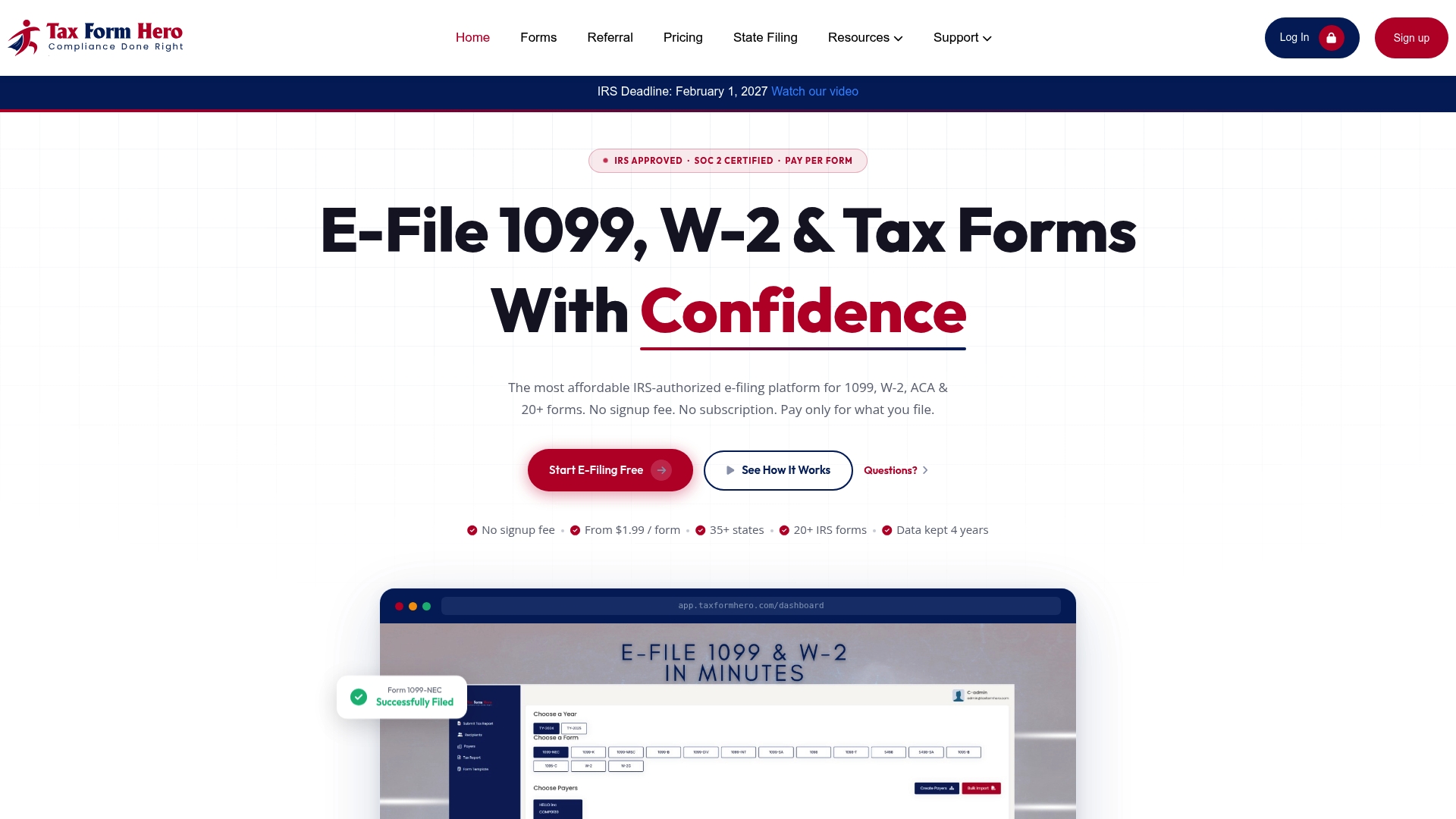
The platform’s pay-per-form structure fits the multi-state reality described above. The first 150 forms run $1.99 each, and the rate steps down as volume grows, so a firm filing for three contractors and a firm filing for three hundred both pay for what they actually submit. State filing runs $0.99 per form as an add-on, and Combined Federal/State Filing states are included at no extra charge when you’re already filing federally through the platform. TIN matching at $0.49 per check catches name and number mismatches before they become a rejected submission mid-season, and encrypted e-delivery or print and mail covers recipient copies without a separate vendor.
Start by filing your Form 1099-NEC online and add state filing for any payee in a direct-filing state or one you flagged for withholding. There’s no subscription and no signup fee, so the only cost tied to your 2026 filing season is the forms you actually submit.
Sources
State thresholds and CF/SF participation change often enough that this guide should be a starting point, not your final check. Confirm the specifics against these sources before you submit:
Beyond these federal resources, check the Department of Revenue website for every state where you have a payee. State guidance is the only authoritative source for that state’s current threshold, format requirements, and deadline, and it updates independently of anything the IRS publishes.
This article is general information, not a substitute for advice from a qualified financial advisor. Consult a qualified financial professional about your own circumstances before acting on anything here.
FAQ
What Are the New 1099 Rules for 2026?
The main change is the federal reporting threshold increase to $2,000 for Forms 1099-NEC and 1099-MISC, up from $600, effective for payments made during 2026. States haven’t uniformly adopted this change, so many still require filings at lower dollar amounts or under different triggers like withholding.
What Is the 1099 Threshold Limit for 2026?
The federal threshold for 2026 is $2,000 in aggregate payments to a recipient for covered 1099-NEC and 1099-MISC reporting. Some states retain lower thresholds, so the applicable limit depends on both federal rules and the specific state where the payee resides or performed the work.
How Much Can You Pay Someone in 2026 Without Issuing a 1099?
At the federal level, payments under $2,000 to a nonemployee generally fall below the federal 1099-NEC filing requirement for 2026. That said, state rules can require filing at lower amounts, and any state withholding applied to a payment can trigger a filing regardless of the total dollar amount.
Do I Have to File a 1099 if I Paid Less Than $20,000?
The $20,000 figure applies specifically to Form 1099-K reporting for third-party payment transactions, not to 1099-NEC or 1099-MISC. Form 1099-K uses its own separate threshold, restored to $20,000 and 200 transactions, and is unrelated to the $2,000 threshold that now applies to nonemployee compensation reporting.
Does TaxFormHero File State 1099s?
TaxFormHero offers a state filing add-on for $0.99 per form, covering many states plus the District of Columbia, with Combined Federal/State Filing states included at no additional cost. That makes it possible to handle both federal and state submissions from the same platform for most multi-state payee files.