
Yes, you can e-file every form in the 1099 series through the IRS IRIS system, and if you file 10 or more information returns in a year, you’re required to. The first move is practical, not procedural: apply for a Transmitter Control Code, since nothing in IRIS works without one. Once that’s in hand, you choose between the Taxpayer Portal for manual or CSV filing and Application to Application for automated bulk transmission.
TL;DR:
- Businesses filing fewer than 10 returns annually generally benefit from using the Taxpayer Portal for no-code manual entry or CSV uploads, while high-volume filers should consider A2A integrations after testing.
- The IRS frequently updates supported forms, so it is essential to consult Publication 5717 to confirm current requirements and avoid mismatched or incomplete filings.
- Applying for a Transmitter Control Code early—preferably in October—can prevent processing delays that may cause missed deadlines or penalties during busy filing seasons.
- Common rejection causes include incorrect TINs, CSV formatting errors, and selecting the wrong tax year, which can be mitigated through TIN verification and pre-submit checklists.
- For businesses with complex volume or limited internal resources, outsourcing to an authorized platform like TaxFormHero streamlines filings, TIN verification, and recipient copy distribution at predictable costs.
What Is the IRS IRIS 1099 Guide Process, and Which Channel Fits Your Business?
IRIS, short for the Information Returns Intake System, is the IRS platform built to replace much of the legacy FIRE system for filing 1099 series returns electronically. It gives filers two distinct ways in: the Taxpayer Portal, a browser-based interface for manual entry or CSV upload, and Application to Application (A2A), a machine-to-machine XML transmission method built for high-volume filers with development resources.
Choosing between them comes down to volume and technical capacity, not preference. A payroll department filing 40 1099-NEC forms a year has no reason to build an API integration. A software vendor or a firm processing thousands of returns across multiple clients has every reason to.
- Taxpayer Portal works well for businesses filing anywhere from a handful up to a few thousand returns, especially when someone on staff can handle spreadsheet formatting.
- A2A suits transmitters, payroll platforms, and accounting firms that need to push large batches automatically, often on behalf of many clients at once.
- The portal requires no coding and no testing cycle beyond your own data checks, while A2A requires schema mapping and formal testing through the Assurance Testing System.
- Both channels sit behind the same requirement: an active TCC tied to your business.
The portal’s advantage is speed to first filing. You can register, get authorized, and submit returns within the same season without writing a single line of code. A2A’s advantage is throughput once it’s built. The trade-off is upfront engineering time, which rarely pays off for a business filing under a few hundred returns annually. For most small and mid-sized filers, the portal is the sensible starting point, even if A2A becomes worthwhile as volume grows.
Need to get this filed? You can e-file Form 1099-NEC online with TaxFormHero, which is IRS-authorized and charges per form, not per month.
Which 1099 Forms and Related Returns Does IRIS Support?
IRIS accepts the core forms that make up the bulk of information return filing for most businesses:
- 1099-NEC (nonemployee compensation)
- 1099-MISC (miscellaneous income)
- 1099-INT (interest income)
- 1099-DIV (dividends and distributions)
- 1099-K (payment card and third-party network transactions)
- 1099-R (retirement distributions)
- 1099-S (proceeds from real estate transactions)
That list covers the forms accounting teams handle most often, but it isn’t exhaustive, and it isn’t fixed year to year. The IRS adds and adjusts supported forms periodically, so the authoritative, current list always lives in Publication 5717, the IRIS Taxpayer Portal User Guide. Treat that publication as the reference to check each filing season rather than relying on last year’s memory of what IRIS accepted.
One practical distinction worth flagging: 1099-K reporting involves payment settlement entities and third-party networks, which means the data often comes from a different internal system than your vendor payment records. If your accounting team pulls 1099-NEC data from accounts payable and 1099-K data from a merchant processor, reconcile those two data sources separately before uploading. Mixing them into one CSV template increases the odds of a field mismatch.
For form-specific mechanics, TaxFormHero’s walkthroughs on filing 1099-INT and filing 1099-R go deeper into box-level requirements than this overview can.
Quick fact: Businesses that file 10 or more information returns in aggregate, counting every return type together including W-2s, are required to e-file rather than submit paper, a threshold that took effect for the 2023 tax year and still applies now.
How Do You Get Access: EIN, TCC, and Realistic Lead Times
Before you touch the IRIS interface, you need two things in place: an Employer Identification Number and an active Transmitter Control Code. Most established businesses already have an EIN. If yours doesn’t, apply through the IRS before starting the TCC process, since the application requires it.
The TCC is the identifier that ties every return you file to your legal entity. You must apply for an IRIS TCC before the system will let you transmit anything, and the application asks you to select a role.
- Issuer — you’re filing returns for your own business only.
- Transmitter — you’re filing on behalf of other businesses, common for accounting firms and payroll providers.
- Software Developer — you’re building software that other filers will use to transmit through A2A.
Pick the role that matches what you’re actually doing. A firm filing for multiple clients should register as a Transmitter, not repeat the Issuer application for every client, since that creates unnecessary duplication in the IRS system.
Lead time is where most filers get caught off guard. The IRS advises that TCC processing can take up to 45 days, and that window doesn’t shrink just because your filing deadline is approaching. A mismatched TCC and EIN combination is a frequent cause of authorization failures, which means even a straightforward application can bounce back for correction and cost you another cycle of waiting.
Pro Tip: Apply for your TCC in October or early November, well before the January filing rush. If you’re filing on behalf of multiple entities, confirm which entity’s EIN you’re registering under before you submit, since a correction request can add weeks you don’t have in mid-January.
Once your TCC is active, you can check its status and manage it directly through your IRIS account. Keep a record of your TCC number somewhere your accounting team can access quickly. Losing track of it during a staff transition is a small problem that becomes a large one when a deadline is two weeks out.
Taxpayer Portal or A2A: Which Filing Method Actually Fits Your Workflow
The two IRIS channels solve different problems, and picking the wrong one wastes time either way.
The Taxpayer Portal is the direct, no-cost option most businesses will use. It supports manual entry for a small number of returns and CSV upload for larger batches, using a template the IRS provides. It also handles the parts of filing that happen after submission: downloading payee copies, filing corrections, and requesting automatic extensions when you need more time.
- Free to use, with no software purchase or developer involvement required.
- Built-in error alerts flag common problems before you submit, which cuts down on post-filing corrections compared with paper filing.
- Manual entry works fine for a few dozen returns; CSV upload is the practical choice once you’re past that.
- Confirmation of receipt often comes back quickly, which gives your team a clear record for compliance files.
A2A is built for scale and automation. It uses an XML schema defined in Publication 5718, transmitted through a dedicated API using a Client ID issued separately from your TCC. Before you can send live production data, you’re required to run test files through the Assurance Testing System described in Publication 5719.
- Requires a developer or an integration partner to build and maintain the connection.
- Handles bulk volume without manual intervention once it’s running correctly.
- Testing is mandatory, not optional. The IRS won’t accept live A2A transmissions from an untested connection.
- Error handling happens at the batch level, so a schema mistake can affect many returns at once rather than one.
The trade-off is straightforward. The portal trades automation for simplicity and zero build cost. A2A trades a testing and development burden for speed at scale. If your business files under a thousand returns a year and doesn’t have in-house development capacity, the portal wins on practicality almost every time. If you’re a transmitter processing tens of thousands of returns across clients, the upfront A2A investment usually pays for itself within a season or two.
A Step-by-Step Walkthrough for Filing 1099s in the IRIS Taxpayer Portal
Once your TCC is active, the actual filing session in the Taxpayer Portal follows a predictable sequence. Here’s how it works in practice.
- Sign in and select the tax year and form type. The portal organizes filings by year, so double-check you’re in the correct year before entering anything, especially if you’re filing corrections for a prior year alongside current-year originals.
- Choose manual entry or CSV upload. Manual entry works for a handful of returns. For anything beyond that, download the CSV template the portal provides and use it exactly as formatted.
- Prepare your CSV carefully. Every TIN needs to match IRS records exactly, EINs need the correct format, and dollar amounts belong in the right boxes for the specific form type. A single misplaced decimal or transposed digit in a TIN is enough to trigger a rejection.
- Run the portal’s built-in validation before final submission. The system flags formatting issues and missing required fields, and it’s worth pausing to fix every flag rather than pushing through a warning you don’t understand.
- Submit and retrieve your confirmation. IRS newsroom guidance notes that portal confirmations often come back in as little as 48 hours, which gives you a fast, documented record for your compliance file.
- Download payee copies for distribution. The portal generates the recipient-facing copies you need to deliver to payees, separate from what gets transmitted to the IRS.
- File corrections through the portal if you catch an error afterward. IRIS supports corrections directly, so you don’t need a separate paper process for a fix.
- Request an automatic extension if you need more time. The portal handles extension requests without a separate paper form.
A few things worth flagging before you start. If you’ve ever generated a Copy A from a home printer for paper filing, know that the IRS explicitly states self-printed Copy A is not scannable and shouldn’t be used for official paper submission. That’s one more reason electronic filing through IRIS is the cleaner path.
Pro Tip: Run a small test batch, five or ten returns, through the portal before you upload your full file. Catching a template formatting issue on ten records is a five-minute fix. Catching it on eight hundred records after a rejection is an afternoon lost.
Quick fact: The portal’s error-checking design matters more than it sounds. IRS commentary on the system notes that built-in alerts reduce the rework businesses previously faced with paper filing, particularly for smaller filers without dedicated compliance staff.
For businesses filing 1099-MISC specifically, TaxFormHero’s comparison of portal filing versus vendor-assisted filing walks through the decision in more detail.
A2A for Technical Teams: What Building an Integration Actually Requires
A2A is a developer project, not a form-filling task, and treating it otherwise is how integrations stall in production.
The setup starts with an API Client ID, issued separately from your TCC and specific to A2A transmission. Your development team then builds against the XML schema package detailed in Publication 5718, which defines the structure every submission file must follow. Before touching the live production endpoint, you’re required to run submissions through the test environment covered in Publication 5719’s Assurance Testing System, and the IRS won’t authorize live transmission until your test files pass.
- File size limits apply to A2A submissions, so very large batches may need to be split across multiple transmissions rather than sent as one file.
- XML formatting has to match the schema exactly. A missing required element or an out-of-sequence field is a common cause of rejected test files.
- Typical developer tasks include schema mapping from your internal data structure, building the authentication flow for the API, and writing validation logic that catches errors before submission rather than after.
- A good practice here is maintaining a separate sandbox data set that mirrors production edge cases, zero-dollar amounts, missing optional fields, unusual entity types, so schema mapping problems surface during testing instead of during a live filing window.
If your team doesn’t have the bandwidth to own this build, partnering with an integrator or licensing existing filing software is often the more realistic path than building from scratch. A2A rewards scale. For a business without dedicated development resources, the Taxpayer Portal will get returns filed correctly with far less overhead.
Common IRIS Errors and a Pre-Submit Checklist That Actually Prevents Rejections
Most IRIS rejections trace back to a small handful of repeat offenders, and nearly all of them are catchable before you hit submit.
The top causes of rejection:
- TINs that don’t match IRS records, often from a transposed digit or an outdated name-to-TIN pairing.
- CSV formatting errors, like extra columns, wrong date formats, or amounts entered as text instead of numbers.
- Incorrect tax year selected at the start of the session, which can misfile an otherwise correct return.
- For A2A, schema validation failures from a missing required XML element or a field out of sequence.
Before you submit, run through this checklist:
- Verify TINs against IRS records or a TIN-matching service rather than trusting what’s in your vendor file.
- Reconcile totals between your internal accounting records and the amounts entered on each return.
- Confirm the correct tax year and form type are selected before uploading.
- For A2A filers, run a test submission through the ATS environment and resolve every flagged error before attempting a live transmission.
- Double-check filenames and schema formatting match what the portal or API expects.
If a submission does get rejected, read the specific error message the portal or API returns rather than resubmitting blindly. Most rejections point to the exact field causing the problem. Fix that field, rerun your internal validation, and resubmit. If you get a rejection you can’t diagnose, or the portal itself seems to be behaving unexpectedly, that’s the point to contact IRS e-help support rather than burning another submission attempt guessing at the fix.
Pro Tip: Build a simple pre-submit checklist into your team’s filing routine, even a shared document with five bullet points, and require someone to initial it before every batch goes out. The businesses with the fewest corrections aren’t the ones with the fanciest software. They’re the ones with a repeatable process. TaxFormHero’s 1099 compliance checklist is a useful model if you’re building your own internal version.
1099 Deadlines, the E-File Threshold, and What Happens After You Submit
The e-file requirement is the rule that trips up more businesses than any deadline confusion does. If you file 10 or more information returns in a calendar year, counting every return type together, including W-2s alongside your 1099s, you’re required to file electronically rather than on paper. That threshold has applied since the 2023 tax year, and it catches businesses that assume the old, higher paper-filing limits still apply. Filing paper returns when you’re required to e-file can result in penalties, separate from any late-filing penalty.
On processing timing: once you submit through the Taxpayer Portal, confirmations often come back in around 48 hours, a meaningful improvement over the multi-week uncertainty many filers experienced with legacy paper submissions. That speed is worth building into your internal deadlines. If your recipient copies are due by the January 31 deadline, allow sufficient time before that date to submit through IRIS in case of rejections. Give yourself buffer for a possible rejection and resubmission cycle, not just the confirmation window.

On extensions and waivers: the portal supports automatic extension requests directly, so if you need more time to file, you can request it without a separate paper process. Waivers from the e-file requirement itself are available in limited circumstances, generally tied to demonstrated hardship, and the request process runs through the IRS rather than through IRIS itself. Don’t assume a waiver is easy to get. It’s designed as an exception, not a routine opt-out.
On penalties: late or incorrect filing penalties scale with how late the correction comes and whether the failure appears to be intentional disregard of the rules. The safest posture is treating your internal deadline as the confirmation date, not the submission date, since a rejected submission that you don’t catch and fix in time is functionally a missed deadline.
Small businesses newly crossing the 10-return threshold should read TaxFormHero’s guide to e-filing 1099-NEC for a walkthrough tailored to first-time e-filers.
Where to Find the Official IRIS Specifications and Updates
Four IRS publications cover essentially everything a filer or developer needs to reference, and it’s worth bookmarking each rather than relying on secondhand summaries.
- Publication 5717 — the Taxpayer Portal User Guide, your primary reference for manual entry and CSV upload procedures.
- Publication 5718 — the A2A specifications, covering the XML schema your development team builds against.
- Publication 5719 — the test package and Assurance Testing System requirements for A2A filers, both available through the IRIS technical resource summary.
- Publication 1099 / General Instructions for Certain Information Returns — the consolidated reference for deadlines, form-specific instructions, and the e-file threshold rules.
Consult Pub. 5717 for anything portal-related, Pub. 5718 and 5719 together for any A2A build or test question, and Publication 1099 whenever a deadline or general filing rule needs verification. These four documents are updated as IRS rules change, which makes them a more reliable source than any third-party summary, including this one.
Meet the Author: Why This IRS IRIS 1099 Guide Comes From Real Filing Experience
This guide was written by Nazrul, whose work focuses on translating IRS electronic filing procedures, IRIS included, into step-by-step guidance accounting teams can actually follow during filing season. That work means staying current with IRS publication updates and tracking how IRIS requirements shift year over year, rather than relying on guidance that goes stale after one filing cycle.
This guide is supported by a platform built specifically for the compliance work IRIS filers need done, featuring bulk import for teams filing across multiple entities, TIN verification to catch mismatches before submission, direct state filing in many states, and encrypted e-delivery for recipient copies.
If your team has developer resources and the volume to justify an A2A build, the IRIS portal or A2A directly may be all you need. If you’re managing filings across multiple clients, need print and mail handled without building that logistics chain yourself, or simply want TIN verification built into the process rather than bolted on afterward, a platform designed around those exact tasks shortens the path considerably.
What to Do When You Need to Correct a 1099 After It’s Already Filed
IRIS supports corrections directly through the same portal you used for the original filing, but the process differs depending on what actually went wrong. A dollar amount typo requires a different correction code than a wrong TIN, and the portal walks you through selecting the right type when you initiate a correction.
Timing matters more than most filers expect. The sooner you catch an error, the simpler the fix. A correction filed within days of the original submission rarely draws scrutiny. One filed months later, especially after a recipient has already used the original figures on their own tax return, can create downstream headaches for both sides.
If you discover the error came from bad source data, a vendor’s incorrect TIN, for instance, fix the source record in your accounting system before filing the correction, not just the correction itself. Otherwise, you risk repeating the same error next filing season.
Multiple corrections on the same return are handled sequentially in IRIS, each treated as its own submission. If you’re correcting a batch of returns rather than a single one, resist the urge to bundle unrelated fixes into one correction file. Keep the correction scoped to what actually needs fixing, and verify each corrected return generates its own confirmation.
Recipients need corrected copies too. The portal’s payee copy generation applies to corrections the same way it does to originals, so don’t assume the recipient already knows about a fix just because you resubmitted to the IRS. Send the corrected copy directly, and keep a dated record of when you sent it in case a discrepancy surfaces later.
Keeping IRIS Filings Secure: What to Know About Data Protection
IRIS handles sensitive taxpayer data, TINs, dollar amounts, and personal information tied to real people, which means your obligations don’t end once a return transmits successfully.
Access control is the first layer. Limit who on your team has TCC credentials and portal login access to the people who genuinely need it for filing. A payroll clerk who only needs to review filed returns doesn’t need submission-level access. Fewer credentialed users means a smaller surface area if something goes wrong.
Data in transit and at rest matters just as much as data in transmission. Whatever system you use to build your CSV files or stage data before upload, whether that’s a spreadsheet, a payroll export, or an accounting platform, should itself be access-controlled and, ideally, encrypted. A perfectly secure IRIS submission doesn’t help if the CSV sitting on a shared drive beforehand is open to anyone in the office.
For A2A filers, the API connection itself needs standard security discipline: authenticated endpoints, credentials that aren’t hardcoded into scripts, and logging that lets you trace who initiated a given transmission. Since A2A submissions happen at batch scale, a compromised credential could expose far more data than a single manual portal error would.
Vendor and third-party risk deserves a look too. If you use a software platform or a transmitter to file on your behalf, ask directly about their data handling practices, encryption standards, and whether they carry relevant compliance certifications. You’re ultimately accountable for the data even when someone else is transmitting it.
Recordkeeping After You File: What to Keep and For How Long
Filing successfully through IRIS doesn’t close the file. The IRS can request supporting documentation well after a filing season ends, and having organized records ready saves real time if that happens.
Keep confirmation records for every batch you submit, including the date, the confirmation number, and the specific returns included. This is your primary proof that you filed on time, which matters if a penalty notice ever arrives that you believe is in error.
Retain the source data behind each filing, not just the final submitted file. If a TIN or dollar amount is ever questioned, you’ll want to trace it back to the original vendor record or payroll entry that generated it, not just the CSV you uploaded.
A general rule of thumb among tax professionals is to retain information return records for at least four years, aligned with the IRS’s typical statute of limitations window for most compliance questions, though certain situations can extend that further. Check with a tax advisor if your business has unusual circumstances, like amended prior-year filings, that might call for longer retention.
Store corrections alongside originals, not as separate, disconnected records. When you pull up a return later, you want the full history, original filing, any corrections, and each confirmation, in one place rather than scattered across different folders or systems.
Digital storage with regular backups is the practical standard here. A filing cabinet full of paper confirmations is harder to search and easier to lose than an organized digital archive with proper access controls.
A Practitioner’s Take on Rolling Out IRIS Without the Usual Headaches
The businesses that struggle with IRIS almost never struggle with the system itself. They struggle with timing and data hygiene they could have fixed weeks earlier. A late TCC application is the most common self-inflicted problem, followed closely by teams still thinking in FIRE-era habits, assuming paper is still an option when the 10-return threshold has already pulled them into mandatory e-filing.
The fix isn’t complicated, even if it requires discipline. Apply for your TCC well before filing season opens. If you’re weighing A2A, run your test files through the ATS environment early enough that a schema problem doesn’t become a January crisis. Run TIN verification on your vendor and recipient data before it ever touches a CSV template.
None of this needs to be sophisticated. A short internal runbook, three or four steps your team follows the same way every year, does more to prevent errors than any software feature. Track what went wrong this season, fix it in the runbook, and next year’s filing gets a little cleaner. That compounding improvement is the real advantage experienced filers have over first-timers.
— Nazrul
Skip the Portal Build: Let TaxFormHero Handle Your 1099 Filings
Filing through IRIS directly works well for teams with the time to manage TCC applications, CSV formatting, and correction workflows in-house. For businesses that would rather hand off that entire process, TaxFormHero offers a faster route to the same compliance outcome.
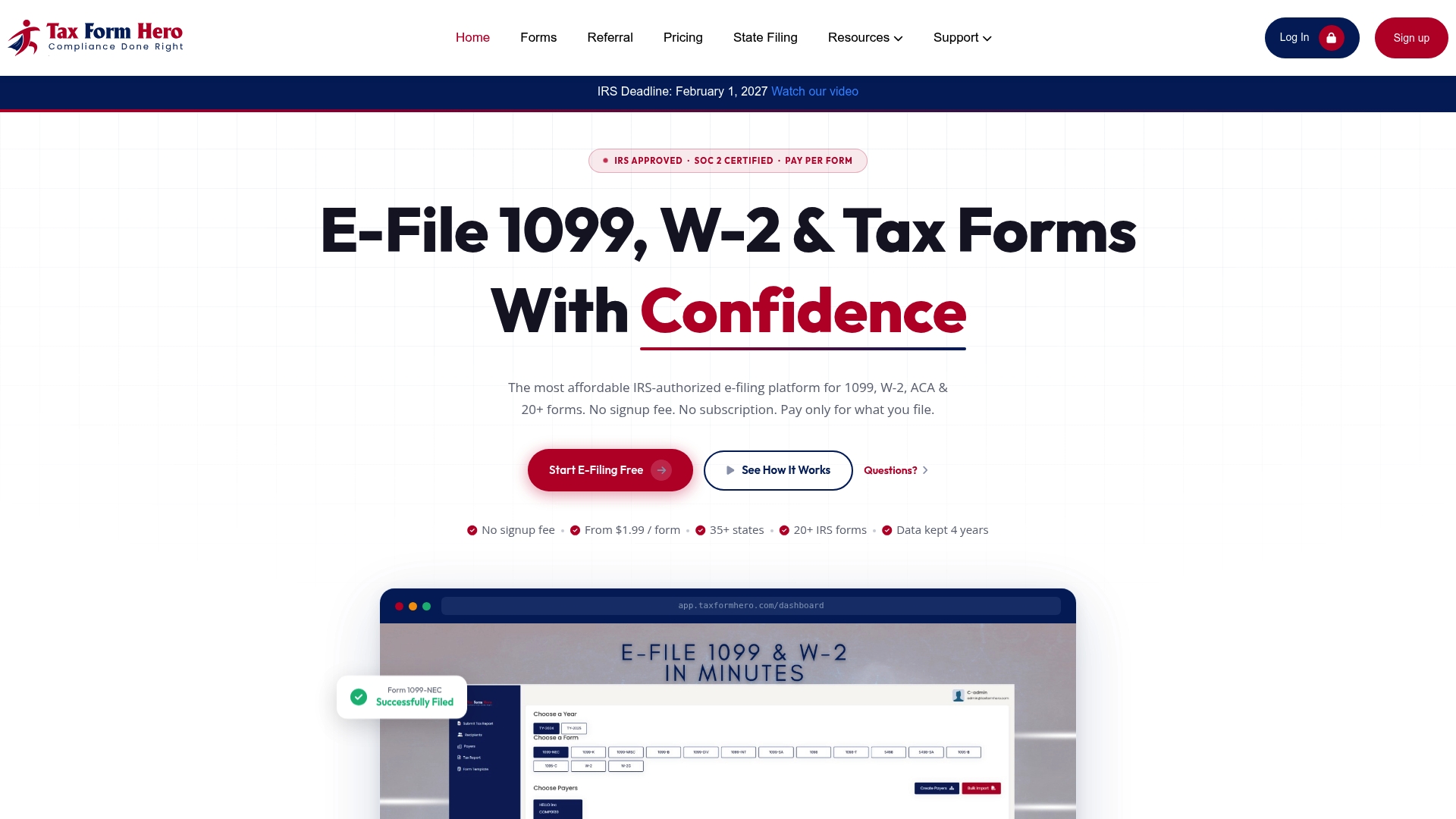
TaxFormHero is an IRS-authorized e-filing platform built around exactly the workflow this guide describes, minus the setup burden. Bulk import handles high-volume filing without a CSV template headache, TIN verification catches mismatches before they become rejections, and direct state filing covers more than 35 states without a separate submission process. Print and mail and encrypted e-delivery take recipient copy distribution off your plate entirely.
This approach fits teams without in-house developer resources for an A2A build, businesses that need TIN matching handled automatically rather than manually, and any accounting team facing a filing deadline with more urgency than bandwidth. Pricing runs per form starting at $1.99, with no signup fees or subscriptions, so you pay only for what you file. Visit TaxFormHero to start your 1099 filing and see the per-form pricing before your next deadline.
This article is general information, not a substitute for advice from a qualified financial advisor. Consult a qualified financial professional about your own circumstances before acting on anything here.
Sources
FAQ
How Do I E-File a 1099 Using IRIS?
Apply for a Transmitter Control Code first, then sign into the IRIS Taxpayer Portal to enter returns manually or upload a CSV, or build an A2A connection if you’re filing at high volume with developer support.
What Are the New 1099 Filing Rules to Know for 2026?
The e-file mandate for filers with 10 or more information returns, aggregated across all return types, remains in effect, and IRIS continues to be the IRS’s primary electronic filing platform for the 1099 series alongside its established portal and A2A channels.
What Are the Most Common 1099 Mistakes to Avoid?
Mismatched or incorrect TINs, CSV formatting errors, and selecting the wrong tax year during submission cause most IRIS rejections; running TIN verification and a small test batch before your full filing catches nearly all of them.
What Do IRS Guidelines Require for Filing a 1099 Form?
Businesses filing 10 or more information returns must e-file rather than submit paper, and self-printed Copy A forms are explicitly not valid for official paper filing, which makes electronic filing through IRIS the more reliable compliance path for most filers.
Recommended
- Avoid $680 per Form: 1099-NEC Deadline, IRIS TCC Steps for Payers
- Avoid 1099 Rejections: 8 Compliance Checks for U.S. E Filing Software
- Avoid Missed 1099s: Small Businesses and the $2,000 1099-NEC Threshold
- E-file 1099-NEC in 2026: Guide for Small Businesses

File Information Returns With Confidence
TaxFormHero supports 20+ IRS information returns, including 1099 and W-2 forms, with bulk Excel import, name/TIN matching and encrypted recipient delivery.
Explore TaxFormHero