
You can e-file Form 1099-R right now through the IRS Information Returns Intake System (IRIS) if you already hold a Transmitter Control Code, or through an IRS-authorized e-file provider that transmits on your behalf without requiring a TCC at all. Either path satisfies the IRS requirement, but the right one depends on your volume, your timeline, and whether you want to build the file yourself.
Before you touch a keyboard, work through this sequence:
- Gather payer and recipient TINs, along with distribution amounts and codes for every return.
- Confirm whether the 10-or-more information returns rule applies to your business this year.
- Choose your route: direct IRIS transmission or a pay-per-form authorized provider.
- Run TIN matching or use your platform’s built-in validation before submission.
- Submit ahead of the deadline and keep the IRS acknowledgement on file.
Pro Tip: If you’re transmitting directly to IRIS, apply for your TCC up to 45 days before filing season opens. If that timeline feels tight, an authorized pay-per-form provider gets you filing the same day, no TCC application required.
Key Takeaways
Filing Form 1099-R electronically requires accurate payer and recipient data, correct box codes, and either a Transmitter Control Code for direct IRIS access or an authorized provider that files on your behalf.
| Point | Details |
|---|---|
| Know the $10 threshold | Any distribution of $10 or more from a pension, annuity, IRA, or similar account requires a 1099-R. |
| Check the aggregate e-file rule | Filing 10 or more information returns across all form types in 2026 makes electronic filing mandatory. |
| Plan TCC timing early | A Transmitter Control Code application for direct IRIS access can take up to 45 days to process. |
| Never truncate TINs on IRS copies | Truncation is allowed on recipient statements but strictly prohibited on the version filed with the IRS. |
| Consider a pay-per-form provider | Tax Form Hero offers quick onboarding, bulk import, TIN verification, and transparent per-form pricing with no TCC required. |
If you would rather not do this on paper, e-file Form 1099-R online with TaxFormHero instead.
What Does Form 1099-R E-File Cover, and Who Must File It?
Form 1099-R reports distributions from pensions, annuities, retirement plans, profit-sharing plans, IRAs, insurance contracts, and similar arrangements. Any payer who distributes $10 or more from one of these accounts during the tax year has to issue a 1099-R, according to the 2026 Instructions for Forms 1099-R and 5498. That threshold is low by design. It catches everything from a full pension payout to a modest annuity disbursement, and it means far more small businesses and plan administrators fall under this requirement than most people assume.
The obligation lands on the payer, not the recipient. That typically means employers running qualified retirement plans, third-party plan administrators, insurance companies issuing annuity payments, and trustees overseeing IRA distributions. If your business writes the check, you’re the one filing the form.
A few scenarios trip up even experienced preparers:
- Rollovers. A direct rollover from a 401(k) to an IRA still gets reported on a 1099-R, even though it isn’t taxable. The IRS needs the paper trail to confirm the money moved correctly, and a reporting gap here can get flagged as an unexplained taxable distribution.
- Qualified Charitable Distributions (QCDs). When an IRA owner age 70½ or older directs funds straight to a qualified charity, that distribution can carry code Y, which the 2026 instructions note is optional for identifying QCDs on the form.
- Recharacterizations and Roth conversions. These carry their own distribution codes and withholding rules, and getting the code wrong can misclassify an entire transaction with the IRS.
Retirement distributions come with layered withholding and reporting rules, and even a tax-free rollover has to be documented precisely, since a coding error can cause the IRS to treat it as a taxable event it was never meant to be.
Before you file anything, get familiar with the box structure: Box 1 (gross distribution), Box 2a (taxable amount), Box 4 (federal income tax withheld), and Box 7 (distribution code). These four fields carry the weight of the return, and an e-file platform’s validation logic lives or dies on whether it catches mismatches among them.
When Are 1099-R Deadlines, and Who Has to E-File?
Recipient statements for 1099-R are due by January 31, and the IRS filing deadline for electronic submissions is February 28 (paper filers face the same February 28 cutoff, since 1099-R doesn’t get the extended March 31 e-file date some other forms receive). Mark your calendar accordingly, because the confusion around this date costs preparers more than it should.
Two scheduling quirks catch people off guard every year. First, if February 28 lands on a weekend or legal holiday, the deadline shifts to the next business day. Second, and this trips up even veteran filers, a leap year does not push the deadline to February 29. The IRS instructions are explicit on this point, and treating a leap year as a grace period is a mistake that generates real penalty exposure.

The e-file requirement itself is now broader than most business owners realize. As of tax year 2023, any filer submitting 10 or more information returns in aggregate, across all form types combined, must file electronically. That means if you issue six 1099-Rs and four W-2s, you’ve crossed the threshold and paper filing is no longer an option. This aggregate counting rule is the single most common source of accidental noncompliance among small and mid-sized filers.
Here’s how to work through the e-file decision:
- Total every information return your business files this year, across all form types, not just 1099-R.
- If that total hits 10 or more, electronic filing is mandatory, not optional.
- Decide whether you’ll transmit directly through IRIS or route through an authorized provider.
- If direct IRIS transmission is your plan, start the TCC application immediately given the processing timeline.
IRIS is the IRS’s own free, web-based portal for e-filing 1099 series returns, and it works well for filers who want to submit directly to the government without an intermediary. But direct access requires a Transmitter Control Code, and that application can take up to 45 days to process. Miss that window and you’re scrambling in late January with no way to file on time.
Quick gut check on whether you need a TCC:
- Transmitting directly to IRIS yourself? You need a TCC, and you need to apply well before the season starts.
- Using an authorized pay-per-form e-file provider that submits returns on your behalf? No TCC required. The provider already holds the credentials.
What Information Do You Need Before You E-File a 1099-R?
Complete data upfront prevents rejections downstream. You need the payer’s legal name, EIN, and address, plus the recipient’s name, TIN (SSN, ITIN, or EIN), address, and account number where one applies. Missing or mismatched data at this stage is the single most common cause of a bounced submission.
Beyond the basic identifiers, you’re reporting specific dollar amounts and codes tied to each box on the form. Box 1 captures the gross distribution. Box 2a shows the taxable portion, which won’t always match Box 1 for a partial rollover or a return of after-tax contributions. Box 4 reports any federal income tax withheld. Box 7 holds the distribution code, and this is where rollovers, early distributions, and QCDs each need the correct designation, including optional code Y where a QCD applies.
| Field | What to verify | Common error |
|---|---|---|
| Payer EIN and name | Matches IRS records exactly | Typo or outdated legal entity name |
| Recipient TIN | Confirmed through TIN matching before filing | Transposed digits or expired ITIN |
| Box 1 (gross distribution) | Matches plan or annuity records | Omitting partial-year distributions |
| Box 2a (taxable amount) | Correctly calculated for partial rollovers | Copying Box 1 without adjustment |
| Box 7 (distribution code) | Matches the actual transaction type | Wrong code for rollover vs. normal distribution |
| Recipient statement TIN | Truncated if allowed on payee copies | Truncating on the IRS-filed copy, which isn’t permitted |
One rule catches people every filing season: TIN truncation is allowed on the recipient’s payee statement, but it’s never allowed on the copy filed with the IRS. Filers also can’t truncate their own EIN on any document sent to the IRS, even though truncating a recipient’s TIN on their copy is fine.
Pro Tip: Run TIN matching before you build a single return, not after. Catching a mismatched name and TIN combination in advance takes minutes; catching it after IRS rejection can cost you a full resubmission cycle and, in worst cases, penalty exposure.
How Do You E-File Form 1099-R Step by Step?
The mechanics break into five phases regardless of which route you take: gather data, prepare the returns, validate everything, submit, then monitor for acceptance and furnish recipient copies. What differs is what happens inside each phase depending on whether you’re transmitting directly to IRIS or working through an authorized provider.
If you’re applying for a TCC and transmitting directly to IRIS:
- Submit your TCC application through the IRS system, allowing for the full 45-day processing window.
- Build your file according to the correct technical specification. Direct A2A transmission follows Pub. 5717/5718 formatting, while FIRE-based bulk transmission follows Pub. 1220.
- Upload the file through IRIS, using either manual entry for small volumes or a bulk file upload for larger batches.
- Review IRIS’s built-in error alerts before final submission.
- Submit and monitor for an acknowledgement, which the IRS says can arrive in as little as 48 hours.
If you’re using an authorized pay-per-form e-file provider:
- Create an account. No TCC, no format specification to master.
- Bulk import your data via CSV or connect an existing payroll or accounting export.
- Review the platform’s validation results, including flagged TIN mismatches or box inconsistencies.
- Submit through the platform, which transmits to the IRS using its own established credentials.
- Download or receive your IRS acknowledgement once processing completes.
A basic bulk import file needs, at minimum, columns for payer EIN, payer name, recipient TIN, recipient name, recipient address, gross distribution amount, taxable amount, federal withholding, and distribution code. Keep your file naming consistent (something like 1099R_2026_Q1_batch1.csv) and transmit only through encrypted upload channels, never as an unsecured email attachment.
Rejections happen even to careful filers. The most frequent culprits are TIN and name mismatches, incorrect distribution codes for the transaction type, and formatting errors in bulk-imported files. Most platforms and IRIS itself will tell you exactly which record failed and why, which means a resubmission is usually a targeted fix rather than a full rebuild.
Pro Tip: Keep a running error log across filing seasons. If the same type of rejection shows up year after year, whether it’s a recurring TIN mismatch or a coding habit, that’s a process fix worth making once rather than a mistake worth repeating annually.
Do You Need to File State Copies of Form 1099-R?
State filing requirements for 1099-R vary widely, and this is where a lot of preparers get caught off guard. Some states participate in the Combined Federal/State Filing Program, which forwards your federal data automatically. Others require a separate, direct state submission with their own deadlines and formatting rules. If you’re filing across multiple states, checking each state’s specific 1099-R requirement individually is worth the time it takes, since assuming CF/SF coverage applies everywhere is a common and avoidable error.
Recipient statements carry their own set of rules, separate from the IRS filing itself. Copies B, C, 1, and 2 go to the recipient, and the IRS makes fillable versions available directly on IRS.gov for payers who need to furnish statements without a full e-file platform. TIN truncation is permitted on these payee copies, which adds a layer of privacy protection recipients appreciate, even though that same truncation is barred on the copy the IRS receives.
| Delivery method | Best for | Trade-off |
|---|---|---|
| Print and mail | Recipients without reliable email or digital access | Slower delivery, added printing and postage cost |
| Encrypted e-delivery | Fast, secure delivery with built-in confirmation | Requires recipient consent under IRS e-delivery rules |
| Downloadable PDF | Recordkeeping and recipient self-service | Recipient needs to actively retrieve the file |
Most platforms that bundle state filing as an add-on will also handle recipient delivery through whichever method you choose, which keeps the entire distribution side of the process inside one workflow instead of three separate ones.
How Do You Correct a Filed 1099-R, and What Are the Penalties?
Corrections happen through the same channel you used to file originally, whether that’s IRIS or your authorized provider’s portal. The process generally follows this sequence:
- Identify the error type: incorrect TIN, wrong dollar amount in Box 1 or 2a, or an incorrect distribution code in Box 7.
- Mark the return as a correction rather than an original filing, following your platform’s or IRIS’s correction workflow.
- Resubmit with accurate data and retain the confirmation of the corrected filing.
- Furnish a corrected statement to the recipient if the original error affected their copy.
The most frequent correction scenarios involve a mismatched TIN that failed matching after the fact, a rollover coded as a normal distribution (or vice versa), and QCD transactions missing the appropriate code. Each of these is fixable, but the earlier you catch it, the less exposure you carry.
Penalties for late, missing, or incorrect information returns scale with how quickly you correct the problem, and the IRS applies a tiered structure where filing sooner after the deadline reduces the per-form penalty compared to waiting longer or not filing at all. Intentional disregard of the filing requirement carries a substantially higher penalty with no cap. Reasonable cause relief can apply in some circumstances, but you’ll need documentation showing the failure wasn’t due to willful neglect. If you’ve missed a deadline entirely, the immediate next steps matter more than dwelling on the miss, and general guidance on what to do after missing a tax deadline applies to the broader mindset here: file as soon as possible and document your correction timeline.
Pro Tip: Save every IRS acknowledgement you receive, whether for an original filing or a correction. If a reasonable cause argument ever becomes necessary, that paper trail is what supports it.
How Should You Choose a 1099-R E-File Provider?
The right e-file method comes down to a handful of concrete features, not brand reputation. Run through this checklist before committing to a platform:
- Does it support bulk import from a CSV or a direct payroll/accounting export?
- Does it include built-in TIN verification before submission, not just after rejection?
- Can it transmit to IRIS or handle state filing as part of the same workflow?
- Does it carry a real security certification, such as SOC 2, plus data encryption?
- Is recipient delivery included, whether print and mail, encrypted e-delivery, or PDF download?
- Is pricing transparent and per-form, or does it require a subscription you don’t need?
Weigh these criteria against your actual filing volume:
- Onboarding time: a TCC application can take up to 45 days, while most authorized provider accounts activate the same day.
- Pricing model: per-form fees scale naturally with a small batch of filings, while a flat subscription only makes sense at high volume.
- Support access: confirm whether help is available when you hit a rejection close to deadline, not just during business hours on a good day.
- State coverage: verify the provider actually transmits to the specific states where your recipients live, not just a generic claim of “state filing available.”
Watch for red flags that separate a dependable platform from a risky one: validation tools that only flag errors after IRS rejection rather than before submission, pricing that isn’t disclosed until checkout, no visible audit trail or acknowledgement record, and vague or absent language about data security. Any of these should make you look elsewhere.
What Trust Signals Should a 1099-R E-File Platform Have?
An IRS-authorized platform built for 1099-R filing typically bundles a specific set of features: bulk import for high-volume filers, TIN verification before submission, state filing as an add-on service, print and mail for recipient copies, encrypted e-delivery, and transparent per-form pricing with no subscription requirement.
Security signals matter as much as filing features. Look for SOC 2 certification, which confirms independent auditing of a provider’s data-handling controls, along with 256-bit encryption for data in transit and at rest, and a clear audit trail showing when each return was submitted and acknowledged.
A dependable workflow moves through the same stages every time: the platform ingests your file or manual entries, runs validation checks against IRS formatting rules, transmits the batch to the IRS, surfaces any rejections with specific error codes, and furnishes recipient copies once the original filing is accepted.
Tax Form Hero operates on exactly this model: IRS-authorized status, SOC 2 certification, 256-bit encryption, bulk import, TIN verification, and per-form pricing starting at $1.99, with no signup fee or subscription attached. You can review the full feature set on the Tax Form Hero platform page.
Direct IRIS Filing or a Provider: Which Fits Your Situation?
Direct IRIS transmission makes sense if your organization already has internal compliance staff, IT capacity to build files in the Pub. 1220 or Pub. 5717/5718 format, and enough lead time to clear the 45-day TCC application window before deadline pressure hits. That’s a real fit for larger payroll operations and plan administrators filing high volumes year after year.
For everyone else, an authorized provider is usually the more practical route. Smaller businesses, accounting firms managing multiple clients, and tax professionals who need to onboard fast without waiting on a TCC benefit from pay-per-form pricing and bundled state filing. If you’re filing under 50 returns a year, the cost and time of building direct IRIS infrastructure rarely pencils out against a per-form platform.
The decision really comes down to three variables: your filing volume, your internal technical capacity, and how much lead time you have before the February 28 deadline. Match those honestly and the choice tends to make itself.
File Your 1099-R Forms Without the TCC Wait
If the 45-day Transmitter Control Code timeline doesn’t fit your schedule, or you’d rather not build a Pub. 1220 or Pub. 5717/5718 formatted file from scratch, Tax Form Hero gets you filing the same day you sign up, with no TCC application and no subscription commitment.
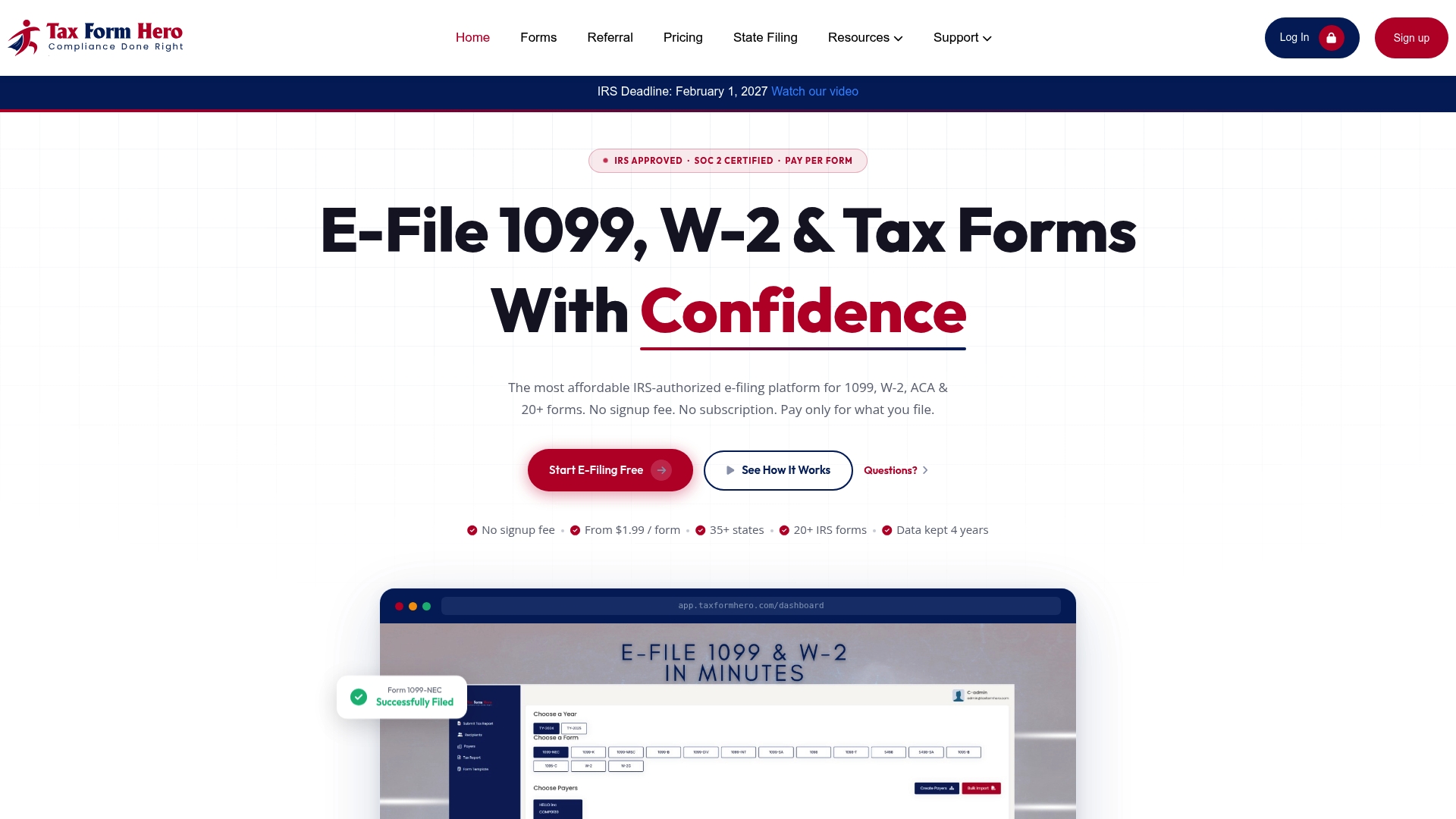
The platform covers what this guide just walked through: bulk import for batch filing, built-in TIN verification, direct state filing for 35+ states, encrypted e-delivery or print-and-mail for recipient copies, and SOC 2-certified security with 256-bit encryption on every submission. Pricing runs per form starting at $1.99, so you pay only for what you file, whether that’s three 1099-Rs or three thousand. There’s no signup fee sitting between you and your first submission.
If your February 28 deadline is approaching and a TCC application isn’t realistic this season, start your 1099-R e-file with Tax Form Hero and have your returns submitted and acknowledged well before the cutoff.
Frequently Asked Questions
Can I e-file 1099-R for free? Yes. The IRS IRIS portal lets business taxpayers e-file 1099 series returns, including 1099-R, at no cost, with acknowledgements arriving in as little as 48 hours. Direct access requires a Transmitter Control Code, so factor in that application timeline.
Do I need a Transmitter Control Code to e-file 1099-R? Only if you’re transmitting directly to IRIS yourself. If you use an authorized e-file provider, the provider holds its own transmission credentials, so you skip the TCC application entirely.
What happens if I file 1099-R on paper when I’m required to e-file? If your aggregate information returns hit 10 or more across all form types, paper filing no longer satisfies the requirement, and continuing to file on paper can trigger penalties for failure to file electronically.
Does a leap year extend the 1099-R filing deadline? No. The IRS instructions are explicit that leap years do not push the February 28 deadline to February 29. The only thing that shifts the date is the deadline falling on a weekend or legal holiday.
Can I truncate a recipient’s TIN on their 1099-R copy? Yes, on the payee statement (Copies B, C, 1, and 2). Truncation is never allowed on the copy filed with the IRS, and you cannot truncate your own EIN on any IRS-filed document.
How do I correct a 1099-R after it’s been accepted by the IRS? File a corrected return through the same channel you used originally, whether that’s IRIS or your provider’s portal, marking it clearly as a correction and furnishing an updated statement to the recipient if their copy was affected.
This article is general information, not a substitute for advice from a qualified financial advisor. Consult a qualified financial professional about your own circumstances before acting on anything here.
Sources
- Topic No. 802 Information Returns Intake System (IRIS) | Internal Revenue Service
- File Form 1099 series information returns for free online | Internal Revenue Service
Recommended

File Information Returns With Confidence
TaxFormHero supports 20+ IRS information returns, including 1099 and W-2 forms, with bulk Excel import, name/TIN matching and encrypted recipient delivery.
Explore TaxFormHero