$2,000 Threshold: Generate 1099-NEC via IRIS for U.S. Contractors

Yes: if you paid a nonemployee contractor $2,000 or more in 2026, you must generate and file Form 1099-NEC. Collect a completed W-9, total each contractor’s payments for the year, and file by January 31 through the IRS IRIS portal or an authorized e-file platform. There is no automatic extension for this deadline.
TL;DR:
- Businesses must generate and file Form 1099-NEC for contractors paid $2,000 or more in 2026, with deadlines on January 31 and no extension.
- Collecting a complete W-9, verifying TINs, and categorizing payments correctly are crucial to avoid IRS rejection and penalties.
- Filing can be done via the IRS IRIS portal for small batches or a paid e-file platform for higher volumes, with mandatory e-filing once 10 or more forms are submitted.
- Recipient copies and the IRS filing must both be sent by January 31, and missing this deadline risks fines and additional correction costs.
- Common problems include missing W-9s or incorrect TINs, which require documentation, corrected filings, and careful recordkeeping.
Quick checklist: documents and data to gather before you create forms
Before you open any filing tool, gather the payer-side data first. Missing information at submission time causes most rejected batches and late corrections.
- Completed Form W-9 for every contractor, with a legible name, address, and correctly formatted TIN or EIN.
- Total payments made to each contractor for the calendar year, categorized by payment type.
- A decision on Form 1099-NEC versus Form 1099-MISC for each payee, based on what the payment was for.
- A chosen filing route: IRIS manual entry, IRIS CSV upload, IRIS A2A bulk XML, or an authorized e-file platform.
- A plan for furnishing recipient copies, either by encrypted PDF or email, or by mail.
Once these five items are in hand, generating the actual form is largely a data-entry exercise.
TaxFormHero is an IRS-authorized e-filing platform, so you can e-file Form 1099-NEC online without paper or a subscription.
Step-by-step: prepare, validate, and generate 1099s
Start by confirming that each payment qualifies as nonemployee compensation. Independent contractor payments for services, not goods, count toward the 2026 threshold of $2,000, a rise from the previous $600 limit. Anything below that threshold does not require a 1099-NEC, though you may still choose to issue one for your own recordkeeping.
- Pull your completed W-9s and check every TIN against the invoice or payment record for that contractor.
- Run TIN matching where it is available. Catching a mismatched name and number now avoids a penalty notice later.
- Fill in the required fields: payer name and EIN, recipient name and TIN, the payment amount in Box 1 (nonemployee compensation), and an account number if you use one to distinguish multiple contracts with the same payee.
- For a handful of contractors, enter each form manually into IRIS or your chosen platform.
- For a larger batch, download the IRIS CSV template or your provider’s template and import all records in a single upload.
- Preview every form before submission. Look specifically at TIN formatting, dollar amounts, and box selection.
- Submit the batch and save the confirmation or validation log.
- Store a copy of every recipient form alongside its confirmation record.
Pro Tip: Keep a single payee spreadsheet with columns for W-9 receipt date, TIN-verified status, and running payment total. That sheet becomes your CSV export when it is time to file.
Bulk import matters more than it looks. A business with even a dozen contractors saves substantial re-keying time by importing once rather than typing each form individually, and a validated CSV catches formatting errors before the IRS does.
How to file with the IRS: IRIS, IRIS A2A, and when paper applies
The IRS IRIS Taxpayer Portal is a free option that accepts manual entry or CSV upload for many 1099 types. It works well for small batches and businesses filing for the first time.
- If you file 10 or more information returns in a calendar year, e-filing is required. The 10-return e-file mandate applies across most information return types combined, not just 1099-NEC alone.
- For high-volume filers, IRIS A2A supports bulk XML submissions, but it requires an IRIS Transmitter Control Code that can take up to 45 days to process on a first application.
- Filers under the 10-return threshold may still file on paper, transmitted with Form 1096 as the cover sheet.
- Combined Federal/State Filing coverage varies by state, so confirm whether your state participates before filing a separate state return.
File early enough to absorb any TCC processing delay, and always run a test upload against the IRIS CSV template before submitting a full batch.
Furnishing recipient copies, deadlines, and penalties to avoid
Form 1099-NEC carries a single hard date: both the IRS filing copy and the recipient copy are due January 31, whether you file on paper or electronically. Unlike some other information returns, there is no automatic extension for 1099-NEC.
- Furnish recipient copies by January 31, by mail or by encrypted electronic delivery.
- File the IRS copy by January 31 as well, through IRIS, an authorized platform, or paper with Form 1096.
- Check state filing requirements separately. Some states require their own copy even when Combined Federal/State Filing applies, and others do not participate in CF/SF at all.
- Missing the deadline or filing with incorrect information exposes you to IRS penalties that increase the longer the correction takes.
Treat January 31 as immovable. Building your W-9 collection and totals well ahead of that date is the difference between a routine filing and a scramble.
Common problems and fixes: missing W-9s, incorrect TINs, and corrected returns
Most 1099 problems trace back to two causes: a contractor who never returned a W-9, or a TIN that was mistyped somewhere along the way.
- If a contractor refuses to provide a W-9, document your request attempts in writing and begin backup withholding on future payments where required.
- If you discover an error after filing, submit a corrected return with the corrected box checked and the accurate values entered.
- For paper corrections, include a corrected Form 1096 and keep the original and corrected submissions filed together.
- Retain every recipient copy, submission confirmation, and validation report for your records.
Pro Tip: Request a W-9 before the first payment goes out, not at year-end. Chasing a missing TIN in January is far harder than asking for one in the same week you sign the contract.
Author perspective: practical workflow advice from a tax-filing practitioner

The businesses that struggle most with 1099 season are not the ones with complicated payments. They are the ones that treat W-9 collection as an afterthought. A validated workflow, TIN checks done before payment, totals tracked monthly, and a CSV template ready to export, turns filing into a non-event.
The free IRIS portal is a reasonable choice for a handful of contractors and a business comfortable managing TCC applications and CSV formatting itself. Once volume grows or the process needs to run without close attention, a paid, authorized e-file platform earns its per-form fee in saved time and fewer rejected batches.
— Nazrul
If you want a pay-per-form, IRS-authorized e-file option
TaxFormHero handles the workflow described above without asking you to build a CSV template from scratch or apply for your own IRIS credentials. The platform lets you collect W-9s, run TIN checks, and import contractor records from Excel or CSV, then transmits federal returns through IRIS A2A on your behalf.
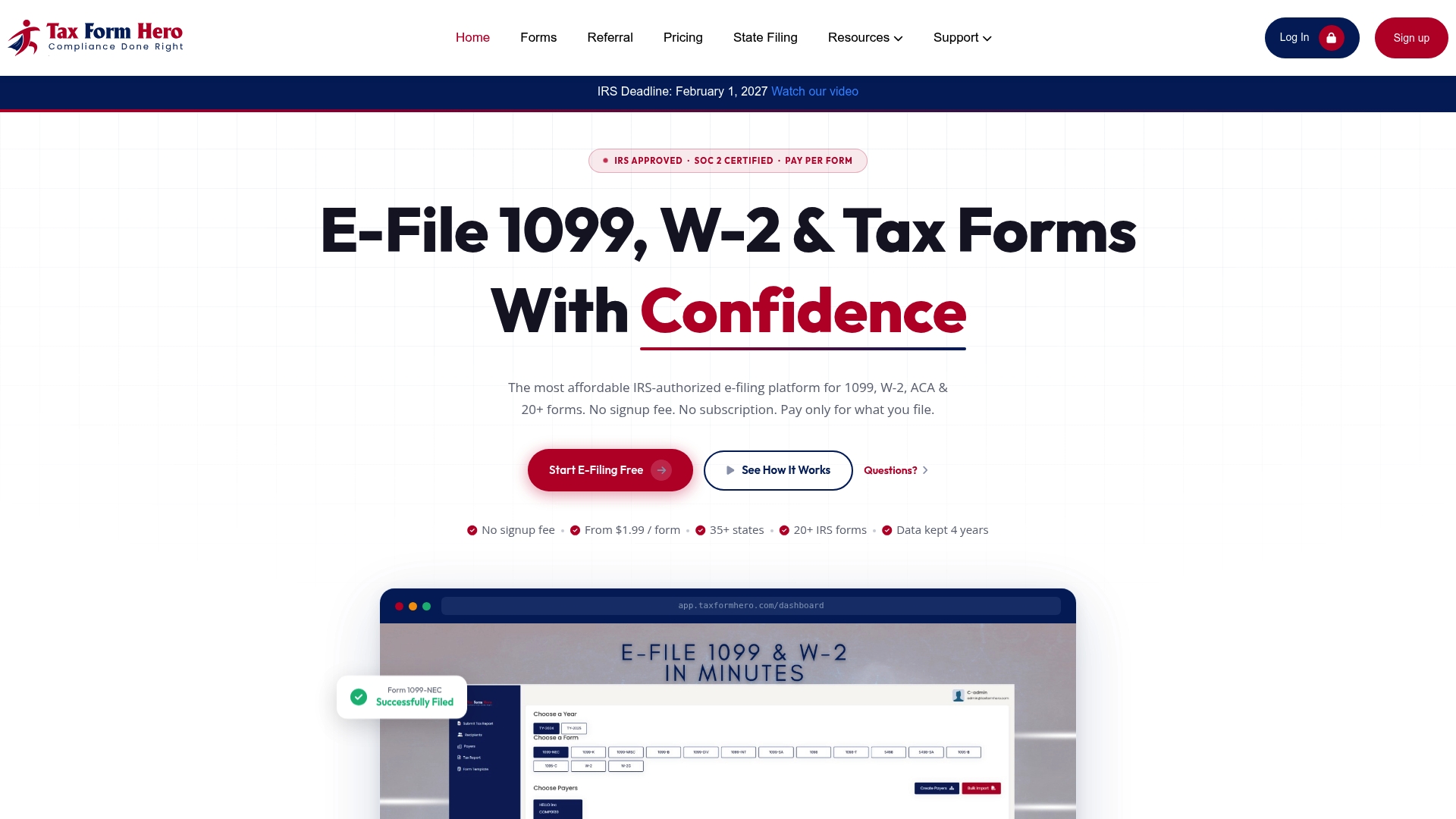
- Pay-per-form pricing with no subscription or signup fee, starting at $1.99 per 1099-NEC form for the first 150 forms.
- Optional add-ons: state filing, print and mail delivery, and encrypted e-delivery, each priced per form on the pricing page.
- Bulk import for contractor lists of any size, with recipient PDF copies included.
Start your filing on the 1099-NEC page once your contractor list and totals are ready.
FAQ
Can I generate my own 1099 form?
Yes, you can prepare and file a 1099-NEC yourself using the free IRS IRIS portal or an authorized e-file platform. You will need a completed W-9 from each contractor and their total payments for the year before you start.
Can I create a 1099 form online for free?
The IRIS Taxpayer Portal lets you enter and e-file 1099 forms at no cost through the IRS. Paid platforms charge a per-form fee but add features like bulk CSV import, TIN checks, and mailed recipient copies.
How much does a contractor have to make to file a 1099?
For 2026, a business must file Form 1099-NEC once it pays a contractor $2,000 or more in nonemployee compensation during the year. That threshold rose from $600 for tax year 2026, with inflation adjustments beginning in 2027.
Do independent contractors need to fill out a 1099?
No, the contractor does not fill out the 1099. The paying business fills it out and files it, based on a W-9 the contractor completes and returns before payment.
Recommended
- 1099-NEC Threshold 2026: $600 to $2,000 Explained
- $2,000 vs $600: U.S. Payers’ 2026 1099-NEC State Checklist
- 1099-NEC for HVAC & Plumbing Subcontractors | 2026
- Avoid $680 per Form: 1099-NEC Deadline, IRIS TCC Steps for Payers

File Information Returns With Confidence
TaxFormHero supports 20+ IRS information returns, including 1099 and W-2 forms, with bulk Excel import, name/TIN matching and encrypted recipient delivery.
Explore TaxFormHero