IRS Deadline: February 1, 2027
$2,000 vs $600: U.S. Payers’ 2026 1099-NEC State Checklist
The federal 1099-NEC threshold jumped to $2,000 for payments made on or after January 1, 2026. That change does not erase your state filing obligations. Several states still require a 1099-NEC at $600, $100, or even $0, so a payment that skips federal filing can still trigger a state one. Compare every payee’s total against both thresholds and collect W-9s before you assume you’re in the clear.
TL;DR:
- States like California and Rhode Island maintain lower 1099-NEC thresholds of $600 and $100 respectively, requiring filings even if the federal threshold is not met.
- Payments made in cash, check, or direct deposit that total $2,000 or more per payee generally trigger federal reporting, but certain attorney or backup withholding payments are reportable regardless of amount.
- Filing through Combined Federal/State Filing typically covers states with higher thresholds, while states with lower thresholds require separate, direct filings outside the system.
- It is crucial to compare payee totals against both federal and state thresholds throughout the year and verify thresholds annually before filing.
- Using tools like TaxFormHero can simplify handling multi-state filings by enabling bulk import, automatic transmission to IRS, and coverage of over 41 states with optional add-ons.
Which States Set Lower 1099-NEC Thresholds Than the Federal Limit?
The federal threshold rose from $600 to $2,000 under the One Big Beautiful Bill Act, and it will be indexed for inflation starting in 2027. States did not automatically follow. A handful kept their own dollar floors, which means a $700 payment to a freelancer might clear the IRS filing bar in 2026 and still require a state copy.
California, Massachusetts, Oregon, and Vermont hold their thresholds at $600. New Jersey sits at $1,000. Rhode Island’s threshold is the lowest on the list at $100. Pennsylvania’s threshold varies and requires annual verification with its Department of Revenue before filing.
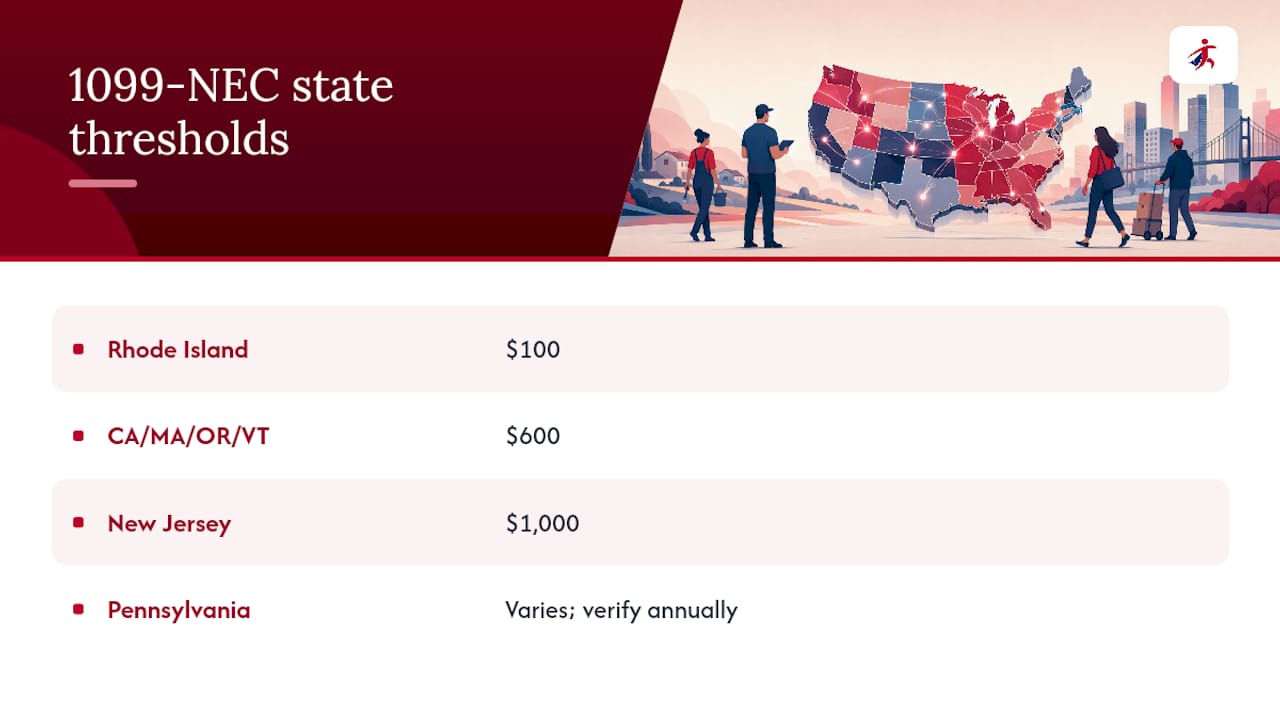
States not listed generally follow the federal $2,000 threshold through the Combined Federal/State Filing program, but participation and formatting rules change year to year. Treat this table as a starting point, not a final answer, and recheck it each filing season.
If you would rather not do this on paper, e-file Form 1099-MISC online with TaxFormHero instead.
Who Must File a 1099-NEC and What Payments Count?
You must file a federal 1099-NEC when you pay a nonemployee $2,000 or more in a calendar year for services, per the IRS instructions for Forms 1099-MISC and 1099-NEC. The threshold applies per payee, not per invoice, so you have to aggregate everything you paid that person across the year before deciding whether filing is required.
A few triggers apply regardless of the dollar amount:
- Any payment subject to backup withholding requires a 1099-NEC no matter how small.
- Certain attorney payments for services are reportable even under $2,000 in specific circumstances outlined in the IRS instructions.
- Payments made in cash, check, or direct deposit to the same nonemployee all count toward the annual total, even across multiple projects.
Check the IRS threshold guidance for exact box definitions before you finalize a form, since misreading which payments qualify is one of the most common preparer errors.
CF/SF vs Direct State Filing: What’s the Difference?
The Combined Federal/State Filing program forwards your federal 1099-NEC data to participating states automatically, so you don’t submit a separate state file for those states. In practice, CF/SF participation usually means the federal $2,000 threshold governs reporting there too, since the state simply receives what you already sent the IRS.
States with their own lower thresholds, like California and Rhode Island, generally require direct filing outside CF/SF, because the state needs data the federal file wouldn’t otherwise capture. That distinction matters operationally:
- CF/SF states: one federal submission typically covers you, assuming your payments clear the $2,000 mark.
- Direct-filing states: you submit through a separate state portal, often with its own deadline and file format.
- Some states mix both, accepting CF/SF for high-threshold payees while requiring direct filing for anyone under their own lower bar.
Pro Tip: Run a test CF/SF export or a sample direct-state file in early January, before your real filing volume hits. Catching a rejected format on a test batch costs you nothing; catching it on your actual deadline costs you a resubmission and possibly a penalty.
Payer Checklist: Steps to Avoid a Missed State Filing
Work through these steps in order, ideally starting well before December:
- Collect a signed W-9 from every nonemployee before the first payment goes out, so you have a valid TIN on file and reduce backup withholding exposure.
- Map each contractor to the state where the work was performed and the state where they reside, since either can create a filing obligation.
- Compare year-to-date payee totals against both the $2,000 federal threshold and the relevant state threshold, not just one or the other.
- Set a mid-year alert to export payee totals and flag anyone approaching a threshold, federal or state.
- Prepare recipient copies by January 31 and submit federal and state copies through CF/SF or direct portals by their respective deadlines.
- If you discover a missed state filing, file it immediately and document the correction. State penalties can mirror the federal tiered penalty structure under IRC §6721, and acting fast is one of the few ways to limit exposure.
Filing Mechanics: Boxes 16 to 18, State Formats, and E-File Rules
Boxes 16 through 18 on the 1099-NEC carry state tax withheld, payer state identification number, and state income amounts. Populate them whenever a state requires a copy or you withheld state tax, and use Copy 1 specifically for the state department when a paper copy is requested rather than sending your federal Copy A.
A few mechanical details trip up otherwise careful filers:
- CF/SF and direct-state files generally follow IRS Publication 1220 formatting, including K-record state totals that some state portals check strictly on upload.
- Volume-based e-file mandates exist at the state level. Nebraska, for instance, requires electronic filing once a payer submits more than 50 forms, regardless of federal filing method.
- Rejected files for bad formatting or missing K-records often carry the same late-filing risk as a missed deadline, since the state treats an unaccepted submission as not filed.
What Tax Professionals Should Change for the 2026 Filing Season
Fewer federal forms this year does not mean less work. It means the work shifts toward state triage, and that shift catches firms that update their thresholds but not their processes. Build mandatory W-9 collection into onboarding, flag each client’s payee states inside your accounting system, and test a CF/SF export before you’re filing under deadline pressure. For clients with multi-state contractors or thin margins for error, lean permissive. File the state copy when in doubt.
— Nazrul
How TaxFormHero Simplifies Federal and State 1099-NEC Filing
Sorting out which of your payees clear a $600 California threshold versus a $2,000 federal one gets tedious fast once you’re managing more than a handful of contractors. TaxFormHero handles both sides of that problem: bulk import lets you upload your full payee list from an Excel template instead of entering each recipient by hand, and the state filing add-on covers 41+ states plus DC, with Combined Federal/State Filing states included at no extra cost.
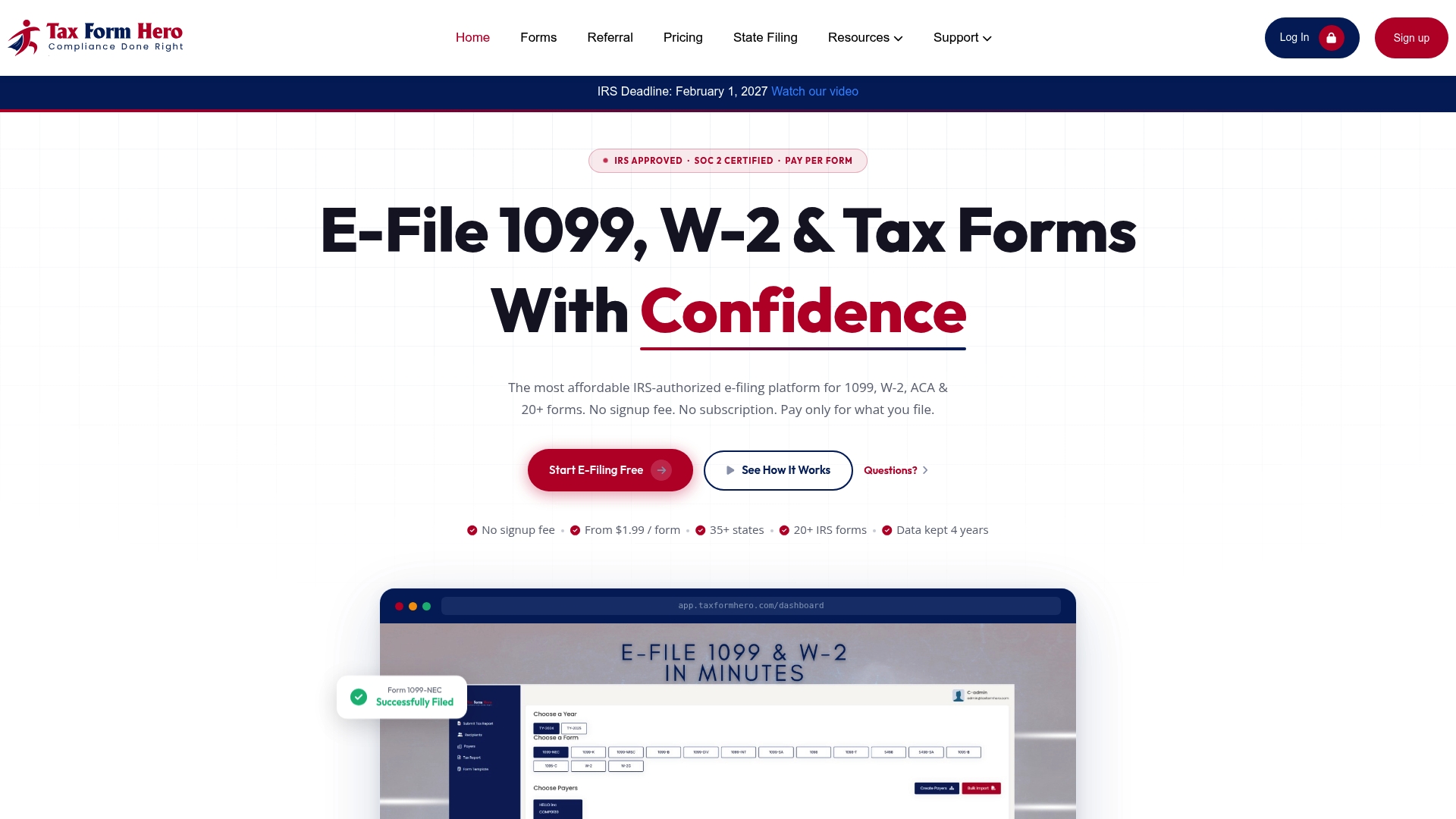
Federal returns transmit to the IRS through IRIS A2A, TIN matching flags bad taxpayer IDs before you submit, and Copy 1 handling takes care of the state-specific paper copies some departments still require. Pricing runs pay-per-form with no subscription: the first 150 forms on the 1099 series run $1.99 each, with graduated per-form pricing after that, and add-ons like state filing at $0.99 per form or e-delivery at $0.19 per form are optional, not bundled. Before your next filing season starts, import a test batch and run a sample CF/SF export to confirm your state coverage lines up with your actual payee footprint.
Where to Verify State 1099-NEC Thresholds Each Year
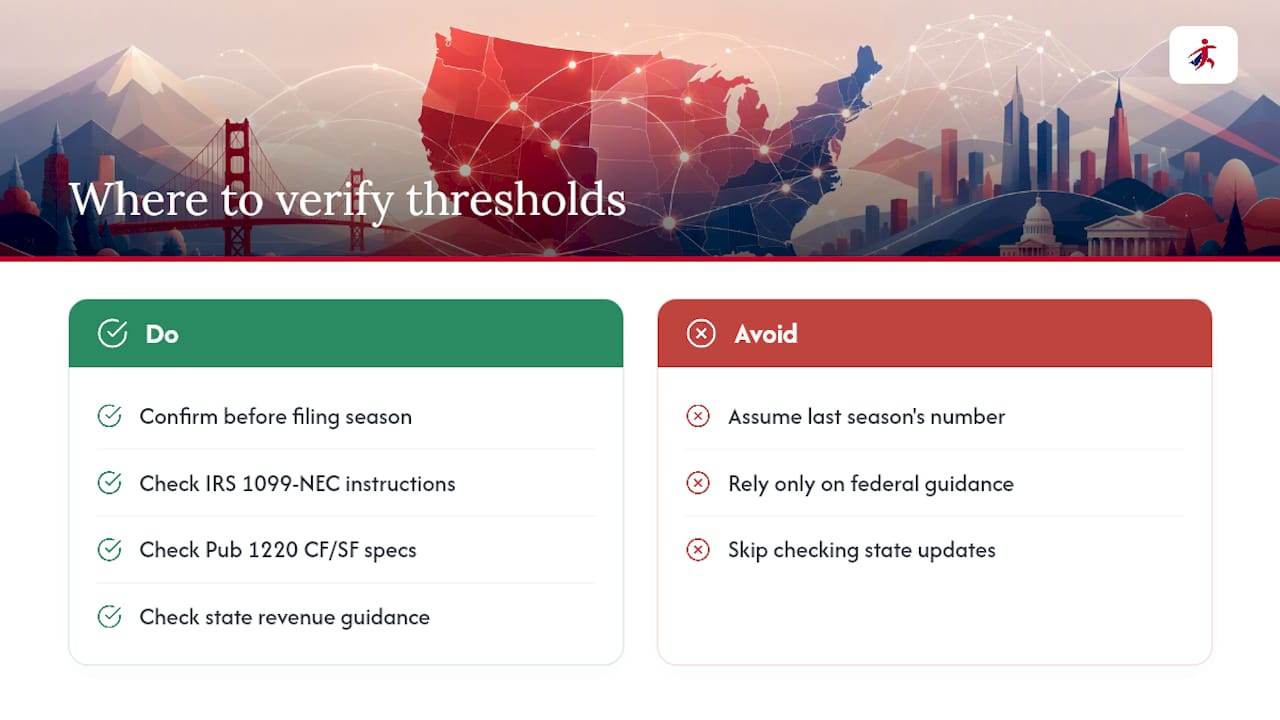
Confirm every threshold before filing season using the IRS 1099-NEC instructions, Publication 1220’s CF/SF specs, and your state revenue department’s current-year guidance. State thresholds change more often than the federal one, so a number that was accurate last season isn’t guaranteed to hold this one.
This article is general information, not a substitute for advice from a qualified financial advisor. Consult a qualified financial professional about your own circumstances before acting on anything here.
Sources
- Instructions for Forms 1099-MISC and 1099-NEC (Rev. December 2026)
- Which States Require 1099 Below $2000 in 2026 | EarnDrift
- FAQs: New 1099 NEC and 1099 MISC Rules Beginning in 2026 - Anchin, Block & Anchin LLP
FAQ
What Is the Federal Threshold for 1099-NEC in 2026?
The federal 1099-NEC threshold is $2,000 per payee for payments made on or after January 1, 2026, up from the previous $600 level. This threshold will be indexed for inflation starting in 2027.
Do I Have to File a 1099-NEC if I Paid Under $2,000?
Not federally, in most cases, but you might still owe a state filing. States including California, Massachusetts, Oregon, and Vermont keep their own $600 threshold, and Rhode Island’s threshold is just $100.
How Do State 1099-NEC Thresholds Differ From the Federal One?
State thresholds are set independently and don’t automatically move when the federal number changes. New Jersey requires filing at $1,000, several states hold at $600, and Pennsylvania’s rule needs annual verification directly with the state.
What’s the Deadline for Filing 1099-NEC With States?
Recipient copies are generally due by January 31, and most states that require direct filing use that same deadline or one close to it. Check each state’s portal, since a handful set separate cutoff dates.
What Happens if I Skip a Required State Filing?
You risk state-level penalties that can mirror the federal tiered structure under IRC §6721, plus potential backup withholding exposure. Filing late but promptly, and documenting the correction, generally limits the damage compared to not filing at all.
Can TaxFormHero File Both Federal and State 1099-NEC Forms?
Yes. TaxFormHero transmits federal returns through IRIS A2A and offers a state filing add-on covering 41+ states plus DC, with Combined Federal/State Filing states included at no additional cost.