Payroll Teams: 5 Step 1099 State Filing Checklist for 2026 ($2,000)

CF/SF forwards many 1099 filings to participating states, but it does not eliminate state-specific direct-filing obligations. Some states require separate submissions, some only trigger when you withhold state tax, and the OBBBA federal threshold change to $2,000 for 2026 does not automatically apply at the state level. Confirm each relevant state’s own rules before assuming your federal filing covers you.
TL;DR:
- Many states still require separate or direct filings for 1099 forms, regardless of CF/SF participation, especially if withholding occurs or the state does not participate.
- States like Massachusetts and Oregon mandate direct electronic filing through their own portals, while others rely solely on CF/SF forwarding or have no filing obligation.
- The federal reporting threshold rises to $2,000 in 2026, but most states have not changed their thresholds, risking missed filings at the state level.
- Errors such as incorrect state codes, missing data, or mismatched addresses are common rejection causes, emphasizing the importance of validation before submission.
- Automated, disciplined processes and accurate payee onboarding are crucial to managing multi-state 1099 compliance effectively and avoiding penalties.
How the Combined Federal/State Filing Program Actually Works
The Combined Federal/State Filing Program, known as CF/SF, is a forwarding service built into the IRS’s electronic filing systems. When you e-file eligible 1099-series forms through the IRS, the agency passes copies of those returns to states that participate in the program. It is not a compliance shield, and treating it as one is where a lot of multi-state filers get into trouble.
CF/SF covers a defined set of forms, and not every 1099 variant qualifies. Forms commonly forwarded include:
Two mechanics matter here. First, Publication 1220 lists the exact file specifications, valid state codes, and the current roster of participating states. That roster changes from year to year, so a state that forwarded data in 2025 is not guaranteed to still participate this year.
Second, electronic filing itself is not optional past a certain volume. If you file 10 or more information returns across all form types combined, you must file electronically rather than on paper. That threshold, set by the IRS, is what makes CF/SF forwarding possible in the first place. Paper filers do not get the forwarding benefit at all.
The practical takeaway: CF/SF is a genuine convenience, but it only works for the forms and states it actually covers. Anything outside that scope is on you.
Need to get this filed? You can e-file Form 1099-NEC online with TaxFormHero, which is IRS-authorized and charges per form, not per month.
Which States Require Direct Filing and Which Don’t
State requirements fall into a handful of predictable buckets once you look past the noise. Knowing which bucket a payee’s state falls into tells you almost everything about your filing obligation.
- Always-direct-filing states. Some states, regardless of CF/SF participation, expect employers and payers to submit 1099 data through their own portal. Massachusetts requires 1099-NEC filings through MassTaxConnect, and Oregon runs its own iWire system for electronic submissions.
- Withholding-triggered states. A number of states only require a direct 1099 filing when you withheld state income tax on the payment. Pennsylvania falls here, using its myPATH portal for withholding-related 1099s and year-end reconciliation.
- Non-participating states. A state that does not participate in CF/SF gets nothing forwarded to it at all. If that state otherwise requires 1099 reporting, you carry the full filing burden yourself, on its schedule and in its format.
- No-income-tax states. States without a personal income tax, such as Texas, Florida, and Wyoming, generally impose no 1099 state filing requirement, since there is no state income tax return for the form to support.
The mistake payroll teams make most often is assuming that because a state has no income tax, or because it participates in CF/SF, no further action is needed. Both assumptions fail regularly enough to cause real problems. Check the state DOR site for every state where you have active payees, every year, not just once when you set up your system.
A Step-by-Step Checklist for State 1099 Compliance
Getting this right is less about tax law expertise and more about disciplined process. Here’s a sequence that works for most payroll and accounting teams handling multi-state 1099 volume:
- Collect state data at onboarding. Capture each payee’s state of residence and whether you’ll withhold state tax, before the first payment goes out. Retrofitting this data in December is where errors creep in.
- Count your total information returns. If you’re at or above 10 returns across all form types, e-filing is mandatory, which is also your gateway into CF/SF forwarding.
- Register for IRIS or FIRE. Get your Transmitter Control Code (TCC) set up early, and cross-check Publication 1220 for correct state codes and file formatting before you submit anything.
- Handle direct-filing states separately. If a payee’s state requires its own submission, register on that state’s portal, confirm whether it wants XML, CSV, or manual portal entry, and run a test file if the state offers one.
- Verify acceptance on both ends. Confirm the IRS accepted your federal filing, then separately confirm the state received and accepted its copy, whether forwarded or direct.
Pro Tip: Build a simple spreadsheet mapping each state you paid a vendor in to its CF/SF status, filing method, and deadline. Update it once a year, right after you check the current Publication 1220 participant list, and you’ll never have to research the same state twice.
Our 1099 compliance checklist walks through this process in more depth if you want a printable version for your team.
Deadlines and the 2026 OBBBA Threshold Shift
Recipient copies of most 1099 forms are due by January 31, and IRS electronic filing deadlines generally follow shortly after, though exact dates shift depending on the form. Check the current-year instructions before you build your filing calendar, since due dates move slightly year to year.
The bigger story for 2026 is the threshold change. OBBBA raised the federal reporting threshold for 1099-NEC and 1099-MISC to $2,000 for payments made in 2026, up from the long-standing $600 mark. That sounds like relief, and for federal purposes it is. But states set their own thresholds, and most have not announced conforming changes.
- A payment of an amount below the new federal threshold might no longer require a federal 1099-NEC in 2026.
- The payee’s state may still require reporting at a lower state-specific threshold.
- Skipping the federal form does not excuse you from a state filing obligation that survives independently.
This gap is exactly where operations teams get caught, filing correctly at the federal level while quietly missing a state requirement that never changed. Our 1099 deadlines guide breaks down the recipient and filing due dates by form if you need the specifics for your calendar.
Why Filings Get Rejected and How to Fix Them
Most state-level rejections trace back to a small set of causes: blank state fields on the return, incorrect state codes, or an address that doesn’t match what the state has on file for that payer. Catching these before submission saves weeks of correction cycles.
Timing adds another wrinkle. CF/SF forwarding happens in scheduled batches, not instantly. The IRS’s own state coordinator guidance notes that corrected returns may not reach a state right away, which means a federal correction alone might leave a state’s records outdated for weeks.
- Rejected for a bad state code: fix and resubmit through the same channel you originally used.
- Correcting after the original CF/SF batch already forwarded: some states require a separate, direct amendment rather than waiting on the next forwarding cycle.
- Persistent mismatches: escalate directly to the state’s coordinator rather than resubmitting the same file repeatedly.
Pro Tip: Validate every state-code field against Publication 1220’s current list before you generate your file. That one check prevents the majority of state-side rejections we see.
What Multi-State 1099 Filing Actually Looks Like in Practice
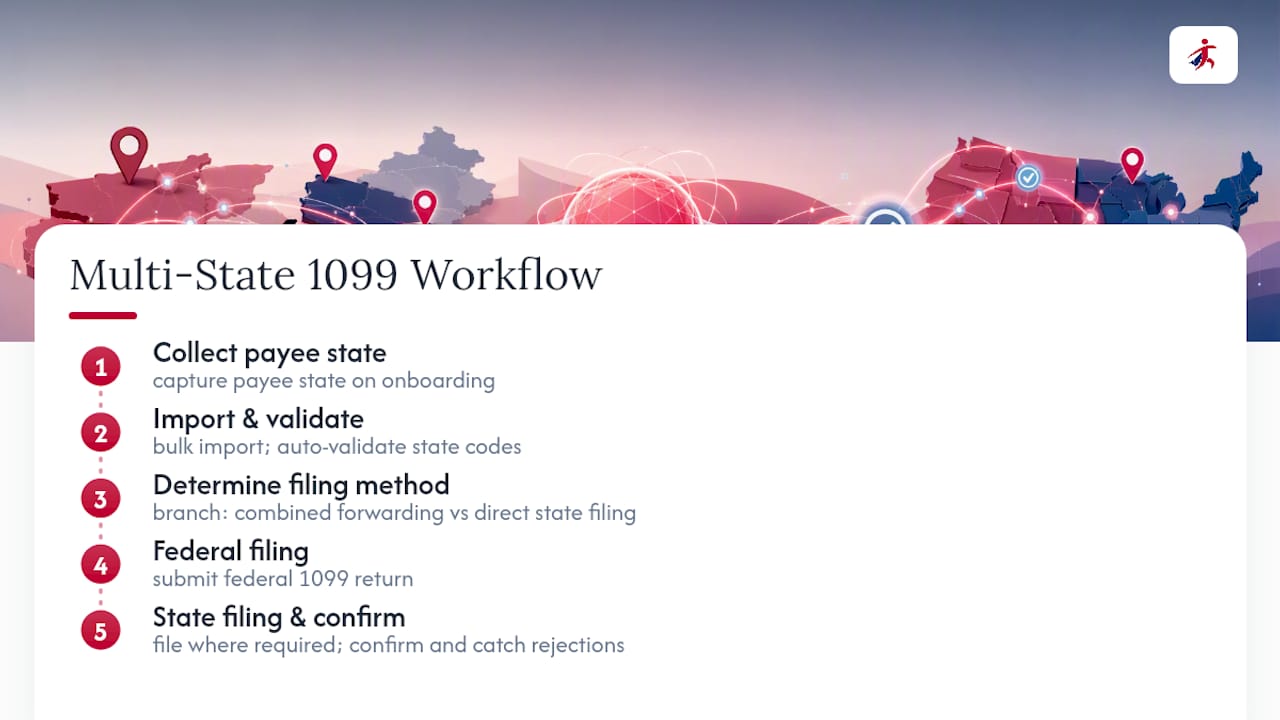
Most of the friction in multi-state 1099 filing isn’t legal complexity. It’s operational: payee state data collected too late, no calendar tracking which states demand direct filing, and no process for catching a rejected state code before it becomes a penalty notice.
Bulk import and automated validation solve the mechanical half of that problem. The harder half is discipline: map every payee’s state at onboarding, and maintain a living reference of each state’s filing method and threshold rather than relying on memory from last year’s season.
— Nazrul
How TaxFormHero Handles Federal and State 1099 Filing Together
Everything covered above, the CF/SF forwarding logic, the state-by-state exceptions, the threshold gaps, is exactly the kind of complexity that eats payroll teams’ December and January. TaxFormHero is built around removing that friction rather than adding another portal to check.
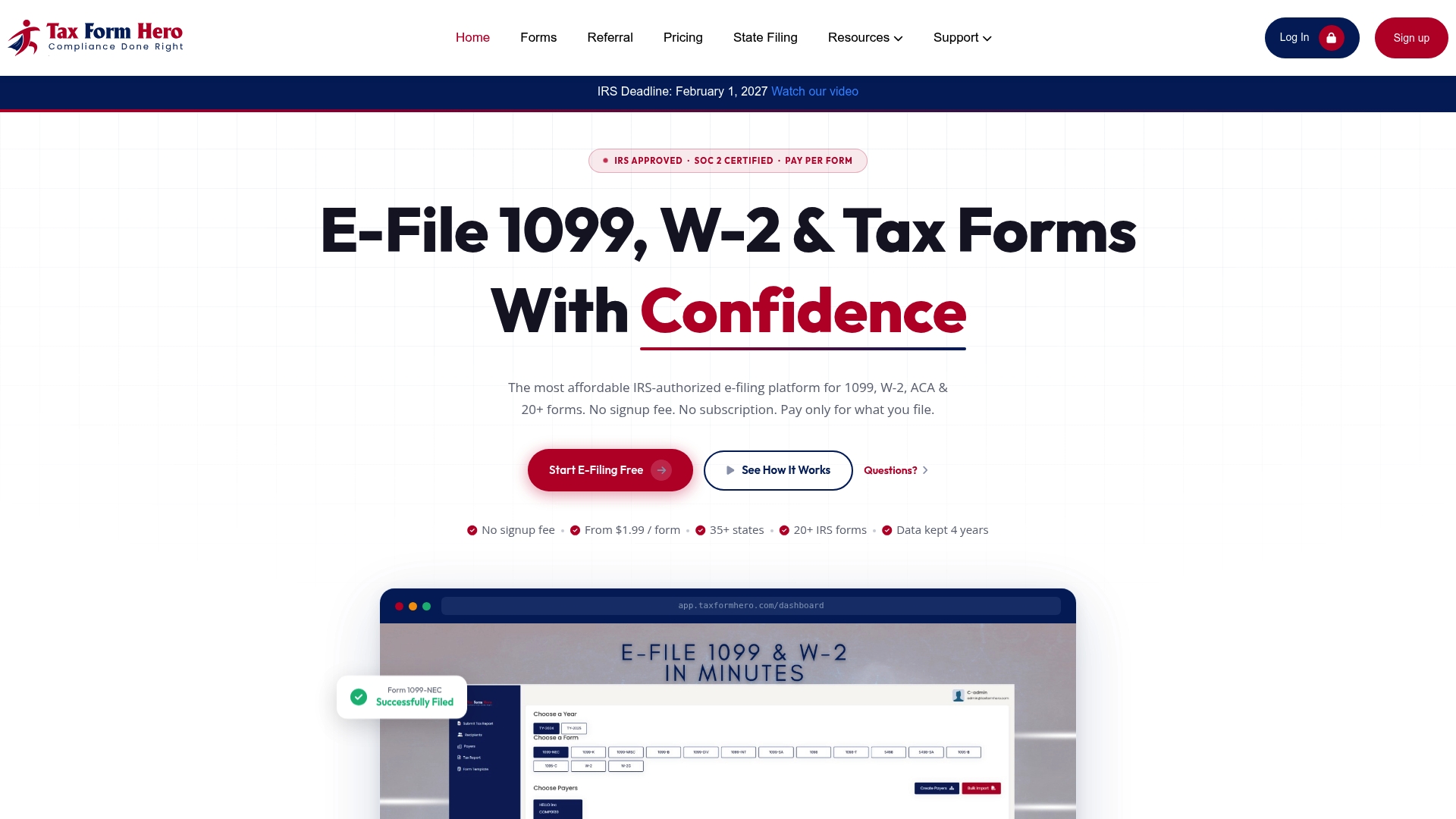
The platform offers bulk import for high-volume filers, TIN verification to catch mismatches before submission, and state filing add-ons that handle direct filing in states that don’t rely on CF/SF forwarding. Encrypted e-delivery and recipient PDF downloads round out the process, and pricing is per form with no subscription or signup fee. If your onboarding process needs tightening first, this vendor onboarding checklist is a solid companion piece for capturing payee state data correctly from day one. Start a filing on the TaxFormHero platform to see how it handles your specific state mix before your next deadline hits.
FAQ
Which states require direct 1099 filing?
States like Massachusetts and Oregon require direct filing through their own portals regardless of CF/SF participation, while others, such as Pennsylvania, only require it when state tax was withheld. Always check the current participant list in Publication 1220, since it changes yearly.
Do I have to file a 1099 if the payment was under $2,000?
For 2026 payments, the federal threshold for 1099-NEC and 1099-MISC rose to $2,000 under OBBBA, but many states have not adopted that change and may still require a state filing at their own lower threshold, often $600.
What are the new 1099 reporting requirements for 2026?
The main federal change is the OBBBA-driven increase of the 1099-NEC and 1099-MISC reporting threshold to $2,000 for payments made in 2026. State thresholds and filing rules remain independent and require separate verification.
What are the basic requirements for filing a 1099?
You need accurate payee TIN and address data, correct form selection based on payment type, and electronic filing if you have 10 or more information returns total. Platforms like TaxFormHero handle the federal submission and offer state filing add-ons for payees in direct-filing states.
Can I rely on CF/SF instead of filing directly with a state?
Only if that state participates in CF/SF for the specific form you filed, and even then, some states still require separate registration or reconciliation. The CF/SF program forwards data but does not replace every state’s own filing process.
Recommended
- How to File 1099 Forms: A 2026 Small Business Guide
- Avoid Missed 1099s: Small Businesses and the $2,000 1099-NEC Threshold
- 1099 Deadlines 2026: What Small Businesses Must Know
- The 1099 Compliance Checklist Every Business Needs

File Information Returns With Confidence
TaxFormHero supports 20+ IRS information returns, including 1099 and W-2 forms, with bulk Excel import, name/TIN matching and encrypted recipient delivery.
Explore TaxFormHero