Cut 2026 1099 Penalties From $340 to $60 With Same Day Fixes

For information returns due in 2026, the IRS charges $60 per form if you file within 30 days of the deadline, $130 per form if you file between 31 days and August 1, and $340 per form if you file after August 1 or don’t file at all. Intentional disregard carries a $680 per-form penalty (or 10% of the reported amount, whichever is greater) with no annual cap. If you’re behind, file or correct now. Every day you wait can push you into a costlier tier.
TL;DR:
- Filing after August 1 or not filing at all for 1099 forms can result in penalties of up to $340 per form, with intentional disregard penalties reaching $680 or 10% of the reported amount.
- The penalty amount depends on how many days late the filing occurs, with earlier correction within 30 days reducing the penalty to $60 per form.
- Missed deadlines for furnishing recipient copies (January 31) and IRS filing (February 28 or March 31) can trigger separate penalties under different IRS sections, stacking penalties for the same form.
- Correcting errors within 30 days of the original due date, especially before August 1, can significantly lower penalties, sometimes to zero under de minimis rules.
- Speed in filing or correcting late returns is the most effective way to minimize penalties, with professional tools enabling bulk corrections and TIN verification to prevent costly errors.
What Are the 2026 Late 1099 Filing Penalties?
The IRS penalty structure for late or incorrect information returns runs on three tiers, and the amount you owe depends entirely on how many days have passed since the original deadline. This isn’t a flat fee. It’s a countdown, and the clock resets differently for every form you file late.
Here’s the exact breakdown for 2026:
| Timing | Penalty per form | Applies to |
|---|---|---|
| Filed within 30 days of deadline | $60 | Late filers who self-correct quickly |
| Filed 31 days after deadline through August 1 | $130 | Moderate delays |
| Filed after August 1, or not filed at all | $340 | Significant delays or nonfiling |
| Intentional disregard | $680 or 10% of reported amount, whichever is greater | Willful noncompliance, no cap |
The math gets serious fast once you multiply by volume. Consider a payroll firm that misses the deadline for 10 contractor 1099-NEC forms and files them after August 1: that’s 10 × $340, or $3,400, before any interest accrues. Drop that same batch into the 31-to-August-1 window instead, and the bill falls to $1,300. File within the first 30 days, and it’s $600.
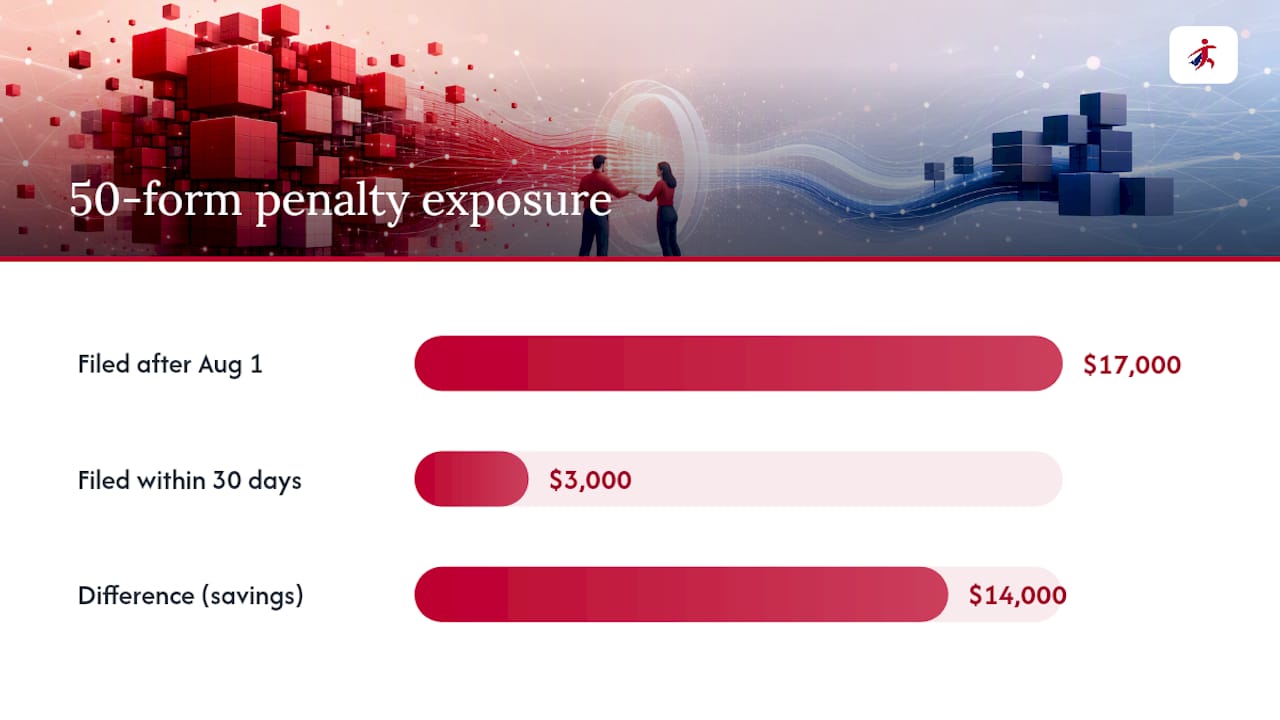
A larger example makes the stakes clearer. A staffing agency that forgets 50 forms and files them in October, well past August 1, faces $17,000 in penalties on a single filing season. Catch the same error within 30 days of the original deadline, and the exposure drops to $3,000. That’s a $14,000 swing based purely on timing.
Two things matter here beyond the raw numbers. First, the IRS assesses penalties per form, not per filer or per batch, so every additional 1099 you’re late on adds a full penalty on top of the last one. Second, time is the only variable you control after a deadline passes. Filing a week earlier, even after you’ve already missed the due date, can move an entire batch into a lower tier and cut your liability by more than half.
Need to get this filed? You can e-file Form 1099-NEC online with TaxFormHero, which is IRS-authorized and charges per form, not per month.
Which 1099 Deadlines and Furnishing Dates Apply?
Penalty exposure starts with knowing exactly which deadline you missed, and that depends on the form. The IRS treats two obligations separately: filing the return with the agency, and furnishing a copy to the recipient. Missing either one can trigger a penalty, and they’re governed by different sections of the tax code.
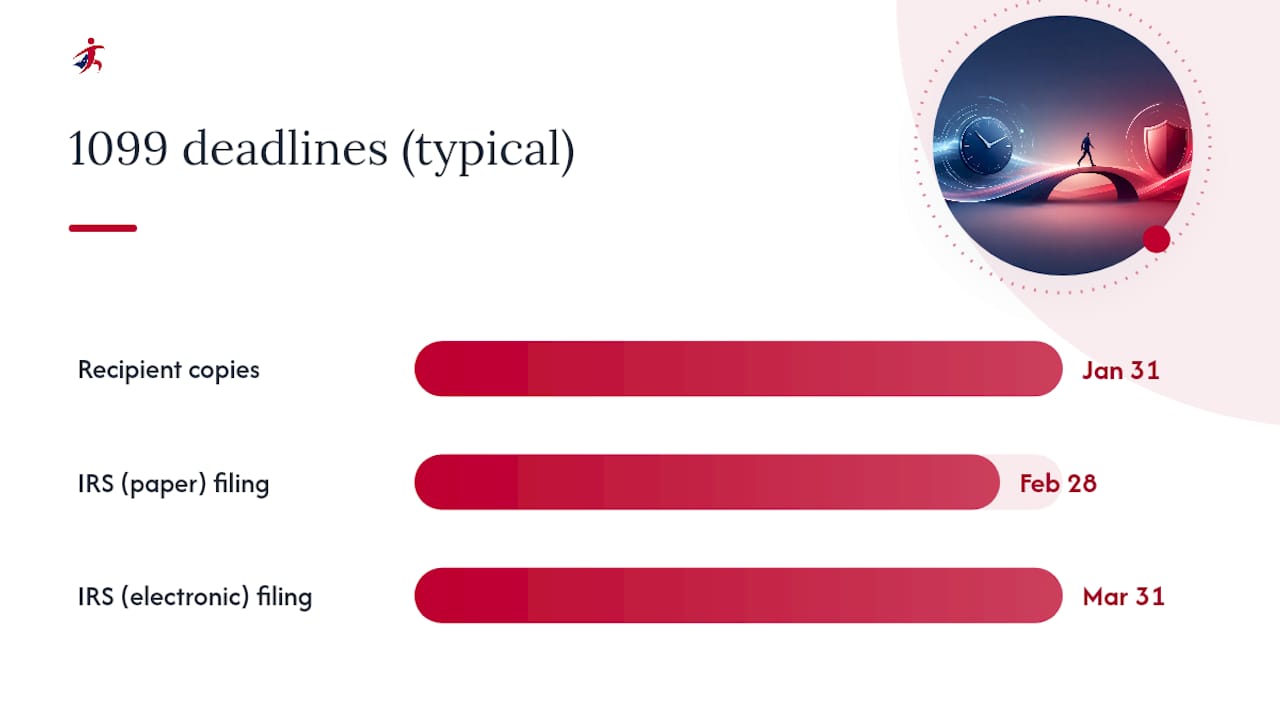
- 1099-NEC: Due to the IRS and to recipients by January 31, whether you file on paper or electronically.
- 1099-MISC: Due to recipients by January 31; due to the IRS by February 28 on paper or March 31 if filed electronically.
- 1099-INT, 1099-DIV, and most other 1099 types: Same February 28 (paper) or March 31 (electronic) IRS deadline, with recipient copies generally due by January 31.
- Weekend or holiday adjustment: When a due date lands on a Saturday, Sunday, or legal holiday, the deadline shifts to the next business day.
The distinction between filing and furnishing isn’t a technicality. Section 6721 of the Internal Revenue Code governs penalties for failing to file correct information returns with the IRS. Section 6722 governs penalties for failing to furnish correct statements to payees. Miss both deadlines on the same form, and you can face penalties under each section, stacked on top of each other.
One overlooked detail: the deadlines don’t shift based on how you plan to file. Whether you e-file or mail paper forms, the January 31 furnishing deadline for 1099-NEC applies identically, and missing it by even a day starts the penalty clock. Businesses juggling multiple form types, 1099-NEC and 1099-MISC especially, often lose track of which deadline governs which form, since the IRS-facing dates for MISC and NEC diverge even though the recipient dates line up.
How Does the IRS Assess and Cap These Penalties?
The penalty math sounds straightforward until you factor in the one-penalty rule and the annual caps, both of which change how much a business actually owes at the end of the year. Publication 1586 lays out the mechanics: even if a single return has multiple problems, such as being both late and containing an incorrect TIN, only the highest applicable penalty under IRC 6721 gets assessed on that return. You don’t get charged twice for two failures on the same form under the same section.
That said, IRC 6721 and IRC 6722 penalties can apply together. A form filed late and never furnished to the recipient can generate a penalty under both sections, since they cover separate failures: one to the IRS, one to the payee.
Annual maximums also matter, and they scale differently depending on your business size:
- Filers meeting the small-business threshold, generally those with average annual gross receipts under a set amount over the preceding three years, face lower annual caps at every tier.
- Larger filers face higher annual maximums, since the cap scales with the size and volume of the business.
- The intentional-disregard penalty has no annual cap at all, regardless of business size.
- Caps apply separately to the failure-to-file penalty and the failure-to-furnish penalty, so a business hit by both types of failures could face two separate maximums in the same year.
These figures aren’t static. The IRS adjusts penalty amounts and caps annually for inflation through a Revenue Procedure, and Rev. Proc. 2024-40 is the vehicle that set the framework carried into the 2026 figures. Pro Tip: Don’t rely on last year’s cap numbers when estimating exposure. Confirm the current-year figures directly against Publication 1586 before you calculate what a batch of late forms will cost, since even small changes compound fast across dozens or hundreds of returns.
What Usually Triggers a 1099 Penalty Notice?
Most penalty notices don’t stem from forgetting to file entirely. They come from smaller, avoidable errors that snowball once the IRS’s matching systems flag them. Understanding the usual culprits makes it much easier to audit your own filings before the agency does it for you.
- TIN and name mismatches. When the taxpayer identification number on a 1099 doesn’t match IRS records for that payee, the return can be treated as incorrect, even if every dollar amount is accurate. Correcting this by August 1 keeps you inside the safe harbor window that avoids the top penalty tier.
- Unprocessable or improperly formatted returns. A return the IRS can’t process, due to missing required fields, wrong file structure, or corrupted data, is treated similarly to a return that was never filed at all.
- Paper filing when e-file is required. The 10-or-more-returns threshold applies to the total of all information returns a payer files in a year, not per form type. A business filing six 1099-NECs and five 1099-MISCs hits that threshold and must e-file, or face a penalty for using the wrong media.
- Furnishing failures. Sending the IRS copy but forgetting the recipient copy (or vice versa) triggers a separate penalty track under Section 6722, independent of whatever happened with the IRS filing.
- Late corrections that miss the safe harbor. Errors caught and corrected after August 1 lose access to the lower-tier treatment, even if the original filing was on time.
Notices for TIN mismatches specifically look for evidence that you tried to get the right number before the return was filed, which is why soliciting a W-9 from every payee before filing season matters more than most businesses realize.
Pro Tip: Run a TIN match check on your full payee list before your filing deadline, not after. Catching a mismatch in December costs nothing. Catching it in March after the IRS has already flagged it costs a penalty tier.
How Do You Correct a Late or Incorrect 1099?
Correcting a problem 1099 is a defined process, and doing it in the right order can be the difference between a $60 penalty and a $340 one. The steps below apply whether you’re catching your own error or responding to an IRS notice.
- Confirm exactly which returns are late or wrong. Pull your full filing list against IRS acknowledgments (if you e-filed) or your own submission records, and flag every return that’s missing, rejected, or contains an error.
- Prepare corrected returns using the proper correction format. A correction isn’t a duplicate original. It follows a specific format that tells the IRS which return it’s replacing and why.
- E-file the correction if you’re required to e-file the original. The same 10-or-more threshold that governs original filings applies to corrections.
- Document the date you identified the error and the date you corrected it. This timeline matters if you later need to argue for a lower penalty tier or reasonable-cause relief.
- Furnish a corrected copy to the recipient if the original had an error affecting them, such as a wrong dollar amount or incorrect TIN.
The timing rules reward speed. A correction filed within 30 days of the original due date, or by August 1 for later corrections, can move you into the $60 or $130 tier instead of the top $340 rate. Publication 1586 also outlines a de minimis correction rule: if you correct a small number of erroneous returns (the greater of 10 returns or 0.5% of your total returns) by August 1, those specific corrections may be exempt from penalty entirely, provided the underlying failures were minor and you meet the rule’s other conditions.
Not every fix requires a full correction filing. If you simply haven’t filed a return yet and the due date hasn’t passed, that’s a late original, not a correction, and it follows the standard tiered penalty schedule rather than the correction rules. Businesses handling frequent corrections in bulk often find it faster to route the whole batch through a structured correction workflow rather than tracking each fix manually, especially when dozens of forms need the same fix applied at once.
- Keep a written log of every correction: what changed, when you caught it, and when you refiled.
- Verify recipient copies went out separately from your IRS correction filing.
- Recheck your e-file confirmation number after submitting a correction. A rejected correction is still an outstanding failure.
What Counts as Reasonable Cause for Penalty Relief?
The IRS grants penalty relief for reasonable cause when a filer shows they exercised ordinary business care and prudence but were still prevented from filing on time by circumstances outside their control. That’s a specific legal standard, and a lot of businesses misjudge where the line sits.
Accepted reasons tend to include a natural disaster that disrupted operations, an inability to access necessary records through no fault of the filer, or a serious illness affecting the person responsible for filing. What usually doesn’t qualify: running out of money to pay for filing services, a staff member simply forgetting, or general business disorganization. The IRS wants evidence of an attempt to comply that was thwarted by something specific, not an explanation for why compliance wasn’t a priority.
Separately, First-Time Abate relief is available to filers with a clean compliance history for the prior three years, regardless of whether they can show reasonable cause. If this is your first penalty and your filing history is otherwise clean, requesting First-Time Abate is often faster and simpler than building a reasonable-cause argument from scratch.
To request relief, whether reasonable cause or First-Time Abate, respond to the penalty notice in writing and include:
- A clear, dated explanation of what happened and why it prevented timely filing.
- Documentation supporting the explanation (medical records, disaster declarations, correspondence showing attempts to obtain missing information).
- Your prior three years of filing history, if you’re requesting First-Time Abate.
- Proof of the correction you’ve since made, showing the return is now filed correctly.
Pro Tip: Write your explanation the way you’d want a stranger to read it cold, with dates, specifics, and no assumptions about what the IRS already knows about your situation. A vague letter reading “we had some issues” gets denied. A letter stating exactly when the disruption started, when it ended, and when you filed once it was resolved gets taken seriously.
What Should You Do the Moment You Realize You’re Late?
Speed determines your penalty tier, so the sequence you follow in the first 48 hours matters more than almost anything else in this process.
- File or correct the outstanding returns immediately. Every day of delay is a potential tier upgrade against you. Don’t wait to have every form perfect. File what’s accurate now and correct the rest as you finalize it.
- Run a TIN verification check on every payee involved. Soliciting corrected W-9s now, even after the fact, builds a record showing you acted to fix the problem.
- Start gathering documentation for a reasonable-cause claim, even if you’re not sure you’ll need it. Dates, records, and correspondence are much easier to collect immediately than six months later.
- If you’ve received an IRS notice, read the response deadline carefully and calendar it. Notices typically give a fixed window, often around 30 days, to respond with an explanation or payment.
- Bring in a tax professional if your exposure crosses several thousand dollars or involves more than a handful of forms. The complexity of stacked penalties across multiple form types is where professional judgment earns its cost.
A notice response should follow a simple structure: acknowledge the specific penalty being assessed, state your position (payment, dispute, or abatement request), attach supporting documentation, and include your corrected filings if applicable. Keep a copy of everything you send, including proof of mailing or electronic submission.
Pro Tip: If a notice cites a dollar figure that doesn’t match your own math, don’t assume the IRS is right or wrong. Recalculate using the exact tier dates on your own filing records before you respond. Mismatches often come from the IRS using a different “date filed” than the one you’re tracking internally, and this checklist can help you audit your own timeline against theirs.
How TaxFormHero Helps You File and Correct 1099s Faster
Filing speed is the single biggest lever you have once a deadline has passed, and that’s the exact problem TaxFormHero is built to solve. As an IRS-authorized e-file provider, the platform handles 1099-NEC, 1099-MISC, and more than 20 other IRS form types through a dashboard designed for bulk submission rather than one form at a time.
Key capabilities relevant to reducing penalty exposure:
- Bulk import for filing or correcting dozens or hundreds of returns in a single batch, instead of one at a time.
- Built-in TIN verification to catch mismatches before submission, which is one of the most common penalty triggers.
- Direct state filing support across 35+ states, alongside federal e-filing.
- Encrypted e-delivery and print-and-mail add-ons for recipient furnishing requirements.
- Pay-per-form pricing, with no subscription or signup fees, so filing a correction doesn’t require a new contract or plan change.
When you’re staring down a batch of late or corrected 1099s and every day pushes you closer to the next penalty tier, the practical move is getting those forms submitted correctly the first time. TaxFormHero’s e-file platform is built for exactly that scenario: fast bulk correction, TIN checks built into the workflow, and per-form pricing that doesn’t punish you for filing in smaller batches as you catch errors.
Where to Verify These Penalty Figures and Rules
Every figure and rule cited in this article traces back to a handful of primary IRS sources, and it’s worth bookmarking these directly rather than relying on secondhand summaries, since penalty amounts and thresholds are adjusted annually.
- IRS Information Return Penalties page: current per-form penalty amounts, tier thresholds, and intentional-disregard rules.
- Publication 1586: detailed IRC 6721/6722 mechanics, the one-penalty rule, annual caps, and the de minimis correction safe harbor.
- General Instructions for Certain Information Returns (Pub. 1099): form-specific deadlines, the e-file 10-or-more threshold, and TIN solicitation procedures.
- Rev. Proc. 2024-40: the inflation-adjustment framework behind the current-year penalty figures.
The Real Problem Isn’t the Penalty Rate, It’s the Delay
The penalty schedule itself is simple math. What trips up most businesses isn’t the $60, $130, or $340 figure. It’s the gap between discovering an error and actually fixing it. That gap is where avoidable money gets lost, and it’s almost always a process failure, not a knowledge failure.
Conventional advice tends to focus heavily on avoiding penalties in the first place, which is right but incomplete. The more useful conversation, especially for accounting staff managing volume, is what to do in the first week after you realize something’s wrong. Waiting to build a “perfect” correction batch, rather than filing what’s ready immediately, is the single most expensive habit I see recommended by omission. The tiers exist specifically to reward speed over perfection.
Reasonable cause relief is also more restrictive than most filers assume. If your plan for penalty exposure is “we’ll explain what happened,” build the documentation now, not after a notice arrives. The IRS wants dates and evidence, not a narrative. Prioritize filing accuracy and TIN verification before the deadline, and treat correction speed as the primary lever after it. That order of operations is what actually keeps penalty exposure manageable.
— Nazrul
This article is general information, not a substitute for advice from a qualified financial advisor. Consult a qualified financial professional about your own circumstances before acting on anything here.
FAQ
What happens if I submit a 1099 late?
You owe a per-form penalty based on how late the filing is: $60 within 30 days, $130 between 31 days and August 1, or $340 after August 1 or if it’s never filed. Intentional disregard raises this to $680 per form or 10% of the reported amount, whichever is greater, with no cap.
How much is the penalty for filing a 1099 late?
The penalty ranges from $60 to $340 per form depending on how many days past the deadline you file, with intentional disregard pushing that to $680 per form or 10% of the reported amount.
What happens if I forgot to file a 1099 form?
Filing it now, even after the deadline, keeps you at a lower penalty tier than waiting. File or correct the return as soon as you catch the mistake, since the $340 top-tier penalty applies to returns filed after August 1 or never filed at all.
Will I get in trouble for not filing a 1099?
Yes. Failing to file triggers the top-tier $340 per-form penalty under Section 6721, and if the IRS determines the failure was intentional, the penalty jumps to $680 per form or 10% of the reported amount with no annual cap.
Is there a way to reduce a 1099 penalty after receiving a notice?
You can request reasonable-cause relief if you can document a specific event, such as a natural disaster or serious illness, that prevented timely filing, or request First-Time Abate if you have a clean filing history for the prior three years.
Recommended
- How to File 1099 Forms: A 2026 Small Business Guide
- 1099 Deadlines 2026: What Small Businesses Must Know
- How to File a 1099 Correction: Complete Payer Guide
- Fixing a 1099 E-File Rejection: What to Do Right Now

File Information Returns With Confidence
TaxFormHero supports 20+ IRS information returns, including 1099 and W-2 forms, with bulk Excel import, name/TIN matching and encrypted recipient delivery.
Explore TaxFormHero