February 1, 2027: W-2 Deadlines and Efile Checks for Payroll Teams

Every 2026 Form W-2 and Form W-3 is due to the Social Security Administration by February 1, 2027, and every employee copy must be furnished by that same date. Mailing a W-2 on or before February 1 satisfies the furnishing requirement even if the employee receives it a few days later. The sections below cover extensions, penalties, electronic filing rules, and what to do when a W-2 goes missing.
TL;DR:
- Employers must file W-2 and W-3 forms with the SSA, and furnish employee copies, by February 1, 2027, which is the official deadline when January 31 falls on a Sunday.
- Electronic filing is mandatory for employers submitting 10 or more information returns annually, requiring early registration with the SSA’s Business Services Online, ideally in December.
- Employee copies can be mailed or electronically delivered with employee consent, but mailing must be properly addressed and postmarked by February 1; electronic delivery requires explicit consent.
- Employers can request a 30-day extension with Form 8809 only under exceptional circumstances; that extension applies solely to SSA filing, not to furnishing copies to employees.
- Missing W-2s should be addressed by verifying form generation, correcting addresses or consent issues, and using Form 4852 as a substitute if necessary, with employees advised to contact the IRS if delays occur.
Exact W-2 Deadlines 2027: Filing With the SSA vs. Furnishing to Employees
The SSA sets February 1, 2027 as the due date for filing 2026 Forms W-2 and W-3, and that date applies identically whether you file on paper or electronically. There is no extra grace period for paper filers anymore. Both methods share one hard deadline, which is a meaningful shift from how some other information returns work.
That same February 1, 2027 date also governs when you must furnish Copy B, Copy C, and Copy 2 to every employee who worked for you in 2026. Furnishing does not require the employee to have the form in hand by that date. It requires you to have properly addressed and mailed it, or made it available electronically under IRS rules, on or before the deadline.
Here is why you will see both “January 31” and “February 1” floating around in payroll conversations for 2027:
- The statutory deadline for W-2 filing and furnishing is normally January 31.
- January 31, 2027 falls on a Sunday.
- When the standard due date lands on a weekend or federal holiday, the deadline automatically shifts to the next business day.
- That shift pushes the 2027 deadline to Monday, February 1, 2027 for both SSA filing and employee furnishing.
This is not a special extension or a discretionary grace period. It is the standard rule the IRS applies every year the January 31 date collides with a weekend, and it appears in the IRS General Instructions for Forms W-2 and W-3. Payroll teams that build calendars off “January 31” by habit should update that entry for the 2027 filing season specifically, since treating February 1 as a buffer day rather than the actual deadline is one of the more common scheduling mistakes we see.
One nuance worth flagging: Copy A of the W-2, the copy that goes to the SSA, cannot be filed using a version you print and complete online for that purpose. The SSA and IRS instructions require Copy A to come from an approved format, either the official red-ink paper form or an SSA-accepted electronic file. Employee copies have more flexibility and can use IRS-acceptable substitute formats.
If your organization files through the mail, double-check the mailing address and ZIP code details in the current-year instructions before printing envelopes. The general instructions list different addresses depending on whether you use the U.S. Postal Service or a private delivery service, and using the wrong one can delay processing even when you mailed well before the deadline.
Filing one yourself? You can e-file Form W-2 online with TaxFormHero, an IRS-authorized e-filing platform.
Who Has to E-File and How to Register for W-2 Submissions
If you file 10 or more information returns across a calendar year, the IRS requires electronic filing unless you have an approved waiver. That threshold counts W-2s together with most other information returns you file, including 1099s, so a small employer who also issues several 1099-NEC forms can cross the 10-return line faster than expected.
Electronic filing runs through the SSA’s Business Services Online (BSO) portal, which supports both direct upload of EFW2-formatted wage files and W-2 Online, a simpler option built for employers filing a small number of forms by hand. Registration is not instant. Creating a BSO account, verifying your identity, and getting employer access approved can take days, which is why waiting until late January to register is a common source of missed deadlines.
A few practical registration notes for payroll professionals handling this for the first time or for multiple clients:
- BSO registration requires a Social Security account tied to a real individual, not just a company name.
- Payroll firms and accounting shops that file for multiple employer clients should register once per firm and add client access under that account.
- If you are close to the 10-return threshold across all forms you file for a client, count early. Aggregate counts across an employer’s full information-return volume can trigger the electronic mandate even when W-2s alone would not.
- Waivers from electronic filing exist but are granted narrowly, typically for undue hardship, and must be requested before the filing season, not after a rejection.
Pro Tip: Register for BSO access in December, before year-end payroll closes. That gives you a working login and a chance to fix any account issues before the January crunch, instead of discovering a registration problem the week your forms are due.
Employers who fall under the 10-return threshold can still file on paper, but most payroll professionals e-file anyway because BSO validates data on submission and flags formatting problems immediately, rather than weeks later in a rejection notice.
Furnishing W-2 Copies: Mail, E-Delivery, and Former Employees
Furnishing means getting Copy B, Copy C, and Copy 2 into each employee’s hands, or making them reasonably accessible, by February 1, 2027. How you satisfy that obligation depends on the delivery method you choose.
- Mail furnishing. If you mail paper copies, the form is considered furnished on time as long as it is properly addressed and postmarked on or before February 1, 2027. A late-arriving envelope postmarked on time still meets the deadline; a form addressed to the wrong address does not, even if you mailed it early.
- Electronic furnishing. You can deliver W-2s electronically, but only after obtaining the employee’s affirmative consent under IRS rules. Consent has to be specific to electronic W-2 delivery, and employees who have not consented must still receive a paper copy by the deadline.
- Terminated or former employees. Employees who left during the year still get a W-2 by the standard deadline unless they specifically requested an earlier copy after separation, in which case IRS rules give you 30 days to respond to that request or until the standard deadline, whichever is later.
- Address changes. If a mailed W-2 comes back undeliverable, retain proof that you sent it to the last known address on file. That record matters if the IRS or the employee later disputes whether furnishing occurred.
Employers using encrypted e-delivery as part of an e-filing workflow still need to track consent status per employee, since mixed workforces (some consenting to electronic delivery, some not) are the norm rather than the exception at most companies.
Extensions and Penalties: What Form 8809 Actually Covers
Requesting more time means filing Form 8809, and the rules here trip up more payroll teams than any other part of the W-2 process. Form 8809 can secure a single 30-day extension for filing W-2s with the SSA, but approval is not automatic. The IRS grants it only in extraordinary circumstances, such as a natural disaster that destroyed payroll records or a catastrophic system failure, not routine end-of-year workload.
Here is the detail that catches employers off guard every filing season: an approved extension to file with the SSA generally does not extend the deadline to furnish copies to employees. Those are two separate obligations with two separate timelines, and Form 8809 addresses only the filing side. If your SSA filing is delayed under an approved extension, your employees still need their copies by February 1, 2027, in the vast majority of cases.
Practical steps if you believe you qualify for an extension:
- File Form 8809 before the regular due date. Late submission defeats the purpose since the form requests more time you have not yet run out of.
- Document the extraordinary circumstance in detail, since the IRS reviews these requests individually rather than granting them as a formality.
- Plan to furnish employee copies on the normal schedule regardless of whether the SSA filing extension is approved.
- Keep backed-up, offsite copies of year-end payroll data specifically so a records-loss scenario does not put you in extension territory in the first place.
Penalty exposure scales with how late you are and whether the failure looks intentional. Late SSA filing and late employee furnishing carry separate penalty structures, and penalties increase the longer a form goes unfiled, with the steepest tier reserved for intentional disregard of the filing requirement altogether. The SSA’s filing deadline page and the IRS General Instructions both lay out the current penalty tiers by how many days late a return is. Because the two obligations, filing and furnishing, are penalized independently, an employer who is late on both can face combined penalties rather than a single flat fee.
When Employees Don’t Receive a W-2: Employer and Employee Steps
Missing W-2s happen every filing season, usually from outdated addresses, mail delays, or a form that was generated but never sent. Both sides have a defined process to follow.
If you’re the employer:
- Confirm whether the form was actually generated and transmitted or furnished, rather than assuming a system error.
- Verify the address or e-delivery consent status on file for the employee in question.
- Reissue a corrected or duplicate copy promptly, marked appropriately if it replaces a form already sent.
- Keep a log of reissue requests, since repeated non-receipt complaints from the same employee may point to an address or delivery-system problem worth fixing at the source.
If you’re the employee who hasn’t received a W-2:
- Contact your employer first. Most non-receipt issues are address or timing problems the employer can fix quickly once flagged.
- If the employer is unresponsive or the business has closed, call the IRS at 800-829-1040 for assistance in obtaining wage and withholding information.
- If the W-2 still doesn’t arrive in time to file, use Form 4852 as a substitute, estimating wages and withholding from your final pay stub of the year.
Filing with Form 4852 instead of an actual W-2 can slow down refund processing, since the IRS has to verify the estimated figures against employer records separately. That is the main reason the IRS recommends holding onto every year-end pay stub. It is often the only record an employee has to reconstruct accurate numbers if a W-2 never shows up.
E-Filing Best Practices: TIN Verification and Avoiding Rejections
Rejected wage reports are the single biggest reason payroll teams miss the February 1 deadline, and almost all of them trace back to a handful of predictable causes. Mismatched TIN and name combinations top the list, followed by formatting errors in EFW2 files and EINs that don’t match SSA records.
The SSA’s EFW2/EFW2C guidance documents these rejection patterns directly, and the fix for most of them is the same: verify before you submit, not after you get a rejection notice back. Running employee name and Social Security number pairs through a TIN-matching check weeks before the filing deadline catches typos, name changes from marriage or divorce that never got updated in payroll, and transposed digits that would otherwise bounce a file on submission day.
- Run TIN verification as soon as your final Q4 payroll data is locked, not the week forms are due.
- Watch for EIN formatting mismatches between what payroll software generates and what the SSA has on file for your business.
- Avoid manual re-keying of employee data between systems where possible. Most rejection clusters trace back to a single data-entry step that introduced an error early and then propagated it.
- For paper submissions, remember that machine-readable formatting rules still apply. Staples and folds on Copy A can cause processing delays even though the form was submitted on time.
Pro Tip: Run a test batch of your W-2 file through TIN verification at least two weeks before you plan to submit. Fixing ten mismatched names in a spreadsheet is a five-minute job. Fixing them after an SSA rejection, while the clock on your February 1 deadline is still running, is not.
This is exactly the workflow gap a platform like TaxFormHero’s e-filing tools is built to close. Bulk import lets payroll teams upload wage data for dozens or hundreds of employees at once rather than entering records one at a time, which cuts down on the manual re-keying errors that cause most rejections in the first place. Built-in TIN verification checks names and Social Security numbers against IRS and SSA records before submission, catching mismatches while there’s still time to fix them. And because print and mail, along with encrypted e-delivery, sit inside the same workflow, a payroll professional can move from “data verified” to “forms filed and employee copies sent” without switching between three separate systems during the tightest week of the filing calendar.
A Week-by-Week Checklist for January and February
Meeting the February 1, 2027 deadline comes down to sequencing, not luck. Here is a timeline payroll teams can adapt directly.
- Early to mid January: Lock final Q4 payroll data. Run TIN and name verification against SSA records for every employee who worked during 2026, including anyone terminated mid-year.
- Mid January: Confirm mailing addresses and e-delivery consent status for every employee. Flag anyone whose address on file is more than a year old for a quick confirmation.
- Mid to late January: Generate draft W-2 forms and run an internal review against final payroll totals, benefits deductions, and any corrections from earlier in the year.
- Late January: Submit a test file through BSO or your e-filing platform if you haven’t validated your format this season. Fix any rejection flags immediately, since resubmission takes time you won’t have if you wait until January 31.
- By January 31 to February 1: Submit final Copy A and Form W-3 data to the SSA. Furnish employee copies via mail (postmarked on or before the deadline) or confirmed e-delivery.
- First week of February: Reconcile confirmation receipts from the SSA against your submission and address any employee non-receipt reports that come in.
Assign clear internal ownership at each step. A single person should own TIN verification, a single person should own final submission, and someone (often the same person) should own tracking rejection notices so a bounced file doesn’t sit unnoticed for days. Communicate proactively with employees in mid-January that W-2s are coming by February 1, which reduces the volume of “where’s my W-2” questions that flood payroll inboxes in the first week of February.
| Week | Primary Action | Owner Focus |
|---|---|---|
| Early January | Lock Q4 payroll data | Data accuracy |
| Mid January | TIN/address verification | Error prevention |
| Late January | Generate forms, test e-file | Format validation |
| Jan 31–Feb 1 | Submit to SSA, furnish to employees | Deadline compliance |
| Early February | Reconcile confirmations | Issue resolution |
Statutory Employees and Household Employees Follow Different Rules
Statutory employees, workers like certain full-time salespeople and traveling agents who are treated as employees for Social Security and Medicare purposes even though they may operate somewhat independently, still receive a W-2 on the same February 1, 2027 schedule as any other employee. The distinction shows up on the form itself, not the deadline: Box 13 gets checked to identify statutory employee status, which affects how that income gets reported on the employee’s own tax return.
Household employers, families who paid a nanny, housekeeper, or home health aide above the annual Social Security wage threshold, face the same W-2 filing and furnishing deadlines as any other employer. That surprises a lot of first-time household employers who assume informal domestic work sits outside standard payroll rules. If you paid a household employee enough during 2026 to trigger W-2 requirements, you file Copy A with the SSA and furnish employee copies by February 1, 2027, exactly like a business would.
The practical difference tends to be preparation, not deadline. Household employers rarely have payroll software already running, so they need to register for SSA filing access and calculate withholding from scratch, often for the first time. Statutory employees usually work for established businesses that already run payroll, but that business needs to correctly classify the worker and check the right box on the W-2 rather than misfiling them as an independent contractor receiving a 1099 instead.
State-Level W-2 Deadlines Can Differ From the Federal Date
Federal deadlines only tell part of the story. Many states that collect income tax also require a separate state-level W-2 filing, and not every state uses February 1, 2027, as its due date. Some states align exactly with the federal SSA deadline. Others set their own dates, require filing through a separate state portal rather than piggybacking on the federal submission, or impose different electronic filing thresholds than the federal 10-return rule.
A handful of states also require W-2 filing even for employers with no state income tax withholding obligation, purely for wage-reporting purposes. Because these rules vary by state and change periodically, payroll teams operating in multiple states should check each state’s department of revenue guidance directly rather than assuming federal compliance covers state obligations automatically. TaxFormHero maintains state filing requirement details covering the deadlines and thresholds that differ from the federal schedule across the states it supports.
What Actually Trips Up Payroll Teams Every Year
The deadlines themselves are simple. What causes missed filings almost never comes down to not knowing February 1 is the date. It comes down to three recurring, avoidable mistakes.
The first is treating TIN verification as a last-minute step instead of an early one. Teams that wait until forms are drafted to check names and Social Security numbers against SSA records are, in effect, building their entire January schedule around discovering errors at the worst possible time. The fix isn’t complicated: run verification against final Q4 data as soon as it locks, weeks before the deadline, not days.
The second mistake is misunderstanding what Form 8809 actually buys you. Payroll teams sometimes file for an extension and assume they’ve bought breathing room across the board, then get blindsided when the furnishing deadline to employees hasn’t moved at all. An approved extension covers SSA filing in narrow, extraordinary circumstances. It almost never touches your obligation to get copies into employees’ hands by February 1.
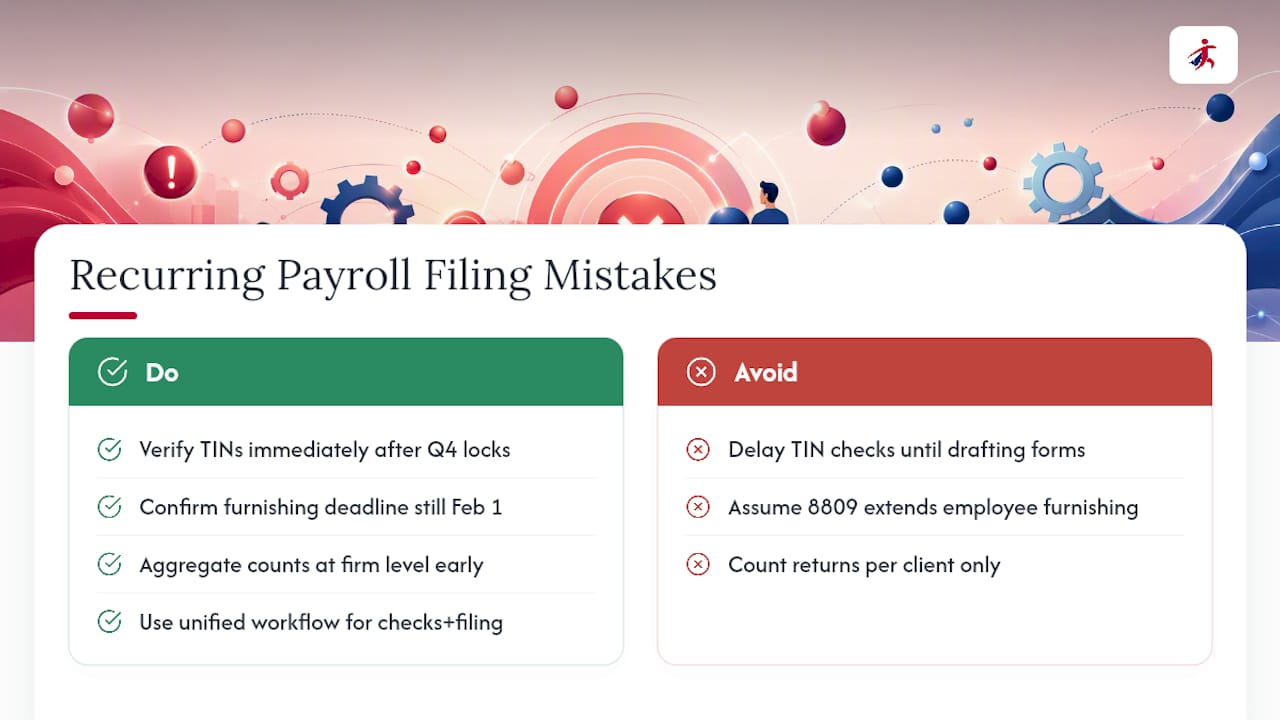
The third is aggregate counting across multiple clients or business units. A payroll firm handling several small employers might file well under 10 returns for any single client, then discover too late that their combined volume crossed the electronic filing threshold months earlier. Counting early, at the firm level rather than the client level, prevents that surprise.
None of these mistakes require a new tool to fix, exactly. They require sequencing discipline, which is where a workflow that combines TIN checks, bulk data handling, and filing in one place earns its keep. TaxFormHero is IRS-authorized and built to SOC 2-ready data security standards, which matters less as a marketing point and more as a baseline: payroll data moving through any e-filing system needs that level of handling, whatever platform a team ultimately chooses.
— Nazrul
A Pay-Per-Form Way to Handle the February 1 Deadline
This type of platform is built for exactly the crunch this article just walked through: verifying data, avoiding rejections, and getting forms to the SSA and employees before February 1, 2027, without paying for a subscription you only need for six weeks a year.
The platform charges per form filed, starting at a low per-form price that decreases as volume increases, with no signup fees and no annual contract sitting behind it. That pricing structure fits payroll professionals and accounting firms who file W-2s seasonally rather than year-round, since you’re not carrying software costs through months when you’re not filing anything. Bulk import handles large employee counts without manual re-entry, TIN verification catches mismatches before submission, and add-ons for state filing, print and mail, and encrypted e-delivery mean furnishing employee copies happens inside the same workflow as SSA filing rather than as a separate scramble.
If your team is heading into the 2027 filing season without a clear e-filing plan, check the per-form pricing and see whether a pay-as-you-file model fits your volume better than what you’re using now.
Sources
The dates and rules in this article come directly from federal guidance, not secondhand summaries. The SSA’s employer deadline page confirms the February 1, 2027 filing and furnishing date, and its Business Services Online portal is where employers register to e-file. The IRS General Instructions for Forms W-2 and W-3 cover Form 8809 extension rules and penalty structures in full detail, and the IRS FAQ on missing or incorrect W-2s walks through employee remedies including Form 4852. For broader payroll workflow context, Roll With Paid covers payroll and employee-communication practices that complement the compliance steps above.
FAQ
What happens if I don’t get my W-2 by February 1?
Contact your employer first to confirm the form was sent to your correct address. If it’s still missing after that, call the IRS at 800-829-1040 for help, and use Form 4852 to file your return if the deadline is approaching and you still don’t have it.
What’s the deadline to file W-2s for the 2026 tax year?
Both the SSA filing deadline and the employee furnishing deadline are February 1, 2027, since the standard January 31 date falls on a Sunday that year.
When should I start filing W-2s for the 2027 season?
Start TIN and address verification in early January and aim to submit final forms to the SSA well before February 1, 2027, ideally by the last week of January to leave room for correcting any rejections.
What is the $600 rule?
The rule about thresholds generally refers to information return thresholds for payments to non-employees, most often 1099-NEC reporting, and doesn’t apply to W-2 wages, which must be reported regardless of amount once an employer-employee relationship and withholding exist.
Can I get an extension for filing W-2s?
You can request a single 30-day extension using Form 8809, but the IRS grants it only for extraordinary circumstances, and it typically doesn’t extend the deadline to furnish copies to employees.
Recommended
- E-File W-2 Forms: 2026 Guide for Payroll Professionals
- Where to Mail W-2 Forms: SSA and IRS Rules for 2026
- 1099 Deadlines 2026: What Small Businesses Must Know

File Information Returns With Confidence
TaxFormHero supports 20+ IRS information returns, including 1099 and W-2 forms, with bulk Excel import, name/TIN matching and encrypted recipient delivery.
Explore TaxFormHero