
Yes, businesses generally must file Form 1099-MISC for rent payments once the total paid to one recipient reaches $2,000 in a calendar year, under the updated 2026 threshold. This applies only to rent paid in the course of a trade or business, not personal rent. Watch two exceptions closely: payments routed through a real estate agent, and rent paid through a third-party network, both of which can affect your filing duty.
TL;DR:
- Rent payments totaling $2,000 or more made in the course of a trade or business must be reported on Form 1099-MISC, but only if paid to non-corporate landlords.
- Payments routed through a property manager or third-party network typically shift the filing responsibility away from the tenant, often to the manager or payment platform.
- If rent is paid by credit card or through a third-party network, the payment processor usually issues a Form 1099-K, so no manual 1099-MISC filing is necessary for those transactions.
- Collecting a signed W-9 upfront and tracking cumulative payments throughout the year helps prevent missed or duplicate filings and ensures accurate reporting.
- Filing deadlines are January 31 for recipient copies, with electronic submissions due by March 31 for those filing multiple forms or large volumes.
Who Must File: The Basic Rule and the 2026 $2,000 Threshold
The IRS raised the rent reporting threshold to $2,000 for payments made during the 2026 calendar year, up from the $600 figure that applied for decades. If your business paid a non-corporate landlord or lessor $2,000 or more in rent, you owe that recipient a Form 1099-MISC with the amount in Box 1.

The word “business” carries weight here. The IRS reporting requirement applies only to rent paid in the course of a trade or business. Renting your own apartment or your family’s vacation home never triggers a 1099-MISC, regardless of how much you pay. Renting office space, a warehouse, retail storefront, or equipment yard for your company does, once the threshold is met.
A few concrete examples clear up where the line falls:
- A dental practice paying $1,800 a month for office space owes a 1099-MISC. That is $21,600 a year, well past $2,000.
- A freelance photographer renting studio space for occasional shoots at $150 a session stays under the threshold unless total annual payments to that studio owner hit $2,000.
- A homeowner paying rent on a personal residence never files, regardless of amount, because there is no trade or business behind the payment.
- A farmer paying a landowner for pasture use as part of a working farm operation counts as reportable business rent.
The aggregation rule trips up more payers than the threshold itself. You do not measure $2,000 against a single check or invoice. You add up every rent payment made to the same recipient across the full calendar year, then compare that total to the IRS threshold. Multiple smaller payments accumulating over the year can cross the threshold even if no individual payment looks large. Track cumulative totals per payee throughout the year rather than waiting until December to add everything up.
TaxFormHero is an IRS-authorized e-filing platform, so you can e-file Form 1099-MISC online without paper or a subscription.
What Counts as Rent for Box 1
Box 1 of Form 1099-MISC covers various types of rent payments related to business use such as real property and equipment rentals.
Common reportable rent payments include:
- Office, retail, or warehouse space leased for business operations
- Land or pasture rented for agricultural or grazing use
- Equipment, machinery, or vehicle rentals used in the business
- Storage unit or facility rental tied to business inventory or records
- Billboard or signage space rented for advertising purposes
Bundled arrangements need prorating. If you rent a piece of equipment and the owner also supplies an operator, only the rental portion belongs in Box 1. The labor portion is a service payment and typically belongs on Form 1099-NEC instead. The same logic applies to a furnished office space where the landlord also provides cleaning or reception staff as part of the deal; separate the property charge from the service charge whenever the invoice allows it.
Rent is also easy to confuse with categories that use different forms entirely. Wages paid to an employee who happens to also lease you space go on a W-2, not a 1099-MISC, because employment status governs that reporting regardless of the rental angle. Reimbursements for a landlord’s actual expenses, when properly documented as pass-through costs rather than rent markup, generally fall outside Box 1 too. If you are unsure whether a payment is rent or a service fee, our guide on 1099-NEC vs 1099-MISC walks through the distinction in more detail.
Do Corporate Landlords and Property Managers Change the Rule?
Two exceptions account for most of the confusion payers run into, and both are worth checking before you assume a 1099-MISC is required.
- The corporate exception. Payments to a corporation are generally exempt from 1099-MISC reporting based on payee tax classification. You confirm this through Form W-9, where the payee checks a box indicating its tax classification. If your landlord is set up as a C corporation or S corporation, you typically do not need to file, even past $2,000. Keep the signed W-9 on record as proof of that classification if the IRS ever asks.
- Agents and property managers. When a property manager collects rent on an owner’s behalf and then pays the owner, the manager, not your business, generally becomes the filer of record. An IRS information letter on this topic confirms that the party distributing funds to the property owner carries the 1099-MISC responsibility for that distribution. As the tenant, your payment to the management company may still need its own reporting if the manager itself is not a corporation, so this exception shifts the obligation rather than erasing it.
- Other non-reportable payments. Purchases of merchandise, inventory, or goods do not belong in Box 1 even when a rental-sounding invoice is involved. Employee wages stay on Form W-2. Straight reimbursements for documented expenses, distinct from rent itself, generally fall outside the rent category as well.
The IRS page on information return filing requirements walks through these exceptions in more depth, including the exact language on agent reporting that supports point two above.
How Does 1099-K Reporting Affect Rent Payments?
Paying rent by credit card or through a third-party network changes who files. Payment-card transactions and many third-party network payments are generally reported by the payment settlement entity on Form 1099-K, not by you on Form 1099-MISC.
That distinction matters in practice. If your business pays commercial rent through a card processor, that processor typically issues the 1099-K to the landlord covering those card transactions. You are not required to also file a 1099-MISC for the same payments, because doing so would create duplicate reporting to the IRS for identical income.
A few situations to watch:
- Rent paid by check or direct bank transfer stays your responsibility to report on Form 1099-MISC once the $2,000 threshold is met.
- Rent paid through a payment app or card processor is generally covered by that platform’s 1099-K, removing it from your Box 1 total.
- Mixed payment methods to the same landlord require you to separate card and network payments (processor’s job) from check and cash payments (your job) when tallying the $2,000 threshold.
Pro Tip: Keep a simple log for each landlord noting how every payment was made. At year-end, you will need seconds, not hours, to determine which payments are yours to report and which the processor already covered.
Collecting Payee Info and Preparing the 1099-MISC
Filing accuracy starts months before the January deadline, not the week before it.
- Request Form W-9 before the first payment. Get it signed when you sign the lease, not after the first rent check clears. The form captures the landlord’s legal name, tax classification (individual, partnership, corporation), and Taxpayer Identification Number.
- Verify the TIN. Run the number through the IRS TIN-matching program or a vendor tool built into your filing platform. A mismatched TIN is one of the most common reasons the IRS sends a notice after filing season.
- Track cumulative rent per recipient monthly. Do not wait until December. A running total for each landlord tells you early whether the $2,000 threshold will be crossed and whether you need to start the W-9 conversation sooner.
- Confirm the correct box. Rent goes in Box 1 of Form 1099-MISC. Double-check that no portion of the payment belongs on a different form, particularly when services are bundled into the lease.
- Apply backup withholding when required. If a payee refuses to provide a TIN or provides one that fails verification, you generally must withhold 24% for backup withholding from future payments until the issue is resolved.
Automating TIN verification instead of checking numbers by hand reduces incorrect-TIN notices and cuts down on the corrected returns that follow those notices. That single step, collecting a signed W-9 at the start of a lease relationship rather than scrambling for one in January, is the difference between a routine filing season and a stressful one spent chasing landlords for missing information.
When Are 1099-MISC Forms Due and How Do You File Them?
Recipients need their copy of Form 1099-MISC for rent reporting by January 31 following the tax year, giving landlords enough time to prepare their own returns. The IRS filing deadline follows a slightly different track depending on how you submit.
- Paper filing with the IRS is due by the last day of February.
- Electronic filing is due by March 31, giving e-filers roughly a month of extra runway.
- Businesses filing 10 or more information returns of any type combined must file electronically, a threshold that catches most landlords and property managers filing multiple 1099s in one season.
The IRS filing system for information returns has shifted to IRIS (Information Returns Intake System), which is replacing the older FIRE system for electronic submissions. If you plan to file directly through the IRS rather than through an authorized e-file provider, you need to apply for a Transmitter Control Code (TCC) well ahead of your filing deadline, since processing that application takes time you do not want to lose in late January. Our breakdown of 1099 deadlines for 2026 covers the IRIS transition timeline in more detail.
Mistakes happen even with careful preparation. If you catch a wrong dollar amount or an incorrect TIN after filing, you file a corrected return marked as such on the form, using the same box structure as the original. The IRS instructions for Forms 1099-MISC and 1099-NEC outline the exact correction process, and you generally need to send the recipient an updated copy as well so their records match yours. Our step-by-step e-filing guide walks through both original and corrected filings.
Year-End Checklist for Rent Reporting
Three tasks separate payers who file smoothly from those who scramble in January.
- Collect and verify a signed W-9 from every landlord, property manager, or equipment lessor before the relationship’s first payment.
- Track cumulative rent paid to each recipient throughout the year and flag any account approaching $2,000.
- Confirm who actually files: you, a property manager acting as agent, or a payment processor issuing a 1099-K.
| Action | Timing | Why it matters |
|---|---|---|
| Collect signed W-9 | Before first rent payment | Confirms tax classification and TIN |
| Monitor cumulative rent per payee | Monthly or quarterly | Catches the $2,000 threshold early |
| Verify TIN accuracy | Before year-end filing | Avoids IRS mismatch notices |
| Confirm filer of record | Before January | Prevents duplicate or missed filings |
| Prepare recipient statements | By January 31 | Meets IRS delivery deadline |
What Happens If You File Late or File Wrong?
The most common errors are avoidable: a missing W-9, a mistyped TIN, or a rent total that undercounts payments spread across multiple checks during the year. Each triggers a different IRS response, but none are pleasant to deal with in April.
Filing late or with an incorrect TIN generally exposes a business to penalties that scale with how late the correction comes, and repeated errors draw closer IRS scrutiny on future filings. A missing or incorrect TIN can also trigger backup withholding obligations you did not anticipate, adding a compliance headache on top of the penalty itself.
- Missing W-9: request one immediately and hold future payments if the landlord refuses to provide a TIN.
- Wrong TIN: file a corrected return once you have the accurate number, and notify the recipient of the correction.
- Underreported rent totals: recalculate the full-year total per payee and file a corrected 1099-MISC reflecting the true amount.
- Late filing: file as soon as the error is caught. Penalties generally increase the longer a correction is delayed.
Timely corrections and documented W-9s are your best defense. Automated e-file tools that flag TIN mismatches before submission catch most of these problems before they become IRS notices.
The Part of This Rule Most Guides Get Backward
Most coverage of 1099-MISC rent reporting treats the $2,000 threshold as the whole story. It is not. The threshold decides whether you file. The trade-or-business test, the corporate exception, and the property manager rule decide who files, and that second question causes far more missed filings and duplicate filings than the dollar amount ever does.
Here is where conventional advice falls short: it tells landlords and small business owners to “check the threshold” without warning them that a property manager relationship can quietly transfer the filing duty away from the tenant, or that a card-processed rent payment removes the obligation entirely. Skip that nuance and you either file when you should not, or assume someone else filed when nobody did.
Prioritize the W-9 collection habit above everything else described here. A signed W-9 on file the day a lease starts answers the corporate-exception question, the TIN-accuracy question, and the trade-or-business question all at once. Everything downstream, from the threshold math to the correct box entry, gets easier once that one document exists.
— Nazrul
File 1099-MISC Rent Payments Without the Guesswork
Tracking rent totals across a dozen landlords, chasing down W-9s, and hoping every TIN matches is not a good use of a small business owner’s January. TaxFormHero is built specifically for the mechanics this article just walked through: an IRS-authorized e-file provider that handles bulk import for multiple properties, built-in TIN verification to catch mismatches before you submit, and encrypted recipient delivery so landlord copies go out by the January 31 deadline without printing a single envelope.
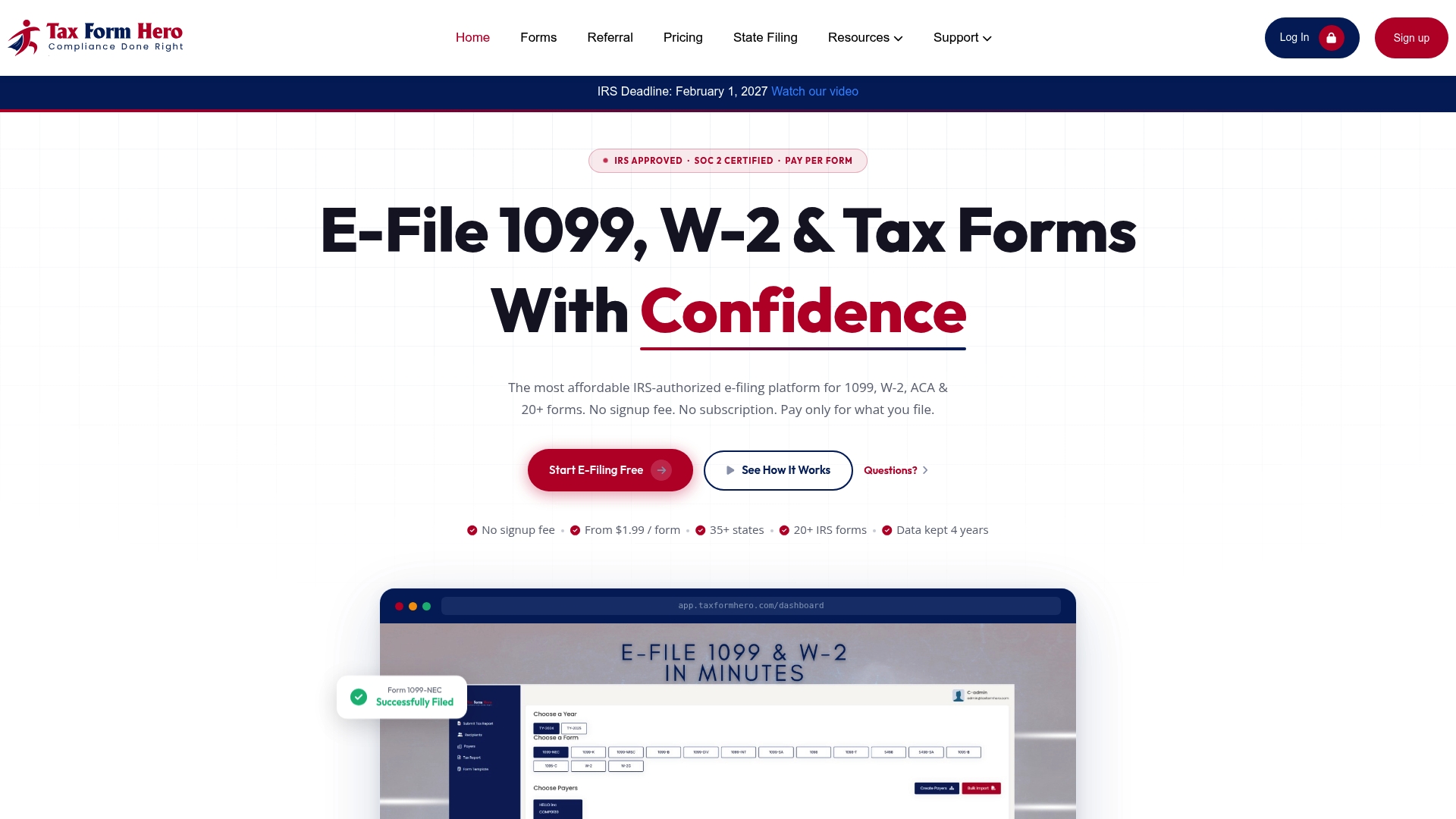
Pricing for pay-per-form e-filing varies, and some services do not require signup fees or subscriptions. Property managers filing for multiple landlords typically pay per form filed. Some services include state filing for multiple states and offer corrected-return workflows that simplify fixing errors such as wrong TINs or underreported rent totals. If you are filing for the first time this season, the step-by-step e-file guide walks through the exact screens you will see, from importing your payee list to submitting the batch.
FAQ
Does Rent Need to Be Reported on a 1099?
Yes, if a business paid $2,000 or more in rent to a non-corporate recipient during the 2026 calendar year in the course of a trade or business. Personal rent payments never require reporting.
Do You Have to Report Rent Payments to the IRS if You Use a Credit Card?
Generally no. When rent is paid by credit card or through a third-party network, the payment settlement entity typically issues Form 1099-K to the landlord, so the payer does not also file a 1099-MISC for those same payments.
Can I Deduct Rent on My 1099-MISC Form?
Form 1099-MISC is an information return you file to report payments made to someone else, not a place to claim your own deductions. Business rent deductions belong on your own tax return, separate from the 1099-MISC you issue to the landlord.
Who Is Responsible for Filing When a Property Manager Collects Rent?
The property manager generally becomes the filer for amounts distributed to the property owner, based on IRS guidance on agent reporting. As the tenant, confirm with the manager who is issuing the 1099-MISC before assuming the duty falls to you.
What Happens if I File a 1099-MISC With the Wrong TIN?
You need to file a corrected return using the accurate Taxpayer Identification Number and send the recipient an updated copy. Verifying the TIN before filing, through IRS TIN-matching or a platform like TaxFormHero, prevents this correction cycle entirely.
Recommended
- Avoid Missed 1099s: Small Businesses and the $2,000 1099-NEC Threshold
- 1099-K Threshold 2026: What Small Businesses Need to Know
- 1099 Deadlines 2026: What Small Businesses Must Know
- How to File 1099 Forms: A 2026 Small Business Guide

File Information Returns With Confidence
TaxFormHero supports 20+ IRS information returns, including 1099 and W-2 forms, with bulk Excel import, name/TIN matching and encrypted recipient delivery.
Explore TaxFormHero