
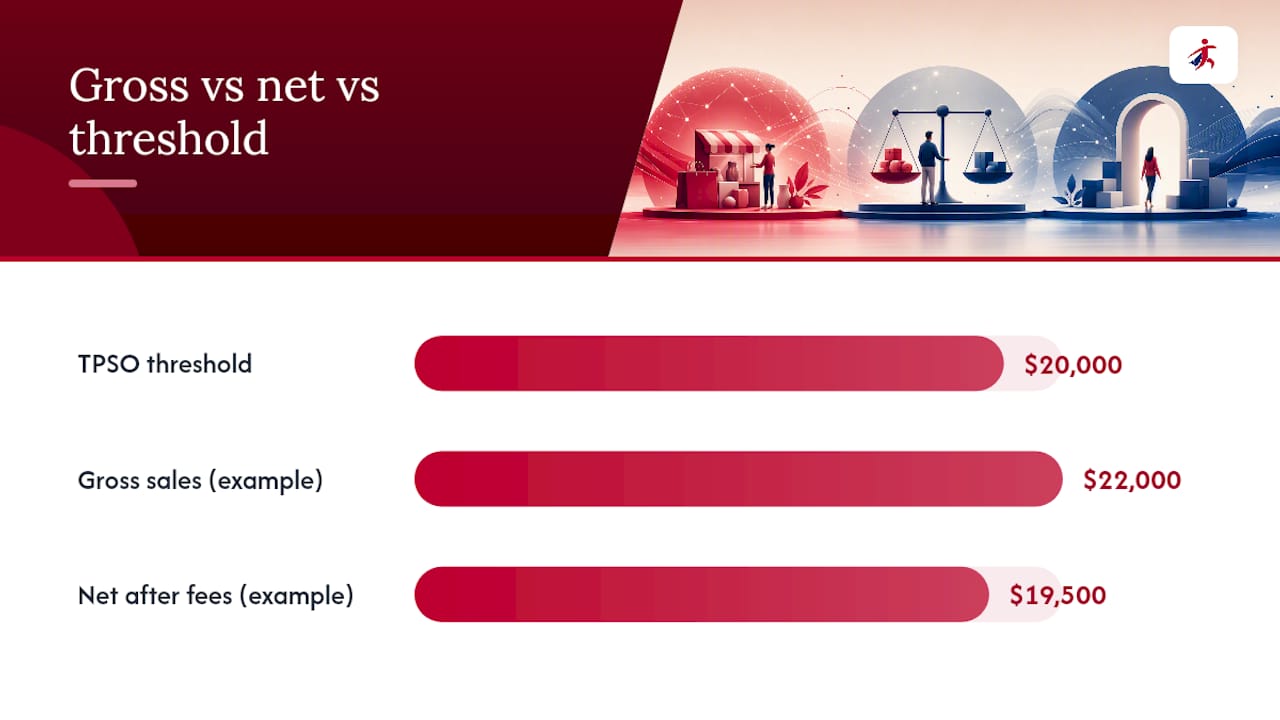
For tax year 2026, third-party settlement organizations (TPSOs) must file Form 1099-K only when gross payments to a payee exceed $20,000 and the total transaction count exceeds 200. That dual requirement was restored by the One, Big, Beautiful Bill Act (P.L. 119-21), which reversed earlier planned reductions to the threshold. One critical caveat applies immediately: payment card processors and merchant acquiring entities operate under a separate rule with no de minimis threshold, meaning they may issue a 1099-K for any dollar amount of card transactions, regardless of volume.
Key Takeaways
For tax year 2026, TPSOs must file Form 1099-K only when gross payments exceed $20,000 and transaction count exceeds 200, a threshold restored by P.L. 119-21, but all income remains taxable regardless of whether a form is issued.
| Point | Details |
|---|---|
| 2026 TPSO threshold | TPSOs file only when gross payments exceed $20,000 AND transactions exceed 200 for the year. |
| Card processors: no floor | Merchant card processors report all card transactions with no dollar or count minimum. |
| All income is taxable | Not receiving a 1099-K does not reduce your tax obligation; report all income from goods or services. |
| Reconcile using gross amounts | Platform reports show unadjusted totals; deduct fees and refunds in your books, not on the form. |
| TaxFormHero for filing | TaxFormHero’s IRS-authorized platform handles bulk 1099 e-filing, TIN verification, and corrected forms starting at $1.99 per form. |
Need to get this filed? You can e-file Form 1099-K online with TaxFormHero, which is IRS-authorized and charges per form, not per month.
What is Form 1099-K and who files it?
Form 1099-K is an information return that reports gross payment transactions received through third-party networks and payment cards. Three categories of payers file it:
- Third-party settlement organizations (TPSOs): Payment apps, online marketplaces, and peer-to-peer platforms (such as payment apps used for goods and services, or e-commerce marketplaces) that settle transactions between buyers and sellers.
- Payment card/merchant acquiring entities: Banks and processors that handle credit card, debit card, and stored-value card transactions on behalf of merchants.
- Other payers: Entities that process payments outside the two categories above but still meet filing criteria under IRS rules.
The IRS defines “gross amount” as the total unadjusted dollar value of reportable transactions. No deductions are made for fees, refunds, shipping costs, or chargebacks before the figure appears on the form. That distinction matters in practice. A seller who processes $22,000 in gross sales but nets only $19,500 after platform fees and refunds will still receive a 1099-K showing $22,000. The net figure belongs in the seller’s books, not on the form itself.
The difference between payer types is equally concrete. A marketplace-issued 1099-K reflects aggregated payments across all buyers on that platform. A merchant processor-issued 1099-K reflects card-swipe transactions at a physical or virtual point of sale. Both use gross amounts, but only the TPSO version carries the $20,000 and 200-transaction threshold.
How did the 1099-K reporting threshold get to $20,000 in 2026?
The threshold history is short but consequential. Before the American Rescue Plan Act of 2021 (ARPA), the federal TPSO threshold stood at $20,000 and 200 transactions. ARPA amended the law to drop that floor to $600 with no transaction-count requirement, a change that would have triggered a flood of new forms for casual sellers and gig workers. The IRS delayed implementation repeatedly through transitional relief notices while Congress debated the practical fallout.
P.L. 119-21, the One, Big, Beautiful Bill Act, resolved that uncertainty by reinstating the pre-ARPA threshold for tax year 2025 and all subsequent years. The planned phase-ins were canceled. For 2026, the operative rule is the restored $20,000 and 200-transaction standard, confirmed in IRS FAQs published after the bill’s enactment.
Pro Tip: Check the IRS newsroom and your platform’s year-end reporting settings each fall. Platforms update their thresholds to reflect current law, and a mid-year legislative change can shift what you receive in January.
Why the threshold applies differently to TPSOs and card processors
The distinction between TPSOs and payment card processors is not a technicality. It determines whether you receive a 1099-K at all, and from whom.
| Payer type | Filing threshold | Examples | Practical note |
|---|---|---|---|
| TPSO (payment apps, marketplaces) | More than $20,000 AND more than 200 transactions | E-commerce platforms, peer-to-peer payment apps used for goods/services | Below threshold, no federal filing obligation — though platforms may still issue forms voluntarily |
| Payment card/merchant acquiring entity | No de minimis threshold | Credit card processors, debit card networks, point-of-sale processors | Must report all card payment transactions regardless of dollar amount or count |
Card processors have no de minimis threshold and must report every card transaction they process. A merchant who accepts $500 in credit card payments for the year can still receive a 1099-K from their card processor. That is a meaningful difference for small retailers, food vendors, and service providers who rely on card terminals rather than marketplace platforms.
The actionable step here is straightforward: contact each platform or processor you use and confirm their year-end reporting rules before December 31. Some TPSOs issue forms voluntarily below the federal threshold, and some states impose lower thresholds that trigger platform reporting even when federal rules do not.
Pro Tip: Request your annual transaction summary from every payment platform you use, not just the ones that send a 1099-K. That report is your primary reconciliation document regardless of whether a form arrives.
What the 1099-K threshold does and does not mean for your tax return
The most consequential misconception about Form 1099-K is that not receiving one means the income does not need to be reported. That is incorrect. The IRS requires taxpayers to report all income from goods or services on their annual tax return, whether or not an information return was issued.
Form 1099-K is an information return only. It tells the IRS what a payer reported; it does not define your taxable income. The threshold governs the payer’s filing obligation, not yours.
A few common myths, corrected:
- Myth: “I didn’t get a 1099-K, so I don’t owe tax on those sales.” Fact: Income is taxable when earned, not when reported on a form.
- Myth: “The amount on my 1099-K is my taxable income.” Fact: The form shows gross payments. Deductible business expenses, fees, and refunds reduce your net taxable income — but you calculate that separately.
- Myth: “The federal threshold is the only one that matters.” Fact: Some states set lower reporting thresholds. You may receive a state-triggered 1099-K from a platform even when you fall below the federal $20,000 and 200-transaction level, as Fidelity’s guidance on state-level thresholds notes.
Practical steps to prepare for 2026 reporting
Good recordkeeping is the foundation of 1099-K compliance. These steps apply whether you are a solo freelancer or a multi-platform seller.
- Open a dedicated business account. Separate business receipts from personal transactions. Commingled accounts make reconciliation far harder and create audit risk.
- Export transaction reports from every platform monthly. Do not wait until January. Most platforms allow CSV or spreadsheet exports; schedule these as a recurring task.
- Tally gross amounts per platform. Use the platform’s gross payment figure, not your net deposits. Fees, refunds, and shipping are deducted in your books, not on the 1099-K.
- Track transaction counts per platform. For TPSOs, the 200-transaction threshold is a separate trigger. Keep a running count alongside your dollar totals.
- Reconcile platform totals against your accounting records quarterly. Discrepancies are easier to resolve before year-end than in February when forms arrive.
- Consult a CPA if you operate across multiple platforms, have high refund volume, or receive tips. The updated Form 1099-K instructions added new boxes for cash tips and Treasury Tipped Occupation Codes, which affect tipped-occupation reporting specifically.
Retain all records for at least three years from the filing date, and up to seven years if you have reported a loss or underreported income in prior years.
Pro Tip: *Set up automated monthly exports from each platform and save them to a dedicated folder organized by platform and year.
A quick reconciliation example: if your e-commerce platform shows $23,000 in gross payments across 215 transactions, you clear both thresholds and should expect a 1099-K. Your taxable income is not $23,000. Subtract documented business expenses, platform fees, and refunds in your accounting software to arrive at net profit, which is what you report.
How to respond if your 1099-K is incorrect
Errors on Form 1099-K do occur, particularly when platforms aggregate transactions incorrectly or include personal transfers in gross amounts. Follow this process:
- Compare the form against your platform’s transaction report. Identify the specific discrepancy with dollar amounts and transaction dates.
- Contact the payer’s support team in writing. Submit a written request for a corrected Form 1099-K with your documentation attached. Email creates a time-stamped record.
- Request a corrected form (marked “Corrected” at the top). The payer must file the corrected version with the IRS and send you a copy.
- Keep all communications and the corrected form. Store screenshots, email threads, and both the original and corrected forms together.
- If the payer does not resolve the error, file your tax return accurately using your own records. Attach a brief explanation of the discrepancy. The IRS instructs taxpayers to report actual income even when a form is wrong.
For persistent disputes, the IRS provides guidance through its Form 1099-K FAQ page and, in cases of suspected fraud or willful misreporting, Form 3949-A for reporting tax law violations.
Pro Tip: Keep a dedicated folder with platform reports, screenshots of your transaction history, and all payer correspondence. If the IRS ever questions a discrepancy, that documentation is your first line of defense.
What the 2026 threshold reinstatement actually means for small sellers
The restoration of the $20,000 and 200-transaction threshold is genuinely good news for small sellers who would have faced a 1099-K for every modest side income under the planned $600 rule. Fewer forms means less administrative burden and fewer opportunities for mismatched data to trigger IRS notices.
But the reinstatement does not reduce the underlying tax obligation, and it does not simplify the recordkeeping requirement. The IRS and tax professionals have been consistent on this point: the threshold governs information reporting, not taxable income. A freelancer earning $15,000 through a payment app will not receive a federal 1099-K, but every dollar of that income remains reportable.
Where professional help is worth the cost: multi-platform sellers with high refund volumes, anyone receiving tips subject to the new cash-tip reporting boxes, and businesses that issue 1099-K or 1099-NEC forms to their own contractors. The compliance picture gets complicated quickly when you are both a recipient and a filer.
File your 1099 forms accurately with TaxFormHero
When you need to issue 1099 forms to contractors or reconcile corrections at scale, TaxFormHero gives you a faster path than manual paper filing.
TaxFormHero is an IRS-authorized e-filing platform built for businesses, accounting firms, and payroll professionals who need to file 1099, W-2, ACA, and 20+ IRS form types without subscriptions or setup fees. Key capabilities relevant to 1099-K compliance include:
- Bulk import: Upload recipient data via CSV to file dozens or hundreds of forms in a single session.
- TIN verification: Match taxpayer identification numbers against IRS records before filing to reduce rejection risk.
- State filing add-ons: Direct state filing for 35+ states, print-and-mail delivery, and encrypted e-delivery to recipients.
- Corrected form filing: File corrected 1099s directly through the platform when a recipient disputes an original form.
Pricing starts at $1.99 per form with no annual commitment. Visit TaxFormHero to file your first form or import a batch today.
Sources
These primary sources should be your first stop for verifying current rules and form requirements:
This article provides general information about federal tax reporting requirements and is not a substitute for professional tax advice. Confirm current rules with IRS.gov or a qualified tax professional before filing.
Recommended

File Information Returns With Confidence
TaxFormHero supports 20+ IRS information returns, including 1099 and W-2 forms, with bulk Excel import, name/TIN matching and encrypted recipient delivery.
Explore TaxFormHero