
Any U.S. person or business you pay for services in a calendar year needs to give you a completed Form W-9 before that money goes out the door. The rule is simple: request the signed form before the first payment, not after, and attach it to the vendor record before you set up recurring payments. Waiting until January, when 1099 season hits, is how businesses end up chasing signatures they should have collected months earlier.
Once you have the form, don’t just file it away. Cross-check the name and Taxpayer Identification Number (TIN) against IRS records through the TIN Matching program, or hold the first payment until you can confirm the information is accurate. Getting this sequence right at the start prevents almost every downstream compliance headache.
Here’s the immediate action plan:
- Before onboarding any new vendor: send the W-9 request as part of the intake packet, not as an afterthought.
- Before the first payment clears: confirm you have a signed, dated W-9 on file.
- Within days of receiving it: run a TIN match or flag the account for manual review if the name and number don’t line up.
- If no form arrives: pause payment rather than proceeding on a promise to “send it later.”
Key Takeaways
A compliant W-9 process gates every payment behind a signed form, a confirmed TIN match, and a documented audit trail that protects the business if the IRS ever questions a filing.
| Point | Details |
|---|---|
| Request before payment | Collect a signed W-9 during onboarding, never after the first check has already been sent. |
| Verify with TIN Matching | Run interactive or bulk TIN Matching before filing to catch mismatches early and avoid CP2100 notices. |
| Store forms securely | Keep signed W-9s in encrypted, access-controlled storage, not shared inboxes or unprotected drives. |
| Act fast on CP2100 notices | Mail a First B-Notice within 15 business days and begin backup withholding within 30 days if unresolved. |
| Automate with TaxFormHero | TaxFormHero centralizes W-9 collection, TIN verification, and secure storage on one IRS-authorized platform. |
Filing one yourself? You can e-file Form 1099-NEC online with TaxFormHero, an IRS-authorized e-filing platform.
Do You Need a W-9? Which Payees and When to Ask
A W-9 request applies to U.S. persons, a category that covers individuals, sole proprietors, partnerships, and most domestic corporations receiving reportable payments. If you’re paying an independent contractor, freelancer, consultant, or most service vendors more than $600 in a year, you need their taxpayer information on file. This includes attorneys, landlords, and freelance designers, not just the obvious 1099-NEC contractor relationships.
The timing matters as much as the requirement itself. Collecting the form before the first payment protects you two ways: it keeps the vendor motivated to respond (nobody delays paperwork when a check is waiting on it), and it gives you a clean audit trail showing you exercised due diligence from day one. Waiting until year-end, when you’re racing to file 1099s, means chasing dozens of vendors simultaneously while some have already moved on or gone unreachable.
There are real exceptions worth knowing:
- Foreign vendors don’t get a W-9. Foreign persons and entities should complete the appropriate W-8 series form instead, since a W-9 certifies U.S. status.
- Many corporations are exempt from 1099 reporting, but you should still collect a W-9 to confirm their entity type and exemption status in writing rather than assuming it.
- One-time purchases of goods (not services) generally don’t trigger a W-9 requirement, though many finance teams collect one anyway to simplify future transactions with the same vendor.
When in doubt, request the form. A W-9 you didn’t strictly need costs you nothing. A missing W-9 for a vendor who crosses the $600 threshold mid-year costs you a scramble.
Step-by-Step Request Process With Templates and Timelines
A reliable W-9 request process treats the form as a gate, not a suggestion. Build it into vendor onboarding so no one can be added to your payment system without a completed form attached to their record.
Here’s the workflow that works for most accounts payable teams:
- Include the W-9 in your onboarding packet. Send it alongside the vendor agreement, direct deposit form, and any other setup paperwork, all in one request.
- Set a due date. Give vendors 7 to 14 days to return the signed form before you follow up.
- Send a reminder at the 7 to 14 day mark if nothing has arrived. Keep it short and specific about what’s missing.
- Escalate after the second missed deadline. Loop in the vendor’s primary contact or their finance department directly.
- Pause payment if the form still hasn’t arrived. Best practice from vendor-onboarding guides is to collect the W-9 before any funds move, and holding payment is the only lever that reliably gets a response.
Three templates cover most situations your team will face:
Onboarding email: “Welcome aboard. Before we can process your first payment, we need a completed and signed Form W-9 on file. You can download the form directly from the IRS website or submit it through our vendor portal. Please return it within 10 business days so we can avoid any delay to your payment schedule.”
Portal notice (for vendors managing their own profile): “Your vendor account is missing a required W-9 form. Payments will be held until this document is uploaded and verified. Log in to your portal to submit it now.”
Phone script (for overdue accounts): “Hi, I’m calling about the W-9 we requested for your account. We haven’t received it yet, and it’s holding up your next payment. Can you send it over today, or would it help if I resend the form?”
Document every request the moment you send it. Date-stamp copies, log the request in your vendor management system or ticketing tool, and keep a record of every follow-up. If a CP2100 notice ever arrives questioning a vendor’s TIN, this paper trail becomes your evidence that you made a good-faith effort from the start.

Electronic W-9 Collection and TIN Matching, Explained
The IRS allows electronic W-9 submissions, but only if your system meets specific requirements. According to the Instructions for the Requester of Form W-9, an electronic system must authenticate the person submitting the form, maintain an audit trail, and be able to produce a hard copy that includes the signer’s electronic signature made under penalties of perjury. A simple email attachment with no verification layer doesn’t meet that bar on its own, which is why many businesses use dedicated vendor portals or e-filing platforms rather than relying on inboxes.
That authentication requirement isn’t a technicality you can skip. If the IRS ever questions a filing, you need to reproduce the exact form your vendor submitted, complete with a verifiable signature trail. A system that can’t do that leaves you exposed even if the vendor genuinely did submit a W-9.
Once you have the form, TIN Matching closes the loop. The IRS’s TIN Matching service lets authorized payers check whether a name and TIN combination matches IRS records, either one at a time through interactive matching or in batches through bulk matching. Interactive matching works well for onboarding a handful of new vendors each month; bulk matching makes more sense if you’re validating a large vendor file ahead of 1099 season.
Result codes tell you what to do next:
- A match means you’re clear to file with confidence.
- A TIN not found result usually means a typo or a name/TIN mismatch that needs correction from the vendor.
- Multiple TINs found or similar ambiguous codes call for a follow-up request to confirm the correct number directly with the payee.
Pro Tip: Run TIN matching in two waves: once during onboarding for every new vendor, and again in October or November before your 1099 filing deadline. Catching a mismatch three months before filing gives you time to fix it. Catching it in January does not.
Pre-filing validation through TIN Matching is the single most effective step for reducing your exposure to CP2100 notices. A mismatch caught before you file never generates a notice at all, which means no B-Notice, no backup withholding deadline, and no scramble to fix records after the fact.
Secure Storage and Retention Rules for W-9 Forms
A signed W-9 contains a Social Security number or Employer Identification Number, which makes it sensitive data the moment it lands in your inbox. Storing it in an unprotected email thread or a shared drive with broad access is the kind of mistake that turns a minor paperwork gap into a real data exposure problem.
Best practice calls for encrypted cloud storage with access limited to the people who actually need it, typically accounts payable staff and whoever handles 1099 filing. Avoid keeping signed forms as email attachments long-term. Move them into a dedicated, access-controlled system as soon as they’re received, and remove them from inboxes once they’re archived properly.

Retention timing matters more than most finance teams assume. While the IRS doesn’t specify a rigid minimum for the W-9 itself, a practical and safer range is to retain the signed form and associated TIN Matching results for as long as the vendor relationship is active, plus several years afterward. This mirrors the retention window many teams already apply to 1099 backup documentation.
Keep this file complete for every vendor:
- The signed W-9, in its original submitted format (PDF or paper scan).
- A timestamp showing exactly when the form was received.
- The TIN Matching result, whether it came back as a match or flagged an issue.
- Copies of any B-Notice correspondence, if one was ever triggered.
- A log of every request and reminder sent, in case the vendor disputes the timeline.
If the IRS ever questions a filing, this bundle is what supports a reasonable-cause defense. A signed W-9 with a clear audit trail shows you collected the right information at the right time and acted on any discrepancy the moment it surfaced.
Handling CP2100 Notices, B-Notices, and Backup Withholding
A CP2100 or CP2100A notice arrives when the IRS finds that a name and TIN combination on one of your filed information returns doesn’t match its records. CP2100 notices go to larger filers; CP2100A goes to smaller ones, but the underlying problem and required response are the same. These notices typically show up months after filing, often in the late summer or fall following the tax season in which the mismatched form was submitted.
The clock starts the moment you receive one. Here’s the sequence:
- Mail a First B-Notice within 15 business days of receiving the CP2100 notice, notifying the vendor that their TIN doesn’t match IRS records and requesting a corrected W-9.
- Give the vendor time to respond with an updated, signed W-9.
- Begin backup withholding at 24% on future payments if you haven’t received a corrected TIN within the required window, generally no later than 30 days after the notice, according to guidance on CP2100 defense and backup withholding.
- Stop withholding once you receive a valid corrected W-9 and the vendor’s information checks out.
A second CP2100 notice for the same vendor within three calendar years triggers a Second B-Notice, and the rules tighten. Instead of accepting a self-certified corrected W-9, you generally need the vendor to provide actual validation from the Social Security Administration or IRS confirming their TIN, since a simple resubmission of the form isn’t enough at that stage.
Document every step of this process the same way you document the original request:
- Save a copy of the CP2100 notice itself, with the date received.
- Keep proof of when the B-Notice was mailed, ideally with tracking or a delivery confirmation.
- Record the date any corrected W-9 arrived and when backup withholding started or stopped.
- Retain evidence of backup withholding remitted to the IRS if it applied.
This is exactly the kind of documentation trail that supports a reasonable-cause argument if the IRS assesses penalties. Businesses that can show they mailed notices on time and began withholding promptly are in a far stronger position than those who can only say they “meant to follow up.”
Common Complications and How to Resolve Them
An unsigned W-9 isn’t a completed W-9. The form includes a certification under penalties of perjury, and without a signature, that certification doesn’t exist, even if every other field is filled in correctly. If you receive an unsigned form, treat it the same as a missing one: send it back immediately with a note explaining exactly what’s needed, and don’t process payment until you have a properly executed version.
“Applied For” in the TIN field means the payee has requested a TIN but hasn’t received it yet. This is legitimate, but it comes with a 60-day clock. You can accept payments during that window, but the vendor needs to follow up with their actual TIN once it’s issued, and you should follow up with them at the 60-day mark if you haven’t heard anything. Don’t let an “Applied For” status sit indefinitely in your files.
A few other situations that call for a fresh W-9 request:
- Entity changes, such as a sole proprietor incorporating or a partnership converting to an LLC, require a new form since the TIN and entity classification may both change.
- Name changes, including a vendor rebranding or a business merging with another entity, need updated documentation to keep your records accurate.
- Address changes alone typically don’t require a new W-9, though it’s reasonable to request one if other details seem outdated.
And remember: foreign payees never belong in your W-9 pile. If a vendor indicates they’re not a U.S. person, redirect them to the appropriate W-8 form instead of pushing a W-9 that doesn’t apply to their situation.
Vendor Onboarding Controls and a Practical Collection Checklist
Reliable W-9 collection isn’t about chasing paperwork harder. It’s about designing a process where payment simply can’t happen without the form in place. That means treating vendor setup as a gated workflow rather than a courtesy request.
Three controls make the biggest difference:
- Payment gating. No vendor record moves to “active” status in your payment system until the W-9 is signed, dated, and stored.
- One master record per payee. Duplicate vendor entries create gaps where a W-9 might exist on one record but not the one actually receiving payment.
- Separation of duties. The person setting up a new vendor shouldn’t be the same person approving payments to that vendor, which reduces the risk of a rushed or skipped W-9 check.
Before approving any payment, confirm you have all three of these on file: a signed W-9, a completed TIN match (or a documented reason it’s pending), and secure proof of both stored where your team can retrieve them quickly.
| Control point | What to verify |
|---|---|
| Signed W-9 on file | Form is complete, dated, and includes a valid signature. |
| TIN match confirmed | Name and TIN combination checked against IRS records, or flagged for follow-up. |
| Secure storage logged | Document is stored in an access-controlled system, not a shared inbox. |
| Re-verification scheduled | Vendor flagged for a fresh W-9 request every 2–3 years or after a structural change. |
That re-verification cadence matters more than most teams realize. A vendor’s entity type or TIN can change years into a relationship, and a periodic refresh every 2 to 3 years catches those shifts before they turn into a mismatch at filing time.
How TaxFormHero Handles the W-9 Process for You
Running this entire workflow manually, spreadsheets, email chains, and a shared drive full of PDFs, works until your vendor list grows past a few dozen names. At that point, the manual gaps start showing up as missing signatures, expired TINs, and CP2100 notices you didn’t see coming.
TaxFormHero is built around the same compliance logic outlined above, but automated. The platform is IRS-authorized and SOC 2 certified, which means the audit trail requirements for electronic W-9 collection, authentication, and reproducibility are built into the system rather than something your team has to engineer on its own. Bulk import lets you onboard an entire vendor list at once instead of chasing forms one at a time, and built-in TIN verification checks name and number combinations before you ever get near filing season.
A few ways this changes day-to-day operations:
- Encrypted e-delivery replaces the unprotected email attachment as the default way forms move between you and your vendors.
- Centralized storage means every signed W-9, TIN match result, and filing record lives in one place instead of scattered across inboxes and drives.
- Reduced manual follow-up since the platform flags incomplete or mismatched records automatically rather than relying on someone remembering to check.
Pro Tip: If you’re managing more than 20 active vendors, the time saved on manual TIN checks alone usually justifies moving W-9 collection into a dedicated platform rather than a shared drive.
What the Conventional W-9 Advice Gets Wrong
Most guidance on this topic treats the W-9 as a single event: send the form, get it back, file it away. That framing misses where the actual risk lives, which is in the gap between collection and verification. A signed W-9 with a mismatched TIN gives you a false sense of security. It looks complete, but it’s the exact scenario that produces a CP2100 notice eight months later.
The businesses that avoid backup withholding entirely aren’t the ones with the fastest W-9 collection. They’re the ones who treat TIN Matching as a mandatory second step, not an optional extra for cautious teams. Running that check before filing, rather than after a notice arrives, is the difference between a five-minute correction and a 30-day withholding deadline.
If you take one thing from this, prioritize the gate: no payment without a signed, verified W-9 on file. Everything else, templates, timelines, storage, exists to support that one rule.
— Nazrul
Get Your W-9 Process Under Control With TaxFormHero
If you’ve been managing W-9 collection through email and spreadsheets, TaxFormHero replaces that patchwork with a single system built for exactly this workflow. The platform charges per form filed, with no signup fees or subscriptions, so you’re not paying for a compliance tool you use twice a year and forget about the rest of the time.
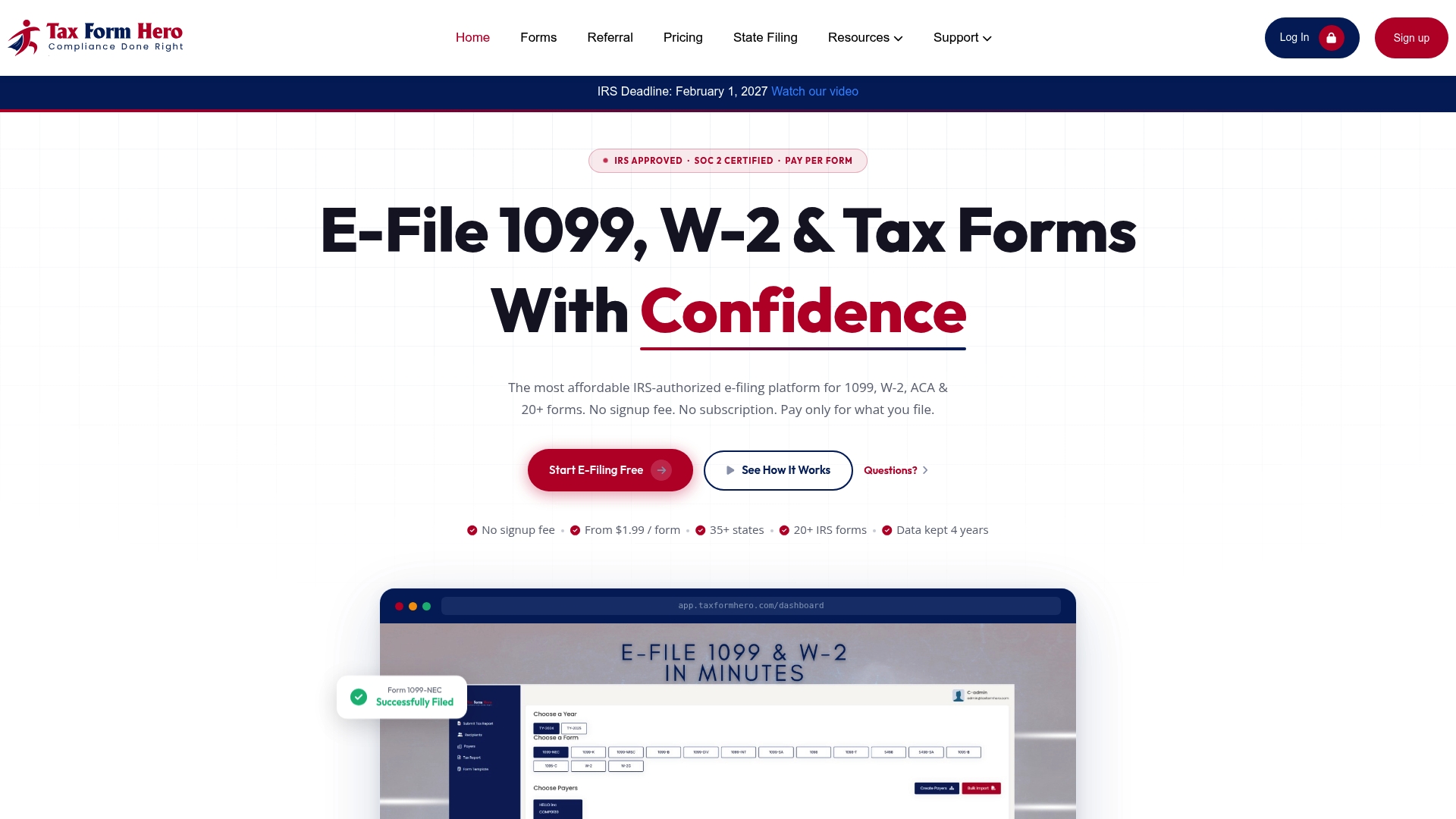
TaxFormHero fits businesses of every size, from freelancers filing a handful of 1099s to accounting firms and payroll departments managing hundreds of vendor relationships. Bulk import handles large vendor lists in one pass, TIN verification catches mismatches before you file, and encrypted e-delivery keeps sensitive taxpayer data off unprotected email threads. State filing across 35+ states and print-and-mail options round out the process so you’re not juggling separate tools for separate steps.
If your next 1099 season is on the calendar, start with TaxFormHero and set up your vendor filings before the rush begins. Pricing starts at $1.99 per form, and you only pay for what you file.
Sources
- Instructions for the Requester of Form W-9 (Rev. March 2024)
- W-9 vendor onboarding: TIN matching, backup withholding, and CP2100 defense
Recommended

File Information Returns With Confidence
TaxFormHero supports 20+ IRS information returns, including 1099 and W-2 forms, with bulk Excel import, name/TIN matching and encrypted recipient delivery.
Explore TaxFormHero