2026 W-2 Deadlines: Payroll Teams Can Check TINs Before Dec. 8

Employers must furnish Copies B, C, and 2 of Form W-2 to employees by February 1, 2027, and file Copy A with Form W-3 at the Social Security Administration by that same date, according to IRS Tax Topic 752. The usual January 31 due date shifts because that date falls on a Sunday in 2027, which triggers the next-business-day rule. Both duties share the same deadline this cycle, but they remain separate filing obligations with separate risks for noncompliance.
TL;DR:
- Track employee delivery and SSA filing separately: the IRS treats them as independent duties, and employers should retain delivery proof for at least four years.
- BSO and EDT begin accepting 2026 files on December 8, 2026; submit early, then resolve rejection notices and confirm SSA acceptance before the deadline.
- Employers must apply before February 1 for a 30 day Form 8809 extension, available only for extraordinary circumstances; employee copies remain due that day.
- Late filing costs $60 per return within 30 days, $130 through August 1, and $340 afterward or if omitted; intentional disregard costs $680.
- Correct errors promptly with a corrected SSA filing and employee copies; employers with 10 or more information returns generally must file corrections electronically.
1. Quick reference: 2026 W-2 dates and what each date means
Payroll teams working the 2026 tax year need to track a short list of dates rather than a single deadline. Each one triggers a different action.
- February 1, 2027: furnish Copies B, C, and 2 to employees; mailing or addressing the statement on or before this date satisfies the furnish requirement, per Tax Topic 752.
- February 1, 2027: file Copy A with the SSA along with Form W-3, whether submitting on paper or electronically.
- December 8, 2026: earliest date Business Services Online (BSO) and Electronic Data Transfer (EDT) accept 2026 W-2 file uploads, according to the SSA EFW2 publication.
- Terminated employees: when employment ends before December 31, 2026, furnishing can happen after the last day worked but no later than February 1, 2027.
Treat these as checkpoints, not a single finish line. Missing the earlier transmission window does not cause a penalty by itself, but it removes the cushion you need to fix problems before the real deadline arrives.
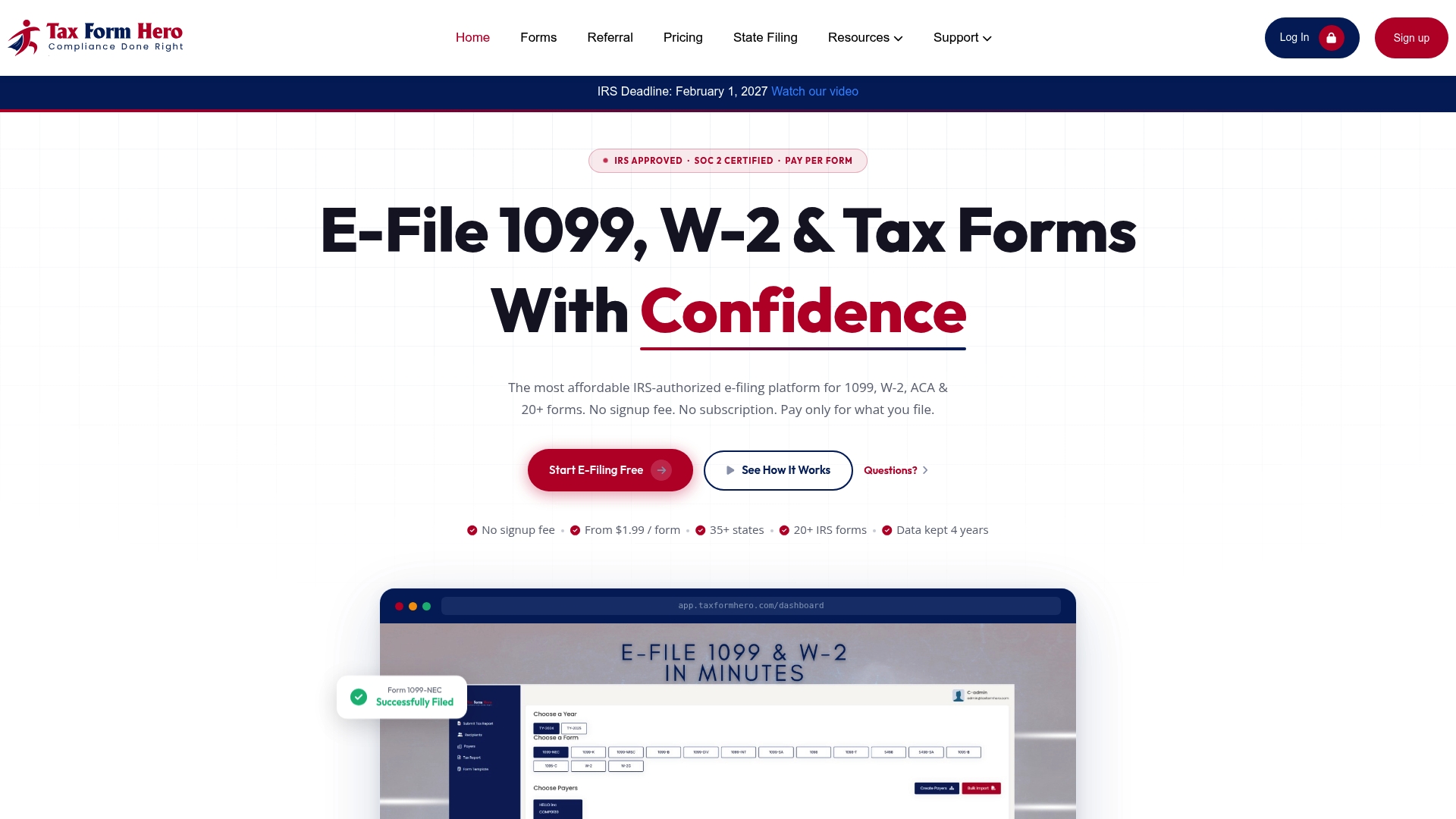
Filing one yourself? You can e-file Form W-2 online with TaxFormHero, an IRS-authorized e-filing platform.
2. Furnish vs. file: the legal distinction and practical checklist
“Furnish” and “file” describe two different duties, and the IRS treats them independently even when the calendar date happens to match. Furnishing means delivering Copies B, C, and 2 to each employee, by mail, in person, or through a secure electronic delivery method the employee has agreed to. Filing means transmitting Copy A and Form W-3 to the SSA, either on paper or electronically through an accepted system.
The next-business-day rule matters operationally: when the standard due date lands on a weekend or federal holiday, the deadline rolls to the next business day, which is why 2026 forms are due February 1, 2027 instead of January 31. That shift applies to both furnishing and filing, but it does not merge the two obligations. A business can meet one and miss the other, and the IRS evaluates each separately for penalty purposes.
A practical checklist keeps both duties on track, which complements key payroll date management strategies for small businesses:
- Confirm employee mailing addresses and print runs are finalized before late January.
- Use encrypted e-delivery or certified mail for employee copies to create a delivery record.
- Retain proof of mailing or electronic delivery for at least four years.
- Document internal signoff dates for both furnishing and SSA transmission.
Pro Tip: Keep furnish and file tracking on separate rows in your compliance log, since treating them as one task is a common source of missed deadlines.
3. How to file for 2026: accepted systems, earliest send dates, and a recommended workflow
The SSA accepts 2026 Forms W-2 through Business Services Online (BSO) for smaller batches and Electronic Data Transfer (EDT) for larger, automated submissions. Form 8809 is a separate system used only for extension requests, not for filing the returns themselves. Employers filing 10 or more information returns in total across form types generally must file electronically, per IRS penalty guidance.
File 2026 W-2s using this sequence:
- Finalize year-end wage and withholding totals in late November.
- Run TIN verification against employee records to catch name and Social Security number mismatches before transmission.
- Import and validate recipient data in bulk, cross-checking totals against payroll reports.
- Submit files as soon as BSO and EDT open, which is December 8, 2026, according to the SSA EFW2 publication.
- Review any rejection notices and correct them immediately rather than waiting for a batch cycle.
- Confirm SSA acceptance and retain the confirmation record.
December 8, 2026 is the earliest date BSO and EDT accept 2026 W-2 files, which gives filers nearly two months of runway before the February 1, 2027 due date, according to the SSA EFW2 publication. That window exists specifically to let filers catch and fix transmission errors before the deadline becomes a penalty risk. Our guide to e-filing W-2 forms walks through the bulk import steps in more detail for payroll teams handling larger employee counts.
4. Extensions and penalties: Form 8809 rules and the IRS penalty tiers

A limited 30-day extension may be granted for Forms W-2 only in extraordinary circumstances. Employers must apply using Form 8809 before the February 1, 2027 due date, and the IRS grants these extensions only for extraordinary circumstances such as a natural disaster or a documented system failure. An approved extension moves the filing deadline, but it never extends the employee furnishing deadline, so statements to employees are still due by February 1, 2027 regardless of extension status.
Missing the deadline without an approved extension triggers a tiered penalty structure. The IRS penalty schedule sets these amounts per return:
- $60 per return filed within 30 days of the due date.
- $130 per return filed between 31 days late and August 1.
- $340 per return filed after August 1 or not filed at all.
- $680 per return for intentional disregard of the filing requirement.
Smaller employers may qualify for reduced annual caps on total penalties, but the per-return amounts above apply broadly. Given how narrow the extension criteria are, the more reliable approach is documenting your justification early if you believe you qualify, submitting Form 8809 well before the deadline, and logging delivery proof for every employee statement you send.
5. Corrections and common mistakes: when to file a W-2c and how to avoid rejects
Correct an error the moment you find it. File Form W-2c with the SSA and furnish corrected copies to the affected employee without waiting for the next filing cycle, since delayed corrections compound penalty exposure. Employers filing 10 or more information returns generally must e-file corrections using the SSA’s EFW2C format, according to the About Form W-2c instructions.
Several recurring mistakes cause rejections:
- Printing Copy A directly from IRS.gov and mailing it to the SSA, which the General Instructions for Forms W-2 and W-3 explicitly says is not acceptable.
- TIN mismatches between payroll records and Social Security Administration files.
- Incorrect wage or withholding totals that do not reconcile with Form W-3.
- Outdated employee addresses that delay furnished copies.
Pro Tip: Run a TIN match and a totals reconciliation against your last payroll report before transmitting, not after a rejection notice arrives.
6. Practical resource: how we support meeting the 2026 W-2 deadlines
Our platform is designed to help with the two pressure points payroll teams hit every January: TIN accuracy and data volume. TIN verification can flag mismatches before transmission, helping reduce rejects that eat into your BSO or EDT window. Bulk import from Excel or CSV handles recipient data at scale, and our graduated per-form pricing, add-ons for state filing, print and mail, and encrypted e-delivery, cover both furnishing and filing in one workflow. We hold a SOC 2 Type I attestation, and our W-2 deadline checklist and mailing rules guide walk through the procedural details.
7. Author’s perspective: treat W-2 season as a short project, not a deadline
Our editorial view is that W-2 season rewards front-loading, not scrambling. Prioritize TIN verification and sample reconciliations in November and December, then use the SSA’s early transmission window to surface rejects while you still have time to fix them. Document any extension rationale or correction the moment it happens, not after the fact.
— Nazrul
8. Start a W-2 e-file checklist with us
We make the furnish-and-file sequence manageable: e-file W-2 forms with instant TIN checks, add state filing or print and mail where you need it, and send employee copies by encrypted delivery. No subscriptions, no signup fees, just per-form pricing you can check on our pricing page before you commit.
| Service | Starting price |
|---|---|
| E-file W-2 forms | $2.99 per form |
| State filing add-on | $0.99 per form |
| Printing & mailing | $1.69 per form |
| Encrypted e-delivery | $0.19 per form |
| TIN check | $0.49 per check |
Visit our TIN matching page to verify recipient data before you import, then start your bulk file.
FAQ
What are the tax dates for 2026?
The W-2 deadline for the 2026 tax year is February 1, 2027 for both furnishing employee copies and filing Copy A with the SSA, since January 31 falls on a Sunday, according to Tax Topic 752. Other 2026 tax dates, such as individual income tax filing deadlines, follow separate IRS schedules not covered by W-2 rules.
What is the penalty for filing a late W-2 form?
Penalties are tiered per return: $60 if filed within 30 days of the due date, $130 if filed between 31 days late and August 1, and $340 if filed after August 1 or not filed at all, per the IRS penalty schedule. Intentional disregard of the filing requirement carries a $680 per-return penalty.
Can I get an extension for filing W-2 forms?
A 30-day extension is available through Form 8809, but it is not automatic for W-2s and is granted only in narrow circumstances such as a documented disaster or system failure. Approval does not extend the employee furnishing deadline, which stays at February 1, 2027 regardless.
How do I correct an error after filing a W-2?
File Form W-2c with the SSA and send corrected copies to the employee as soon as you discover the error, rather than waiting for the next filing cycle. Employers filing 10 or more returns generally must e-file corrections using the SSA’s EFW2C format, according to About Form W-2c.
Sources
Recommended
- February 1, 2027: W-2 Deadlines and Efile Checks for Payroll Teams
- Beat Feb 1 Rejects: W-2 Workflow With Exception Queue for U.S. Payroll
- TIN Matching & Verification

File Information Returns With Confidence
TaxFormHero supports 20+ IRS information returns, including 1099 and W-2 forms, with bulk Excel import, name/TIN matching and encrypted recipient delivery.
Explore TaxFormHero