IRS Deadline: February 1, 2027
$2,000 & $20,000 Rules: Freelancers’ 2026 Checklist After OBBBA

For tax year 2026, the One Big Beautiful Bill Act raises the 1099-NEC and 1099-MISC reporting threshold to $2,000 and restores the 1099-K threshold to $20,000 and 200 transactions. Your payors will send fewer forms. Your tax liability does not shrink at all: every dollar you earn stays reportable, so keep tracking income, saving records, and paying estimated taxes as if nothing changed.
TL;DR:
- The new $2,000 reporting threshold for 1099-NEC and 1099-MISC will likely result in fewer forms sent to independent workers, but all income remains taxable and must be reported.
- The 1099-K threshold reverts to $20,000 in gross payments and over 200 transactions, meaning many small transactions and sales under this level will not generate a 1099-K in 2026.
- Income received through platforms or payment apps must be reported regardless of whether a 1099-K is issued, so contractors should keep detailed transaction records for accurate tax filing.
- Filing deadlines for 1099 forms stay the same, but self-employed individuals need to be proactive in tracking income, as fewer forms mean more reliance on personal records.
- The thresholds will adjust for inflation starting in 2027, gradually increasing the reporting limits, but the obligation to report income remains unaffected by form issuance.
What The One Big Beautiful Bill Act Means For 1099 Filers For Tax Year 2026: The Rule Changes At A Glance
The One Big Beautiful Bill Act, signed into law as H.R.1, rewrites two separate reporting thresholds that had been on a collision course with freelancers and gig workers. Both changes take effect for tax year 2026, meaning the forms you receive in early 2027 will reflect the new rules, not the old ones.
Here is what actually moved:
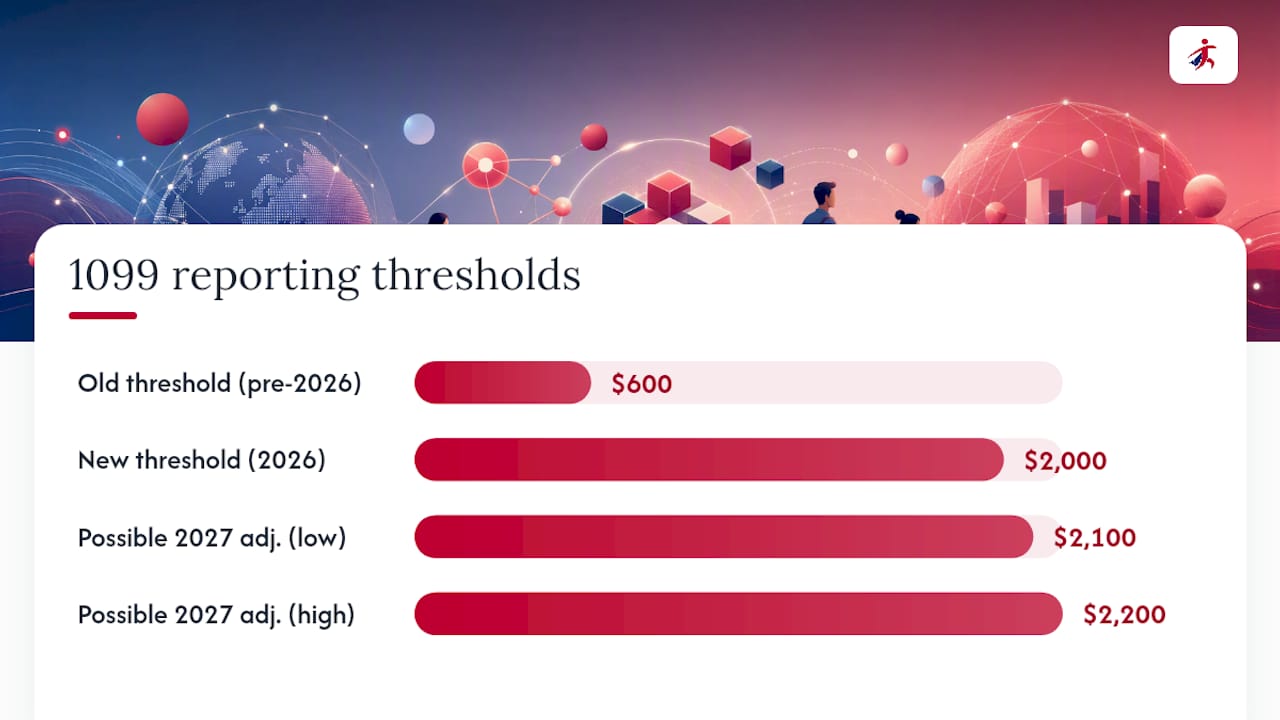
- 1099-NEC and 1099-MISC: the reporting threshold jumps from $600 to $2,000 per payee, per calendar year. A client who pays you $1,999 for freelance work in 2026 has no legal obligation to send you a form.
- 1099-K: the threshold reverts to $20,000 in gross payments AND more than 200 transactions in a calendar year, undoing the $600 rule that had been scheduled to phase in. This restoration applies to payment card and third-party network transactions, as the IRS explains in its 1099-K guidance.
- Inflation indexing begins in 2027: starting with tax year 2027, the $2,000 threshold for 1099-NEC and 1099-MISC will adjust annually for inflation, rounded down to the nearest $100. The IRS confirmed this mechanism as part of its broader 2026 inflation adjustments tied to the new law, according to its newsroom release on OBBBA amendments.
The $2,000 figure is not a small tweak. Industry analysts have called it the first meaningful update to the 1099-NEC threshold in decades, since $600 had been frozen since the 1950s despite decades of inflation.
Backup withholding rules did not change in structure. If a payor is required to withhold 24% because you failed to provide a valid taxpayer identification number, that obligation still applies once a payment crosses the applicable threshold. What changed is simply where that threshold sits. A payor who was withholding on a $700 payment last year under the old $600 rule may no longer need to withhold or report that same payment in 2026, since it now falls under the $2,000 line.
One nuance worth flagging early: these thresholds are calendar-year totals per payer, not per invoice. If a single client pays you $500 a month across four months, that adds up to $2,000 for the year, and a 1099-NEC becomes required. Payors track cumulative totals, not individual transactions, when deciding whether to issue a form.
Filing one yourself? You can e-file Form 1099-NEC online with TaxFormHero, an IRS-authorized e-filing platform.
1099-K Restored To $20,000: What To Expect From Payment Platforms
Third-party settlement organizations (TPSOs) like payment apps, online marketplaces, and payment card processors are the entities required to file 1099-Ks, not individual clients or customers. Under the restored rule, these platforms only issue a 1099-K when a recipient crosses both the $20,000 gross payment mark and the 200-transaction mark in the same calendar year.
That “and,” not “or,” matters enormously. A seller who processes $25,000 through a payment platform but only completes 90 transactions will not receive a 1099-K, because the transaction count falls short. Someone who runs 250 small transactions but only collects $8,000 total also stays under the reporting line. Both scenarios were previously at risk of triggering a form under the abandoned $600 rule.
Common situations where no 1099-K will arrive in 2026 despite real income changing hands:
- Selling personal items occasionally through a marketplace app, even if total sales hit a few thousand dollars.
- Splitting rent or bills with roommates through a payment app (these are not taxable transactions anyway, but the volume alone would not trigger a form).
- A part-time freelancer who invoices through a platform but stays under 200 separate payments for the year.
- A small Etsy or eBay seller whose gross sales sit below $20,000 even with steady weekly activity.
None of this changes what you owe the IRS. If you earned taxable income through a payment platform, that income belongs on your tax return whether or not a 1099-K shows up in your inbox. The IRS’s own guidance on Form 1099-K is explicit that receiving or not receiving the form does not determine taxability.
Pro Tip: Download your full transaction history from every payment platform you use at the end of each quarter, not just at tax time. Platforms sometimes purge older data or change account access after a year, and reconstructing six months of Venmo or PayPal activity from memory in April is a miserable way to spend an afternoon.
If you sell goods casually and want a deeper breakdown of how the restored threshold affects marketplace sellers specifically, TaxFormHero’s guide on the 1099-K threshold for 2026 walks through platform-specific scenarios in more detail.
1099-NEC And 1099-MISC: How The $2,000 Threshold Changes Payor Behavior
Form 1099-NEC covers nonemployee compensation: payments to independent contractors, freelancers, and consultants for services rendered. Form 1099-MISC covers a different bucket entirely, including rent payments, prizes and awards, and royalties. Both forms now share the same $2,000 reporting floor for 2026, up from $600.
Here is how that plays out for the people who actually deal with these forms:
- If you are a contractor, expect fewer clients to send you a 1099-NEC. A graphic designer who does a single $1,200 project for a small business will likely not get a form, even though the income is fully taxable.
- If you are a payor, you still need a completed Form W-9 on file before you pay any contractor, because you will not know in advance whether total payments for the year will cross $2,000. Waiting until December to collect a W-9 from a vendor you have already paid $1,700 creates a scramble if a fourth invoice pushes them over the line.
- If you rent commercial space or receive royalty income, the same $2,000 threshold now applies to 1099-MISC, replacing the old $600 line for most payment categories on that form.
Nothing here stops a payor from voluntarily issuing a 1099 below the new threshold. The IRS confirms that payors retain the option to file 1099-NEC forms even for smaller amounts if that fits their internal recordkeeping practices. Some accounting software defaults to issuing forms for any payment over $600 regardless of the statutory floor, simply because reprogramming thresholds takes time. Don’t assume silence from a payor means the law requires it. It might just mean their software has not caught up yet.
Starting with the 2027 tax year, the $2,000 threshold adjusts for inflation annually, rounded down to the nearest $100 increment. That means you might see the threshold creep to $2,100 or $2,200 within a few years, not a dramatic jump, but enough that payors and bookkeeping software will need to update their reporting logic yearly rather than treating $2,000 as a permanent fixture.
For a closer look at how this threshold shift affects collection practices specifically, TaxFormHero’s breakdown of the 1099-NEC threshold increase covers what businesses should update in their vendor onboarding process.
Why Fewer 1099s Doesn’t Mean A Smaller Tax Bill
Reporting thresholds tell payors when they must send a form. They say nothing about what you must report on your own return. That distinction gets lost constantly, and it is the single most expensive misunderstanding a contractor can carry into filing season.
Every dollar of self-employment income belongs on Schedule C of your Form 1040, regardless of whether a 1099-NEC, 1099-MISC, or 1099-K ever arrives. The IRS has always taxed income based on when you earned it, not based on whether a third party documented it for you. A tax-industry analysis of the OBBBA changes frames this accurately: the new thresholds create administrative relief for payors, not a tax break for recipients.
The mistakes that trip people up most often:
- Assuming no form means no obligation. This is the costly one. The IRS receives copies of every 1099 that is filed, and matches those against your return, but the absence of a form does not erase income you actually received.
- Forgetting cash and check payments entirely. These were never subject to 1099 reporting thresholds in the first place, yet they get left off returns more than platform payments do.
- Misclassifying reimbursements as income, or the reverse: treating taxable service fees as nontaxable reimbursements without documentation to back it up.
The cleanest way to catch gaps before the IRS does is to reconcile your bank and payment platform deposits against what you report on Schedule C once a quarter. Pull your deposit total for the quarter, subtract any transfers between your own accounts or personal reimbursements, and compare what’s left against your income ledger. If freelance work moves through more than one channel, TaxFormHero’s comparison of 1099-K versus 1099-NEC reporting is a useful reference for sorting which income belongs where.
Deadlines And Timing Filers Should Track For 2026
The threshold changes apply to payments made during the 2026 calendar year, which means the forms reflecting these new rules will not land in mailboxes or inboxes until January and February of 2027. If you are filing your 2025 return in early 2026, none of this affects that filing at all. The new $2,000 and $20,000 thresholds govern income earned starting January 1, 2026.
Key dates to have on your calendar:
- January 31, 2027: deadline for payors to furnish 1099-NEC copies to recipients for 2026 income, and the same date the IRS expects e-filed 1099-NEC submissions.
- Late February to March 2027: standard deadlines for 1099-MISC and 1099-K recipient copies and IRS filing, depending on paper versus electronic submission.
- 2027 tax year: the first year the $2,000 threshold adjusts for inflation, rounded to the nearest $100.
If a payor issues you a 1099 late or not at all, that does not extend your own filing deadline. Your personal return is still due by the standard April deadline (with extensions available through the usual process), and you are expected to estimate your income accurately using your own records if a form never arrives.
TaxFormHero’s full rundown of 1099 deadlines for 2026 breaks out the specific dates by form type if you’re managing multiple 1099s as either a payor or a recipient juggling several income streams.
Your Practical Checklist: Records, Tracking, And Estimated Taxes
Fewer forms landing in your inbox puts more responsibility on you to build your own paper trail. Here’s the order of operations that keeps you protected if the IRS ever asks questions.
- Log every payment the day you receive it, not at tax time. A simple spreadsheet with date, payer, amount, and payment method takes thirty seconds per entry and eliminates the January scramble to reconstruct a year of gig income from memory.
- Separate business and personal accounts. Running client payments through the same account you use for groceries and rent makes reconciliation painful and increases audit risk if the IRS ever needs to trace deposits.
- Reconcile monthly, not annually. Pull statements from every bank account, PayPal, Venmo for Business, Stripe, or Square account you use, and match deposits against your income log. Catching a missing $400 payment in February is a two-minute fix. Catching it in April, mid filing, is not.
- Calculate and pay quarterly estimated taxes. Self-employment tax runs at 15.3% on net earnings (covering Social Security and Medicare), on top of ordinary income tax. If you expect to owe $1,000 or more for the year, the IRS expects quarterly payments, generally due in April, June, September, and January.
- Collect a W-9 from every client relationship before the first invoice, not after. You have no way of knowing in advance whether total payments will cross $2,000, so having the form on file protects both you and the payor if the threshold is triggered later in the year.
- Retain records for at least three years, longer if you have significant unreported income concerns, since that’s the general statute of limitations window the IRS uses for standard audits.
Pro Tip: Set a recurring calendar reminder for the 25th of every month to spend fifteen minutes reconciling income. Contractors who batch this task quarterly instead of monthly are far more likely to discover a payment discrepancy months after the client relationship has ended, when it’s much harder to track down documentation.
Retention and reconciliation are not busywork. They are the entire reason the $2,000 and $20,000 thresholds feel like relief instead of risk. Payors are sending fewer forms specifically because Congress decided the paperwork burden on both sides had outpaced its usefulness at low dollar amounts. That relief only holds up if you replace the missing form with your own equally reliable record.
Other OBBBA Provisions Self-Employed Filers Should Know
Three additional changes in the law affect independent contractors beyond the 1099 thresholds themselves, and each deserves a quick, honest look.
No Tax on Tips is narrower than its name suggests. Treasury and the IRS issued final regulations listing specific occupations that qualify as customarily and regularly tip-earning roles. This is not a blanket exclusion for anyone who occasionally receives a gratuity. If you’re a self-employed worker in a qualifying service occupation, tips can be excluded up to statutory limits, but you need contemporaneous logs and payor records to substantiate the claim. Treat every tip like income you need to document, because the IRS will expect proof it qualifies under the specific occupation list, not just your own characterization of the payment.
Qualified Business Income (QBI) deduction treatment under Section 199A was extended and made a permanent fixture of the tax code under OBBBA, according to the IRS’s 2026 inflation adjustment release. For most sole proprietors and single-member LLC owners filing Schedule C, this means the 20% deduction against qualified business income remains available going forward rather than sunsetting, which had been a real concern heading into 2026.
SALT cap changes raise the state and local tax deduction ceiling, though the practical benefit skews toward higher earners in high-tax states who itemize deductions. A congressional analysis of the bill’s provisions notes the increased cap phases based on income, so most contractors with modest state tax bills won’t see a dramatic shift, while those in states like California or New York with substantial property and income tax bills may benefit meaningfully.
Three Quick Scenarios: How The New Thresholds Play Out
Numbers make these rules concrete faster than explanation alone. Here’s how three common situations resolve under the 2026 thresholds.
| Scenario | Income received | Form expected? | What the filer must do |
|---|---|---|---|
| Casual seller, payment app, 45 transactions totaling $1,800 | below the 1099-K reporting threshold | No 1099-K (under both $20,000 and 200 transaction thresholds) | Report income on Schedule C if it’s business activity; keep transaction records |
| Freelance contractor paid by one client | $2,200 across the year | Yes, 1099-NEC required (over $2,000 threshold) | Confirm W-9 was submitted; report the $2,200 as income even if the form is delayed |
| Tipped worker in a qualifying service occupation | $3,500 in documented tips | Depends on payor reporting; No Tax on Tips exclusion may apply | Maintain contemporaneous tip logs; confirm occupation qualifies under Treasury’s final list |
The middle scenario is the one people misjudge most. A single client crossing $2,000 does trigger the 1099-NEC requirement, even though that number can feel small compared to a full year’s freelance income. If you work with multiple clients who each stay under $2,000 individually, you could easily receive zero 1099s while still owing tax on several thousand dollars of combined income. Your own tracking is what catches that gap, not any form a payor sends you.
What Independent Contractors Should Actually Prioritize In 2026
The instinct after a law like this passes is to relax a little. Fewer forms feels like less oversight, and for a moment it’s tempting to treat the higher thresholds as a signal that the IRS cares less about small-dollar contractor income. That read is backwards. The IRS still has full authority to assess tax on every dollar you earn. What changed is who does the paperwork, not who owes the money.
If you take away three priorities from all of this, make them these: keep records as if no one else is keeping them for you, estimate and pay quarterly taxes on schedule rather than waiting for a form to tell you what you owe, and bring in a tax professional the moment your situation involves multiple income streams, tip income under the new occupation rules, or QBI calculations that get complicated by multiple business activities.
The administrative relief here is real, but it shifts work onto you rather than eliminating it. A contractor who treats the $2,000 and $20,000 thresholds as permission to stop tracking small payments is going to have a rough conversation with the IRS eventually. A contractor who treats the same thresholds as one less form to chase down, while keeping their own ledger airtight, comes out ahead every time.
— Nazrul
How TaxFormHero Simplifies Filing Under The New Thresholds
Higher reporting thresholds mean fewer forms overall, but the ones you still need to file (or the ones your clients need from you) still have to be accurate, on time, and properly delivered. This platform is built specifically for that narrower, higher-stakes stack of filings: an IRS-authorized service where users pay only for the forms they actually file, with no subscription or signup fee added.
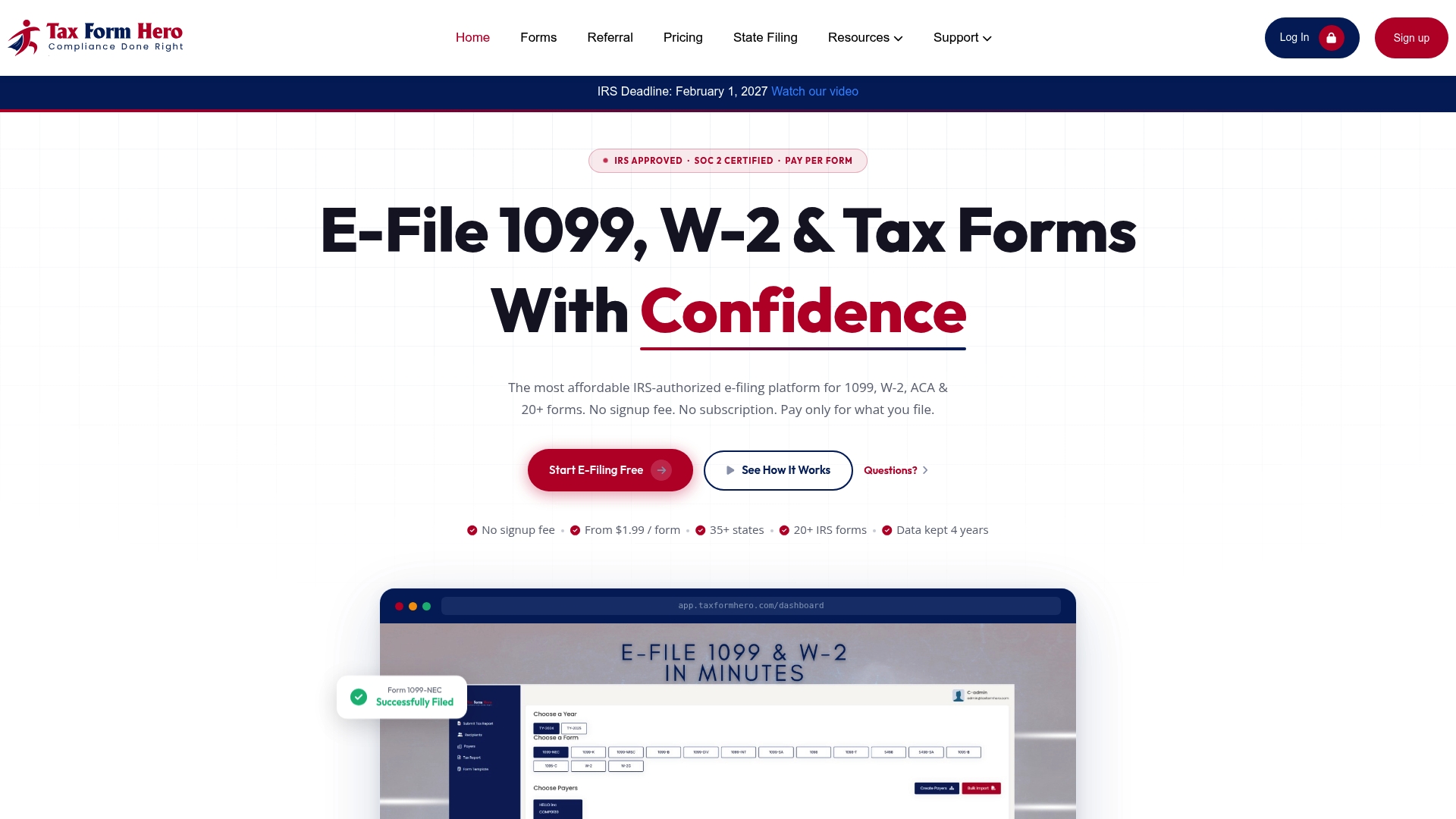
If you’re a contractor who occasionally needs to issue your own 1099-NECs to subcontractors, or a small business owner adjusting your vendor reporting to the new $2,000 threshold, TaxFormHero’s 1099-NEC e-filing starts at $1.99 per form for your first 150 forms, with rates stepping down as volume increases. Bulk import from Excel handles high-volume filing in minutes instead of hours, and add-ons like state filing, TIN matching, and encrypted recipient delivery let you build exactly the compliance workflow the new thresholds demand, without paying for anything you don’t need. Check current rates and add-ons on the pricing page, and file your next batch of 1099-NEC forms directly through TaxFormHero when you’re ready.
Sources
The core facts in this guide come directly from primary government sources, not secondhand summaries:
- Understanding Your Form 1099-K (IRS)
- IRS releases tax inflation adjustments for tax year 2026, including amendments from the One Big Beautiful Bill (IRS newsroom)
- Congress
This article is general information, not a substitute for advice from a qualified financial advisor. Consult a qualified financial professional about your own circumstances before acting on anything here.
FAQ
How will the One Big Beautiful Bill affect my tax return in 2026?
Your tax return itself doesn’t change: all self-employment income is still reportable on Schedule C regardless of thresholds. What changes is how many 1099 forms you’ll receive, since payors now report at $2,000 (up from $600) and payment platforms report at $20,000 and 200 transactions.
What is the IRS 1099 threshold for 2026?
For 1099-NEC and 1099-MISC, the threshold is $2,000 per payer for the calendar year. For 1099-K, the threshold reverts to $20,000 in payments and more than 200 transactions with the same payment platform.
What are the biggest changes for self-employed people in 2026?
Beyond the 1099 thresholds, self-employed filers should note that the QBI deduction was made permanent and the No Tax on Tips provision applies to specific occupations listed in Treasury’s final regulations, not tip income generally.
Who qualifies for the extra standard deduction under OBBBA?
The expanded standard deduction adjustments for 2026 are detailed in the IRS’s inflation adjustment release, which ties eligibility to filing status and income parameters set under the new law rather than a flat rule for all filers.
Do I still owe taxes on income if I don’t receive a 1099?
Yes. Reporting thresholds determine when a payor must send you a form, not whether the income is taxable. You’re required to report all self-employment income on your return whether or not a 1099-NEC, 1099-MISC, or 1099-K ever arrives.
Can I still file a 1099-NEC for a contractor paid less than $2,000?
Yes. The IRS confirms payors can voluntarily issue 1099-NEC forms below the statutory threshold if they choose to. Platforms like TaxFormHero let you file at any dollar amount through 1099-NEC e-filing, starting at $1.99 per form.