
Payments to attorneys are reportable on IRS information returns, and the corporate exemption does not apply. If your firm or business paid an attorney $600 or more for legal services in 2026, you must file Form 1099-NEC for fees or Form 1099-MISC Box 10 for gross proceeds, per the Instructions for Forms 1099-NEC and 1099-MISC. Start now: collect a signed Form W-9 from every attorney payee and classify each payment as either fees for services or gross settlement proceeds before year-end.
- Attorneys’ fees for services: report on Form 1099-NEC
- Gross proceeds paid to an attorney (e.g., settlement funds): report on Form 1099-MISC, Box 10
- Corporate exemption: does not apply to legal services payments
Key Takeaways
Attorney 1099 reporting requires the correct form selection, TIN verification before filing, and timely submission, with the corporate exemption providing no shelter for legal services payments.
| Point | Details |
|---|---|
| Two-form rule | Use 1099-NEC for attorneys’ fees and 1099-MISC Box 10 for gross settlement proceeds. |
| No corporate exemption | Report payments to law firms regardless of entity type — corporations, LLCs, and partnerships all qualify. |
| $600 threshold | Cumulative payments of $600 or more per attorney payee per year trigger reporting; verify the current threshold before filing. |
| W-9 and TIN first | Collect Form W-9 at engagement; apply 24% backup withholding immediately if a TIN is missing or mismatched. |
| TaxFormHero | IRS-authorized e-file with TIN matching, bulk import, and state filing support starting at $1.99 per form. |
If you would rather not do this on paper, e-file Form 1099-NEC online with TaxFormHero instead.
What counts as attorneys’ fees versus gross proceeds
The distinction between fees and gross proceeds controls which form you file, and getting it wrong produces IRS matching notices.
Attorneys’ fees are amounts paid directly for legal services rendered. A business paying its outside counsel $15,000 for contract work reports that amount on Form 1099-NEC. Gross proceeds are settlement or judgment funds paid to an attorney as payee or joint payee, regardless of how the attorney later allocates the money among fees, client share, or lien payments.
The IRS instructions for Box 10 confirm that the full gross amount paid to the attorney is reportable, not just the fee portion. A defendant paying a $500,000 settlement to “Smith & Jones LLP as attorneys for plaintiff” reports the entire $500,000 in Box 10, even if the firm keeps only $150,000 as its contingency fee.
Key rule: The reporting obligation attaches to the payment itself, not to how funds are allocated afterward. Even when litigation costs, third-party liens, or client shares are later paid out, the gross amount paid to the attorney is what gets reported.
Common traps to avoid:
- Joint-payee checks made to both the plaintiff and the attorney still trigger Box 10 reporting for the full amount.
- Credit card payments processed through a third-party network may generate a Form 1099-K from the processor, creating a potential duplicate. Reconcile carefully.
- Reimbursements for documented out-of-pocket expenses are generally not reportable, but only when supported by receipts and clearly separated from fees in your records.
Pro Tip: Keep a payment classification log in your accounting system. Tag each disbursement as “fees,” “gross proceeds,” or “reimbursement” at the time of payment, not at year-end when details are harder to reconstruct.
Who must file and what thresholds apply
Trade-or-business payors must file information returns when payments to attorneys meet the applicable threshold. Personal payments are not reportable.
The historical threshold is $600 per payee per year, cumulative across all payments. Payments made after December 31, 2025 may be subject to statutory threshold changes; check the current IRS instructions before filing for the applicable year. Wages paid to attorney-employees go on Form W-2, not a 1099. Profit distributions to attorney-partners flow through Schedule K-1.
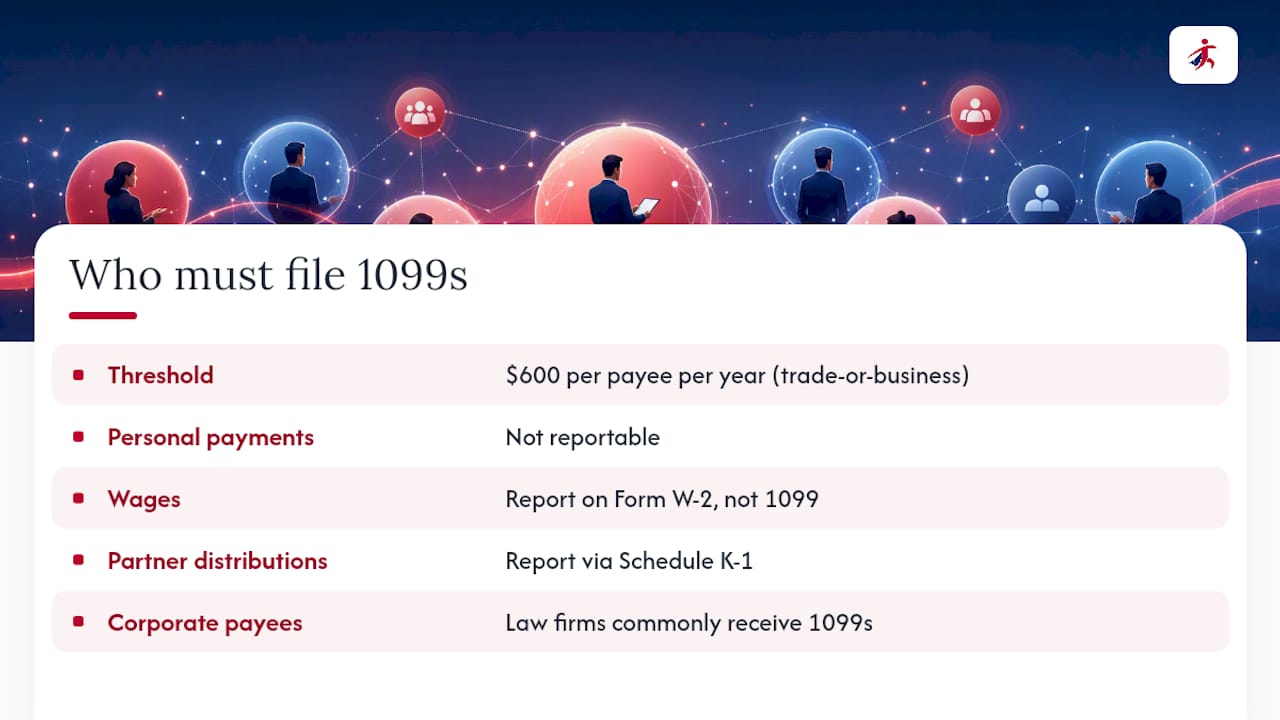
The corporate exemption override is the most frequently misunderstood rule in attorney 1099 reporting. The American Bar Association’s practitioner guidance confirms that law firms commonly receive 1099s regardless of entity type, because IRS rules for legal services specifically override the standard corporate payee exemption.
How to collect W-9s and verify TINs before backup withholding kicks in
Missing or incorrect TINs are the fastest path to backup withholding obligations and IRS penalties. The solution is front-loading the W-9 collection process.
- Request Form W-9 at engagement. Send a W-9 request before or at the time of the first payment. Never wait until December.
- Confirm four fields on every W-9: legal name, taxpayer identification number (TIN), entity classification, and signature date.
- Run TIN matching before filing. The IRS TIN Matching program lets authorized payors verify name/TIN combinations before submitting returns.
- Document the W-9 in your records. Store a copy for at least four years from the due date of the return.
- Apply backup withholding immediately if an attorney fails to provide a TIN or if the IRS notifies you of a mismatch. The current backup withholding rate is 24% of the payment amount.
When a TIN is missing, the LegalClarity practitioner guide notes that the payer must withhold and remit backup withholding, and the attorney may face separate penalties for failure to furnish a TIN. Resolving the mismatch quickly limits your exposure.
Pro Tip: A short, professional W-9 request email works well: “To comply with IRS reporting requirements, please complete and return the attached Form W-9 before we process your first invoice. We cannot issue payment without a completed form on file.”

How to prepare and file Form 1099-NEC and Form 1099-MISC
A defensible filing workflow reduces errors and keeps deadlines manageable.
- Aggregate payments by recipient from your payment ledger and trust-account disbursement records. Total all payments to each attorney payee for the calendar year.
- Classify each total as fees (1099-NEC) or gross proceeds (1099-MISC Box 10) based on the payment type log you maintained during the year.
- Reconcile against source documents: invoices, settlement agreements, and trust-account statements.
- Prepare the returns with the correct form, box, and TIN for each payee.
- File and furnish by the deadlines below.
| Form | Recipient Copy Due | IRS Paper Due | IRS E-File Due |
|---|---|---|---|
| 1099-NEC | January 31 | January 31 | January 31 |
| 1099-MISC (Box 10) | February 15 | February | March 31 |
The EisnerAmper filing tips for law firms recommend e-filing for any firm processing more than a handful of payees, noting that batch preparation and TIN matching before submission reduce the most common error sources. State filing requirements vary; many states require separate 1099 submissions or participate in the IRS Combined Federal/State Filing program.
Pro Tip: Set a firm internal deadline of January 15 for all 1099-NEC data to be finalized. That two-week buffer before the January 31 deadline gives your team time to resolve TIN mismatches without missing the IRS due date.
Special cases: settlements, trust accounts, and joint-payee checks
Settlement payments routed through attorneys create the most complex reporting scenarios in attorney 1099 reporting.
The general rule: The settling defendant is the payer who issues the 1099. A plaintiff’s law firm handling trust disbursements is usually a conduit, not the payer, unless it is named as a payee or exercises payer-like control over the funds.
The mail-stop “c/o” exception is narrow. If a check is made payable to the plaintiff but mailed “c/o Smith & Jones LLP,” the attorney is treated as a mere mail stop and no Box 10 reporting obligation attaches to the firm. Conversely, a check made payable to “Smith & Jones LLP” or jointly to “Plaintiff and Smith & Jones LLP” triggers Box 10 reporting for the full settlement amount.
| Check Payee | Attorney’s Role | Box 10 Reporting? |
|---|---|---|
| Plaintiff only, mailed c/o attorney | Mail stop / conduit | No |
| Attorney only | Payee | Yes, full amount |
| Plaintiff and attorney jointly | Joint payee | Yes, full amount |
| Plaintiff only, delivered directly | Conduit | No |
Trust-account best practices protect correct payer identification. Keep settlement funds in a dedicated IOLTA account, document the source and payee of every disbursement, and record whether each check names the attorney as payee. That paper trail is your defense if the IRS questions who should have filed the 1099.
Pro Tip: For large settlements with multiple payees or lien holders, prepare a settlement disbursement memo at closing that maps each payment to its 1099 classification. Attach it to the file permanently.
How to correct errors, handle penalties, and maintain records
Errors happen. Filing a corrected return promptly is always better than leaving an incorrect return uncorrected.
- Corrected 1099: Check the “CORRECTED” box on a new form and file it with the IRS. Furnish the corrected copy to the recipient on the same day.
- B-Notice response: When the IRS sends a B-Notice for a TIN mismatch, re-request the W-9 within 15 business days, verify the TIN, and apply backup withholding if the issue is unresolved after the second notice.
- Penalty tiers for late or incorrect filings increase with the length of delay. Filing late is always less costly than not filing at all.
- Recordkeeping minimum: Retain W-9s, payment ledgers, reconciliation worksheets, and copies of filed returns for at least four years from the return’s due date.
- Document your classification decisions. A written memo explaining why a payment was classified as fees versus gross proceeds is your first line of defense in an audit.
The LegalClarity guidance on penalties emphasizes that practitioners should file corrected forms as soon as an error is discovered to limit penalty exposure. The IRS uses 1099 data for computer matching, so unresolved discrepancies reliably generate notices.
Pro Tip: Schedule a mid-year 1099 review in July. Catching TIN mismatches and classification errors six months before year-end gives you time to correct records before filing season.
Why an IRS-authorized e-file platform reduces your compliance risk
Manual preparation of attorney-related 1099s at scale introduces errors that an authorized e-file platform is specifically designed to prevent.
- Built-in TIN matching flags name/TIN mismatches before submission, eliminating the most common source of B-Notices.
- SOC 2 certification and 256-bit data encryption protect sensitive payee information at rest and in transit.
- Bulk import lets you upload payment data from your accounting system rather than entering records one by one.
- State filing support for 35+ states handles the variance in state 1099 submission requirements automatically.
- Encrypted e-delivery sends recipient copies securely, with an audit trail confirming delivery.
- Audit trail and data storage give you documented proof of filing dates, TIN verification results, and recipient delivery.
These features directly reduce the error sources that produce penalties: TIN errors, missed deadlines, and incorrect box selection.
An editorial perspective on attorney 1099 compliance
The most persistent compliance failure in attorney 1099 reporting is not ignorance of the rules. It is the assumption that the corporate exemption provides cover. Law firms organized as professional corporations or LLCs routinely expect to avoid receiving 1099s, and payors sometimes skip filing on that basis. The IRS rules are unambiguous: legal services payments are reportable regardless of the attorney’s entity type.
The second failure is timing. Firms that wait until January to collect W-9s from co-counsel or expert witnesses paid in October face a predictable problem: the payee is unresponsive, the TIN is missing, and backup withholding should have been applied months earlier. Front-loading W-9 collection at engagement is not a best practice. It is the only defensible practice.
For complex settlements involving multiple claimants, structured payments, or cross-border elements, the classification questions go beyond what a standard compliance checklist resolves. Consult a tax advisor before filing, not after receiving an IRS notice.
TaxFormHero handles attorney-related 1099 filings efficiently
Filing 1099-NEC and 1099-MISC returns for attorney payments carries real deadline pressure and TIN-matching complexity. TaxFormHero is an IRS-authorized e-file platform built for exactly this workflow, with no subscription fees and pricing starting at $1.99 per form.
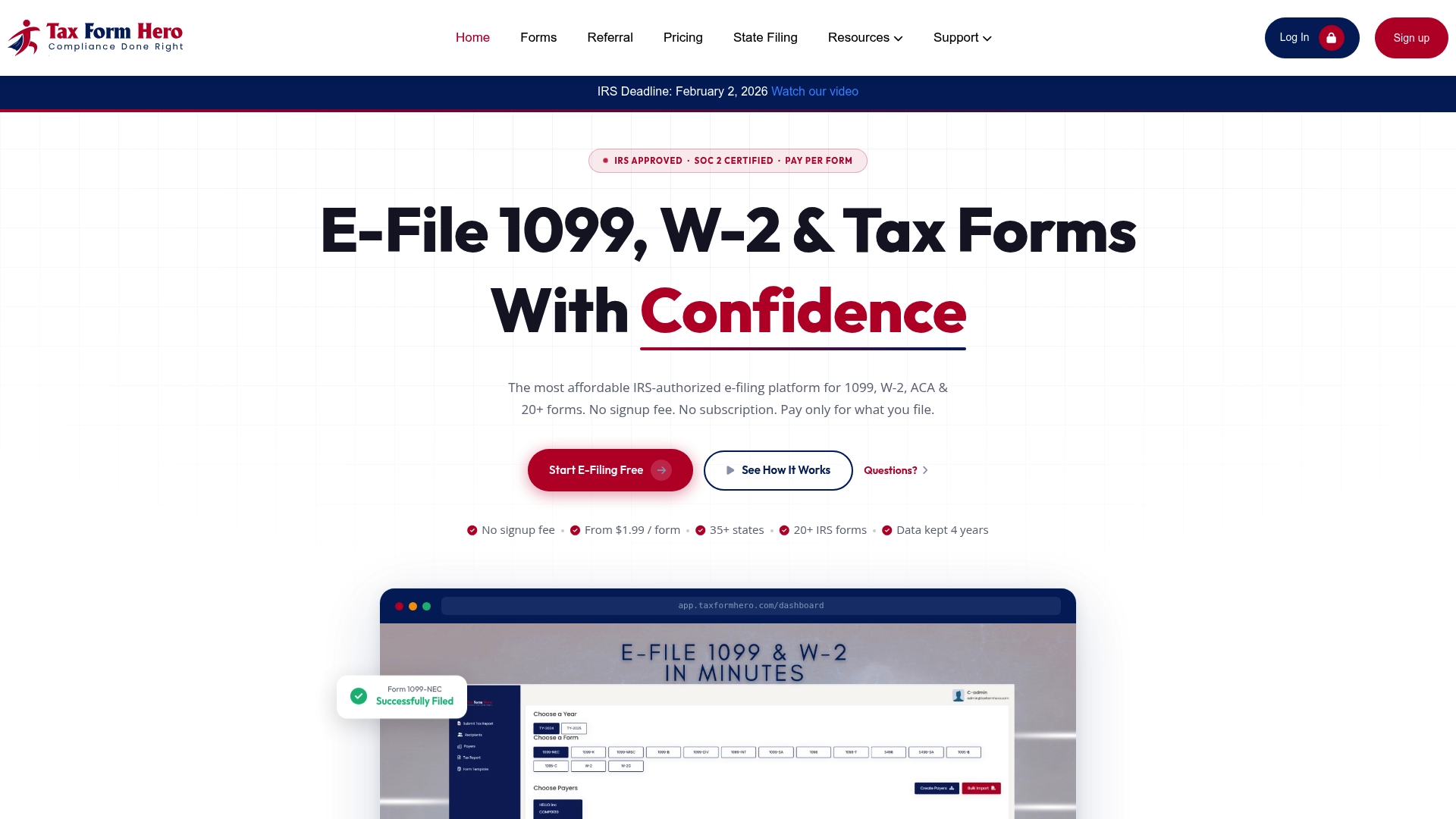
TaxFormHero gives payors and law firms TIN verification before submission, bulk import from existing payment records, direct state filing for 35+ states, and SOC 2-certified encrypted delivery to recipients. Every filing generates a timestamped audit trail. For firms processing co-counsel payments, expert witness fees, and settlement disbursements across a full calendar year, that combination of built-in verification and batch processing is the practical difference between a clean filing season and a stack of B-Notices. Start your filing at Taxformhero.
Sources
- Instructions for Forms 1099-NEC and 1099-MISC
- IRS Form 1099 rules for settlements and legal fees | American Bar Association
- 1099 Reporting Requirements for Attorney Fee Payments - LegalClarity
- Top Form 1099 filing tips for law firms | EisnerAmper
This article provides general information about IRS 1099 reporting requirements and is not a substitute for professional tax or legal advice. Confirm current thresholds and rules with the IRS instructions or a qualified tax advisor before filing.