
Outsource 1099 filing if you issue 10 or more information returns a year, worry about TIN mismatches, or lack staff to manage January and March deadlines. Below that threshold, with clean vendor data and available staff, in-house filing usually works fine.
Two compliance triggers make the decision for you. The IRS requires electronic filing once a business submits 10 or more information returns in a calendar year, counting across all form types combined, not per form. Layer on the January 31 recipient deadline and the March 31 e-file deadline, and manual processes get risky fast. TaxFormHero handles this as a pay-per-form provider with built-in TIN verification and SOC 2 security, so you file without buying software you’ll use six weeks a year.
Your next move: pull last year’s 1099 count and check it against that 10-return threshold before you decide anything else.
- Count total information returns filed last year (all types combined)
- Check for TIN mismatches or rejected forms from prior seasons
- Confirm whether you have staff available between mid-January and March 31
Key Takeaways
Outsourcing 1099 filing pays off once volume, TIN-mismatch risk, or staffing limits make in-house processing unreliable near the January 31 and March 31 deadlines.
| Point | Details |
|---|---|
| Check the 10-return threshold | E-filing becomes mandatory once you submit 10 or more information returns in a year, across all types combined. |
| Mark both deadlines | Recipient copies are generally due January 31; most e-filed 1099s are due to the IRS by March 31. |
| Run TIN matching early | Verify TINs at vendor onboarding, not during filing season, to avoid rejection backlogs and penalty exposure. |
| Vet providers on five points | Confirm IRS filing authorization, SOC 2 security, correction SLAs, scope of forms, and transparent pricing. |
| Consider TaxFormHero for pay-per-form filing | TaxFormHero offers IRS-authorized e-filing, SOC 2 security, TIN verification, and pricing starting at $1.99 per form with no subscription. |
A Practitioner’s Note on Outsourcing 1099s
The pitfall I see most often isn’t a filing error. It’s teams cleaning up contractor TINs in late January instead of at onboarding, which turns a five-minute check into a February scramble. Build the habit of collecting and verifying W-9s the day a vendor signs on, and correction season stops being stressful.
— Nazrul
If you would rather not do this on paper, e-file Form W-2 online with TaxFormHero instead.
What 1099 Outsourcing Services Actually Include
A 1099 outsourcing engagement isn’t just “someone else pushes the button.” It covers the full production line from raw vendor data to a filed, acknowledged return, and understanding each step tells you what you’re actually paying for.
- W-9 collection and validation. The provider gathers W-9s from your vendors or imports the ones you already have, checking for missing fields or obvious formatting errors.
- Bulk import and data cleaning. Your vendor list gets uploaded, usually via spreadsheet, and scrubbed for duplicates or inconsistent naming before anything touches the IRS.
- TIN matching. Names and taxpayer ID numbers get checked against IRS records to catch mismatches before submission, not after rejection.
- Form preparation and e-filing. The provider generates the correct forms (1099-NEC, 1099-MISC, 1099-INT, and others) and transmits them through an authorized channel like IRIS or FIRE.
- Recipient delivery and corrections. Copies go out by print and mail or encrypted e-delivery, and the provider manages any corrections after the fact.
Why Businesses Outsource Their 1099 Preparation
Outsourced 1099 preparation trades staff hours for a predictable per-form cost, and for most filers that trade pays off. Instead of a payroll or accounting team scrambling every January, the workload shifts to a vendor whose entire job is getting forms filed correctly and on time.
The trade-offs run in both directions:
- Time: Outsourcing frees internal staff from data entry and IRS portal navigation during your busiest weeks.
- Risk: Proactive TIN matching lowers rejection rates and cuts penalty exposure tied to incorrect filings.
- Cost: You pay per form instead of maintaining software licenses or headcount for a seasonal task.
- Control: You give up some direct oversight of the filing mechanics, though not legal responsibility.
In-house filing still makes sense if you issue a handful of forms and your payroll system already handles them cleanly.
Pro Tip: Run TIN matching when you onboard a vendor, not when you’re preparing forms in January. Catching a mismatch in October costs you an email; catching it in February costs you a rejected filing and a scramble.
What Are the Current 1099 Filing Deadlines and Rules?
Three IRS rules drive the outsourcing decision more than anything else, and they aren’t optional.
The mandatory e-file threshold. As of 2026, the IRS requires electronic filing for any business submitting 10 or more information returns in a calendar year, and that count is aggregate across all return types, not just 1099s. This threshold dropped from 250, so far more small filers now fall under it than a few years ago.
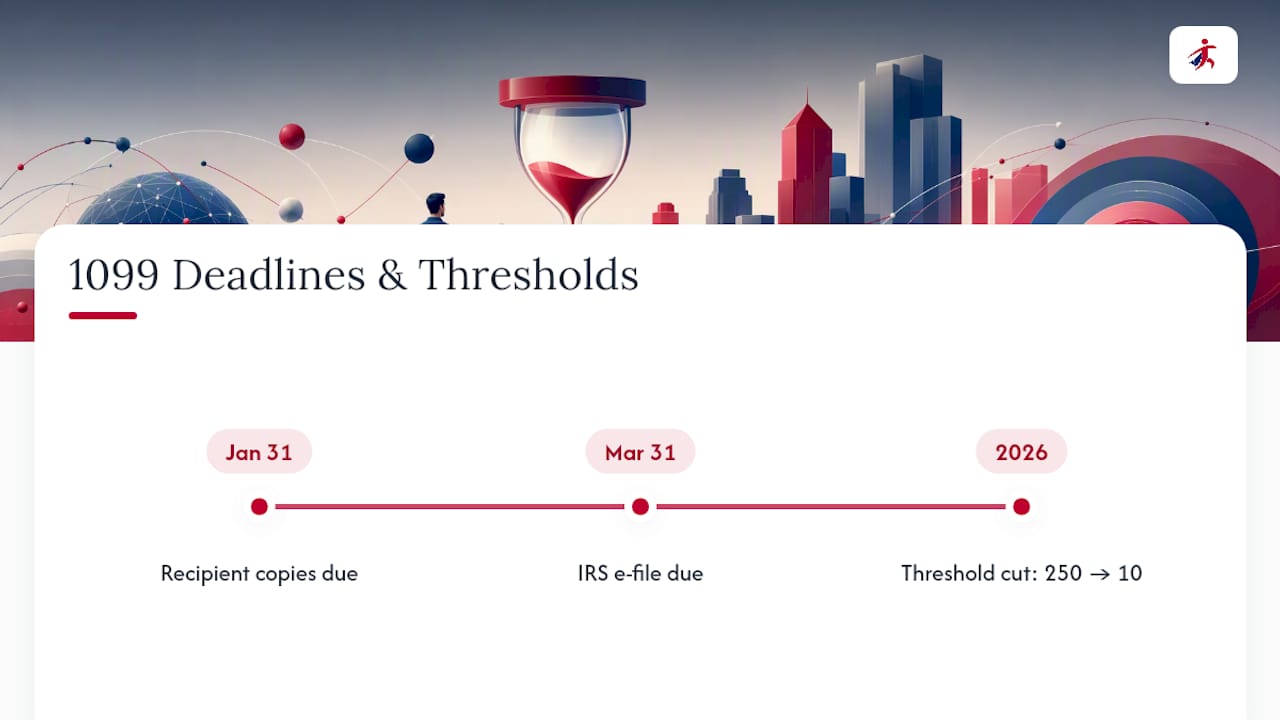
The two key deadlines. Recipient copies of many 1099 forms are generally due by January 31, while the e-file deadline for most Forms 1099 with the IRS falls on March 31. When either date lands on a weekend or federal holiday, the deadline shifts to the next business day.
Exact-match TIN rules. IRS guidance requires names and TINs to match exactly, and a mismatch triggers a rejection that must be corrected quickly to avoid escalating penalties.
How to Vet a 1099 Filing Provider Before You Sign
Not every provider that advertises “1099 filing services” operates the same way behind the scenes. Before you commit, run through this checklist.
- Confirm IRS filing authorization. Ask whether the provider transmits directly through IRIS or FIRE as an authorized transmitter, or whether they route through a third party.
- Verify security credentials. Look for SOC 2 compliance or an equivalent standard, along with encryption details and data retention policies.
- Ask about correction turnaround. Get a specific SLA for how fast a rejected return gets corrected and retransmitted, plus whether you’ll get an audit log.
- Clarify scope and exclusions. Confirm which 1099 types are supported, whether state filing is included, and whether print/mail and TIN matching are bundled or billed separately.
- Request sample pricing scenarios. Ask for a real cost breakdown at your expected volume, including any add-on fees.
Keep in mind that outsourcing shifts the production work, not the legal responsibility. The issuer remains accountable for the accuracy of every filing, so oversight during the review step still matters even after you hand off the mechanics.
What Does Outsourcing 1099 Filing Actually Cost?
Pricing structures vary more than most buyers expect, and the sticker price rarely tells the whole story.
- Pay-per-form: You’re charged a flat fee per form filed, which favors organizations with fewer or irregular filings.
- Volume tiers: Rates drop as your form count rises, which can beat pay-per-form pricing for high-volume filers.
- Subscriptions: Some vendors charge a recurring fee regardless of volume, which rarely makes sense for seasonal 1099 work.
- Add-ons: Print and mail, TIN matching, and state filing often carry separate charges if not bundled.
To compare fairly, add up the vendor’s all-in cost (base fee plus every add-on you’ll actually need) against your internal labor cost plus your realistic penalty risk from late or rejected filings. Rejection and correction penalties escalate quickly, so a slightly higher per-form fee that includes TIN matching often wins on total cost.
What the End-to-End Outsourced Filing Process Looks Like
The mechanics behind a typical 1099 outsourcing engagement follow a consistent sequence once you’ve selected a provider.
- Data submission. You upload vendor and payment data, typically as a CSV, Excel export, or through an API connection to your accounting software.
- Review and approval. The provider generates draft forms for your review before anything transmits, giving you a last check on names, amounts, and TINs.
- Transmission and acknowledgment. Once approved, forms transmit electronically, and the provider retrieves IRS acknowledgments confirming acceptance or flagging rejections.
- Corrections and recordkeeping. Rejected forms move into a correction workflow, and you retain copies for your own records regardless of what the vendor stores.
Your team still owns final approval and recordkeeping. Outsourcing removes the manual production work, not your obligation to review what goes out under your EIN.
How TaxFormHero Fits This Checklist
Run TaxFormHero against the vetting criteria above and the fit becomes concrete rather than promotional. It operates as an IRS-authorized electronic filing service with SOC 2 certification, supporting more than 20 IRS forms beyond just 1099s, including W-2 and ACA filings.
Specific features that map directly to the checklist:
- Bulk import for handling vendor lists at any volume
- Direct state filing support across 35+ states
- Print and mail plus encrypted e-delivery for recipient copies
- Built-in TIN verification to catch mismatches before submission
Pricing runs pay-per-form, starting at $1.99 per form, with no signup fees or subscriptions attached. Before ordering, have your payer EIN, a vendor CSV, and any collected W-9s ready to speed up the import step.
Pro Tip: If you’re testing a provider for the first time, file one low-stakes form first to confirm the review screen matches your source data before you upload your full vendor list.
What to Expect During Vendor Onboarding
Getting set up with an outsourced 1099 provider typically takes less time than businesses expect, but the steps matter for a clean first filing.

Most platforms start with account creation, which requires basic company details: your EIN, business name as registered with the IRS, and contact information for the person authorizing filings. From there, you’ll connect a data source. Some providers accept a straightforward CSV upload, others offer API connections to accounting platforms like QuickBooks or Xero, and some support both depending on your volume and technical comfort.
Once data lands in the system, expect a validation pass. The platform checks for missing fields, formatting issues, and TIN mismatches, flagging anything that needs your attention before it reaches the review stage. This is where a clean vendor master record pays off, since messy data at this step means more back-and-forth before you can approve anything.
The review step is where you sign off on generated forms before transmission. Treat this as your actual control point rather than a formality, since it’s your last chance to catch an error before it becomes an IRS submission under your name.
After approval, the platform transmits your forms and retrieves acknowledgments, typically within a short window. If anything gets rejected, you’ll want clarity upfront on how corrections route back to you and how fast turnaround runs, since that detail rarely shows up on a pricing page but matters enormously come February.
Ready to File Your 1099s Without the Software Overhead
Everything covered here, TIN matching, IRS-authorized transmission, correction handling, print and mail, is available through TaxFormHero without a subscription or a signup fee. You pay per form, starting at $1.99, whether you’re filing three 1099-NECs for contractors or several hundred across multiple entities.
Before you start, gather three things: your payer EIN, a spreadsheet of vendor payments, and any W-9s you’ve already collected. If you’re not sure how a filing will look, you can prepare a sample form to see the review screen before committing to your full batch. From there, request a quote based on your actual volume or head straight to the TaxFormHero platform to begin your first filing. Either path gets you a concrete number instead of a guess, and gets your forms filed well before the March 31 e-file deadline closes in.
Recommended

File Information Returns With Confidence
TaxFormHero supports 20+ IRS information returns, including 1099 and W-2 forms, with bulk Excel import, name/TIN matching and encrypted recipient delivery.
Explore TaxFormHero