Reporting dividends on Form 1099-DIV

A 1099-DIV is required once dividends reach $10, and filing 10 or more information returns of any type makes electronic filing mandatory. This guide covers who receives one, how ordinary and qualified dividends differ, and what belongs in each box.
Before you touch a filing portal, work through this checklist:
- Gather payer and recipient data, including current TINs and mailing addresses.
- Run TIN verification to catch mismatches before they trigger backup withholding.
- Choose an IRS-authorized transmitter or e-file vendor that fits your volume.
- Submit before March 31, 2026, and confirm recipient copies go out by February 2, 2026.
Pro Tip: Don’t wait until late March to test your file format. A rejected transmission two days before deadline leaves you no room to fix errors and refile.
Key Takeaways
Filing Form 1099-DIV correctly comes down to meeting the $10/$600 thresholds, hitting both deadlines, and validating TINs before transmission, not after.
| Point | Details |
|---|---|
| Know your thresholds | File for recipients with $10+ in dividends or $600+ in liquidation distributions. |
| Track both deadlines | Furnish recipient copies by February 2, 2026, and e-file with the IRS by March 31, 2026. |
| E-file if you hit 10 returns | Filers with 10 or more aggregate information returns must e-file, not paper file. |
| Verify TINs before transmitting | Run TIN matching early to avoid backup withholding and correction filings. |
| Consider a vendor-assisted option | TaxFormHero offers bulk import, TIN verification, and pay-per-form pricing starting at $1.99. |
Where to Verify Official 1099-DIV Rules
- Instructions for Form 1099-DIV: thresholds, deadlines, and penalty amounts.
- Publication 1099: e-file mandate and correction rules.
- Pub. 1220 electronic filing guidance: technical file specifications.
- IRS FAQ on 1099-DIV: recipient reporting guidance.
This article is general information, not a substitute for advice from a qualified financial advisor. Consult a qualified financial professional about your own circumstances before acting on anything here.
If you would rather not do this on paper, e-file Form 1099-DIV online with TaxFormHero instead.
How to E-File 1099-DIV Step by Step
E-filing 1099-DIV isn’t complicated once you break it into stages: prepare, validate, transmit, furnish. Skipping steps is what causes rejected files and late notices.
-
Pull your data. You’ll need payer name, TIN, and address; recipient name, TIN, and address; and box-level amounts, most commonly Box 1a (ordinary dividends), Box 1b (qualified dividends), and Box 2a (capital gain distributions). Export these directly from your accounting or brokerage software rather than retyping them.
-
Collect and verify W-9s. Every recipient should have a signed W-9 on file. Run TIN matching before you file. This single step prevents the majority of IRS notices tied to name and TIN mismatches.
-
Format to spec. If you’re building your own file, it needs to follow the Pub. 1220 layout. Most vendors handle this automatically, converting your spreadsheet or CSV into a compliant submission. Run a validation pass, checking that totals reconcile against your general ledger before you transmit anything.
-
Transmit through an approved channel. If you’re filing directly, you’ll register for a Transmitter Control Code and submit through FIRE or IRIS. If you’re using an authorized vendor, this step is handled on your behalf. Either way, confirm you receive an acknowledgment, not just a submission receipt.
-
Furnish recipient copies. You can deliver via encrypted e-delivery, print and mail, or a downloadable PDF, as long as it reaches the recipient by February 2, 2026. Keep records of delivery method and date for every recipient.
Who must report dividends, and by when?
The dollar thresholds are lower than most people expect. You must file Form 1099-DIV for any recipient who received $10 or more in dividends or capital gain distributions, or $600 or more in liquidation distributions, during the tax year.
Two dates matter most this filing season:
- February 2, 2026: recipient copies must be furnished.
- March 31, 2026: IRS e-file deadline.
If your business files 10 or more information returns in aggregate across all form types, not just 1099-DIV, the IRS requires electronic filing under Publication 1099. Paper filing is only an option below that threshold, and even then, a hardship waiver request is possible but not guaranteed. Most small businesses issuing multiple 1099s to vendors and investors will cross the 10-return line without realizing it.
Which IRS E-File System Should You Use?
Direct filers have two main routes: the FIRE System (Filing Information Returns Electronically) and IRIS (Information Returns Intake System), the newer no-cost portal. IRIS tends to suit smaller filers submitting a modest batch of forms manually, while mid-size and high-volume filers often lean on Pub. 1220-compliant files submitted through FIRE or an authorized transmitter, since that format supports larger batch processing.
Either path requires planning ahead on registration:
- A Transmitter Control Code (TCC) and valid EIN are required for direct FIRE or IRIS submissions.
- TCC applications can take up to 45 days to process, so apply well before your filing window opens.
- Files must meet Pub. 1220 specifications exactly, covering record layout, field lengths, and transmission format.
- After submission, the IRS returns an acknowledgment; a rejected file must be corrected and retransmitted, not ignored.
Working with an IRS-authorized vendor sidesteps the TCC registration entirely, since the vendor transmits on your behalf using its own credentials.
The most common 1099-DIV reporting mistakes
Most penalty notices trace back to a handful of recurring errors, not fraud or negligence. Watch for these:
- Incorrect or missing TINs, or a name/TIN combination that doesn’t match IRS records.
- Amounts entered in the wrong box, especially confusing ordinary dividends with qualified dividends.
- Missing or outdated recipient addresses.
- Duplicate records from re-importing the same data twice.
Filers who skip W-9 collection upfront often discover TIN problems only after the IRS sends a notice, at which point backup withholding may already apply. Running TIN matching before transmission catches this early. Before you submit, reconcile your total distributions against your ledger and spot-check a sample of recipient records against source documents.
Pro Tip: Treat TIN matching as a pre-flight check, not a post-filing cleanup task. Catching a mismatch before transmission costs minutes; catching it after costs a correction filing and possible penalty exposure.
Do state agencies need a copy of your 1099-DIV?
Requirements vary by state: some accept your IRS e-file transmission through the Combined Federal/State Filing Program, while others require a separate state submission entirely. Check your state’s department of revenue before assuming federal filing covers you.
- Confirm state participation in Combined Federal/State Filing before skipping a separate state submission.
- Furnish recipient copies through encrypted e-delivery or mail well ahead of February 2, keeping delivery records for your files.
- Budget for state filing add-on fees if your vendor charges separately per state.
How Do You Correct a Filed 1099-DIV?
If you already e-filed the original, the correction must also be e-filed. This isn’t optional. Filers who reach the aggregate 10-return threshold can’t fall back to paper corrections just because the mistake feels minor.
- Submit the correction using the same channel or vendor you used for the original filing.
- Penalties climb with delay, starting around $60 per form for corrections made within 30 days and rising for later filings, with higher caps for larger businesses.
- Contact IRS information reporting support directly if you’re facing a systemic issue, and document your reasonable-cause argument if you plan to request a penalty waiver.
A Practical Option: E-Filing 1099-DIV With TaxFormHero
Every step covered above, from data prep to recipient delivery, maps directly to what TaxFormHero is built to handle. The platform offers bulk import for pulling payer and recipient data at once, built-in TIN verification to catch mismatches before transmission, and Pub. 1220-compliant output so you’re not building file specs from scratch.
Here’s how the features line up against the workflow:
- Prepare: Bulk import pulls your data without manual re-entry.
- Validate: TIN verification flags mismatches before you file.
- Transmit: IRS-authorized status means no separate TCC registration needed.
- Furnish: Encrypted e-delivery or print-and-mail covers recipient copies, with state filing add-ons available where required.
Pro Tip: Pay-per-form pricing starting at $1.99 means you’re not locked into a subscription for forms you file once a year.
Backed by SOC 2 certification and encrypted data handling, it’s built for accountants and small businesses who’d rather not build a FIRE submission from scratch. You can review the full feature list on the TaxFormHero site.
What Tax Professionals Should Prioritize This Filing Season
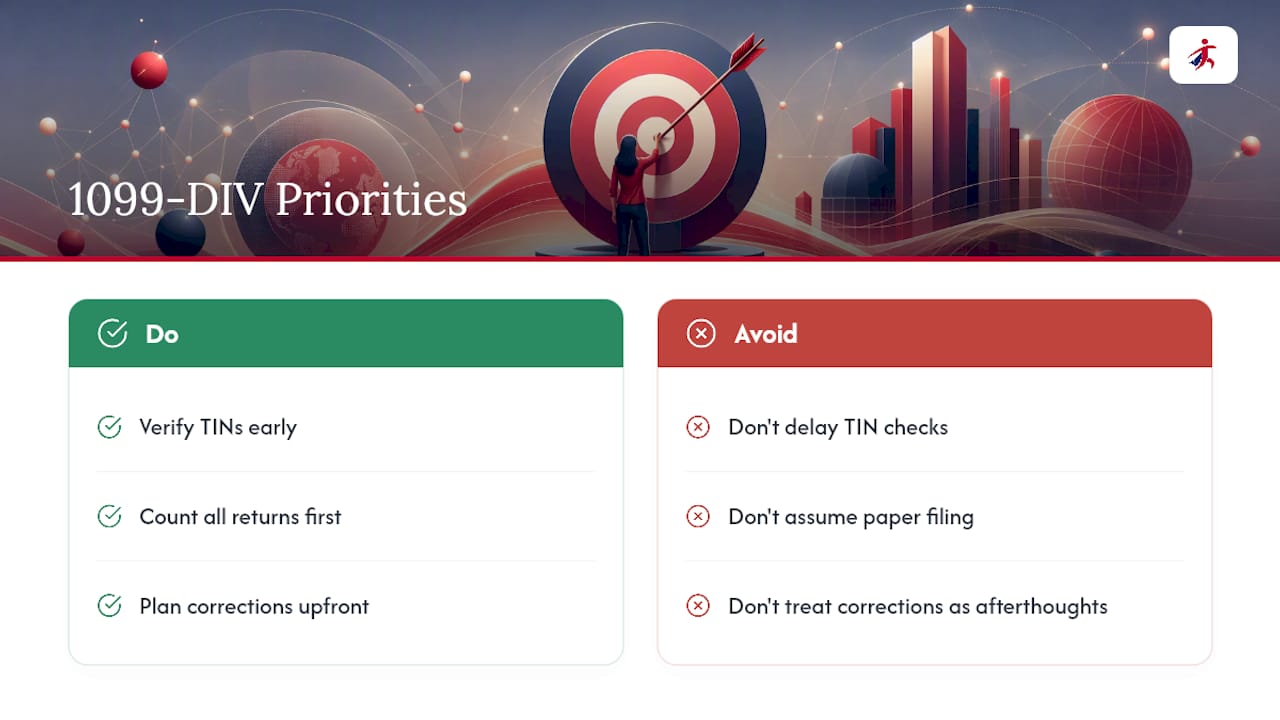
The conventional advice on 1099-DIV filing treats every step as equally urgent, and that’s where most guidance falls short. TIN verification deserves more attention than it gets. A mismatched TIN caught in January costs you five minutes. The same mismatch caught in April, after backup withholding should have applied, costs you a correction filing, a penalty exposure conversation, and possibly an unhappy recipient asking why their 1099 doesn’t match their brokerage statement.
The 10-return e-file threshold also gets underestimated. Plenty of small businesses assume paper filing is still an option because they’ve always done it that way, then discover mid-February that combining 1099-DIV, 1099-NEC, and 1099-MISC pushes them over the line. Count your aggregate returns before you decide on a filing method, not after.
If there’s one habit worth adopting over any other, it’s treating corrections as part of the original filing process rather than an afterthought. A return filed electronically must be corrected electronically. Businesses that plan for that upfront spend far less time scrambling in April.
File Your 1099-DIV Forms Without the Subscription Commitment
If you’ve made it this far, you know the mechanics: TIN verification, Pub. 1220 formatting, TCC registration, recipient delivery deadlines. TaxFormHero handles that entire chain in one dashboard, without asking you to sign a contract or pay for forms you’re not filing this year.
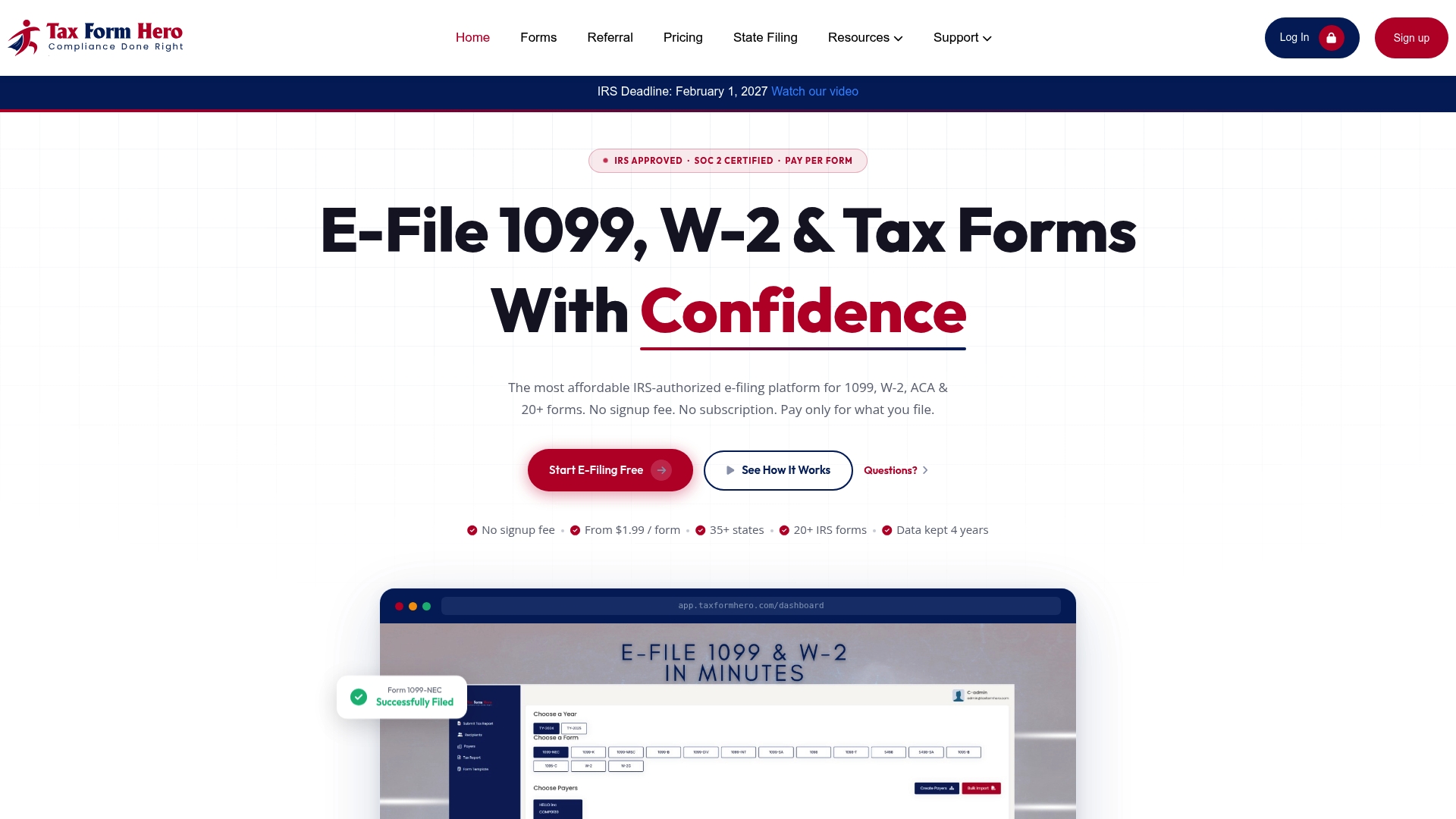
The platform fits businesses filing a handful of 1099-DIVs and firms filing hundreds, since pricing scales per form rather than per subscription tier. Bulk import handles the data entry, TIN verification runs before you transmit, and encrypted e-delivery or print-and-mail covers your recipient copies without a separate vendor. State filing add-ons are available for the states that require a separate submission, so you’re not juggling two systems for one filing season.
If your February and March deadlines are approaching, start a filing on TaxFormHero and see your form count and pricing before you commit to anything.
Sources
- Instructions for Form 1099-DIV (Internal Revenue Service)
- Publication 1099 (2026), General Instructions for Certain Information Returns (Internal Revenue Service)
- 1099-DIV dividend income | Internal Revenue Service
- Publication 1099 (2026) — electronic filing guidance (Internal Revenue Service)
Recommended

File Information Returns With Confidence
TaxFormHero supports 20+ IRS information returns, including 1099 and W-2 forms, with bulk Excel import, name/TIN matching and encrypted recipient delivery.
Explore TaxFormHero