Avoid IRIS Rejects: Best 1099-MISC Software for 2026 with TIN Checks

We recommend TaxFormHero as the best overall pick for most small businesses and accountants filing 1099-MISC forms in 2026, mainly because it combines pay-per-form pricing with built-in TIN verification and state filing support. For high-volume firms that need tiered discounts, Yearli is worth a look. For developers who want API access, Track1099 fits that niche. Your final choice should weigh TIN matching, state filing coverage, and recipient delivery options, not just the sticker price.
TL;DR:
- TaxFormHero offers pay-per-form pricing with optional TIN verification and supports multiple states, making it ideal for small-scale or irregular filers.
- For high-volume needs, Yearli’s tiered pricing better suits firms managing thousands of contractors, while API-based Track1099 appeals to developers and automation-focused teams.
- State filing coverage varies, with some platforms including multiple states or D.C. under no extra charge, but others bill separately for multi-state filing.
- Recipient delivery options include print, mail, and encrypted electronic delivery, with costs that can add up per form, depending on the vendor.
- Ensuring TIN matching and proper security measures like SOC 2 attestation is crucial when selecting software, alongside confirming whether bulk or manual data import fits your workflow.
How the top 1099-MISC filing tools compare at a glance
Before you commit to a vendor, it helps to see how the main options stack up on price structure, compliance features, and delivery methods. We built this shortlist around the factors that actually affect your filing outcome: whether TIN mismatches get caught before submission, whether your state is covered, and whether recipients get their copies on time.
- TaxFormHero: pay-per-form pricing for small businesses and accountants who want transparent, graduated rates.
- Tax1099: accountants and bookkeeping firms running QuickBooks or Xero integrations.
- efile4Biz: filers who want print, mail, and e-file bundled into one workflow.
- Yearli: high-volume firms that need tiered volume pricing.
- 1099Online: small teams that want a minimal, no-frills web uploader.
- CheckMark 1099 Software: desktop users and firms that print forms in-house.
- Track1099: developers and teams that need API integration.
- BoomTax: small businesses that want a simple interface with automated error checks.
Read the “starting price shape” column as a description of how billing works, not a quote you can use for budgeting. Confirm exact per-form rates, add-on fees, and the states each vendor actually covers directly on the vendor’s pricing page before you commit, since these details change as providers update their plans.
TaxFormHero is an IRS-authorized e-filing platform, so you can e-file Form 1099-MISC online without paper or a subscription.
Profiles of the eight 1099-MISC filing tools we compared
Each of these tools handles the core job of transmitting 1099-MISC data to the IRS, but the details of pricing, automation, and delivery vary enough to matter for your workflow.
TaxFormHero is built around pay-per-form pricing with no subscription or signup fee, which matters if you file a small or irregular batch of forms each year.
- IRS-authorized filing, with federal returns transmitted through IRIS A2A.
- Graduated pricing: forms above 1,000 cost less per form than the first 150, so the rate drops as your volume grows instead of repricing the whole order.
- Instant TIN verification is available as an optional add-on, allowing users to detect mismatches before submission.
- State filing support includes multiple states plus Washington, D.C., with some states covered under Combined Federal/State Filing without additional charge.
- The platform holds a SOC 2 Type I attestation, and recipient delivery options include print and mail as well as encrypted e-delivery, both available for additional fees.
Pro Tip: If you file fewer than 150 forms a year and want to avoid a subscription, TaxFormHero’s graduated per-form pricing usually works out cheaper than a flat-tier competitor.
Tax1099 is a common choice for accounting firms that already run their books through QuickBooks or Xero.
- Offers real-time TIN matching as part of its workflow.
- Integrates directly with several accounting platforms, cutting down on manual data entry.
- Supports multi-state filing for firms handling clients across several jurisdictions.
- Pricing scales with volume, though exact per-form rates require checking current vendor documentation.
Pro Tip: If your firm’s contractor data already lives in QuickBooks or Xero, confirm Tax1099’s integration list before assuming a smooth sync.
efile4Biz bundles print, mail, and e-file into a single workflow, which suits filers who don’t want to manage recipient delivery separately.
- Combines e-filing with built-in print and mail service.
- Handles multi-state filing for businesses that need it.
- Reduces the number of separate vendors you manage for one filing season.
Pro Tip: If you dread coordinating a separate mail house for recipient copies, a bundled print/mail and e-file workflow like this saves a step.
Yearli scales for firms that file in bulk and want pricing that reflects volume.
- Tiered pricing structure designed for high-volume filers.
- Offers TIN matching options as part of its service.
- Supports print/mail and e-delivery for recipient copies.
- Built for firms managing a lot of contractors or vendors across multiple clients.
Pro Tip: If you file thousands of forms a year, ask Yearli for its volume pricing table before assuming a flat per-form rate applies.
1099Online keeps things simple: a web uploader with CSV bulk import and not much else.
- CSV bulk import lets you upload recipient data in bulk rather than entering it manually.
- Web-based with a minimal interface, which suits teams that just need the filing done.
- State filing support is more limited than some of the larger platforms on this list.
Pro Tip: If you only need to file a handful of forms without extra compliance tools, a bare-bones uploader like this avoids paying for features you won’t use.
CheckMark 1099 Software is the one desktop option here, aimed at firms that print forms in-house and want to avoid per-recipient fees.
- One-time licensing model instead of per-form charges.
- Prints directly on blank paper, which cuts down on pre-printed form stock.
- Runs locally rather than through a browser, which some firms prefer for data control.
- Lacks the cloud-based automation (like instant TIN checks) that web platforms typically offer.
Pro Tip: If you already print and mail forms yourself every year, a one-time desktop license can cost less over several seasons than per-form web pricing.
Track1099 leans into automation for teams comfortable working through an API.
- API-first design lets developers integrate filing directly into internal systems.
- Automated W-9 collection reduces the manual follow-up work of gathering recipient data.
- Supports e-delivery and mail for recipient copies.
- Best suited to teams with development resources to build around the API.
Pro Tip: If you need filing to run inside your own software stack rather than through a web form, check whether Track1099’s API documentation covers your integration case.
BoomTax focuses on a simple interface paired with automated error detection.
- Drag-and-drop file uploads simplify the data entry process.
- Automated error detection flags issues like missing TINs before submission.
- Web-based platform with a straightforward user interface.
Pro Tip: If your team is filing 1099s for the first time, automated error detection can catch formatting mistakes a manual review might miss.
How to choose 1099-MISC software without overpaying
Picking the right vendor comes down to matching features to your actual filing volume and compliance needs, not just comparing headline prices.
- TIN verification: confirm whether the vendor checks taxpayer ID numbers against IRS records before submission, and at what cost per check.
- State filing and CF/SF support: check which states are covered and whether Combined Federal/State Filing is included or billed separately.
- Recipient delivery options: look at whether print and mail, encrypted e-delivery, or both are available and what each costs per form.
- Security practices: ask about data encryption and any independent security attestations, such as SOC 2.
- Pricing model: decide whether pay-per-form or a tiered subscription fits your filing volume better.
- Integrations and API access: check whether the platform connects to your accounting software or offers API access if you need to automate data transfer.
Before signing up, ask each vendor these questions:
- Do you file through IRIS, FIRE, or both?
- How long does your Transmitter Control Code (TCC) setup take?
- Is state filing included, or billed as a separate add-on?
- What does TIN matching cost per check?
- Can you give me sample pricing for 50, 500, and 1,000 contractors?
- What delivery options do recipients get, and what do they cost?
- Do you support bulk import from Excel or CSV files?
- Is there a signup fee or annual contract?
Watch for red flags like vague pricing pages, no mention of IRS authorization, or support teams that can’t explain their TCC timeline. A clean, six-point check (price per form, TIN matching cost, state coverage, delivery fees, security attestation, and contract terms) can rule out a poor fit in a few minutes.
Pro Tip: Keep your contractor records organized before filing season starts. Tools like an invoice numbering system make it easier to match recipient data to the right forms when you’re entering information in bulk.

Why your IRS filing route affects which software you need
The IRS gives you two main ways to transmit 1099-series returns electronically, and which one a vendor uses shapes what features actually matter. The IRIS Taxpayer Portal is a free option for direct data entry or CSV upload, and it supports Combined Federal/State Filing participation for many states. Software vendors that transmit in bulk typically use IRIS A2A (a system-to-system XML connection) or the older FIRE system, which requires files formatted to Pub. 1220 specifications.
- IRIS Taxpayer Portal: free, direct filing for businesses that don’t need bulk automation.
- IRIS A2A: bulk, system-to-system filing used by most commercial vendors.
- FIRE: the legacy system, still in use, requiring Pub. 1220-formatted files.
Practitioner guidance commonly recommends submitting a Transmitter Control Code application at least 45 business days before you intend to e-file. Missing that window can force you into paper filing or manual workarounds during peak season.
If you only need to file a handful of forms, the free IRIS portal may cover you. Once you’re dealing with bulk uploads, TIN verification, or recipient print and mail, a vendor typically saves more time than it costs. For a closer look at how the portal compares to vendor workflows, see our guide to e-filing 1099-MISC through IRIS versus a vendor.
How we evaluated these 1099-MISC filing tools
We compared these eight platforms on pricing structure, TIN verification availability, state filing and CF/SF support, recipient delivery options, platform type, and volume scaling, drawing on vendor documentation and IRS publications where figures are cited.
- Pricing and feature claims for competitor products come from publicly available vendor documentation.
- TaxFormHero’s claims are drawn from its own published pricing and security attestations.
- Exact per-form fees can change, and some vendors require an account login to see final pricing, so always confirm current rates directly before purchasing.
When TaxFormHero fits and when it doesn’t
For most small businesses and accountants who want transparent, pay-per-form pricing with TIN verification and state filing built in, TaxFormHero is the practical choice. If your firm needs deep API integration or has relied on desktop software for years, a tool like Track1099 or CheckMark 1099 Software may fit your existing workflow better.
— Nazrul
File your 1099-MISC forms with transparent, pay-per-form pricing
This IRS-authorized platform charges only for forms filed, with graduated pricing where tiers apply to forms within each volume bracket. Optional add-ons include TIN verification, state filing for multiple states plus D.C., and recipient delivery methods such as print, mail, or encrypted e-delivery. The platform holds a SOC 2 Type I attestation for its security practices.
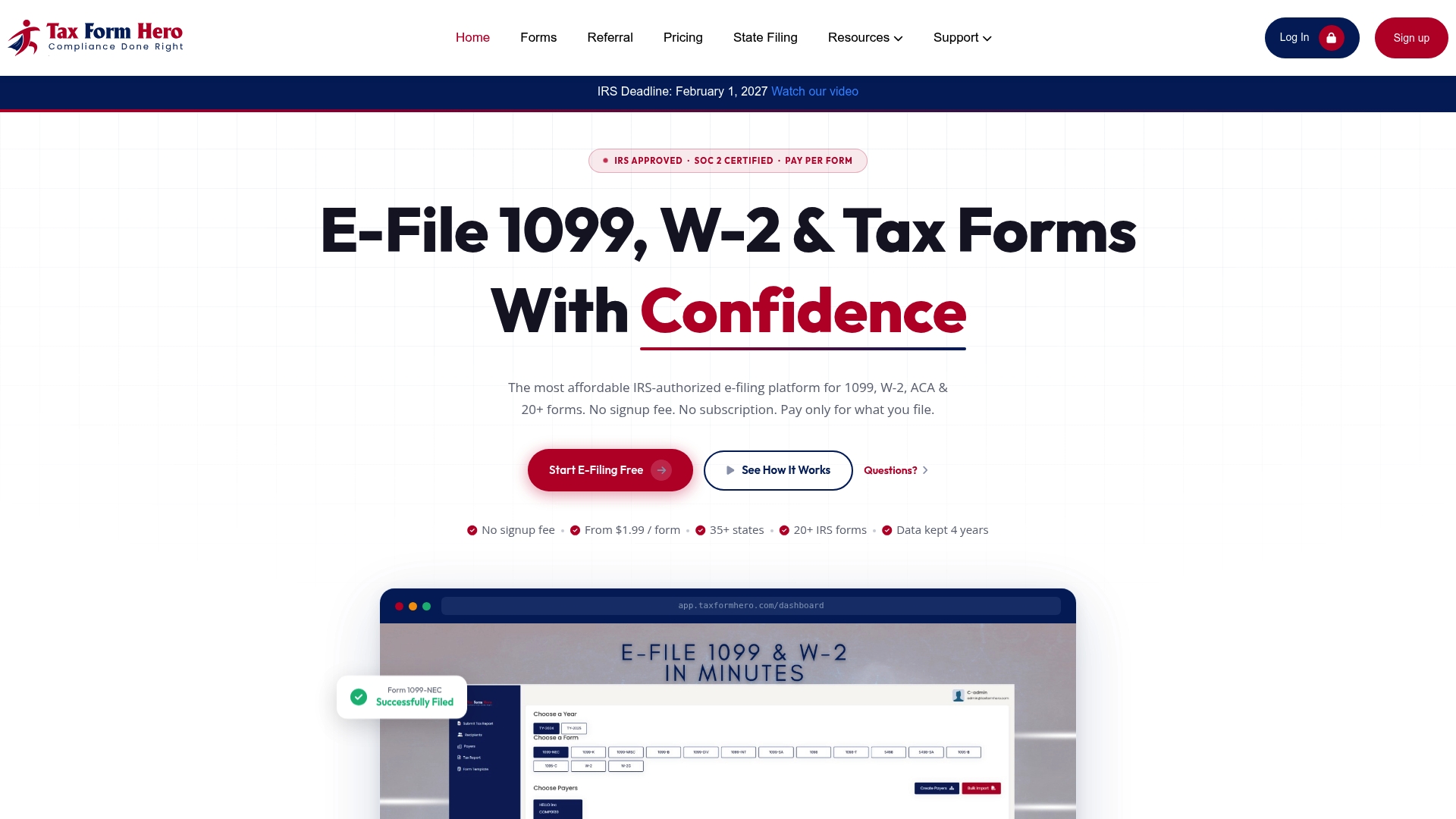
Ready to see your exact cost before you file? Check current pricing and add-on fees or head straight to filing your 1099-NEC online to get started.
FAQ
Can 1099-MISC forms be filed electronically?
Yes, 1099-MISC returns can be filed electronically through the IRS IRIS Taxpayer Portal or through IRS-authorized software vendors that transmit via IRIS A2A or FIRE. Many filers are required to file electronically rather than on paper.
Can you file a 1099-MISC on TurboTax for free?
TurboTax is built primarily for individual income tax returns rather than business information-return filing, so it is not the standard route for transmitting 1099-MISC forms to the IRS. For 1099-series filing, the IRS offers a free portal called IRIS for businesses that want to file without paying a vendor.
What tax software do CPAs commonly use for 1099 filing?
CPAs and accounting firms commonly choose platforms with integrations into their existing bookkeeping software, such as Tax1099, since syncing contractor data from QuickBooks or Xero cuts down on manual entry. Firms handling higher volumes of 1099-MISC filings for multiple clients often weigh pricing tiers and TIN matching availability alongside those integrations.
How much does 1099-MISC filing software typically cost?
Pricing models vary: some vendors charge per form with discounts at higher volumes, while others use one-time desktop licenses or tiered subscription plans. TaxFormHero, for example, charges starting at $1.99 per form on a graduated scale with no subscription fee.
Do I need to apply for a Transmitter Control Code before I file?
Yes, a Transmitter Control Code is required to file through IRIS A2A or FIRE, and the IRS recommends applying well in advance since processing can take several weeks. Practitioner guidance commonly suggests applying at least 45 business days before your intended filing date to avoid delays.
Recommended
- Avoid 1099 Rejections: 8 Compliance Checks for U.S. E Filing Software
- Avoid a 45 day TCC Delay: IRS IRIS 1099 Filing for U.S. Businesses
- E-file 10+ 1099s in the U.S.: IRIS or Vendor, TIN Match
- Tax Form Hero - The Best 1099 Software for Accountants in 2026

File Information Returns With Confidence
TaxFormHero supports 20+ IRS information returns, including 1099 and W-2 forms, with bulk Excel import, name/TIN matching and encrypted recipient delivery.
Explore TaxFormHero