Pay Contractors With 1099s: $2,000 Rule for Small Businesses

If you pay an independent contractor $2,000 or more in a year for services, you must report those payments on Form 1099-NEC. Before you send the first payment, collect a completed Form W-9, verify the taxpayer identification number (TIN) on it, and choose a traceable payment method such as ACH or a business check. Tag the payment in your books as contractor pay from the start, and file Form 1099-NEC with the IRS when the threshold is met.
TL;DR:
- Payments to contractors are reportable on Form 1099-NEC once total annual payments meet or exceed the $2,000 threshold, which increased from $600 starting in 2026.
- Collecting a signed W-9 before paying and verifying TINs early prevents backup withholding and supports correct filing.
- Payments should be made through traceable methods like ACH or business checks, with records retained for at least four years.
- Filing deadlines are January 31 for both recipient copies and IRS submissions, whether electronic or paper, with penalties rising for late or incorrect filings.
- Proper worker classification requires assessing behavioral and financial control and documenting relationships, preventing misclassification risks.
Step-by-step: onboarding, invoicing, payment, and bookkeeping
Getting 1099 reporting right starts before any money changes hands. We recommend building the same five-step process into every contractor relationship so that year-end filing becomes a formality rather than a scramble.
- Collect a completed Form W-9 from the contractor before the first payment.
- Agree on a written contract or invoice that ties the work performed to the amount billed.
- Pay through a traceable method, such as ACH transfer or a business check.
- Record the payment in your books and link it to the matching invoice.
- Reconcile contractor payments monthly instead of waiting until January.
Each step closes a gap that causes problems later. A signed W-9 confirms the contractor’s legal name, business type, and TIN, and IRS guidance on forms for independent contractors treats this as the baseline step for avoiding backup withholding. Keep the form on file for at least four years, since that’s the retention period the IRS expects you to support a filing if it’s ever questioned.
Written invoices matter because they give you a paper trail that shows the payment was for a specific deliverable, not a personal transfer. Use consistent vendor names and account codes in your bookkeeping software so that every payment to the same contractor rolls up to one 1099 total at year-end.
- Keep contractor transactions in a dedicated vendor category, separate from employee payroll.
- Avoid paying contractors through personal payment apps or informal cash hand-offs.
- Store signed W-9s and invoices in one place, not scattered across email threads.
Pro Tip: Set up a recurring monthly reminder to reconcile contractor payments against invoices. This catches mismatches while the details are still fresh instead of at tax time.
A deposit-invoice workflow can help formalize partial payments on larger contractor projects, which keeps your records aligned with what the contractor actually billed.
Need to get this filed? You can e-file Form 1099-NEC online with TaxFormHero, which is IRS-authorized and charges per form, not per month.
When to file Form 1099-NEC and the key deadlines you must meet
Form 1099-NEC reports nonemployee compensation, which covers most payments to independent contractors, freelancers, and sole proprietors for services. As of the 2026 tax year, the reporting threshold for Form 1099-NEC increased to $2,000 for payments made to contractors for services performed in your trade or business, up from the longstanding $600 threshold. That change means some smaller vendors who fell under the old threshold may now fall under the new one too, so it’s worth rechecking totals rather than assuming last year’s list still applies.
Form 1099-MISC still applies to different categories, such as rent payments or gross proceeds paid to an attorney, while payments for an attorney’s legal services go on 1099-NEC. The instructions for Forms 1099-MISC and 1099-NEC spell out exactly which box each payment type belongs in.
- Furnish recipient copies by January 31 of the year following payment.
- File Form 1099-NEC with the IRS by January 31 as well, whether on paper or electronically.
- Electronic filers get the same January 31 deadline for NEC, though other information returns sometimes carry later electronic-filing dates.
The reporting threshold for Form 1099-NEC rose to $2,000 for payments made after 2025, a change that affects which contractors now require a form you may not have filed for previously.
Collecting W-9s, verifying TINs, and handling backup withholding
A completed Form W-9 is the document that gives you the contractor’s legal name, business classification, and TIN, and you should request one before you issue any payment, not after. Store it securely, since it contains sensitive identifying information, and keep it accessible in case you need to support a filing later.
- Request a signed W-9 as part of your standard onboarding paperwork, not a one-off email.
- Use TIN-matching tools or vendor verification services to catch a mismatched or missing TIN early.
- Flag any contractor who refuses to provide a W-9 and treat that payment as high-risk for backup withholding.
If a contractor doesn’t provide a correct TIN, or the IRS notifies you that the TIN on file is wrong, you’re required to begin backup withholding at a 24% rate on future payments to that contractor. You report backup withholding to the IRS on Form 945, separate from the 1099 itself, and the withheld amount still needs to be remitted on the usual deposit schedule for that form.
Pro Tip: Run TIN verification as soon as you receive a W-9, not when you’re preparing forms in January. Catching a bad TIN early gives the contractor time to correct it before backup withholding becomes necessary.
For a contractor who pushes back on providing a W-9, our guide to filing when a contractor refuses a W-9 walks through the documentation steps that protect you either way.
Payment methods and recordkeeping that simplify 1099 prep
ACH transfers and business checks leave a clear audit trail: a bank statement, a check number, and a payee name that matches your records. That trail is what you’ll rely on if your filing is ever questioned.
Cash payments and personal Venmo or Zelle transfers complicate things. They’re harder to reconcile against invoices, and large cash payments carry their own separate reporting duty: cash payments over $10,000 in a trade or business must be reported on Form 8300, on top of whatever 1099 reporting applies.
Payments routed through third-party settlement networks sometimes generate a Form 1099-K from the payment processor itself, rather than a 1099-NEC from you as the payer. When that happens, you’ll want to reconcile the two so you don’t double-report or create a mismatch at tax time.
- Keep signed contracts and invoices for every contractor relationship.
- Retain the W-9 and any TIN-verification results on file.
- Save proof of payment (bank records, check copies, or processor statements).
- Follow IRS recordkeeping guidance and retain these records for at least four years.
How to evaluate worker classification and what to do if you’re unsure
Before you pay anyone as a contractor, confirm that the role actually qualifies. The IRS evaluates worker status using three categories of facts: behavioral control (who directs how the work gets done), financial control (who bears the cost of tools, expenses, and profit or loss), and the relationship of the parties (contracts, benefits, and whether the work is a key part of your regular business). No single factor settles the question on its own.
- Review whether you control the schedule, methods, and tools, or whether the worker does.
- Check whether the worker can realize a profit or loss, which points toward contractor status.
- Confirm the relationship is defined by a contract, not treated like an ongoing employment role.
If the answer still isn’t clear after weighing those factors, you or the worker can file Form SS-8 to request a formal IRS determination. Expect the process to take several months, so it’s worth starting it well before filing season if classification is genuinely in doubt. In the meantime, document deliverables, payment terms, and the contractor’s own invoicing practices to support your position.
Withholding obligations tied to 1099 payments
In most cases, you don’t withhold federal income tax, Social Security, or Medicare tax from payments to an independent contractor. Independent contractors handle their own self-employment tax, reported on their own return, which is one of the defining differences between a 1099 payment and a W-2 paycheck.
The exception is backup withholding. If a contractor’s TIN is missing or doesn’t match IRS records, you must withhold 24% of the payment and remit it using Form 945, as described earlier. That withholding gets reported to both the IRS and the contractor, who can then claim it as a credit on their own return.
State withholding obligations vary. Some states require withholding on contractor payments under specific conditions, such as nonresident contractors performing services in-state, while others impose no withholding requirement at all on 1099 income. Because these rules differ by state and by the contractor’s residency, check your state’s department of revenue guidance for the specific category that applies to your situation rather than assuming a blanket rule. When you do owe state withholding, it’s typically reported alongside your state’s own information-return filing, which may run on a separate schedule from the federal Form 1099-NEC deadline.

Penalties for missing or incorrect Form 1099-NEC filings
Filing late, filing on paper when electronic filing is required, or leaving out a required 1099-NEC altogether can trigger penalties that scale with how late the correction comes. The IRS instructions for Forms 1099-MISC and 1099-NEC outline the filing requirements that these penalties enforce, including the January 31 deadline for both recipient copies and IRS filing.
Penalties generally increase the longer a return goes uncorrected: a brief delay costs less than a filing that’s still wrong well into the year, and the IRS can impose separate penalty tiers for late filing versus intentional disregard of the filing requirement. Incorrect information, such as a wrong TIN or an incorrect dollar amount, can draw a penalty even if the form itself was filed on time.
The safest path is prevention: verify TINs before you file, double-check payment totals against your books, and file by the deadline even if you’re still confirming a few details. If you discover an error after filing, correcting it promptly matters more than waiting for a better moment, since penalty exposure tends to grow with time rather than shrink.
How to correct errors on previously filed 1099 forms
If you catch a mistake after filing, submit a corrected Form 1099-NEC rather than a brand-new original. Mark the “corrected” box on the form, since this tells the IRS and the recipient that the new version replaces the one already on file.
Common corrections include a wrong dollar amount, an incorrect TIN, or a misspelled recipient name. For a dollar-amount correction, you’ll file a corrected form showing the right figure. For a TIN or name error, the correction process depends on whether the original form had no payee TIN at all versus an incorrect one, so check the specific correction instructions in the Form 1099-MISC and 1099-NEC instructions for the exact procedure that matches your error type.
Send the corrected copy to both the IRS and the recipient, and keep a copy of the correction alongside your original filing records. If you’re filing electronically, most e-filing platforms have a dedicated correction workflow that walks through which boxes to check and what to resubmit. Acting quickly on a known error is generally better than waiting, since an uncorrected mistake can compound into a bigger penalty if the IRS flags it first.
Common payment scenarios and how to handle them
A few recurring situations tend to confuse payers, so it helps to see them laid out plainly.
A freelance graphic designer paid $2,400 across the year for several projects: this meets the $2,000 threshold, so you’d issue a 1099-NEC reporting the total. A part-time bookkeeper paid $1,500 for the year: this falls under the threshold, so no 1099-NEC is required, though you should still keep records in case total payments change later in the relationship.
A contractor paid through a third-party payment app that issues its own 1099-K: here, the processor handles that reporting, but you should still reconcile your own records against theirs to avoid confusion if the IRS cross-checks both forms. A landlord paid $14,000 in rent for office space: this goes on Form 1099-MISC, not 1099-NEC, since rent is a different reporting category under the instructions for Forms 1099-MISC and 1099-NEC. An attorney paid $5,000 for legal services: this is reported on 1099-NEC for the services themselves, while a settlement payment made to an attorney on behalf of a client follows separate 1099-MISC rules.
Each scenario comes back to the same question: what category of payment is this, and does the total exceed the threshold for that category.
Common payer mistakes and quick fixes
The most common mistake we see is paying a contractor before collecting a W-9, which leaves you scrambling for a TIN in January. A close second is mixing personal payment apps with business expenses, which muddies the audit trail. A standing onboarding checklist, monthly reconciliation, and a habit of tagging contractor expenses as you go turn year-end 1099 prep into a non-event instead of a fire drill.
— Nazrul
An IRS-authorized platform for TIN checks and e-filing
Once you’ve got your W-9s and payment records in order, filing itself is the last step, and it’s where many payers lose time to manual entry and TIN errors. There are platforms authorized by the IRS that allow you to run TIN verification before you file, import contractor data in bulk from a spreadsheet instead of typing it form by form, and deliver recipient copies by encrypted e-delivery or mail.
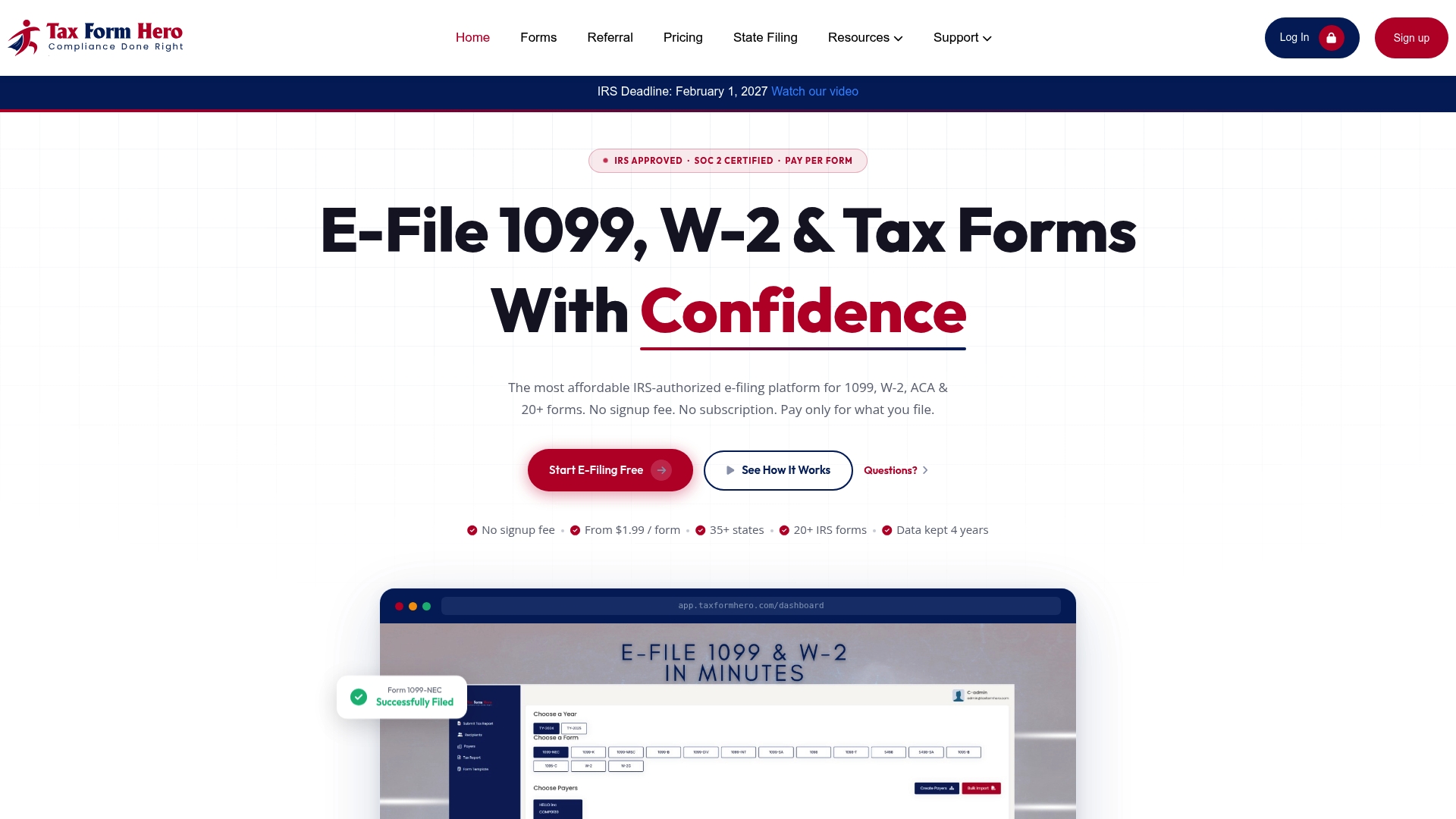
Our pricing is pay-per-form with no subscription: the first 150 1099-NEC forms cost $1.99 each, with lower per-form rates at higher volumes. If you’re filing for several states, state filing add-ons are priced separately at $0.99 per form, and combined federal and state filing states are included without that extra charge. If your contractor list is growing past a handful of names, it’s worth filing your 1099-NEC forms online rather than building the forms by hand.
This article is general information, not a substitute for advice from a qualified financial advisor. Consult a qualified financial professional about your own circumstances before acting on anything here.
FAQ
Can I give someone a 1099 if I paid them cash?
Yes. Cash payments to a contractor are reported on Form 1099-NEC the same way as any other payment method, as long as the total meets the reporting threshold. Keep in mind that cash payments over $10,000 in a trade or business may also trigger a separate Form 8300 filing.
How much can I pay someone without filing a 1099?
As of the 2026 tax year, you can pay an independent contractor up to $2,000 in a calendar year without triggering a 1099-NEC filing requirement. Once total payments for services reach that amount, you’re required to file.
Can I pay an employee with a 1099?
No. Worker classification depends on the actual working relationship, not on which form you’d prefer to file. The IRS evaluates behavioral control, financial control, and the relationship of the parties to determine whether someone is legally an employee or a contractor, and misclassifying an employee as a contractor can expose you to back taxes and penalties.
How do I pay taxes if I’m a 1099 employee?
If you receive 1099 income, you’re generally responsible for your own self-employment tax, since payers typically don’t withhold income or payroll taxes on contractor payments. You’ll usually need to make estimated quarterly tax payments and report the income on your own return.
Recommended
- $2,000 & $20,000 Rules: Freelancers’ 2026 Checklist After OBBBA
- 1099-NEC Threshold 2026: $600 to $2,000 Explained
- Avoid Missed 1099s: Small Businesses and the $2,000 1099-NEC Threshold
- Payroll Teams: 5 Step 1099 State Filing Checklist for 2026 ($2,000)

File Information Returns With Confidence
TaxFormHero supports 20+ IRS information returns, including 1099 and W-2 forms, with bulk Excel import, name/TIN matching and encrypted recipient delivery.
Explore TaxFormHero