Avoid State Penalties on 1099-NEC: What Payers Must Do by Feb 2, 2026

Filing Form 1099-NEC with the IRS does not automatically satisfy state reporting duties. Many states run separate systems, and some opt out of federal forwarding entirely. Check the Combined Federal/State Filing status for each payee’s state, then confirm that state’s own rules. The federal deadline for tax year 2025 is February 2, 2026, but state deadlines can differ.
TL;DR:
- Many states do not automatically accept IRS 1099-NEC filings through the CF/SF program, requiring separate, direct submissions with varying formats and deadlines.
- State participation in CF/SF can change annually, and some states have additional filing requirements such as specific data fields, registration, or withholding account setup beforehand.
- Accurate verification of each payee’s state and understanding individual state rules are essential, especially when filing for multiple states with different thresholds and formats.
- Deadlines for state filings often differ from the federal February 2, 2026, cutoff, and errors or late corrections can result in penalties independent of federal compliance.
- Using a platform like TaxFormHero simplifies multi-state filings by automating federal and state submissions, ensuring compliance, and helping avoid common mistakes like delayed registrations or ignoring state-specific formats.
How the Combined Federal/State Filing program works and where it falls short
The Combined Federal/State Filing program, known as CF/SF, lets the IRS forward your 1099-NEC data to participating states after you file federally. It saves a step, but it is not a guarantee of state compliance.
CF/SF has three built-in limits every payer should know:
- Participating states can change each year, so a state that accepted CF/SF data last year may not this year.
- Some participating states still require extra data fields, a separate notification, or a state account number that CF/SF does not carry.
- A state outside the program requires its own direct filing, on its own schedule, regardless of what you sent the IRS.
The IRS CF/SF coordinator page lists current state participation and recommends contacting each state agency directly to confirm its criteria, since the list and the requirements behind it change annually. If a state has opted out or added conditions, your only path to compliance is a direct filing through that state’s own system. Treat CF/SF as a convenience for the states that fully participate, not as a blanket state filing solution.
Filing one yourself? You can e-file Form 1099-NEC online with TaxFormHero, an IRS-authorized e-filing platform.
How to verify whether you must file 1099-NEC with a state
Before you file anything, run every payee through the same verification sequence. This keeps the check consistent whether you have five 1099-NECs or five thousand.
- Match each payee to their state of residence and the state where the payment activity occurred.
- Look up that state’s revenue department guidance on 1099 and information return filing, including dollar thresholds.
- Confirm whether the state participates in CF/SF for the current tax year, and note any extra fields or notices it requires.
- If you withheld state income tax from any payment, register for that state’s withholding or reporting account before you file, not after.
Pro Tip: Build a simple spreadsheet with one row per state you operate in, columns for CF/SF status, threshold, and account number, and update it once a year before filing season opens.
This sequence matters most for payers working across several states, where one payee’s filing requirement can look nothing like another’s. A contractor paid in a non-participating state needs direct filing even if every other payee’s state is covered by CF/SF. Resources like our state thresholds checklist walk through how reporting dollar amounts differ from the federal $600 trigger, which is worth reviewing before you assume one threshold applies everywhere.
Representative state rules that show how much filing requirements vary
State 1099-NEC rules are not a single template with minor edits. A few examples show the range of what payers run into.
- Virginia does not participate in CF/SF for 1099 forms. Payers submit through Web Upload or eForms, and the file layout requires the state code placed in a specific record position.
- Ohio requires many filers to upload wage and income statements, including 1099-NEC, through its Upload Income Statement feature, using fixed-length records and specific CF/SF coding.
- Colorado requires payers who voluntarily withhold Colorado income tax to register a separate withholding account, with filing frequency set by total annual withholding.
- Wisconsin ties many of its state filing requirements to withholding activity, and enforces its own penalties for noncompliance separate from federal penalties.
- California maintains its own 1099-NEC filing expectations tied to state residency and payment source, independent of what the IRS or CF/SF forwards.
One pattern holds across every state examined here: none of them treat federal filing as sufficient on its own, according to the IRS’s own CF/SF guidance, which frames the program as a forwarding mechanism rather than a compliance substitute.
The lesson for any state not listed above: check for CF/SF participation first, then check for a withholding tie, then check for a unique file format. Those three questions cover most of what separates one state’s process from another’s.
Technical requirements, deadlines, and how to fix a state filing mistake
Most state systems that accept electronic files build their layout on the same foundation: the IRS’s Publication 1220 specifications for fixed-length record files. Some states accept a spreadsheet upload as an alternative for smaller filers, but larger volumes typically require the fixed-length format.

Deadlines compound the complexity. The federal rule requires you to file and furnish Form 1099-NEC by February 2, 2026 for payments made in tax year 2025, with electronic filing required once you have 10 or more information returns. States set their own deadlines on top of that, and several require electronic submission at a far lower volume threshold than the federal rule does.
A few operational points keep filings clean:
- Confirm whether your state accepts a FIRE test file or runs its own state test portal before you submit production data.
- If a state rejects a file for a formatting error, correct the specific record and resubmit; most states do not require you to refile every payee again.
- Keep a dated log of every corrected submission, since state penalty calculations often hinge on how quickly you fixed an error.
- When withholding was involved, confirm the correction also updates your state withholding account, not just the information return.
Corrections sent late or filed with the wrong record type are a common source of state penalties that have nothing to do with the original data being wrong. The fix is usually procedural: resubmit the corrected record in the exact format the state specifies, and keep proof of the resubmission date.
Payer checklist: step-by-step actions for state 1099-NEC filing
A repeatable process beats a once-a-year scramble. Work through these steps in order for every filing season.
- Collect and validate Form W-9 from every payee as early as possible, and run TIN checks before data entry begins.
- Map each payee to their state and flag which states require direct filing, which fall under CF/SF, and which require a withholding account.
- Choose your filing method: manual state portal entry works for a handful of payees, while bulk filings need a properly formatted electronic file.
- Run any required test file through the state’s test portal before submitting production data.
- Register with each state’s filing portal and schedule uploads ahead of its deadline, not the federal one.
- Set up a corrections workflow now, including a log of filing dates and confirmation numbers, so a correction later does not start from zero.
Pro Tip: Run TIN matching in batches as W-9s come in rather than waiting until filing season, since a bad TIN found in January is far cheaper to fix than one found in a rejected state file.
For payers managing payee data in spreadsheets, a structured template for organizing recipient and state information keeps the mapping step consistent across filing years, an approach outlined in this payroll template resource.
What payers consistently get wrong about state 1099-NEC filing
The most common mistake is assuming federal filing is a catch-all. Payers file with the IRS, see the confirmation, and stop there, not realizing a state outside CF/SF or one with withholding ties still expects a direct submission. The second most common mistake is registering for a state withholding account after the filing deadline rather than before, which triggers penalties that have nothing to do with the accuracy of the form itself. The third is skipping test-file validation and finding out a record layout is wrong only after a production file bounces.
The fix is procedural, not complicated: keep a state-reporting matrix for every state you have payees in, validate files against Publication 1220 standards before submission, and automate TIN checks so bad data never reaches the state portal. An IRS-authorized platform authorized for federal transmission through IRIS A2A with SOC 2 Type I attestation supports direct state filing for many states plus Washington, D.C.
— Nazrul
How TaxFormHero simplifies multi-state 1099-NEC filing
Coordinating federal and state 1099-NEC filing by hand means tracking CF/SF participation, state-specific formats, and separate deadlines for every state you operate in. TaxFormHero handles the federal side through IRS-authorized IRIS A2A transmission, and the state filing add-on covers 41+ states plus Washington, D.C., for $0.99 per form.
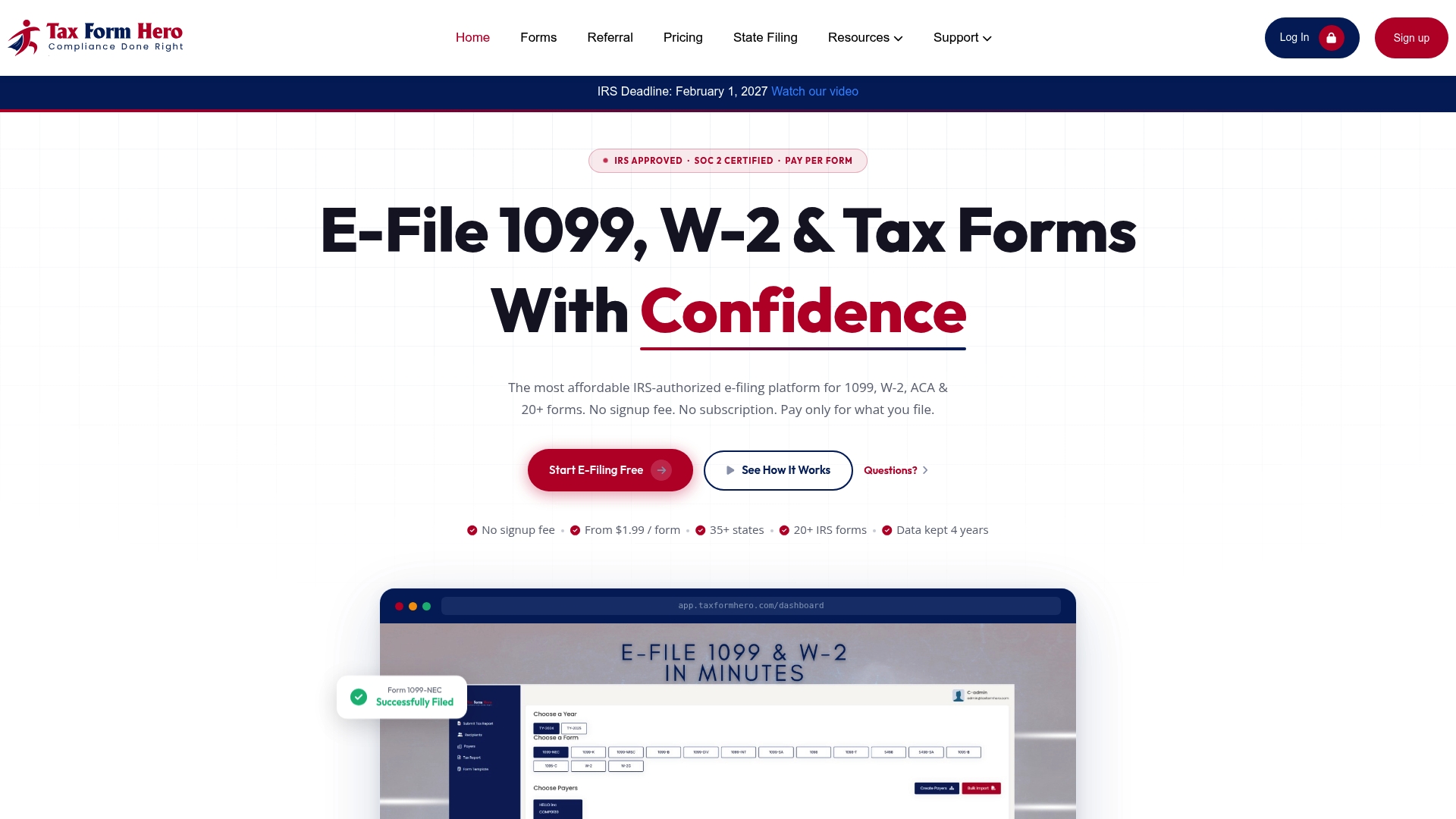
Pricing is pay-per-form with no subscription: File 1099-NEC Online starts at $1.99 per form for the first 150 forms, with lower rates at higher volumes. Optional TIN checks run $0.49 per verification, catching bad data before it reaches a state portal. If you are weighing a platform against manual filing, our breakdown of cheaper filing options compares the cost of each approach by volume.
When you are managing payees across several states, with test-file requirements and differing deadlines, that’s the point where a platform earns its cost over manual entry. Check current state coverage and pricing before your next filing deadline.
This article is general information, not a substitute for advice from a qualified financial advisor. Consult a qualified financial professional about your own circumstances before acting on anything here.
FAQ
Where do I enter 1099-NEC income on my tax return?
Nonemployee compensation reported on Form 1099-NEC is generally entered on Schedule C as business income if you are self-employed. The payer’s filing with the IRS and any state does not replace your own return reporting.
Do I need to file taxes if I receive a 1099-NEC form?
Receiving a 1099-NEC generally means you have self-employment income to report, and you typically need to file a tax return and pay self-employment tax if your net earnings meet the filing threshold. Check current IRS filing thresholds directly, since they are tied to your overall income and filing status, not the 1099-NEC alone.
What are the filing requirements for Form 1099-NEC in 2026?
For payments made in tax year 2025, payers must file and furnish Form 1099-NEC by February 2, 2026, with electronic filing required once a payer has 10 or more information returns. State filing requirements are separate and depend on each state’s own rules, including whether it participates in CF/SF.
How much do I have to make on a 1099-NEC to file taxes?
The federal threshold for a payer to issue a 1099-NEC is generally $600 in nonemployee compensation during the year, but your own obligation to file a tax return depends on your total income and filing status rather than this single form. State reporting thresholds can differ from the federal trigger, so check the specific state’s guidance for payees in that state.
Sources
- Instructions for Forms 1099-MISC and 1099-NEC
- Withholding Tax Topics: Combined Federal/State Filing (CF/SF)
- Web Upload Guide for W-2s, W2-Cs, and 1099s — Virginia
- Withholding tax topics and 1099-NEC guidance — Colorado Department of Revenue
Recommended
- Avoid $680 per Form: 1099-NEC Deadline, IRIS TCC Steps for Payers
- $2,000 vs $600: U.S. Payers’ 2026 1099-NEC State Checklist
- U.S. Payers: 1099 State Requirements for 2026 and IRIS Playbook
- Payroll Teams: 5 Step 1099 State Filing Checklist for 2026 ($2,000)

File Information Returns With Confidence
TaxFormHero supports 20+ IRS information returns, including 1099 and W-2 forms, with bulk Excel import, name/TIN matching and encrypted recipient delivery.
Explore TaxFormHero