ACA State Filing: Transmission Formats Employers Must Know by March 31

Applicable Large Employers and certain coverage providers must file Forms 1094-C/1095-C or 1094-B/1095-B with the IRS by March 31, 2026, with recipient statements due March 2, 2026. Several states, including California, New Jersey, Rhode Island, Massachusetts, Vermont, and the District of Columbia, add separate transmissions, formats, or portals on top of the federal filing.
TL;DR:
- Most employers must file electronically if they submit 10 or more information returns, with strict adherence to AIR XML schemas to avoid rejection.
- State-specific filing deadlines often differ from federal rules, requiring employers to track multiple deadlines and transmission methods for each mandate state.
- Confirming TIN accuracy and resident-state assignments before data entry reduces errors that cause filings to be rejected or delayed.
- Early testing of transmission formats through test credentials helps identify common issues like invalid TINs and incomplete data before the final deadline.
- Using specialized tools can simplify compliance by handling TIN verification, multi-state filings, recipient delivery, and reducing errors caused by manual processing.
At-a-glance compliance checklist and immediate action items
Payroll and tax teams should move through these steps in order.
- Confirm ALE status for the current tax year and identify which entity, employer, carrier, or third-party administrator, files each record.
- Collect and validate TINs, then map every employee to a resident state, not a worksite state.
- Decide who furnishes statements, employer or carrier, and set an internal deadline ahead of March 2.
- Choose a transmission method for each state (AIR, a state portal, Axway/MFT, or a pipe-delimited flat file) and request test credentials now if the state requires them.
- File Form 8809 early if an extension is likely, and confirm penalty exposure for late or incorrect filings.
Pro Tip: Run your resident-state mapping before you touch form data. Fixing filer assignments after entry costs far more time than fixing them first.
Filing one yourself? You can e-file Form 1095-C online with TaxFormHero, an IRS-authorized e-filing platform.
Who must file and how responsibilities are allocated
ALE status depends on average full-time employee counts, including full-time equivalents, calculated using a look-back measurement period as described in the IRS ALE information center. Reporting responsibility then splits by plan type and entity.
- Self-insured ALEs file Form 1095-C with Parts I, II, and III completed for every enrolled individual.
- Fully insured ALEs complete Parts I and II only; the insurer reports enrollment on Form 1095-B.
- Multiemployer plans and designated government entities (DGEs) may shift reporting duties to a plan administrator or a DGE filer.
- If a carrier fails to file on time, the employer generally remains on the hook for the coverage it sponsored, so confirm carrier filing status well before deadlines.
- Check that payroll data actually reflects the population you must report: full-time status, waiting periods, and mid-year hires or terminations all affect who appears on a 1095-C.
Federal filing rules, deadlines, and the AIR program
The federal timeline anchors every state deadline that follows it. For the 2025 tax year, the IRS requires electronic filing by March 31, 2026, and recipient statements must go out by March 2, 2026.
- Any filer with 10 or more information returns in aggregate, counting across form types, must file electronically; a hardship waiver is requested on Form 8508.
- Self-insured ALEs use Form 1095-C with Part III completed; fully insured ALEs and small self-insured employers use Form 1095-B, filed by the IRS-defined coverage provider.
- Alternative furnishing rules, effective for statements after January 31, 2024, let some filers post a clear notice online instead of mailing every 1095-B, provided they furnish a copy on request within the IRS retention window.
- Publication 5165 is the authoritative technical guide for AIR: it lays out XML schemas, business rules, and the validation checks a transmission must pass before the IRS accepts it.
The 10-or-more aggregate threshold means most mid-size and large employers no longer have a paper-filing option; Pub. 5165 governs the electronic format they must use instead.
State-by-state filing notes for mandate states
Federal acceptance does not guarantee state acceptance. Each mandate state layers its own form, deadline nuance, or transmission channel on top of the federal rules, and treating them as identical is a common source of late or rejected filings.
- California: The state transmittal deadline for minimum essential coverage forms generally falls on March 31, matching the federal date; confirm current-year instructions and any electronic filing thresholds directly with the Franchise Tax Board before assuming last year’s rules still apply.
- New Jersey: Filers must transmit by March 31 and the Division of Taxation accepts either the state’s NJ-1095 or a fully completed federal 1095 form, including Part III where applicable. Larger filers must register for MFT SecureTransport through Axway, and the state expects fully completed files rather than partial federal data.
- Rhode Island: Filing timing often aligns with the federal calendar, recipient furnishing by March 2 and state transmittal by March 31, but the Division of Taxation publishes its own flat-file templates and portal instructions, so confirm whether your file goes through the portal or by another accepted method.
- Massachusetts: Employers and carriers must file Form MA 1099-HC electronically through MassTaxConnect. Carriers typically handle submission for fully insured plans, but the employer must file if the carrier does not.
- Vermont: The Health Care Fund Contribution Assessment creates a reporting track that can differ from standard 1095 filing. Confirm with Vermont’s guidance whether your filing falls under HCFCA rules, standard ACA reporting, or both.
- District of Columbia: D.C. maintains its own guidance on Form 1095-C furnishing and state transmission, so check current instructions rather than assuming federal furnishing timing automatically satisfies district requirements.
Filers operating across several of these states should build a matrix of deadlines and transmission methods rather than relying on the federal date alone.
Technical formats, testing, and common rejection causes
Getting a file accepted depends as much on format as on accuracy.
- Follow the AIR XML schemas exactly as published in Pub. 5165; manual edits to schema structure are a frequent cause of rejected transmissions.
- States accept different transport methods: XML through Axway/MFT for New Jersey, pipe-delimited flat files or portals for Rhode Island, and web upload through MassTaxConnect for Massachusetts.
- Register for AIR test transmissions (via IRIS credentials) and Axway accounts early; test windows and approval queues take time, and waiting until March leaves no room to fix errors.
- The most frequent rejection causes are invalid TINs, name and TIN mismatches, and incomplete Part III data on self-insured filings; run validation against the IRS instructions before every transmission.
Pro Tip: Submit a small test batch first. A rejected file of five records is far easier to diagnose than a rejected file of five thousand.
Practical compliance checklist, corrections, and red flags
A short set of controls, applied consistently, prevents most late or rejected filings.
- Verify TINs and resident-state assignments before data entry begins, not after.
- Set a hard cutoff date for carrier and vendor data feeds, with a buffer before the furnishing deadline.
- Handle corrections through the standard corrected-1095 workflow, and file the correction as soon as an error is found rather than waiting for a batch.
- Escalate to a tax professional when aggregation rules, multiemployer allocations, or state-specific substitute forms create ambiguity.
- Watch for red flags: inconsistent SSN or EIN formatting, missing dependent records, mismatched enrollment dates, and carrier feeds arriving after your internal cutoff.
Author perspective: operational priorities for payroll teams this filing season
Most of the pain in ACA reporting is preventable. Re-verifying ALE status and running TIN checks in January, not March, catches the errors that otherwise surface as rejections. The recurring failure points are formatting mismatches and late carrier feeds, both fixable with an earlier cutoff. Teams without in-house AIR or state-portal experience often reduce risk by routing filings through an IRS-authorized platform instead of building that expertise from scratch.
— Nazrul
How TaxFormHero helps meet state filing requirements
Coordinating federal AIR transmissions with separate state portals, Axway credentials, and flat-file templates takes real setup time each season. The platform handles the mechanics directly: recipient TIN verification, bulk data import from Excel, and transmission to many states plus the District of Columbia, without a subscription or signup fee.
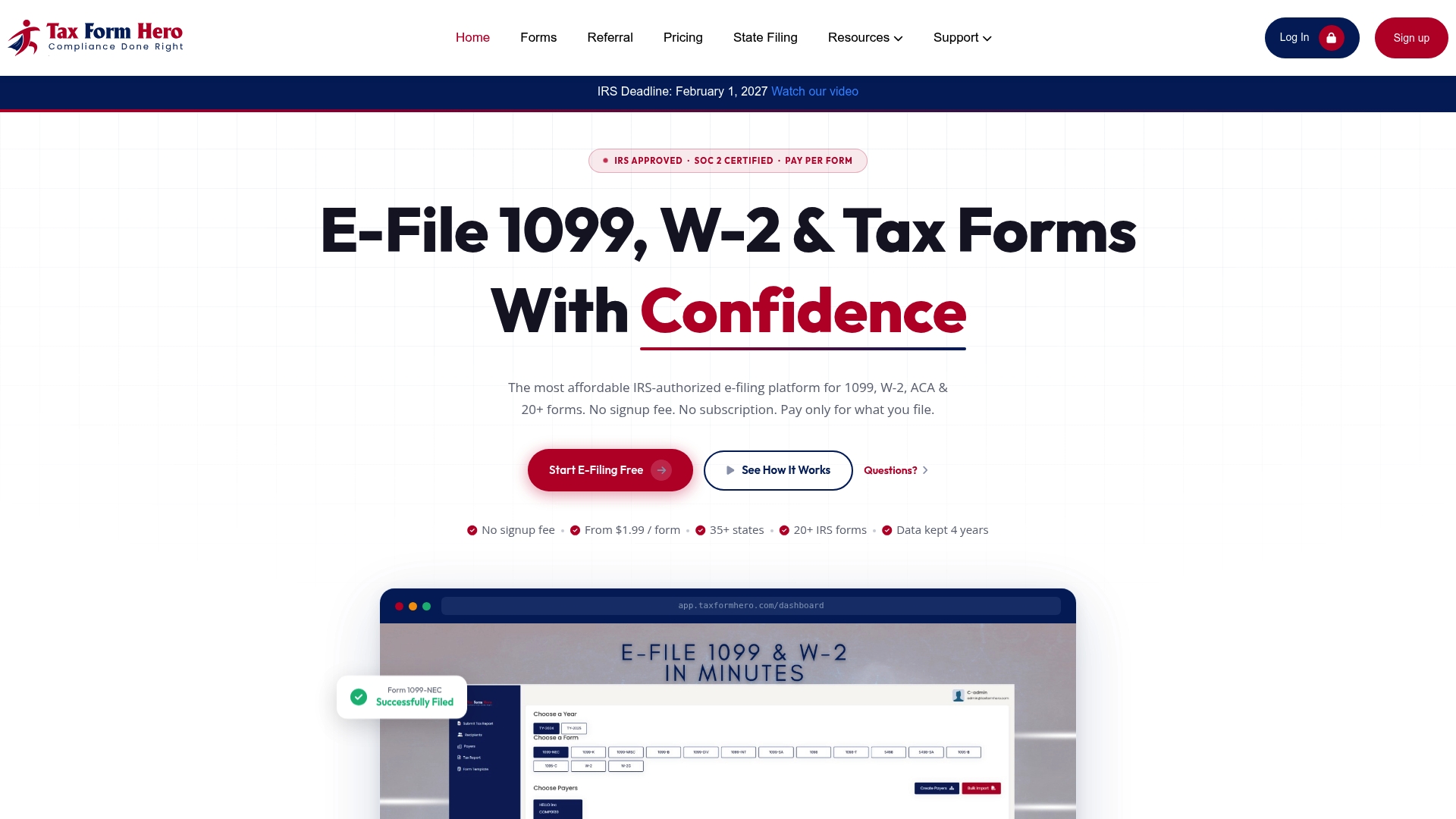
- File the required ACA forms and add state filing without separately building Axway or portal connections.
- Verify TINs before submission with per-check TIN matching, reducing common rejection causes.
- Deliver recipient copies by encrypted e-delivery or print and mail, handled by the service.
Pricing is graduated and pay-per-form, so a small batch of corrections costs proportionally less than a full annual filing. Start with the ACA e-filing page to see current-year form support and pricing tiers, or review the full pricing details before your next filing.
Key IRS and state pages to bookmark

Bookmark the IRS Form 1094-C/1095-C instructions and Pub. 5165 for federal deadlines and AIR schemas. For state specifics, keep the New Jersey, Rhode Island, and Massachusetts guidance pages on hand for templates and portal access. For a deeper walk-through of federal mechanics, see this step-by-step 1095-C e-filing guide, and payroll teams juggling other information returns can reuse the workflow in this 1099 state filing checklist.
Sources
- Instructions for Forms 1094-C and 1095-C (2025) | Internal Revenue Service
- NJ Health Insurance Mandate - Employers and Coverage Providers
- Rhode Island health insurance mandate reporting | Rhode Island Division of Taxation
- Mass
FAQ
Is ACA reporting still required for 2026?
Yes. Applicable Large Employers and certain coverage providers must file with the IRS by March 31, 2026 for the 2025 tax year, with recipient statements due March 2, 2026. Several mandate states impose their own separate filing requirements in addition to the federal deadline.
Do I need a 1095-C to file my taxes in 2026?
Most individual taxpayers do not need to attach Form 1095-C to their personal tax return. Employers and coverage providers use it to report offers of coverage to the IRS and to the employee, and the alternative furnishing rules let some filers post a notice online instead of mailing every copy.
What are the requirements for ACA reporting?
Applicable Large Employers must file Form 1094-C and 1095-C, completing Part III if self-insured, while smaller self-insured employers and insurers use Form 1094-B and 1095-B. Filers with 10 or more aggregate information returns must file electronically through the IRS AIR system, and several states add their own transmission requirements.
Who is required to file a 1094 and 1095 form?
Applicable Large Employers file Form 1094-C as a transmittal with Form 1095-C for each full-time employee, per the IRS instructions. Insurers, small self-insured employers, and other coverage providers file Form 1094-B with Form 1095-B for covered individuals instead.
Recommended
- 1099 Deadlines 2027: Feb 1 & Mar 31, IRIS/TCC Checklist for Small Teams
- Payroll Teams: 5 Step 1099 State Filing Checklist for 2026 ($2,000)
- February 1, 2027: W-2 Deadlines and Efile Checks for Payroll Teams
- State Filing Requirements for 1099 & W-2

File Information Returns With Confidence
TaxFormHero supports 20+ IRS information returns, including 1099 and W-2 forms, with bulk Excel import, name/TIN matching and encrypted recipient delivery.
Explore TaxFormHero