
Whether a worker is an employee or an independent contractor depends on the economic reality of the working relationship and the degree of control an employer exercises, not the label written into a contract. The Internal Revenue Service (IRS) and the Department of Labor (DOL) each apply their own version of this analysis, and both can reach different conclusions about the same worker depending on whether the question is tax withholding or wage-hour law.
If you’re reviewing a worker’s status right now, take these steps today:
- Stop relying on the contract’s job title or independent contractor clause as proof of anything.
- Pull together contracts, invoices, schedules, and any written instructions given to the worker.
- Run the IRS common-law factors and, if wage-hour risk is in play, the DOL economic-reality factors side by side.
- Document how the work actually happens day to day, not just what the paperwork says.
- If the answer still isn’t clear, consider filing Form SS-8 for a formal determination.
Key Takeaways
Correct worker classification hinges on documented, actual working practices, not contract labels, and employers who align the two face far less exposure to back taxes and wage claims.
| Point | Details |
|---|---|
| No single deciding factor | The IRS and DOL both weigh multiple factors together; no one clause or job title settles the question. |
| Actual practice beats paperwork | Agencies and courts favor evidence of day-to-day control over what a contract states. |
| Misclassification carries real cost | Research estimates 10% to 30% of employers misclassify at least some workers, risking back taxes and penalties. |
| Formal relief exists but is limited | Form SS-8, VCSP, and Section 530 offer paths to certainty or relief, each with strict eligibility rules. |
| Filing still follows classification | Once status is confirmed, Tax Form Hero helps e-file the resulting W-2s or 1099s with bulk import and TIN verification. |
Filing one yourself? You can e-file Form W-2 online with TaxFormHero, an IRS-authorized e-filing platform.
Why Correct Worker Classification Matters for Payroll and Tax Risk
Misclassifying an employee as an independent contractor exposes a business to back payroll taxes, unpaid employer FICA and FUTA contributions, and potential overtime and back-wage claims under wage-hour law. Penalties compound quickly once an audit finds a pattern across multiple workers rather than a single mistake.
By the numbers: Policy research from the Economic Policy Institute estimates that 10% to 30% of employers misclassify at least some of their workforce, with significant financial losses to workers and states each year.
Two mitigation paths exist, but both come with strings attached:
- The Voluntary Classification Settlement Program (VCSP) offers partial relief for employers who reclassify workers going forward.
- Section 530 relief can reduce tax exposure for past treatment, but only for employers who meet strict, narrow eligibility rules.
If a review turns up several workers with contractor status but employee-like conditions, that’s the moment to loop in payroll counsel rather than wait for a notice from the IRS.
What Are the Main Worker Classification Tests?
Three distinct frameworks decide whether a worker counts as an employee, and each one exists for a different legal purpose. Knowing which applies to your situation determines which factors actually matter.
| Test name | Primary legal focus | Core factors considered | Who enforces it | Typical outcome drivers |
|---|---|---|---|---|
| IRS common-law test | Federal tax withholding | Behavioral control, financial control, relationship of the parties | IRS | Who directs how work gets done day to day |
| DOL economic-reality test | Wage and overtime law (FLSA) | Control, opportunity for profit or loss, investment, permanence, skill/integration | DOL, courts | Whether the worker is economically dependent on the business |
| IRS 20-factor test | Federal tax withholding (older framework) | Instructions, training, integration, continuing relationship, and other factors | IRS, Tax Court | Cumulative weight of overlapping factors |
A quick way to keep these straight:
- The common-law test asks who is running the show.
- The economic-reality test asks who bears the financial risk.
- The 20-factor test is the common-law test’s older, more granular ancestor, still cited in Tax Court opinions.
When the three tests point in different directions, agencies and courts default to whichever body of evidence best reflects actual daily practice. A contract that says “independent contractor” carries little weight against a spreadsheet of company-set hours and mandatory training sessions.
How Does the IRS Common-Law Test Work?
The IRS groups its analysis into three categories of evidence, and it has said repeatedly that no single factor decides the outcome on its own, according to its independent contractor guidance.
Behavioral control asks whether the business directs how the work gets done. Look for instructions on when, where, and how tasks happen, mandatory training sessions, and performance evaluations that judge process rather than just results.
Financial control asks who carries the financial risk. Indicators include whether the worker has unreimbursed business expenses, has made a real investment in tools or equipment, can realize a profit or suffer a loss, and is free to seek work from other clients at the same time.

Relationship of the parties looks at how both sides describe and treat the arrangement: written contracts, the presence of benefits like health insurance or a retirement plan, whether the work is expected to continue indefinitely, and whether the services are a key part of the regular business.
Consider three quick contrasts:
- A bookkeeper who sets her own hours, invoices monthly, and serves five other small businesses looks like a contractor.
- A delivery driver who works company-set shifts, wears a company uniform, and uses a company vehicle looks like an employee, regardless of what the 1099 says.
- A software consultant hired for a single defined project, paid a flat fee, and free to decline future projects sits closer to contractor status, assuming the business doesn’t dictate daily work hours.
The IRS training materials on classification note that “reserved rights” in a contract, meaning clauses that say the business could direct the work even if it doesn’t, get little credit if they’re never actually exercised.
Pro Tip: Keep a running log of actual instructions given to a worker, not just the contract terms. If an auditor ever asks how the relationship really functioned, contemporaneous notes carry far more weight than a boilerplate agreement drafted a year earlier.
What Does the DOL’s Economic-Reality Test Cover?
The DOL evaluates wage-hour status under the Fair Labor Standards Act (FLSA) using a five-factor economic-reality framework, according to Fact Sheet 13. The five factors are:
- The nature and degree of control over the work.
- The worker’s opportunity for profit or loss based on managerial skill.
- The worker’s investment in equipment or materials.
- The permanence of the working relationship.
- Whether the work is an integral part of the business.
On February 26, 2026, the DOL announced proposed rulemaking that elevates two of these as “core” factors: the degree of control and the opportunity for profit or loss. When both factors point the same direction, the proposed rule suggests investigators can weigh them more heavily than the remaining three.
Regulatory update: As of early 2026, this economic-reality framework exists as a proposed rule, not yet final. Employers currently under DOL investigation should confirm with counsel which framework, the standing rule or the new proposal, applies to their specific case timeline.
The underlying question the DOL keeps returning to is economic dependence: is this person running their own business, or are they economically reliant on your business the way an employee would be? That framing matters for policies around scheduling, exclusivity, and equipment provision just as much as it matters for a wage-hour audit.
How Do Courts Apply the IRS 20-Factor Test Today?
The IRS’s 20-factor checklist predates the modern three-category framework and traces back to Revenue Ruling 87-41. Tax examiners still reference it in audits, and Tax Court opinions continue to cite individual factors even when they don’t walk through all 20.
Courts consistently favor actual practice over paper agreements. A written contract calling someone a contractor rarely survives scrutiny if the business set the worker’s hours, provided all equipment, and treated the role as ongoing rather than project-based. Representative disputes in this area tend to turn on a small cluster of factors: who controlled the schedule, whether the worker’s services were integrated into core business operations, and whether the relationship had an expected end date.
The factors that most often decide these cases boil down to three:
- Degree of behavioral control exercised in practice.
- How integral the worker’s role is to normal business operations.
- Whether the arrangement has genuine permanence or a defined endpoint.
How Do You Run a Worker-Classification Review?
A defensible classification decision comes from documentation, not instinct. Here’s a workflow that mirrors what auditors actually look for:
- Gather every contract, statement of work, and job description tied to the role.
- Collect schedules, timesheets, or shift records showing who set the hours.
- Pull invoices and payment records to see whether pay is hourly/salaried or project-based.
- Check whether the worker filed a W-9 (contractor) or W-4 (employee), and confirm which forms your payroll system generated.
- Note who owns the equipment, software licenses, or vehicle used for the work.
- Review whether the worker receives benefits, training, or performance reviews typical of staff.
Watch for these red flags, which tend to push a worker toward employee status regardless of contract language:
- Fixed hours set by the business rather than the worker.
- Company-owned tools, laptops, or uniforms.
- An exclusivity requirement barring outside clients.
- Mandatory training tied to how tasks get performed.
- Ongoing, indefinite engagement with no defined project end.
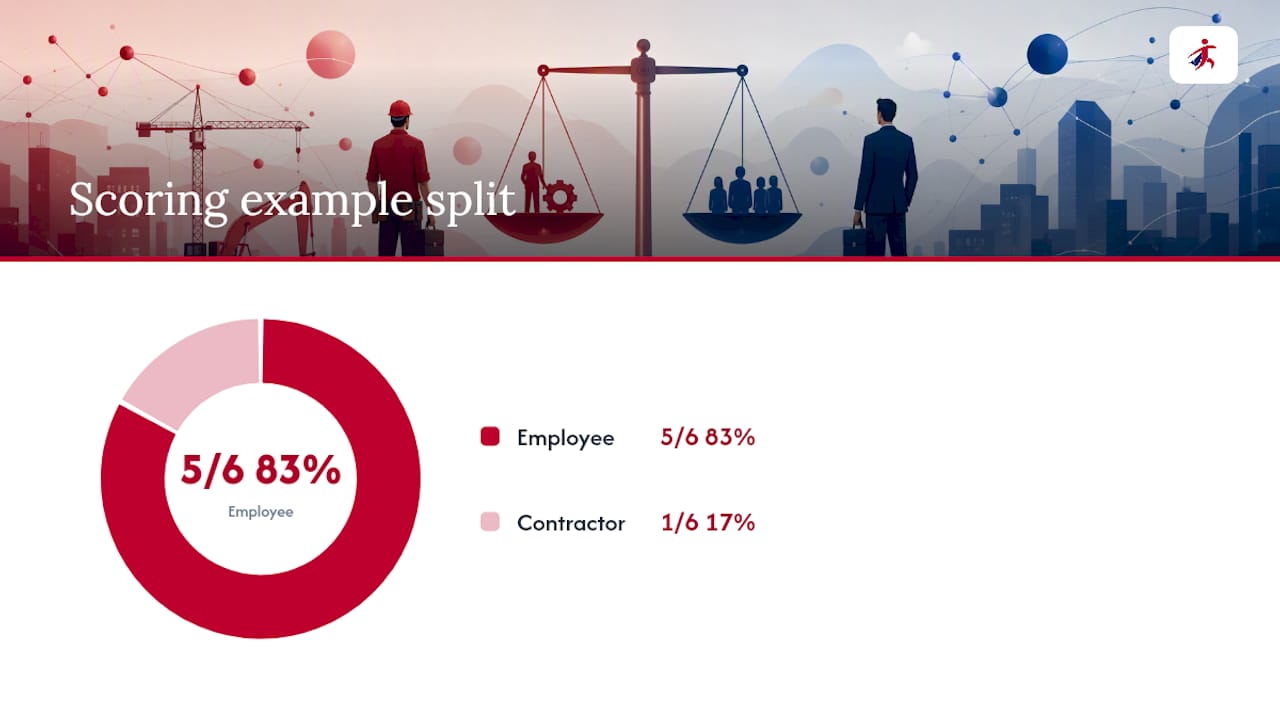
A simple scoring approach helps here: count how many indicators point toward employee status versus contractor status across the three IRS categories. This isn’t a strict formula, since the IRS itself avoids one, but a lopsided count, say five employee indicators against one contractor indicator, is a strong signal that reclassification review is overdue.
Pro Tip: Retain classification documentation for at least four years after the relationship ends, matching the general IRS statute of limitations for employment tax audits. A folder of dated emails and schedules is worth more than a memory of “how things usually worked.”
What Are Your Options If a Classification Is Challenged?
Three formal paths exist once a classification question moves beyond internal review.
Form SS-8 lets either the employer or the worker request an official IRS determination. Processing can take several months, and while it offers certainty, filing proactively also puts the question on the IRS’s radar, so many advisors treat it as a last resort rather than a first step.
VCSP allows employers to voluntarily reclassify workers as employees going forward in exchange for limited back-tax relief, according to Publication 1779. It requires consistent past treatment of similar workers as contractors.
Section 530 relief, named for a provision in the Revenue Act of 1978, can shield an employer from certain back-tax liability if it had a reasonable basis for treating workers as contractors and reported consistently on 1099s. It reduces tax exposure but doesn’t change the worker’s legal status for wage-hour or benefits purposes.
If you’re notified of an audit:
- Preserve every classification-related document immediately, and stop any routine deletion.
- Consult employment counsel before responding to agency questions.
- Evaluate whether VCSP makes sense before the audit concludes, since eligibility narrows once an investigation is underway.
A payroll advisor’s take on the most common employer mistake
The single biggest mistake I see is employers treating the contractor agreement as a shield rather than a starting point. A well-drafted contract means little if the day-to-day relationship contradicts it. Fix the practice first, align the paperwork second, and use VCSP or Section 530 relief when you find a mismatch instead of hoping it never surfaces in an audit.
Filing Correctly Once You’ve Made the Call
Once you’ve settled on employee or contractor status, the filing work still has to happen correctly, and that’s where Tax Form Hero saves employers real hours over manual filing. Instead of managing separate W-2 and 1099 processes by hand, you upload your worker data once and the platform routes each form to the right filing path, with no subscription fee and pricing that starts at $1.99 per form.
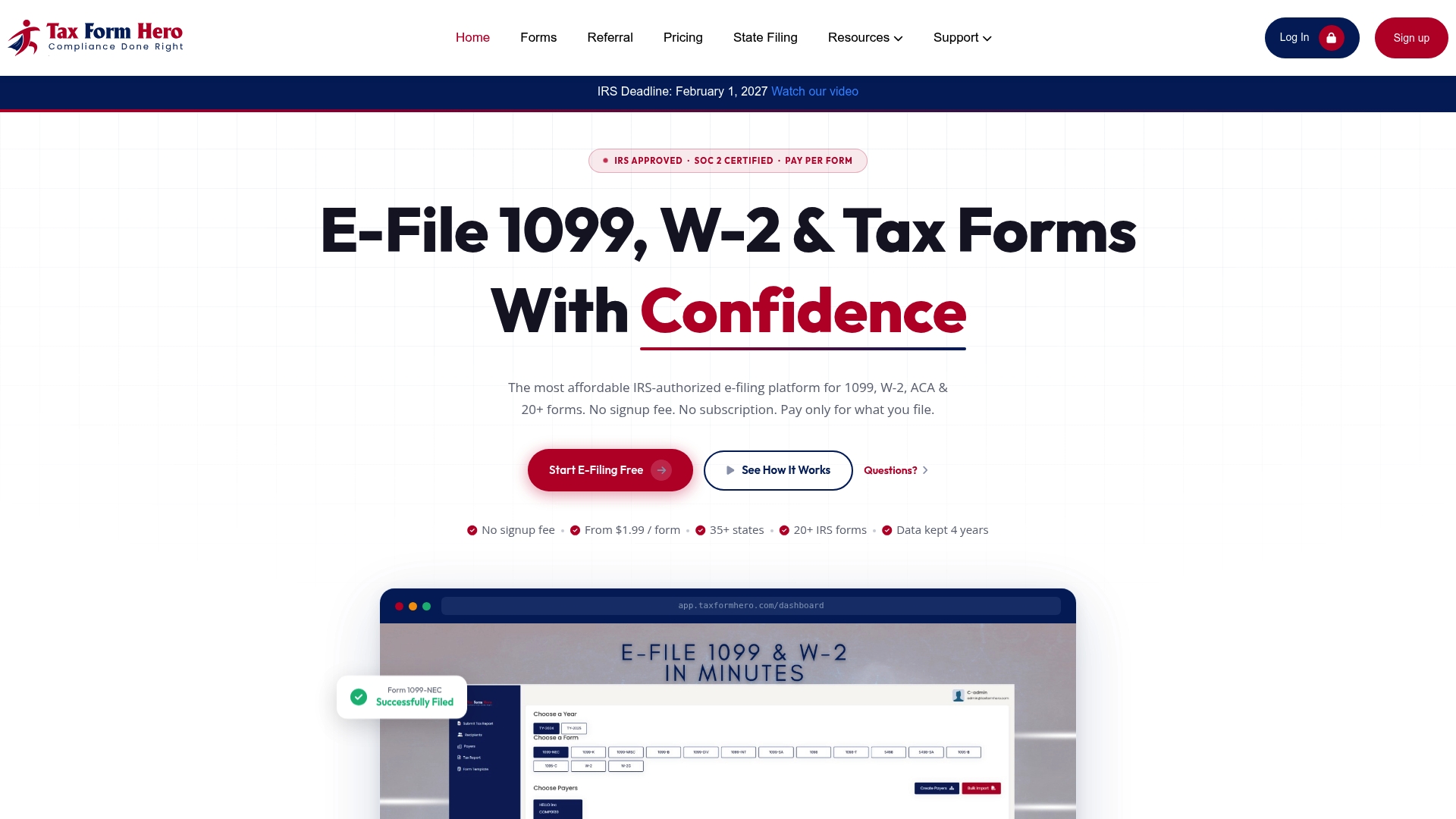
Tax Form Hero supports the exact paperwork this classification decision leads to:
- E-file W-2s for reclassified workers and 1099-NEC/1099-MISC for confirmed contractors.
- Bulk import worker data instead of entering each form by hand.
- Run TIN verification to catch mismatched names and numbers before submission.
- Add state filing for 35+ states, encrypted e-delivery, and print-and-mail service as needed.
- Keep organized digital records that support VCSP or SS-8 documentation if questions arise later.
For workers whose situation involves cross-border reporting complexity, this IRS compliance checklist for employers with workers abroad is worth a look before filing.
Borderline cases still deserve a conversation with employment counsel or a tax advisor before you file anything. Once the classification is settled, though, Tax Form Hero turns that decision into finished, IRS-compliant paperwork in a fraction of the time manual filing takes.
Where to Find the Official Guidance
- IRS: Independent Contractor or Employee for the core three-category framework.
- Publication 1779 for detailed examples and tax-form implications.
- DOL Fact Sheet 13 for the wage-hour economic-reality approach.
- DOL 2026 proposed rulemaking page for the pending core-factors update.
- Know Who You’re Hiring for practical IRS steps and Form SS-8 links.
Frequently Asked Questions
What is the main contractor vs employee test the IRS uses? The IRS applies a common-law test built around three categories: behavioral control, financial control, and the relationship of the parties. No single factor is decisive on its own.
How is the DOL’s test different from the IRS test? The DOL’s economic-reality test focuses on wage-hour law under the FLSA and asks whether a worker is economically dependent on the business, weighing control and profit/loss opportunity most heavily under the 2026 proposed rule.
Can I file Form SS-8 to get an official determination? Yes. Either the worker or the employer can file Form SS-8 with the IRS, though processing can take several months and the request applies IRS scrutiny to the case.
What happens if I’ve misclassified workers in the past? The Voluntary Classification Settlement Program lets you reclassify workers going forward with partial tax relief, while Section 530 may limit past tax liability if you meet its strict, consistent-reporting requirements.
Do state laws affect worker classification? Yes. Many states apply their own tests, some stricter than the federal standard, for wage-hour and unemployment insurance purposes, so a worker compliant under federal rules may still need review under state law.
This article is general information, not a substitute for advice from a qualified lawyer. Consult a qualified legal professional about your own circumstances before acting on anything here.
Sources
- Independent Contractor (Self-Employed) or Employee? | Internal Revenue Service
- Publication 1779, Independent Contractor or Employee (PDF) | IRS
- Notice of Proposed Rule: Employee or Independent Contractor Status Under the Fair Labor Standards Act | DOL
- Fact Sheet 13: Employment Relationship Under the Fair Labor Standards Act (FLSA) | DOL Wage and Hour Division
- Misclassifying workers as independent contractors is costly for workers and states | Economic Policy Institute
Recommended

File Information Returns With Confidence
TaxFormHero supports 20+ IRS information returns, including 1099 and W-2 forms, with bulk Excel import, name/TIN matching and encrypted recipient delivery.
Explore TaxFormHero