
The One Big Beautiful Bill Act raises the 1099-NEC and 1099-MISC reporting threshold to two thousand dollars and restores 1099-K reporting to twenty thousand dollars and two hundred transactions, while the IRS retires FIRE on December 31, 2026 in favor of IRIS. If your organization files 10 or more information returns, the immediate priority is securing IRIS Transmitter Control Codes and scheduling test transmissions before filing season 2027 arrives.
TL;DR:
- Fewer small vendors will receive 1099s under the new $2,000 threshold, but reporting requirements will become stricter for remaining transactions.
- IRIS enforces more detailed validation rules than FIRE, requiring accurate XML schema adherence and role-specific TCC applications before filing.
- Entities must count all scope forms to determine if they are required to e-file, with corrections excluded from the threshold, but failed validations will increase if mapping is improper.
- Deadline for IRIS adoption is the 2027 filing season, with applications and testing recommended well before the December 31, 2026, FIRE system retirement.
- Confirming role-specific TCCs and conducting early test transmissions are crucial for a smooth migration, especially since multiple states may have differing filing rules.
What Is the OBBBA Threshold Change and How Does It Affect Your Filings?
The One Big Beautiful Bill Act raises the 1099-NEC and 1099-MISC reporting threshold from $600 to $2,000 for payments made in tax year 2026 and beyond, and the figure will adjust for inflation going forward. Form 1099-K reporting reverts to $20,000 and 200 transactions, retroactive to 2022. Both changes shrink your low-dollar filing volume, but they raise the compliance stakes on everything that remains.
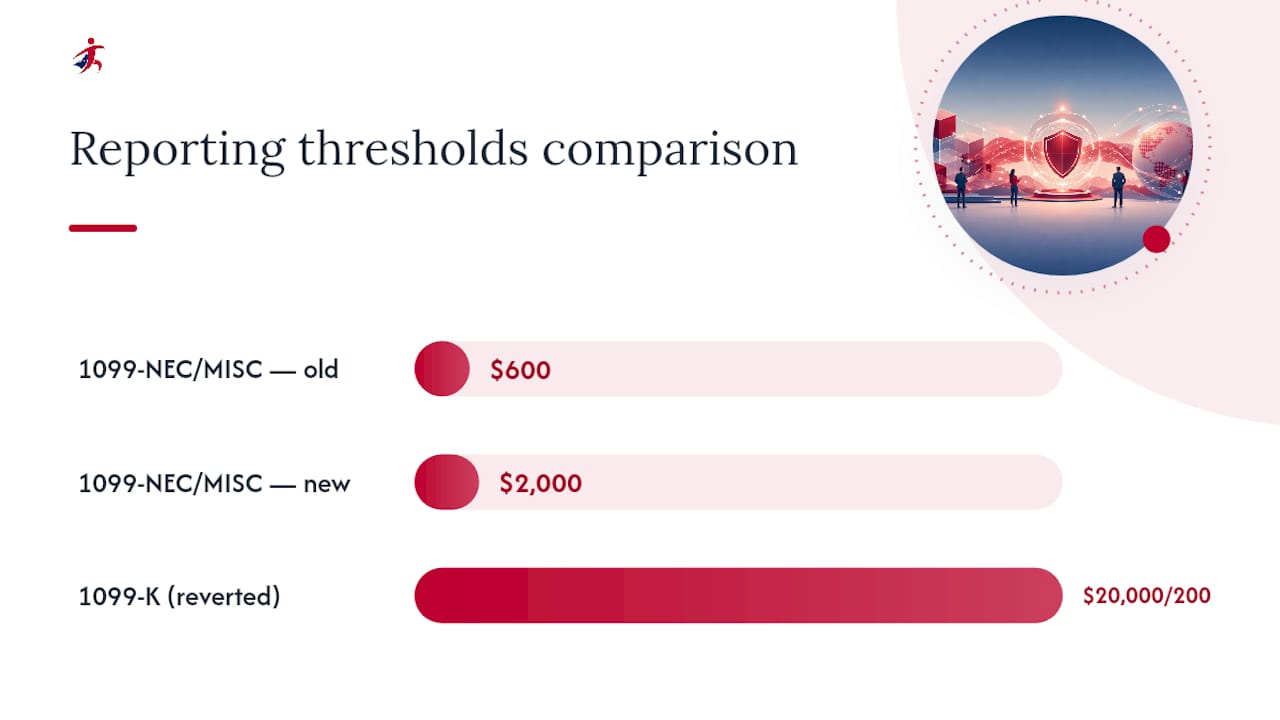
The threshold applies to nonemployee compensation, miscellaneous payments, and payment card or third-party network transactions. That scope covers freelance contractors, rent payments, and marketplace platforms alike.
Practical consequences for your team include:
- Fewer 1099s issued for small vendors and gig payments under $2,000
- Vendor monitoring and AP systems need reconfiguration to track the new, indexed threshold rather than a fixed $600 trigger
- Backup withholding triggers may shift since they’re tied to reporting thresholds
- Some states may not adopt the higher federal threshold, so state-level requirements deserve their own review
Treat this as an indexed figure, not a one-time reset. Systems that hardcode $600 will misreport starting in tax year 2026.
Filing one yourself? You can e-file Form 1099-NEC online with TaxFormHero, an IRS-authorized e-filing platform.
How Does IRIS Differ From the FIRE Filing System?
IRIS replaces FIRE’s flat-file, post-submission error model with XML-based validation that catches problems before you transmit. Filing information returns electronically through IRIS means either uploading through the free Taxpayer Portal or connecting through Application-to-Application (A2A) for bulk batch filing.
The two paths serve different filer profiles:
- Taxpayer Portal: web-based, manual entry or CSV upload, built for smaller volumes
- A2A: XML-based, automated, built for transmitters and software developers handling bulk files
IRIS enforces stricter schema rules than the old Publication 1220 flat-file format. Name fields split into first, middle, and last components, and recipient-level fields that many legacy 1220 exports never captured now show up as required. Skip that remapping and you’ll see elevated rejection rates during validation, not after.
Your file generators, ETL scripts, and downstream reconciliation reports all need review before go-live. A field that flowed silently through FIRE for a decade can fail outright under IRIS validation on day one.
Who Must E-File Under IRIS, and How Do You Count Returns?
The mandatory electronic filing threshold is 10 or more information returns in aggregate, counted across form types rather than per form. Add your 1099-NEC total to your 1042-S total, your W-2 count, and everything else in scope. Cross 10 combined and e-filing stops being optional.
A few counting rules change how that math works in practice:
- Corrected returns aren’t included in the 10-return aggregate count, though corrections must still be e-filed if the original filing was required to be filed electronically.
- IRIS TCCs are entity-assigned and role-specific. They are not interchangeable with legacy FIRE TCCs, so a code that worked for FIRE gets you nowhere in IRIS.
- Roles break out into issuer, transmitter, and A2A software developer, and each carries distinct application requirements.
- IRIS 101 recommends applying early and allowing roughly 45 days for TCC processing before you need to file.
Apply for the wrong role, or apply too late, and you’ll be requesting a second TCC mid-season instead of testing.
What Deadlines Should You Be Tracking Right Now?
FIRE retirement lands on December 31, 2026, with new FIRE TCC applications already cut off as of July 21, 2026. IRIS becomes mandatory for tax year 2026 filings submitted during filing season 2027. There is no extension built into that timeline.
Build your internal schedule around these milestones:
- Confirm or submit your IRIS TCC application now, not next quarter
- Complete field mapping and update file generators before touching the test environment
- Run test transmissions through the IRS test environment and resolve every validation error
- Lock a go-live date with buffer time before the actual filing deadline, not the other way around
Legacy FIRE TCCs remain accessible in a read-only capacity for historical reference, but they won’t process new submissions once the system retires.
Building a Readiness Checklist for the IRIS Transition
Sequence matters more than speed here. A team that maps files before confirming TCC roles ends up remapping twice.
- Confirm your threshold status. Inventory every form and payee touched by the $2,000 rule and verify whether your aggregate return count crosses 10.
- Submit or verify IRIS TCC applications. Assign issuer, transmitter, and A2A roles explicitly; Responsible Officials need to create accounts before anything else moves.
- Map existing exports to IRIS XML, or plan your Taxpayer Portal and CSV workflow if volume doesn’t justify A2A. Update ETL scripts to match the new schema.
- Run test transmissions early, using the IRS test environment for A2A or a sample batch through the Taxpayer Portal.
- Implement pre-submission TIN matching and name-parsing checks. Automated prechecks during migration testing cut down on late-season correction rushes far more effectively than fixing errors after rejection.
- Update your SOPs and notify AP, payroll, vendors, and any outside service providers about the new workflow.
Pro Tip: Run your first A2A test transmission with a deliberately messy sample file, including a split name field and a borderline TIN. IRIS will surface the exact validation failures you need to fix before your real filing volume hits the system.
How Does IRIS Handle State Filing and Combined Federal/State Filing?
IRIS supports Combined Federal/State Filing the same way FIRE did, but the details on which states participate and how live in Publication 5717 and Publication 5718, not in the general IRIS guidance.
Some states haven’t adopted the OBBBA thresholds and still require reporting below the new federal minimums. A state-rules matrix, maintained separately from your federal tracking, prevents gaps that only surface during a state audit. Consent options selected during your TCC application also affect state disclosure, so loop in whoever owns state filing at your organization before you finalize that application, not after.
Where Compliance Teams Should Focus Their Effort First
TCC access and successful test transmissions matter more than any other line item on your checklist. Without both, nothing else you prepare gets submitted, no matter how clean your data is.
IRIS’s stricter validation is a genuine advantage disguised as an inconvenience. Catching a malformed TIN in a test environment in October beats discovering it in a rejected batch in January. Compliance leaders should treat the OBBBA threshold increase as a chance to simplify vendor onboarding, not just as fewer forms to file. Fewer low-dollar 1099s means more attention available for the payments that still require full reconciliation.
— Nazrul
Get IRIS-Ready Without Rebuilding Your Filing Process
Migrating to IRIS doesn’t have to mean building XML mapping and TIN validation from scratch. TaxFormHero is IRS-authorized, SOC 2 ready, and built for exactly the workflow this transition demands: bulk import for high-volume filers, TIN verification before submission, and direct state filing across 35+ states so your federal and state obligations stay aligned.
Where TaxFormHero saves the most time is in the testing phase itself. Instead of writing your own IRIS field mappings, you upload your existing data and let a platform built for this migration handle the schema requirements, error checks, and TIN matching before anything reaches the IRS. There’s no subscription, no signup fee. You pay per form, starting at $1.99 per form.
Check your current filing volume against the 10-return threshold, then upload a sample file to TaxFormHero to see how your data holds up against IRIS validation before the real deadline arrives.
Recommended

File Information Returns With Confidence
TaxFormHero supports 20+ IRS information returns, including 1099 and W-2 forms, with bulk Excel import, name/TIN matching and encrypted recipient delivery.
Explore TaxFormHero