IRS Deadline: February 1, 2027
3 Critical Deadlines for FIRE to IRIS Transition for Tax Pros

IRIS replaces FIRE for information return filing, and if you file for tax year 2026, you need to complete an IRIS TCC application now. Begin migration immediately: apply for your IRIS Transmitter Control Code, decide between the Taxpayer Portal (CSV entry, 100-return limit) or A2A (XML, bulk volume), and run assurance testing before you file a single return in production.
TL;DR:
- Applying for an IRIS TCC can take weeks due to USPS mailing, so submit early and double-check all owner information before application.
- Migrating to IRIS requires mapping data fields to their schema and running extensive ATS testing, which is critical before the November 2026 deadlines.
- Small filers should start with the free Taxpayer Portal for up to 100 returns, while large filers with developer resources should aim for A2A integration.
- Many teams combine using the Taxpayer Portal with parallel A2A testing to reduce risks and avoid last-minute scrambling before the final FIRE cutoff.
- Using a vendor platform can simplify IRIS A2A adoption by bypassing schema mapping and validation, with costs based on the number of forms filed.
What Is IRIS and How Does It Differ From FIRE?
IRIS runs on two channels: a web-based Taxpayer Portal for manual or CSV entry, and A2A (Application-to-Application), which uses XML for high-volume transmission. FIRE, by contrast, relies on a legacy 1220 flat file format with delayed error feedback. You often didn’t learn about a bad TIN or formatting error for weeks.
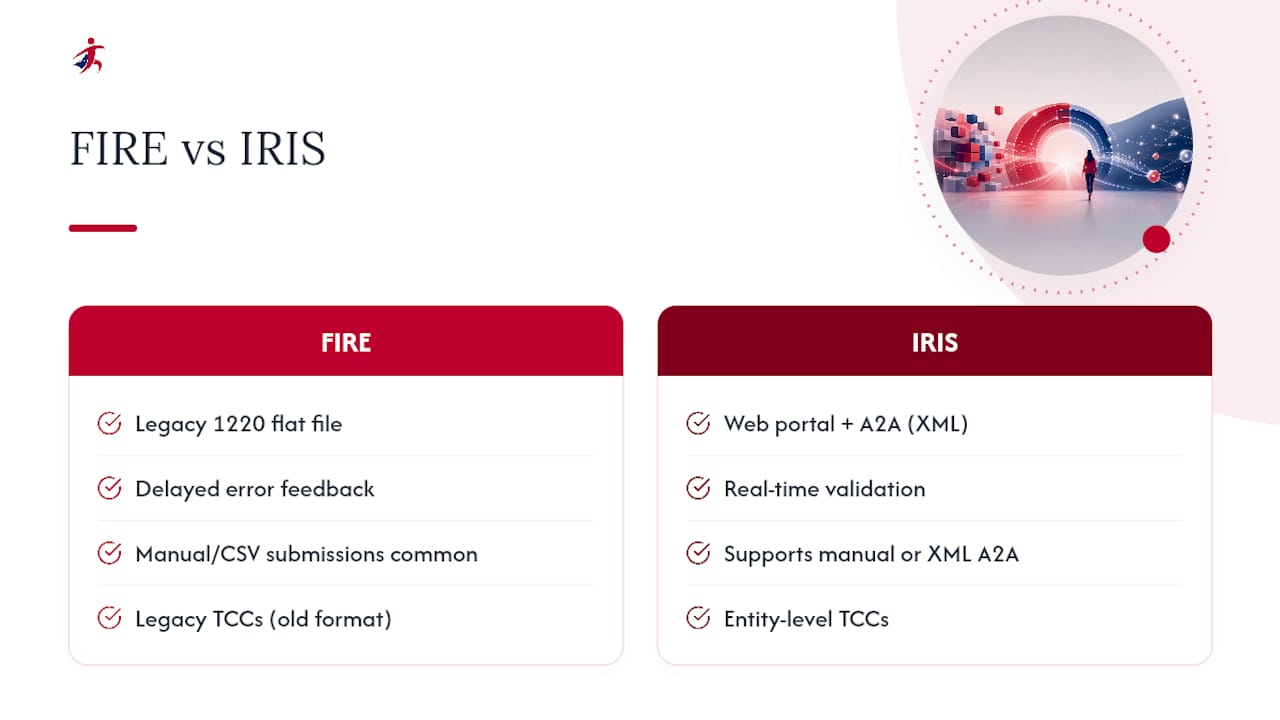
IRIS validates in real time. That earlier feedback loop cuts down on downstream B-Notices and CP2100 volume, but it also means you need clean data mapping before you submit anything, not after. IRIS TCCs work differently, too. They’re assigned at the entity level with a different application format than FIRE TCCs, so an existing FIRE credential does not carry over.
Filing one yourself? You can e-file Form W-2 online with TaxFormHero, an IRS-authorized e-filing platform.
What Are the Critical FIRE-to-IRIS Deadlines?
Three dates from the IRS govern everything else on your calendar. Miss them, and you’re filing blind or not at all.
- November 1, 2026: last day to submit test returns through the FIRE Trading Partner Test System.
- November 9, 2026: last day to make changes to IR Applications for TCCs.
- November 19, 2026, 3:00 p.m. ET: final cutoff to file information returns through FIRE.
If your TCC application or ATS testing is running behind, don’t wait on A2A to be perfect. File smaller batches through the Taxpayer Portal while your integration catches up. The safe sequence is test first, lock in your TCC, then move to production. Reversing that order is how teams end up scrambling in mid-November.
How Do You Apply for an IRIS TCC?
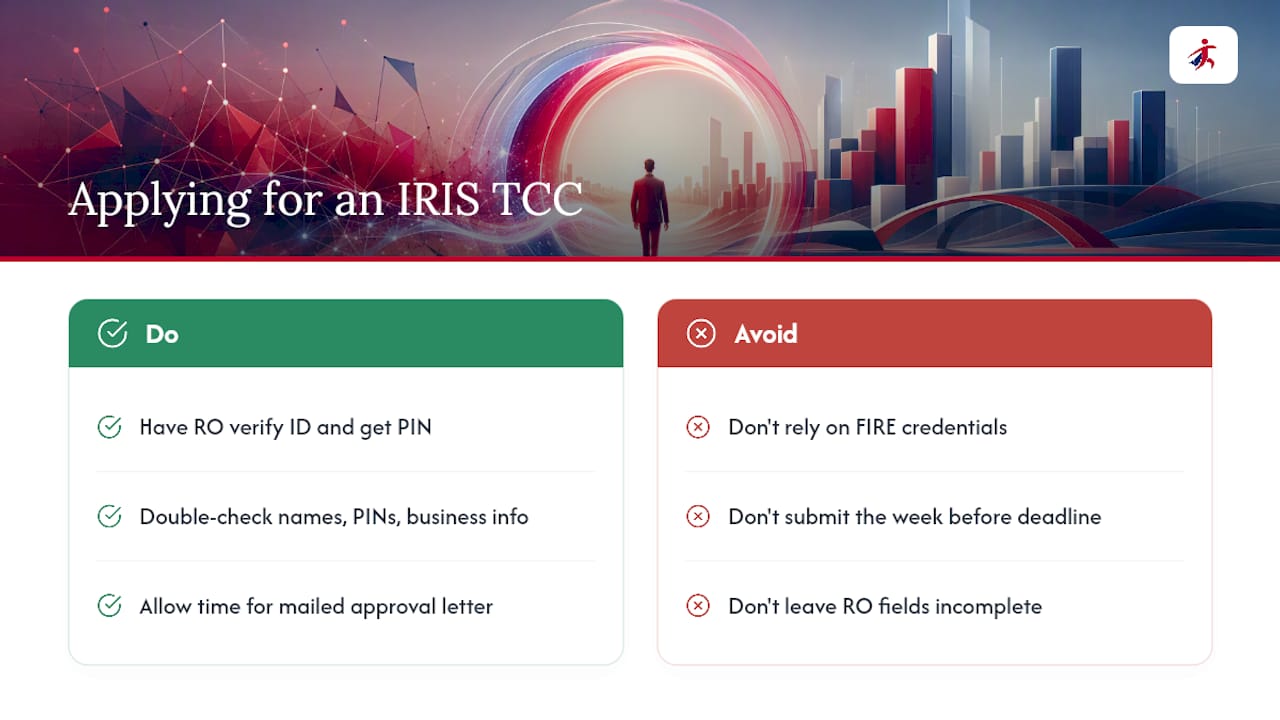
Apply through the IRS’s IRIS Application for TCC, where a Responsible Official (RO) submits identity verification and receives a PIN. The IRS mails an approval letter through USPS, and that step alone can add days to your timeline, so don’t submit your application the week before a deadline.
IRIS TCCs are not interchangeable with FIRE TCCs. They’re formatted differently and tied to filing permissions specific to the IRIS platform, meaning a valid FIRE credential does nothing for you here. If you already have a FIRE application, the IRS allows edits through December 2026, after which those applications become read-only.
The most common delay isn’t the IRS’s processing speed. It’s incomplete RO information submitted on the first pass, which triggers manual review and can push approval past the typical window. Double check names, PINs, and business details before submitting.
Should You Use the Taxpayer Portal or A2A?
Your filing volume and internal resources should drive this decision more than anything else.
The Taxpayer Portal is free and accessible through a browser. You can key in returns manually or upload a CSV, capped at 100 returns per submission. It suits small businesses, occasional filers, or anyone piloting IRIS before committing to a bigger build.
A2A is built for scale. It uses XML, requires an API Client ID, and depends on schema packages you’ll need to map your systems against. Every A2A filer must pass Assurance Testing (ATS) before touching production.
- Filing under 100 returns per period? Start with the Taxpayer Portal.
- Filing in the thousands, with in-house developers? Build toward A2A.
- Short on developer time but high volume? A vendor platform with IRIS A2A support skips the integration work entirely.
Pro Tip: Don’t treat this as an all-or-nothing choice. Many teams run the Taxpayer Portal for smaller, immediate filings while their A2A integration finishes ATS testing in parallel.
How Do You Test Your IRIS A2A Integration?
The IRIS ATS environment is available year-round, and passing it is a gating requirement before you get production access for A2A. Schema and business rule packages arrive through the Secure Object Repository in scheduled bulk deliveries, not generated on demand, so build your XSD validation timeline around that distribution schedule rather than assuming instant access.
Before you consider yourself ready, confirm four things: your XML or CSV formatting passes validation without warnings, your error handling actually catches and logs rejected records, your TIN and name matching returns clean results, and you’ve run a full end-to-end test that confirms receipt back from the IRS.
What Should Your IRIS Migration Checklist Look Like?
Assign each step to an owner and give it a real deadline, not a vague “before year end.”
- Apply for your IRIS TCC immediately. Owner: tax or payroll lead. Lead time: plan for weeks, not days, given USPS mailing steps.
- Inventory your current FIRE filings by form type and volume to size the right IRIS channel.
- Map your data fields to the IRIS schema, whether you’re building A2A or formatting CSVs for the portal.
- Request schema and business-rule packages through the Secure Object Repository if you’re going the A2A route.
- Run ATS testing and don’t skip edge cases like corrected returns or unusual TIN formats.
- Pilot a small batch through the Taxpayer Portal, even if A2A is your end state, to confirm your data is clean.
- Schedule your production switchover well before November 19, 2026, with buffer time for rejections.
- Archive your FIRE filing history and confirm you can still retrieve past submissions if needed.
Small filers can often complete this in a few weeks using the Taxpayer Portal alone. Larger filers building A2A should start now. Schema mapping and ATS cycles eat more calendar time than anyone estimates on the first pass.
What Tax Teams Get Wrong About This Transition
The biggest mistake is starting ATS testing in October for a November deadline. Field mapping always takes longer than expected, and duplicate filings across both systems create IRS-side confusion nobody wants to untangle. Run TIN matching early, use the Taxpayer Portal as your bridge, and put one person in charge of the whole migration. Subscribe to IRIS QuickAlerts and sit in on working-group calls. That’s where the IRS flags problems before they hit your inbox as a rejected batch.
— Nazrul
Get IRIS-Ready Without Building It Yourself
Not every accounting team has developers on standby to build an A2A integration before November. A vendor platform that supports IRIS A2A transmission can allow you to skip schema mapping, XSD validation, and ATS scheduling steps.
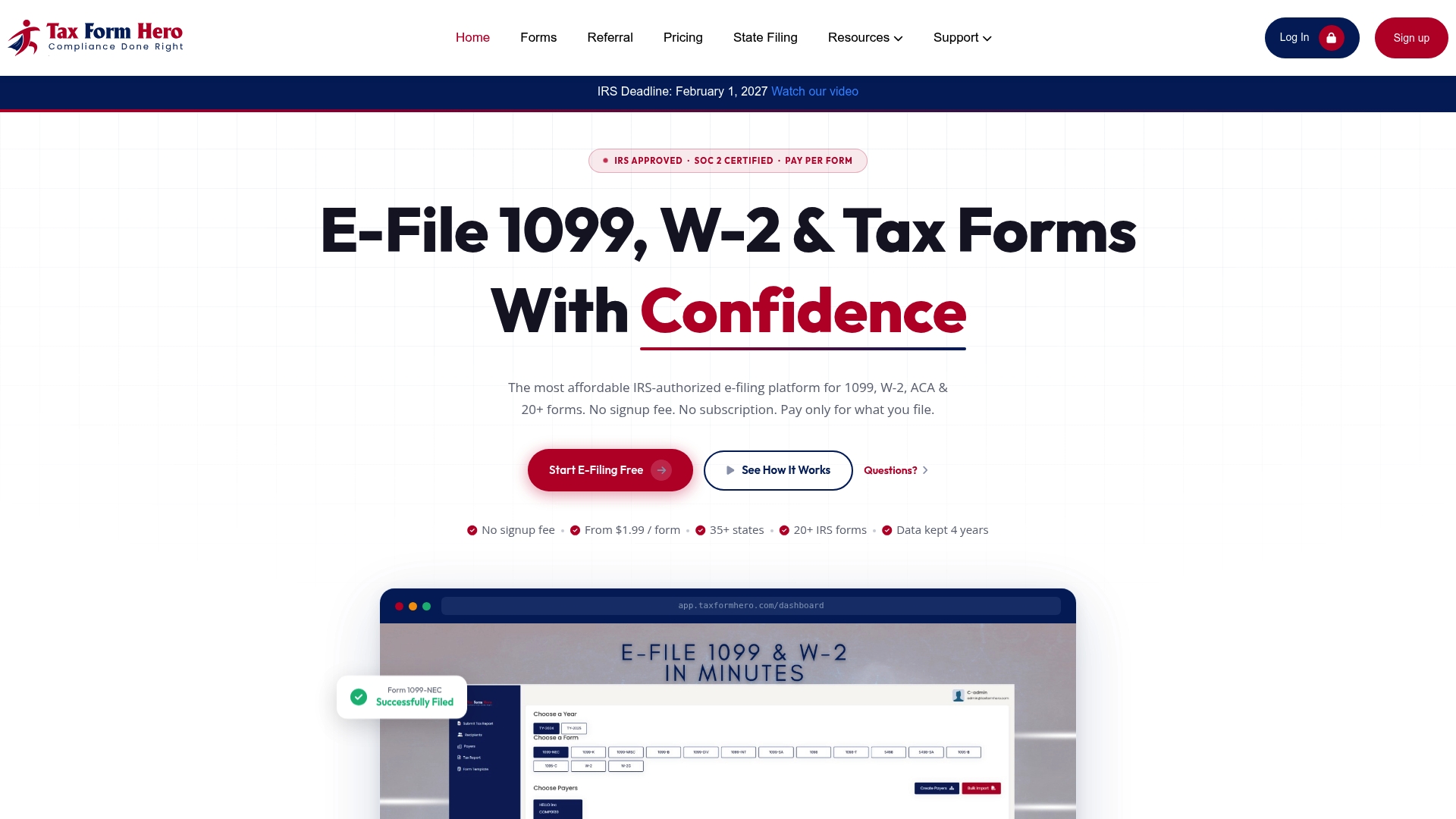
Filing typically uses a pay-per-form structure without subscription or signup fees, so you pay based on the number of forms filed rather than an annual contract sized for peak volume. Optional add-ons such as TIN matching, encrypted e-delivery, and print-and-mail services may also be available to help manage recipient-copy distribution during the transition. Review the pricing structure and see how the tiered rates apply to your actual filing volume, then start a batch on TaxFormHero before your FIRE access closes on November 19, 2026.
This article is general information, not a substitute for advice from a qualified financial advisor. Consult a qualified financial professional about your own circumstances before acting on anything here.
FAQ
Is IRIS Replacing FIRE?
Yes. IRIS becomes the only intake system for information returns starting with filing season 2027, and FIRE stops accepting filings after November 19, 2026, at 3:00 p.m. ET.
Can I Still Use FIRE to File 1099s?
You can file through FIRE only through November 19, 2026. After that date, all information returns must go through IRIS.
What Are the Main Differences Between FIRE and IRIS E-Filing?
FIRE uses a legacy 1220 flat file with delayed error feedback, while IRIS validates in real time through either XML-based A2A or the web-based Taxpayer Portal. IRIS also requires a separate TCC application, since FIRE credentials don’t transfer.
What Is the $600 Reporting Rule?
Reporting thresholds govern when payers must issue certain 1099 forms, but they are separate rules from the FIRE to IRIS transition; learn more about revocation of election procedures and their tax implications. The platform you use to file, whether FIRE or IRIS, doesn’t change your reporting threshold obligations.
Do I Need to Choose Between the Taxpayer Portal and A2A?
Not permanently. Many filers use the Taxpayer Portal for smaller batches while building or testing an A2A integration, or they use a platform like TaxFormHero that already handles A2A transmission on their behalf.