
TaxFormHero is the strongest overall alternative to eFile4Biz for most businesses, thanks to IRS authorization, transparent pay-per-form pricing, bulk import, and built-in TIN verification. Other credible options worth evaluating include eFile4Biz itself as the incumbent baseline, plus two SERP-surfaced competitors focused on bulk delivery and combined federal/state filing. The right choice depends on filing volume, state coverage needs, and how much automation your team actually requires.
TL;DR:
- TaxFormHero supports pay-per-form pricing, bulk import, and TIN verification, making it suitable for high-volume filers and small businesses alike.
- Confirm the provider’s IRS authorization and ensure TIN validation is integrated, not optional, before switching or choosing a platform.
- Check that the platform covers all relevant states where your payees reside, especially if you handle multi-state clients.
- Verify security credentials such as encryption standards and SOC 2 readiness to protect sensitive payee information during filing.
- For most small businesses, TaxFormHero offers a scalable, cost-effective option to start filing quickly without subscription commitments.
What Are the Best eFile4Biz Alternatives?
Four platforms consistently come up when businesses shop for information-return e-filing outside eFile4Biz. Each serves a slightly different filer, and these differences show up fast once you look past the marketing copy.
TaxFormHero leads this list for good reason. It’s an IRS-authorized platform built around pay-per-form pricing, so you never pay for a subscription tier you don’t use. The standout features are practical, not flashy: bulk import for high-volume filers, built-in TIN verification to catch mismatches before submission, direct state filing in 35+ states, and SOC 2-ready security controls protecting sensitive payee data. It’s built for businesses of all sizes, from solo freelancers filing a handful of 1099s to accounting firms managing hundreds of clients.
eFile4Biz remains the incumbent many businesses already know. It supports a standard set of information returns, plus print and mail delivery for recipients who still expect paper copies. If you’ve filed with it before and never had a reason to look elsewhere, it’s a familiar baseline, though “familiar” and “best fit for 2026” aren’t always the same thing.
Alternative A markets itself around bulk upload speed and workflow automation. It’s a reasonable pick for teams that process large batches at once and want integrated recipient delivery baked into the same workflow, though pricing transparency and add-on costs deserve a closer look before you commit.
Alternative B positions itself for accounting teams that need combined federal and state filing plus audit-ready reporting output. That combination matters if your firm handles multi-state clients and needs a paper trail for compliance reviews, but it’s worth confirming exactly which states are covered before assuming full coverage.
- TaxFormHero: pay-per-form pricing, TIN verification, 35+ state filing, SOC 2-ready
- eFile4Biz: established e-filing service with print/mail delivery
- Alternative A: bulk upload speed and recipient delivery automation
- Alternative B: combined federal/state filing with compliance reporting
Filing one yourself? You can e-file Form W-2 online with TaxFormHero, an IRS-authorized e-filing platform.
Which Features Actually Matter When Comparing Providers?
Every e-file platform lists a similar feature set on its homepage. The differences that actually affect your filing season show up in the details.
Forms supported determines whether you can consolidate all your filings on one platform or juggle two. If you file 1099-NEC, 1099-MISC, W-2, and ACA forms across different systems, you’re duplicating data entry and multiplying your error risk.
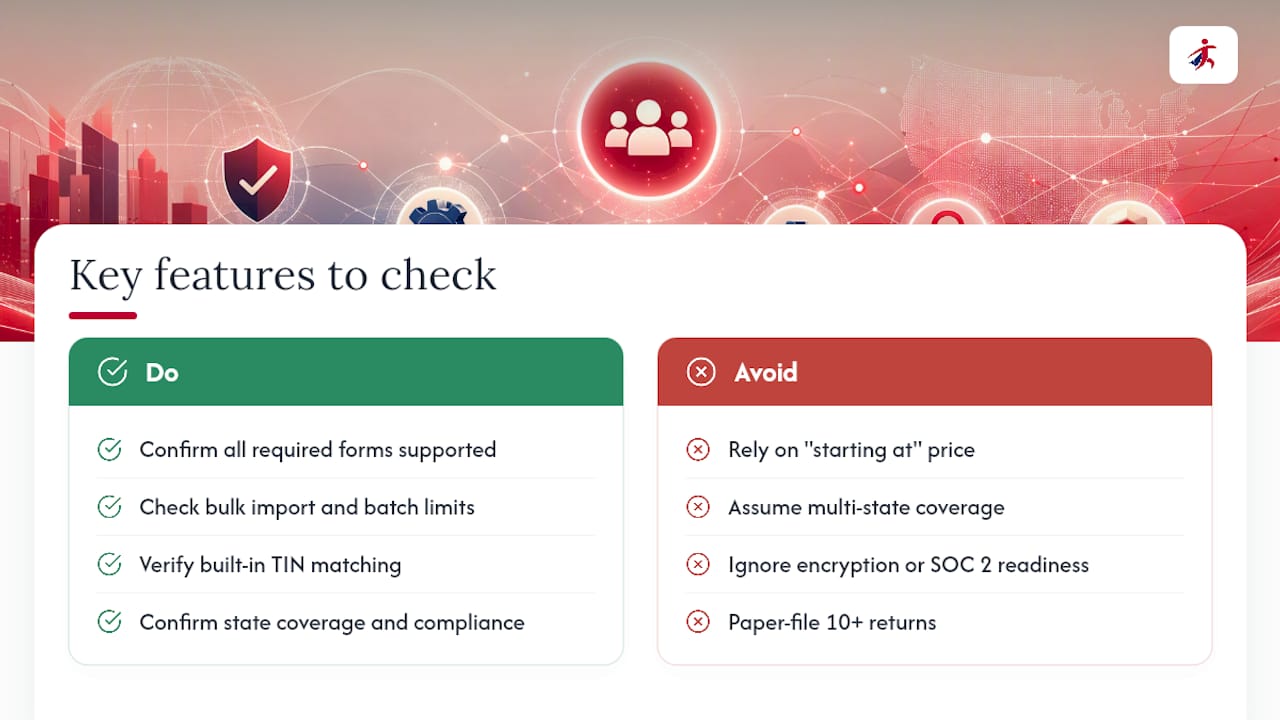
Bulk import and batch limits matter more than most buyers realize until deadline week. A platform that caps batch uploads at a low number forces you to split large filings into multiple sessions, which eats time you don’t have in late January.
TIN verification is arguably the most underrated feature on this list. A mismatched Taxpayer Identification Number can trigger IRS notices and, in repeated cases, penalties for the filer. Catching that mismatch before submission, rather than after the IRS flags it, is the entire point of built-in TIN matching.

State filing coverage varies widely between vendors. Some handle a small handful of states; others cover dozens. If your business operates across multiple states, confirm coverage before assuming your vendor handles it automatically.
Security and compliance credentials should include encryption standards and SOC 2 readiness at minimum, since you’re transmitting Social Security numbers and EINs.
On the technical side, filers with 10 or more information returns must e-file rather than paper file, and the IRS’s own IRIS and FIRE systems carry their own TCC and ATS testing requirements for direct filers. That technical burden is exactly why most businesses use an intermediary instead of filing directly with the IRS.
Pro Tip: Ask any vendor for their per-form price at your actual volume, not their advertised “starting at” rate. Tiered pricing structures often shift the effective per-form cost once you cross a volume threshold.
How Do You Choose the Right e-File Provider?
Start with authorization, then work through delivery and pricing. A vendor that fails the first check isn’t worth evaluating further.
- Confirm IRS authorization. Ask for the provider’s EFIN acceptance letter, or check the IRS Authorized Provider locator. The IRS itself notes that listing in this database is a technical credential, not an endorsement, so pair it with your own due diligence.
- Verify TIN validation is built in, not an expensive add-on you’d have to purchase separately.
- Check bulk import formats and batch limits against your actual filing volume, not your best-case estimate.
- Confirm state filing coverage for every state where you have payees, not just your headquarters state.
- Ask about data security specifically: encryption standards, SOC 2 status, and how long payee data is retained after filing season ends.
- Confirm delivery options and turnaround, including print and mail, encrypted e-delivery, and recipient access.
When you talk to a vendor, ask directly: “Can you provide your EFIN acceptance letter?” “What’s your migration process for payee data from our current provider?” “What’s your per-form price broken down by tier?” “What happens if a form needs to be corrected after submission?”
Red flags include no proof of EFIN authorization, pricing that’s only available after a sales call, no TIN checks offered at any tier, thin state coverage advertised as “full coverage,” and no clear process for migrating existing payee records. Before switching, run a small test batch, confirm recipient delivery actually reaches a test address, and keep your own copy of every filing confirmation.
Does TaxFormHero Meet the Criteria That Matter Most?
TaxFormHero is IRS-authorized and supports 1099, W-2, ACA, and more than 20 other information return types, covering nearly every filing scenario a business or accounting firm encounters in a given season.
On security, the platform uses 256-bit encryption for data in transit and storage, is SOC 2-ready, and includes built-in TIN verification so mismatches get caught before submission rather than after an IRS notice arrives.
Pricing follows a pay-per-form model with rates that decrease at higher volume tiers, and there are no signup fees or subscription commitments. You pay only for what you file.
- Bulk import for high-volume filers
- Direct state filing across 35+ states
- Print & mail plus encrypted e-delivery options
- Pay-per-form pricing with no subscription lock-in
For accounting teams migrating from another platform, TaxFormHero’s e-filing dashboard is built to import existing payee data in bulk, which shortens the switching process considerably compared to manual re-entry.
Which Path Fits Your Filing Situation?
Small businesses filing a handful of 1099s each year rarely need anything beyond a pay-per-form self-serve platform. High-volume filers processing thousands of returns should weigh whether an API or A2A integration makes sense. Accounting firms juggling multiple clients need a real migration checklist and volume pricing before switching. For most readers here, TaxFormHero remains the strongest starting point.
— Nazrul
Ready to File Your Forms With TaxFormHero?
Switching e-file providers doesn’t have to mean a steep learning curve or a drawn-out onboarding process. TaxFormHero gets you filing in one sitting: create an account, import your payee data in bulk, and file only the forms you actually need, with no signup fees and no subscription commitment sitting between you and tax season.
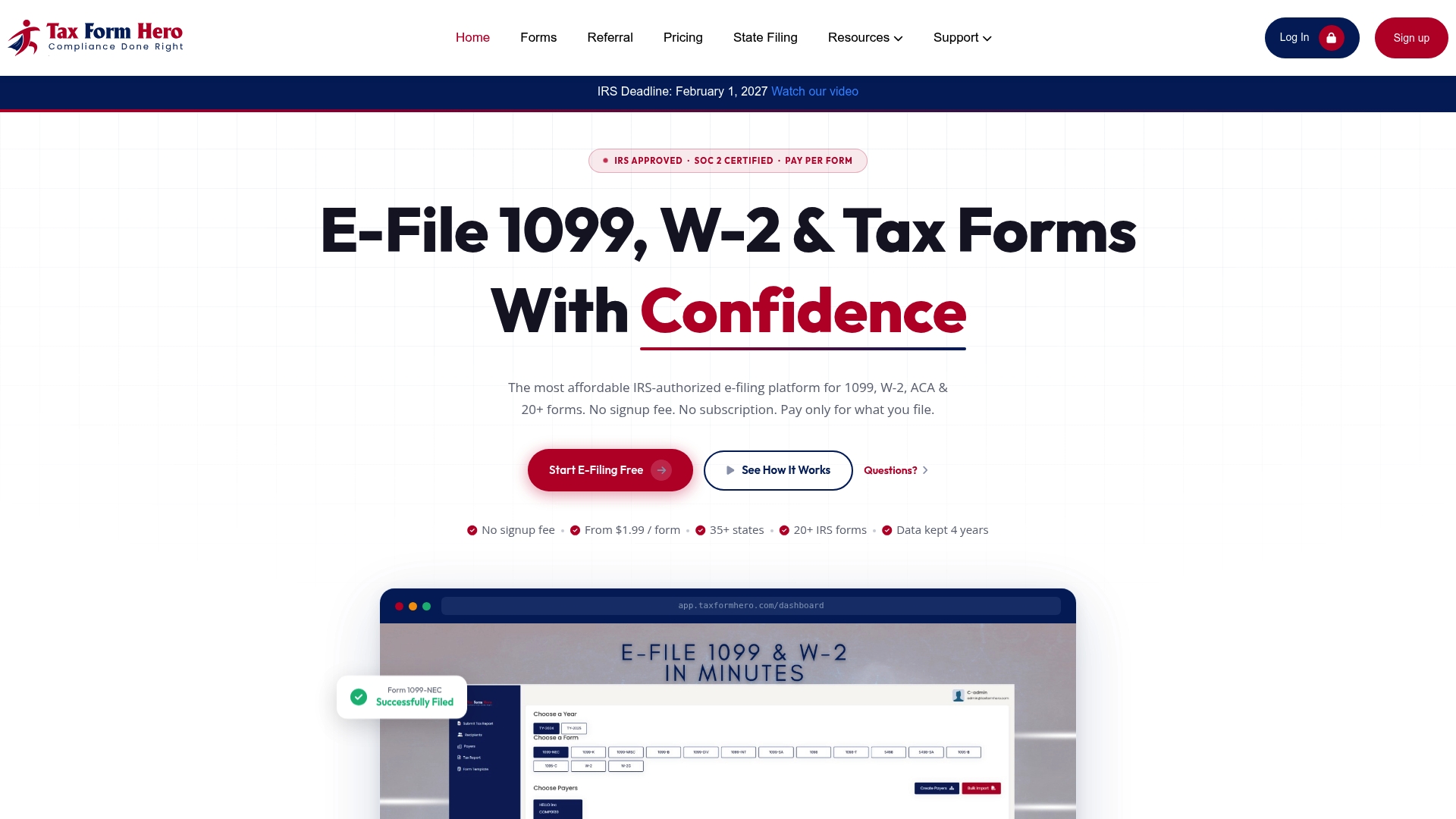
Pricing starts at $1.99 per form and drops as low as $0.45 per form at higher volumes, so the cost scales with your business rather than penalizing a small filer for not hitting a subscription tier. If your filing deadline is approaching and you’re also weighing a business tax extension, it’s worth locking in your e-file provider first, since extensions buy time on payment, not on your information return deadlines. Visit the TaxFormHero e-filing platform to start your first batch and see the per-form pricing before you commit to anything.
Where Can You Verify Provider Authorization?
Before filing with any provider, confirm its standing directly through the IRS. Start with Become an Authorized e-File Provider to understand the suitability checks every provider must pass, then review E-File Information Returns for current thresholds. For EFIN specifics, the EFIN FAQ page covers issuance and verification directly from the source.
Recommended

File Information Returns With Confidence
TaxFormHero supports 20+ IRS information returns, including 1099 and W-2 forms, with bulk Excel import, name/TIN matching and encrypted recipient delivery.
Explore TaxFormHero