Printing 1099 Forms: Skip Copy A Printer Calibration With Print and Mail

The quickest compliant routes are downloading recipient PDFs from an authorized e-file portal and printing them at actual size, or using an IRS-authorized e-file provider that offers compliant print-and-mail. The first option fits businesses that file under the mandatory e-file threshold. The second fits anyone who wants turnkey delivery or who needs scannable copies without in-house equipment.
TL;DR:
- Businesses filing 10 or more information returns across all types must file electronically; printing remains necessary for recipient copies due by January 31.
- Copy A substitutes need specified OCR paper, red dropout ink, exact positioning, and tested scan quality; ordinary printers are generally unsuitable.
- Recipient PDFs can be printed on plain paper with black ink, but set actual size, verify the copy type, and test alignment before mailing.
- IRIS supports up to 100 returns per filing batch and offers downloadable recipient copies, but the filer remains responsible for delivery.
Real-world options for getting print-ready 1099 forms
Several paths produce usable 1099 copies, and each one fits a different volume and risk level.
The IRIS Taxpayer Portal supports manual entry or CSV upload and lets filers e-file up to 100 returns at a time, with the option to download payee copies for distribution. IRIS downloads have batch-size limits, with files packaged into a ZIP file with separate PDFs and CSVs for each record. The IRS does not track whether a downloaded form actually reaches the recipient; that responsibility stays with the filer, according to the IRIS Taxpayer Portal user guidance.
Authorized software exports work the same way in principle. Most platforms generate a PDF of each recipient copy that you print locally. Common pitfalls include exporting at the wrong scale, mixing form years in one batch, or exporting Copy B when the recipient needed Copy C for their own records.
Ordering official IRS scannable forms makes sense only at low volume, since Copy A for paper filing must meet strict print specifications that most offices cannot reproduce on a standard printer. Forms printed from the IRS website are generally not acceptable for a scanned Copy A unless a specific exception applies, per Publication 1099.
For many filers, a print-and-mail add-on through an e-file provider removes the guesswork entirely. Some e-file providers offer print and mail fulfillment that handles paper production and delivery without requiring you to source scannable stock or calibrate a printer.
- IRIS and vendor portals both offer downloadable recipient PDFs, but batch limits apply.
- Software exports are convenient but require careful attention to scale and copy type.
- Official scannable forms are only practical for small, paper-filed batches.
- Print-and-mail add-ons remove the printer-specification burden entirely.
Need to get this filed? You can e-file Form 1099-NEC online with TaxFormHero, which is IRS-authorized and charges per form, not per month.
Printer, paper, ink, and layout specs that matter
Copy A has tight production rules because the IRS scans it. Publication 1179 specifies the paper grade (20 lb OCR bond or 50 lb offset book), red OCR dropout ink for shaded areas, exact print positioning, and equipment testing to confirm OCR density.
Pub. 1179 sets exact print tolerances for substitute Copy A forms, including paper grade and ink color specifications, which is why generic office printers rarely meet the standard without calibration.
Recipient copies (B, C, and state copies) are far more forgiving. Plain white paper and standard black ink work fine as long as the text is legible and the layout matches the official form.
- Copy A requires OCR-compliant paper stock and red dropout ink in the shaded areas.
- Recipient copies can be printed on plain paper with standard black toner or ink.
- Scale matters: print at actual size, never “fit to page,” so box alignment stays correct.
- Consumer inkjet or laser printers are fine for recipient copies; Copy A substitutes typically need commercial print equipment capable of OCR-grade output.
Step-by-step printing checklist and printer setup
Running through a short sequence before you print a full batch catches most errors before they reach a mailbox.
- Confirm the source PDF is set to actual size, not scaled to fit the page.
- Open the print dialog and disable any automatic scaling or shrink-to-fit setting.
- Set the printer to high-quality, non-glossy output with standard black ink for data fields.
- Load the correct paper tray and confirm the feed method matches the form’s page count.
- Print one test copy and check alignment against a blank form template.
- Verify TIN digits, dollar amounts, and decimal points are fully readable.
- Confirm any required instruction text for recipients printed in full, not cut off at the margin.
- Prepare mailers: use a flat envelope, never staple the form, and never fold Copy A if it will be filed on paper.
Pro Tip: Keep one printed test copy on file as your quality baseline before running the full batch, so a misaligned print job never reaches a recipient’s mailbox.
E-filing rules, deadlines, and how they change the role of printing
Businesses that file 10 or more information returns in total, combining every 1099, W-2, and 1095 type, must file electronically rather than on paper, according to the IRS guidance on e-filing information returns. That threshold aggregates across form types, so a business issuing six 1099-NEC forms and five W-2s crosses the line even though neither form alone hits 10.
Filers combining 10 or more information returns of any type must file electronically rather than on paper, per the e-file threshold rule, a detail many small businesses discover only after assembling their year-end forms.
When that threshold applies, printing no longer serves IRS filing at all. It still matters for furnishing recipient copies by January 31 and for keeping records, but the government copy has to go through electronic transmission. Treating printing as a furnishing task rather than a filing task once you cross the threshold keeps the workflow straightforward.

Compliance checklist before you print or mail recipient copies
A few checks before printing catch the errors that cause the most rework later.
- Run TIN verification ahead of time, since mismatched names and numbers are a common source of IRS notices.
- Confirm each recipient’s preferred delivery method: electronic copies require documented consent, while mailed copies need current addresses.
- Include any required furnishing instructions on the recipient copy itself.
- Retain both printed and digital records according to IRS recordkeeping guidance, and know the corrected return process in case a figure needs to change after filing.
Why an IRS-authorized e-file platform with print and mail lowers risk
An authorized e-file platform with built-in print and mail removes most of the variables that cause rejected or mismatched forms. An authorized e-file platform transmits federal returns to the IRS through IRIS A2A, runs TIN verification before submission, and offers encrypted delivery alongside traditional mail, often on pay-per-form pricing with no subscription.
- IRS authorization and IRIS A2A transmission remove guesswork about filing eligibility.
- TIN verification at $0.49 per check catches mismatches before they become notices.
- Print and mail at $1.69 per form avoids the need for OCR-capable equipment in house.
- SOC 2 Type I attestation provides a documented control standard relevant for tax professionals.
This combination suits filers with growing volume, no in-house OCR printing capability, or a preference for certified delivery over manual mailing.
Choosing an approach without creating more rework
If you file 10 or more returns across all types, focus your energy on electronic filing and treat printing purely as a furnishing task, not a filing method. For low volumes with strong internal quality control, ordering official IRS forms or printing recipient PDFs directly can work fine. Outside of that narrow case, an authorized vendor tends to save more time than it costs, since the alternative is rebuilding IRS print specifications from scratch and hoping a test scan confirms it.
— Nazrul
How TaxFormHero fits into your printing and filing workflow
Some e-file platforms help users get accurate 1099 forms to the IRS and to recipients while supporting bulk import from Excel or CSV, TIN verification before submission, and IRIS A2A transmission. Print and mail add-ons and encrypted e-delivery can cover both furnishing methods.
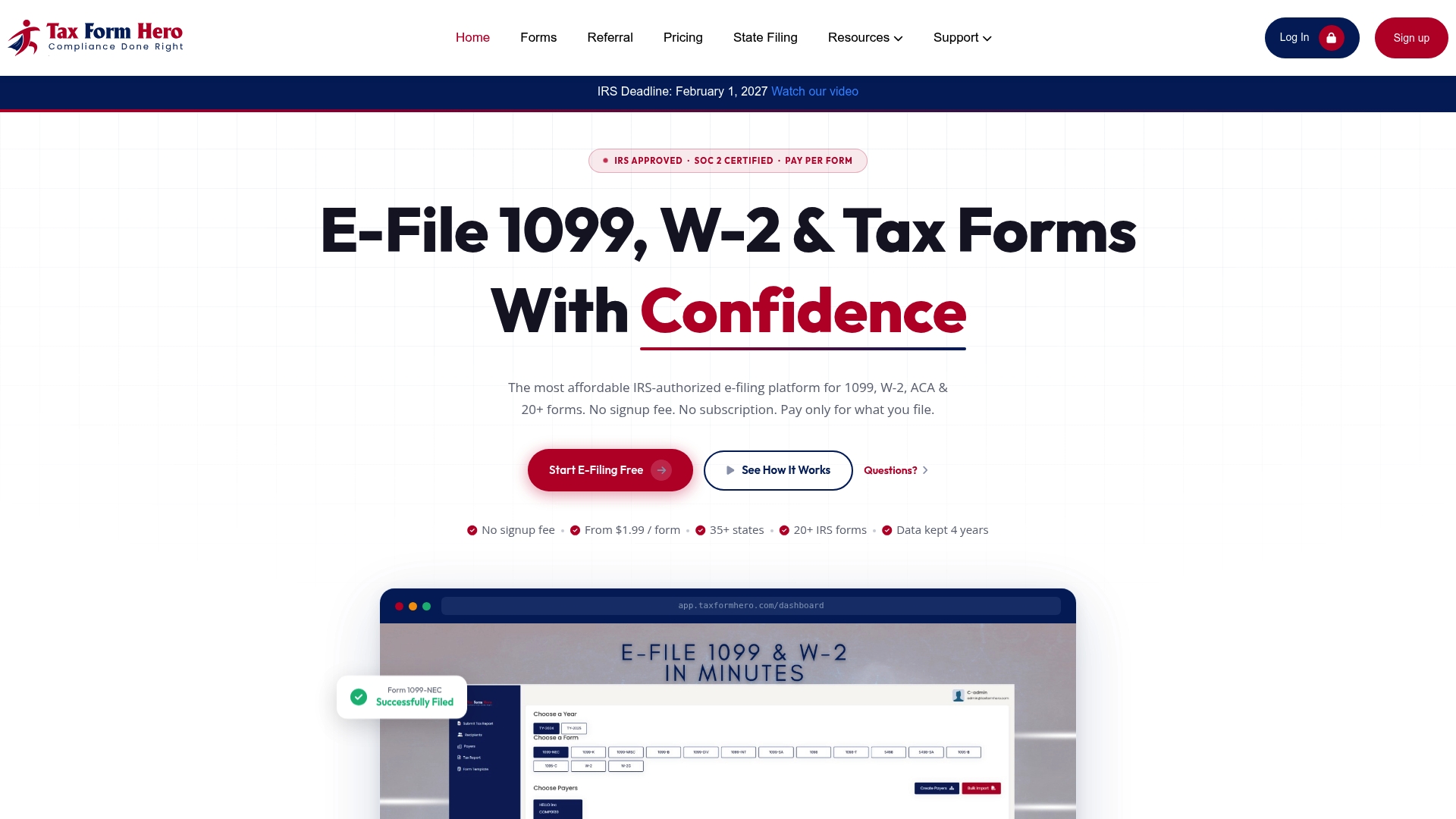
Start with filing 1099-NEC online from $1.99 per form, and check our pricing page for state filing, print and mail, and e-delivery add-ons before you commit to a DIY print run.
FAQ
Can I print out my own 1099 forms?
You can print recipient copies (B and C) on plain paper with standard black ink, but Copy A for IRS filing generally cannot be a form printed from the IRS website unless a specific exception applies, per Publication 1099. Copy A substitutes must meet the scannable specifications in Publication 1179.
What is the $2,000 rule for 1099 reporting?
Reporting thresholds vary by form and payment type rather than following one universal dollar figure, so check the instructions for your specific form before assuming a single rule applies. The e-file requirement, separately, kicks in once a business files 10 or more information returns in total, according to the IRS e-file threshold guidance.
Where can I get printable 1099 forms?
The IRIS Taxpayer Portal lets filers download recipient PDF copies after e-filing, and most authorized software platforms generate the same type of printable export. Official scannable Copy A forms need to come from an approved print vendor rather than a home printer.
What is the best software for filing 1099s?
The right choice depends on volume, budget, and whether you want print and mail handled for you. Our platform offers IRS-authorized e-filing with pay-per-form pricing starting at $1.99, bulk import, TIN verification, and optional print and mail for readers who want a documented, low-risk path.
Recommended
- How to Print and Mail 1099 Forms Without IRS Penalties
- Print & Mail
- Best 1099 Print and Mail Service for 2026 (Ranked)
- Resend 1099 to Recipient (2026): Reprint vs. Correction

File Information Returns With Confidence
TaxFormHero supports 20+ IRS information returns, including 1099 and W-2 forms, with bulk Excel import, name/TIN matching and encrypted recipient delivery.
Explore TaxFormHero