W-2 Mate vs TaxFormHero: Check IRIS Support Before 2027

For businesses and tax professionals who need to prepare and e-file W-2s and other information returns, we recommend TaxFormHero as the IRS-authorized, pay-per-form platform built for this job. We support IRIS A2A transmission, bulk import, and secure recipient delivery, so filers get compliance and control without a subscription.
TL;DR:
- Ten or more information returns in one calendar year require electronic filing and an IRS Transmitter Control Code, which can take weeks to process.
- The IRS plans to make IRIS the sole information return filing system after January 1, 2027, so verify that your filing method supports it.
- SSA BSO direct entry suits employers filing 50 or fewer wage statements; larger batches call for file upload or software with direct IRS transmission.
- Direct state filing costs $0.99 per form unless your state participates in combined federal and state filing; verify coverage for every state.
- File a small test batch at least a week before your deadline to catch data issues or TCC delays before submitting the full set.
What to expect from an IRS-authorized e-filing platform
A platform built for information-return filing needs to do more than generate PDFs. It needs to transmit directly to the IRS, handle volume without manual rework, and protect recipient data at every step.
We transmit federal returns through IRIS A2A, the IRS’s Application to Application channel. That matters because A2A removes the manual upload step required by portal-based filing. Instead of logging into a government portal and uploading files by hand, your data moves straight from our platform to the IRS, which cuts the rejection risk tied to formatting errors.
Here is what we built around that transmission method:
- Bulk import: upload thousands of recipient records from Excel or CSV templates instead of entering them one by one.
- Multi-payer accounts: manage several employers or clients from a single login, useful for accounting firms.
- Recipient delivery choices: send copies by encrypted e-delivery or order USPS First-Class Mail print and mail.
- Secure storage: recipient and payer data stay encrypted at rest and in transit.
We hold a SOC 2 Type I attestation, an independent audit of how we control access to sensitive filer data. Pricing runs pay-per-form, with no subscription or signup fee, so a payroll team filing 40 W-2s pays only for those 40 forms plus any add-ons it chooses.
If you would rather not do this on paper, e-file Form W-2 online with TaxFormHero instead.
Which IRS and SSA rules decide your filing path
Before picking software, you need to know which filing method the IRS actually requires for your volume. Three rules drive that decision.
- Count your returns. If you file 10 or more information returns in a calendar year, including Forms W-2, electronic filing is mandatory, not optional.
- Get a Transmitter Control Code. Any filer using IRS systems to e-file needs a TCC, and processing can take several weeks, so apply well before your deadline. IRIS TCCs start with the letter “D” while FIRE TCCs start with a number.
- Plan around the IRIS transition. The IRS has confirmed that IRIS will become the only information-returns e-file system after January 1, 2027, replacing FIRE. IRIS accepts filings through its Taxpayer Portal or through A2A, which is why software with A2A support matters for your 2026 and 2027 filings.
| Filing path | Best suited for | Key requirement |
|---|---|---|
| SSA Business Services Online (BSO) direct entry | 50 or fewer W-2 forms | SSA BSO registration |
| SSA BSO file upload | Larger W-2 batches | Formatted file matching SSA specifications |
| IRS IRIS Taxpayer Portal | Low-to-moderate volume, manual entry | TCC and IRIS registration |
| IRS IRIS A2A via authorized software | Recurring or higher-volume filers | TCC plus A2A-enabled vendor |
If your volume is small and occasional, SSA BSO direct entry can be enough. Once you are filing repeatedly across clients or employees, an A2A-enabled vendor removes the manual steps that BSO and the IRIS portal still require.
How to set up and run your first e-file season
Getting from a spreadsheet of names to accepted IRS submissions takes a sequence of checks, not a single upload.
- Collect and validate payer and recipient data. Gather legal names, addresses, EINs, and recipient TINs before you touch the software.
- Map your data to a CSV or Excel template. Our bulk import template matches each field (name, TIN, wages, withholding) to the IRS layout, so mismatched columns get caught before submission.
- Confirm or apply for your TCC. If you plan to transmit through IRIS A2A, apply early since the IRS notes processing can take weeks.
- Run TIN matching before you file. Catching a mismatched name and TIN before submission avoids a rejected batch later.
- Choose recipient delivery. Pick encrypted e-delivery for speed or print and mail for recipients who need a paper copy.
- Run a small test batch first. File a handful of forms, watch the exception queue, and resolve any flags before submitting the full batch.
- Document and archive. Keep filed-return confirmations and recipient PDFs on file for your own records and for any correction requests later.
Pro Tip: File your test batch at least a week before your deadline so a TCC delay or data mismatch does not force a late, unplanned paper filing.
How pay-per-form pricing and add-ons affect your total cost
Add-ons are priced per form, so you only pay for what you use:
A small business filing 25 W-2s with state filing and e-delivery pays per-form rates across just those line items, with no subscription fee layered on top. An accounting firm processing several hundred forms across multiple clients benefits most from the graduated tiers, since the per-form rate drops as the batch grows. Our cost breakdown guide walks through exact totals at different volumes.
How the two platforms compare on interface and support
W-2 Mate is desktop software that installs locally and generates files for manual upload to SSA BSO or the IRS systems you choose. That model puts the interface closer to traditional accounting software: menus, form grids, and manual export steps.
We built our platform as a browser-based service, so there is no installation and no local file management. Payer and recipient data live in one account, forms are built from that data directly, and submission happens inside the same session rather than as a separate export-and-upload step.
On support, desktop software like W-2 Mate typically routes users through phone or ticket-based help tied to its installed version. Our support model is built around the same web account you use to file, which keeps troubleshooting and the filing session in one place rather than switching between a desktop tool and a separate help channel.
For a payroll team filing once a year, the practical difference shows up at setup: installing and configuring desktop software takes longer than logging into an account and importing a spreadsheet. For an accounting firm managing several clients, having payer accounts inside one web platform, rather than separate desktop files per client, cuts down on the file juggling that desktop tools require.

State filing coverage you should check before you commit
Most information returns need to go to both the IRS and your state, and coverage varies by platform and by state.
We support direct state filing in 41+ states and Washington, D.C., and Combined Federal/State Filing states are included in that coverage without an extra state-filing charge. That matters because states that participate in Combined Federal/State Filing receive your federal data automatically in many cases, so confirming whether your state is one of them before you pay for a separate state submission saves money.
Desktop software vendors like W-2 Mate generally list their own state coverage separately, and that number can differ from ours depending on which states each vendor has built direct filing connections for. Before choosing a platform, check the specific states you file in against the vendor’s published state list rather than assuming general coverage. A business filing only in a Combined Federal/State state has different needs than one filing in a state that requires a separate direct submission, and your add-on costs will depend on which category your state falls into.
If you file across multiple states for different clients, confirming each state’s status before filing season starts avoids a surprise fee or a missed state submission after your federal forms are already in.
What filers say about ease of use and platform trust
Reviews of information-return software tend to focus on three things: how fast setup takes, how clear the exception handling is when a batch gets flagged, and whether the vendor is transparent about pricing before checkout.
Desktop tools like W-2 Mate draw consistent praise for familiarity among users who have filed with the same software for years, since the learning curve is already behind them. The tradeoff that shows up in feedback on desktop tools is the extra step of exporting a file and uploading it separately to SSA BSO or the IRS, compared with a platform that files directly.
For our own platform, the attributes filers call out most are the graduated pricing that avoids subscription fees, the bulk import that handles large recipient lists without manual entry, and the exception queue that flags a rejected or mismatched record before it holds up the rest of a batch. A first-time filer moving from paper forms tends to value the guided data entry, while a repeat filer managing multiple client accounts values having everything in one login rather than juggling separate installs per client.
Neither platform type suits every filer equally. A one-person shop filing a handful of forms a year may be comfortable with either option, while a firm filing for dozens of clients benefits more from a platform built around multi-payer accounts and direct transmission.
Connecting your filing platform to payroll and accounting software
Most filers are not starting from a blank spreadsheet. Payroll and accounting data usually already live in a system like QuickBooks, Gusto, or a similar platform, so the real question is how much rework it takes to get that data into a filing-ready format.
We accept bulk import from Excel and CSV templates, which covers the export format most payroll and accounting systems produce. That means a payroll team can export its W-2 data, map the columns to our template once, and reuse that mapping each filing season rather than rebuilding it from scratch.
Desktop software like W-2 Mate typically supports similar import formats, since both platform types rely on standard CSV or Excel exports rather than live, continuous syncing with payroll systems. The practical difference between platforms tends to come down to how much manual cleanup the import requires and whether multi-payer or multi-client data can be imported in a single batch or needs to be loaded client by client.
If your accounting or payroll system can export a clean Excel file with recipient names, TINs, and wage or payment amounts, either platform type can work with that file. The time savings come from how well the template mapping holds up across filing seasons, not from a deeper, always-connected integration.
Best practices for verifying TINs before you file
A mismatched name and Taxpayer Identification Number is one of the most common reasons a batch gets rejected or flagged for correction after submission.
Run TIN verification before you submit, not after. We offer TIN matching at $0.49 per check, which confirms that a recipient’s name and TIN match IRS records before the form goes into your filing batch. Catching a mismatch at this stage means you can contact the recipient for a corrected W-9 or W-4 before your deadline, rather than filing a return that comes back rejected.
A few habits reduce TIN errors before they ever reach the matching step: collect a signed W-9 or equivalent form directly from each recipient rather than relying on a name typed from memory, confirm that the legal name on file matches the name associated with the TIN (not a nickname or a trade name), and re-verify TINs for recipients who have not filed with you in the past year, since names and entity structures can change. For multi-payer accounts, running TIN matching separately for each payer’s recipient list, rather than assuming one shared verification pass covers everyone, catches errors specific to each client’s data.
Building TIN verification into your pre-filing checklist, alongside the test batch step covered earlier, catches most data errors before they turn into a rejected submission or a correction filing later.

A payroll manager’s view on IRIS-ready filing
A payroll manager’s year-end workload gets harder every time a filing step requires a manual export and a separate portal login, which is why understanding how businesses prepare for tax season using Patriot Software can help streamline these processes. Each extra hand-off is a place where a file can get mismatched or a deadline can slip.
Software that transmits through IRIS A2A removes one of those hand-offs entirely: the batch goes from your account to the IRS without a separate upload step. Combined with an exception queue that flags problems before submission rather than after rejection, that structure turns what used to be a frantic week into a predictable checklist. Pay-per-form pricing adds a second kind of predictability: knowing the exact cost of a filing season before you start, rather than estimating against a subscription tier, makes budgeting for next January easier every year after the first.
— Nazrul
TaxFormHero: where to learn more
We built TaxFormHero around the parts of information-return filing that cause the most friction: manual uploads, unpredictable costs, and recipient delivery that takes extra steps to arrange. Our platform transmits federal returns through IRS-authorized IRIS A2A, accepts bulk import for payer and recipient data, and supports multi-payer accounts for firms managing several clients at once.
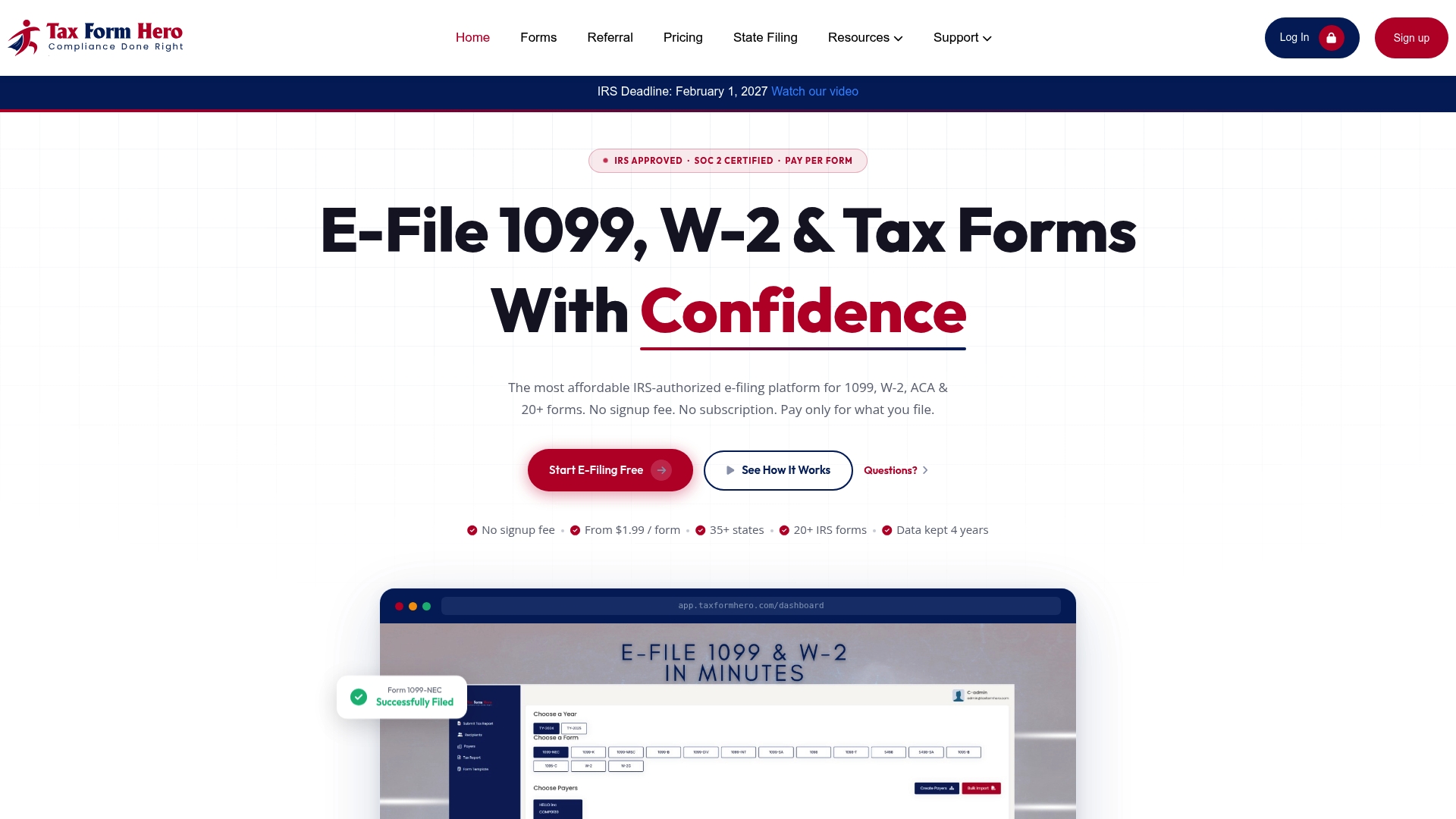
Here is what filing through our platform includes:
- IRS-authorized IRIS A2A transmission with no manual portal upload.
- Bulk import for recipient data and support for multiple payer accounts.
- Encrypted e-delivery or USPS First-Class Mail for recipient copies.
- Transparent, graduated pay-per-form pricing with no subscription or signup fee.
Our pricing page lays out every add-on cost, including state filing, print and mail, e-delivery, and TIN matching, so you can estimate your season’s total before you start. For a closer look at what changes for the 2026 tax year, our guide to this year’s updates covers the new threshold and IRIS timeline in detail. When you are ready to file, our e-file W-2 and ACA forms page is the place to start.
FAQ
What is the e-file threshold for information returns?
Filers with 10 or more information returns in a calendar year must file electronically, and this threshold applies to Forms W-2 along with other information returns. The rule replaced an earlier 250-return threshold, which means many smaller filers who previously filed on paper now fall under the mandate.
What is a Transmitter Control Code and how do I get one?
A Transmitter Control Code (TCC) is the credential the IRS requires before you can e-file information returns through its systems, and you apply for one directly with the IRS. Processing can take several weeks, so applying early in the filing season helps you avoid a deadline crunch.
When does IRIS fully replace the FIRE system?
The IRS has stated that IRIS will become the only information-returns e-file system after January 1, 2027, retiring FIRE. Filers who use software with IRIS A2A support, like our platform, are already transmitting through the system that will remain in place after the cutover.
Is SSA Business Services Online enough for small employers?
SSA Business Services Online (BSO) direct entry works well for employers filing 50 or fewer Forms W-2, while larger batches are better suited to file upload or a dedicated e-filing platform. If your volume is likely to grow, starting with software built for bulk import avoids switching tools later.
Sources
- E-file information returns | Internal Revenue Service
- IRS reminder: Information return e-file system transitioning to a new platform | Internal Revenue Service
- General Instructions for Forms W-2 and W-3 (2026) | Internal Revenue Service
Recommended
- 1099 Deadlines 2027: Feb 1 & Mar 31, IRIS/TCC Checklist for Small Teams
- Avoid a 45 day TCC Delay: IRS IRIS 1099 Filing for U.S. Businesses
- Avoid IRIS Rejects: Best 1099-MISC Software for 2026 with TIN Checks
- Beat Feb 1 Rejects: W-2 Workflow With Exception Queue for U.S. Payroll

File Information Returns With Confidence
TaxFormHero supports 20+ IRS information returns, including 1099 and W-2 forms, with bulk Excel import, name/TIN matching and encrypted recipient delivery.
Explore TaxFormHero