
You have two practical paths for filing IRS information returns electronically: the IRS’s own free portals (IRIS or A2A, with FIRE still handling some legacy flows) or an IRS-authorized e-file service. Most small businesses and tax professionals filing more than a handful of forms are better served by an authorized provider like TaxFormHero, since it automates validation, TIN matching, and delivery that the IRS portals require you to manage yourself.
TL;DR:
- Small businesses and tax professionals filing more than 10 forms annually must switch to e-filing to avoid penalties, especially for multiple form types.
- Validating TINs and proper authorizations before submission significantly reduces rejection rates and ensures faster processing times.
- Choosing between IRIS portals, A2A, or authorized vendors depends on the volume and frequency of filings, with automation and security being key factors.
- A trustworthy e-file service should publicly display its IRS authorization, encryption standards, and data retention policies; vague claims indicate risk.
- Platforms like TaxFormHero offer low-cost, secure, and automated options suitable for high-volume filers, with features like TIN matching and multi-state filing.
What Is IRS Form E-Filing and Which Channels Handle It?
Electronic filing sends your information returns to the IRS in a digital format instead of paper, and the agency is explicit that it’s faster, safer, and more accurate than mailing forms. Built-in validation catches TIN mismatches and formatting errors before submission, cutting down on the penalty notices that paper filers often see months later.
The IRS routes filers through a few distinct systems, and picking the wrong one wastes time:
- IRIS Taxpayer Portal: manual entry or CSV upload, built for occasional or small-volume filers who don’t want software.
- IRIS A2A: an XML-based system-to-system channel for bulk transmitters and payroll platforms filing hundreds or thousands of forms.
- FIRE: the older intake system the IRS still uses for certain legacy information return flows.
- IRS Free File: no-cost federal return preparation for qualifying taxpayers, aimed at individual filers rather than business information returns.
An employer filing a dozen W-2s once a year fits the Taxpayer Portal. A payroll bureau filing for 200 clients needs A2A or a vendor that already has that pipe built.
How Do You Register and Get a Transmitter Control Code?
Before you can transmit anything to IRIS or FIRE, you need a Transmitter Control Code (TCC), a unique identifier tied to your business or software. Different systems use different TCC prefixes, and Publication 5717 confirms any entity with an EIN can apply for an IRIS Taxpayer Portal TCC.
- Confirm which system you need a TCC for: IRIS, FIRE, or AIR (for ACA forms).
- Have an authorized company official complete the online application with basic business and contact details.
- Submit and wait. Processing can take up to 45 days, and the IRS itself warns filers to plan ahead since applying too close to a deadline risks missing it entirely.
- If you file W-2s or W-2Cs, register separately with SSA Business Services Online, which handles wage reporting outside the IRS’s own systems.
Filers under time pressure sometimes transmit through a vendor’s existing TCC while their own application is pending.
How Do You Actually Submit Forms and Capture Signatures?
Submission mechanics depend on volume. Small filers can enter data manually in the IRIS Taxpayer Portal or upload a CSV built from the IRS template, which IRIS 101 caps at 250 records per file. Bulk filers use A2A, transmitting XML directly between their payroll or accounting system and the IRS, which avoids re-entering data every filing season.
- Manual entry or CSV: best for under a few hundred forms per year.
- A2A/XML integration: built for repeatable, high-volume transmission through software or a vendor’s API.
- Vendor dashboard upload: many authorized e-file services let you drop in a spreadsheet and handle the XML conversion behind the scenes.
For e-filed tax returns prepared by a paid preparer, Form 8879 authorizes the electronic return originator (ERO) to transmit on the taxpayer’s behalf. The ERO collects the taxpayer’s signature, often electronically, and retains it for the required retention period rather than mailing anything to the IRS.
Pro Tip: If you’re filing for multiple clients as a tax pro, confirm your e-file service supports electronic Form 8879 signature capture and secure retention. Chasing down paper signatures every January is the single biggest bottleneck EROs report.
When Is E-Filing Required, and What Trips People Up?
Once a business files 10 or more information returns in a calendar year, combining forms like W-2s and 1099s, e-filing becomes mandatory. That threshold catches far more small businesses than owners expect, since it counts across form types, not per form.
Most rejections trace back to a short list of preventable mistakes:
- Formatting errors in CSV or XML files that don’t match IRS templates.
- TIN and legal name mismatches, which automated TIN matching catches before submission rather than after rejection.
- Missing or improperly retained ERO authorization on e-filed returns.
The IRS notes that immediate validation during e-file is specifically designed to catch these mismatches before they turn into penalty notices. Build in pre-validation and, where the system allows test submissions, run one before your real deadline.
How Do You Choose the Right E-Filing Route for Your Business?
Match the method to how you actually operate, not to whichever option sounds simplest on paper.
- Volume and frequency: a handful of forms once a year fits the IRIS portal; recurring monthly or quarterly filings favor a vendor or A2A integration.
- Automation needs: if your payroll or accounting software can’t talk directly to the IRS, a vendor dashboard closes that gap without custom development.
- Extras: state filing, TIN validation, print-and-mail, and encrypted e-delivery matter once you’re filing for employees or clients who expect copies.
- Security and pricing: look for IRS authorization, published encryption standards, and a pricing model that doesn’t lock you into a subscription for occasional filing.
An occasional employer filing five W-2s does fine on the IRIS Taxpayer Portal. A CPA firm filing for forty clients needs the automation a vendor provides.
Pro Tip: Treat “no published security information” and “no stated IRS authorization” as disqualifying red flags, not minor gaps. A legitimate e-file service will name both on its site without you having to ask.

What Security Signals Should a Trustworthy Vendor Show?
A vendor handling Social Security numbers and EINs for hundreds of clients needs to prove its controls, not just claim them. Look for specifics you can verify rather than vague assurances.
- 256-bit data encryption and TLS/HTTPS across the entire filing workflow.
- SOC 2 readiness or attestation covering data handling practices.
- Documented access controls limiting who inside the vendor can view filer data.
- A stated data retention policy and breach notification process.
TIN validation and audit logs matter beyond avoiding rejections. If the IRS or a client ever questions a filing, you need a record showing what was submitted, when, and by whom.
A vendor that won’t publish its security posture, IRS authorization status, or retention policy in plain language is asking you to trust it on faith. In a business built on Social Security numbers and EINs, that’s a request worth declining.
What Real Filings Show About Switching to an Authorized E-File Service
Businesses that move from manual portal entry to an authorized e-file platform tend to report a similar pattern: fewer rejected batches once TIN matching runs automatically, and faster distribution once print-and-mail or e-delivery replaces manual copy-sending. If you’re weighing whether the switch is worth it, start with your rejection rate from last season. If it’s the primary lever, TaxFormHero and similar vendor-led platforms exist to close that gap.
— Nazrul
How TaxFormHero Simplifies IRS E-Filing for Businesses
TaxFormHero exists for exactly the volume, validation, and delivery problems this article just walked through. It’s IRS-authorized, SOC 2 ready, and built around 256-bit encrypted data handling, so the security questions you should be asking any vendor already have public answers.
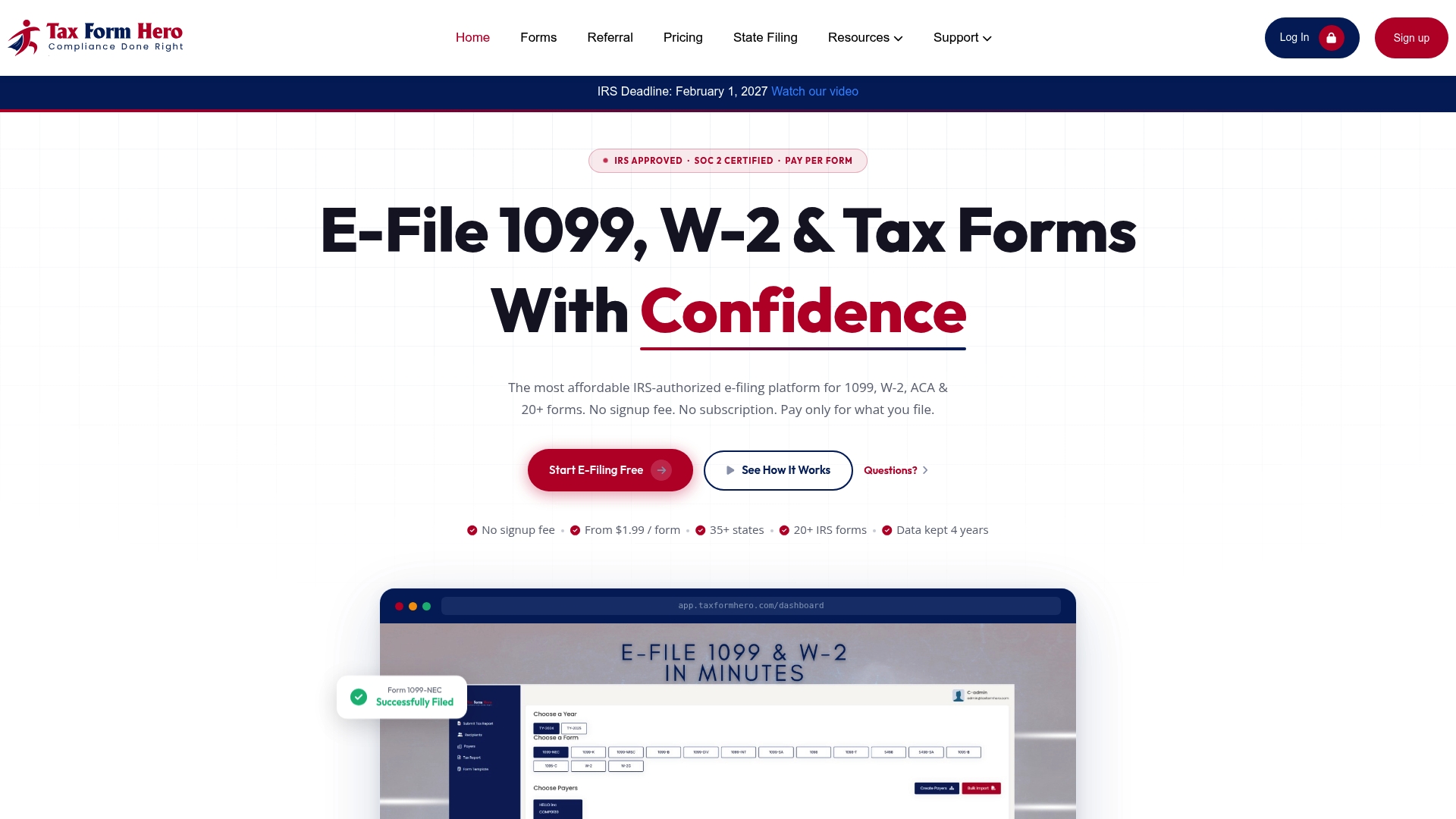
Instead of a subscription, you pay per form starting as low as $0.45, with no signup fees. Bulk import handles high-volume filing, built-in TIN matching catches mismatches before they become rejections, and add-ons cover direct state filing in over 35 states, print-and-mail fulfillment, and encrypted e-delivery of recipient copies. Payroll teams, CPA firms, and freelancers filing 1099s, W-2s, or ACA forms all fit the same dashboard. Check current per-form pricing and start your next batch directly from the TaxFormHero filing platform.
Sources
- Electronic filing (e-file) | Internal Revenue Service
- E-file information returns | Internal Revenue Service
- Publication 5717 (Rev. 2-2026)
Recommended
- Fixing a 1099 E-File Rejection: What to Do Right Now
- IRS Authorized E-File Providers: A Guide for Businesses
- IRS TIN Matching Guide for Tax Professionals: 2026

File Information Returns With Confidence
TaxFormHero supports 20+ IRS information returns, including 1099 and W-2 forms, with bulk Excel import, name/TIN matching and encrypted recipient delivery.
Explore TaxFormHero