
An IRS-authorized e-file provider is a firm the IRS has formally accepted into its e-file program to electronically transmit tax returns on behalf of taxpayers or businesses. Not every filing service qualifies. Before you hand over sensitive payroll or vendor data, confirm the provider’s status using the IRS Authorized e-file Provider Locator.
- Authorization comes directly from the IRS, not a third-party certification body.
- Every authorized provider holds an active EFIN (Electronic Filing Identification Number).
- IRS approval can take up to 45 days, so verify a provider’s status early. Tax Form Hero operates as an IRS-authorized platform for 1099, W-2, and ACA filings.
Key Takeaways
An IRS-authorized e-file provider must hold an active EFIN, pass ongoing suitability checks, and support the specific MeF form families a business actually needs.
| Point | Details |
|---|---|
| Verify before you file | Check the IRS locator and ask for an EFIN or acceptance letter directly. |
| Match the role to your need | Small businesses typically need a provider acting as both ERO and Transmitter, not software-only. |
| Confirm MeF form coverage | Ask which specific forms, like 1099s, W-2s, or Form 941, the provider is tested to transmit. |
| Expect a 45-day approval window | Providers seeking authorization pass credit, tax, and background suitability checks before receiving an EFIN. |
| Consider Tax Form Hero | An IRS-authorized platform offering 1099, W-2, ACA, and 20+ form types with TIN matching and per-form pricing from $1.99. |
This article is general information, not a substitute for advice from a qualified financial advisor. Consult a qualified financial professional about your own circumstances before acting on anything here.
Need to get this filed? You can e-file Form W-2 online with TaxFormHero, which is IRS-authorized and charges per form, not per month.
How Do You Find an IRS Authorized E-File Provider?
The IRS maintains a searchable database of every firm it has accepted into the program, and it’s the fastest way to confirm you’re dealing with a legitimate service rather than a look-alike site. The locator tool lets you search by zip code, state, or provider type, and it will return names, addresses, and services offered.
- Go to the IRS locator page and enter your zip code or state.
- Filter by provider type: Electronic Return Originator (ERO), Transmitter, Software Developer, or Online Provider.
- Review the results list and cross-check the firm name against the one on your invoice or contract.
- Download the delimited file if you’re comparing multiple providers or need records for compliance files.
Keep in mind that listing in the locator is optional. A provider can be fully authorized without appearing in search results, which is why the locator works best as a first check, not the only one.
Pro Tip: If a provider isn’t listed, ask directly for their acceptance letter or EFIN. A legitimate authorized provider will produce this without hesitation.
What Are the Different IRS E-File Provider Roles?
The IRS doesn’t treat “authorized provider” as a single job description. Publication 3112 breaks the program into distinct roles, and a single company can hold more than one at once.
- Electronic Return Originator (ERO): Originates the electronic submission of a return, often the point of contact for the taxpayer.
- Transmitter: Sends the return data directly to the IRS through Modernized e-File.
- Software Developer: Writes the software that formats returns for electronic submission.
- Intermediate Service Provider: Processes return data between the originator and the transmitter.
- Reporting Agent: Files returns on behalf of clients, common among payroll processors.
- Online Provider: Offers a web-based e-file service directly to taxpayers.
A small business filing its own 1099s typically needs a provider acting as both ERO and Transmitter. A software-only vendor may only prepare files, leaving transmission to someone else, which matters if you want a single point of accountability.
How Do You Become an Authorized IRS E-File Provider?
Becoming an authorized provider follows a fixed sequence, and the IRS lays it out in three steps: create an e-Services account, submit the online e-file application, and pass a suitability check.
- Create an IRS e-Services account. This is the portal through which the entire application happens.
- Complete the e-file application. You’ll identify your provider role (or roles), list principals and responsible officials, and provide firm information. There’s no application fee.
- Pass the suitability check. The IRS reviews credit history, tax compliance, and criminal background; some principals may need Livescan fingerprinting.
Approval can take up to 45 days from the date you submit a complete application, so timing matters if you’re planning to file for an upcoming season.
Once accepted, the IRS issues an acceptance letter along with your EFIN. Anyone preparing individual returns should also review Publication 1345, while business-focused applicants should study Publication 3112 closely before submitting.
What Can Authorized Providers File Through Modernized E-File?
Modernized e-File, or MeF, is the IRS system that authorized transmitters actually use to send returns. It covers a wide swath of business filings: 1099 series forms, W-2s, ACA reporting, and corporate, partnership, and excise returns all route through MeF.
- 1099-NEC, 1099-MISC, and related information returns
- W-2 and other employment tax forms
- ACA forms 1094/1095
- Corporate returns (1120), partnership returns (1065), and employment tax forms like 940/941
MeF transmits data in XML format, and providers must pass IRS schema testing before they’re cleared to submit live returns. If your business files Form 941 quarterly and 1099s annually, don’t assume one provider covers both. Ask specifically which MeF form families the provider supports before you commit.
How Do You Verify a Provider Is Legitimate?
Verification comes down to three checks: confirm the firm in the IRS locator, ask for the EFIN or ETIN directly, and clarify whether you’re dealing with a Transmitter or a software-only vendor repackaging someone else’s transmission service.
- A provider that dodges questions about its EFIN is a warning sign, not a technicality.
- Vague answers about data security or no mention of encryption standards should raise concern.
- No visible process for staying current with IRS schema or compliance updates suggests the provider isn’t actively maintained.
If a firm claims authorization but won’t produce documentation, or you can’t find it anywhere in IRS records, contact the IRS e-help Desk rather than taking the claim at face value.
Pro Tip: Ask to see a sample acceptance letter or recent EFIN confirmation before signing up. A provider with nothing to hide will show you.

What Should Businesses Look for in an E-File Provider?
Authorization is the floor, not the finish line. Beyond IRS acceptance, look for TIN matching, pre-submission error checks, and bulk import tools that cut down on manual entry mistakes.
- IRS authorization confirmed through the locator, with an active EFIN or ETIN
- Ongoing compliance: Publication 1345, Publication 3112, and Publication 4163 govern participation, and providers who reference these openly tend to take compliance seriously
- Security controls, including encryption standards that meet IRS e-file security and privacy requirements
- Clear documentation of which MeF form families and states the provider supports
Ask any prospective provider for their security certifications, their MeF form list, and a sample acceptance letter before you file a single form.
Why Authorization Isn’t a One-Time Achievement
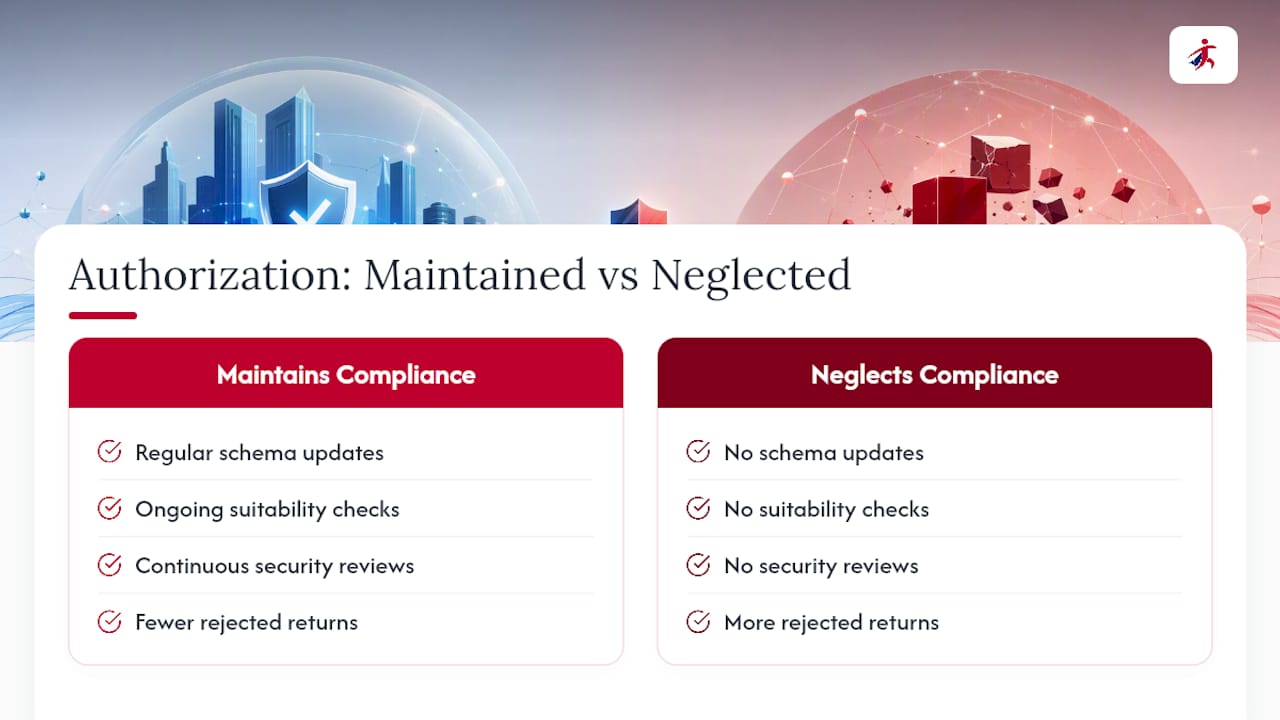
Authorization is a status the IRS actively monitors, not a badge earned once and forgotten. Providers that stay compliant treat schema updates, suitability checks, and security reviews as continuous work. The ones that don’t tend to produce more rejected returns and more headaches for the businesses relying on them.
File With a Platform Built Around IRS Requirements
Choosing a provider shouldn’t mean guessing whether they’ll still meet IRS standards next filing season. Tax Form Hero is built as an IRS-authorized platform from the ground up, which means the compliance work described above is already handled before you upload a single form.
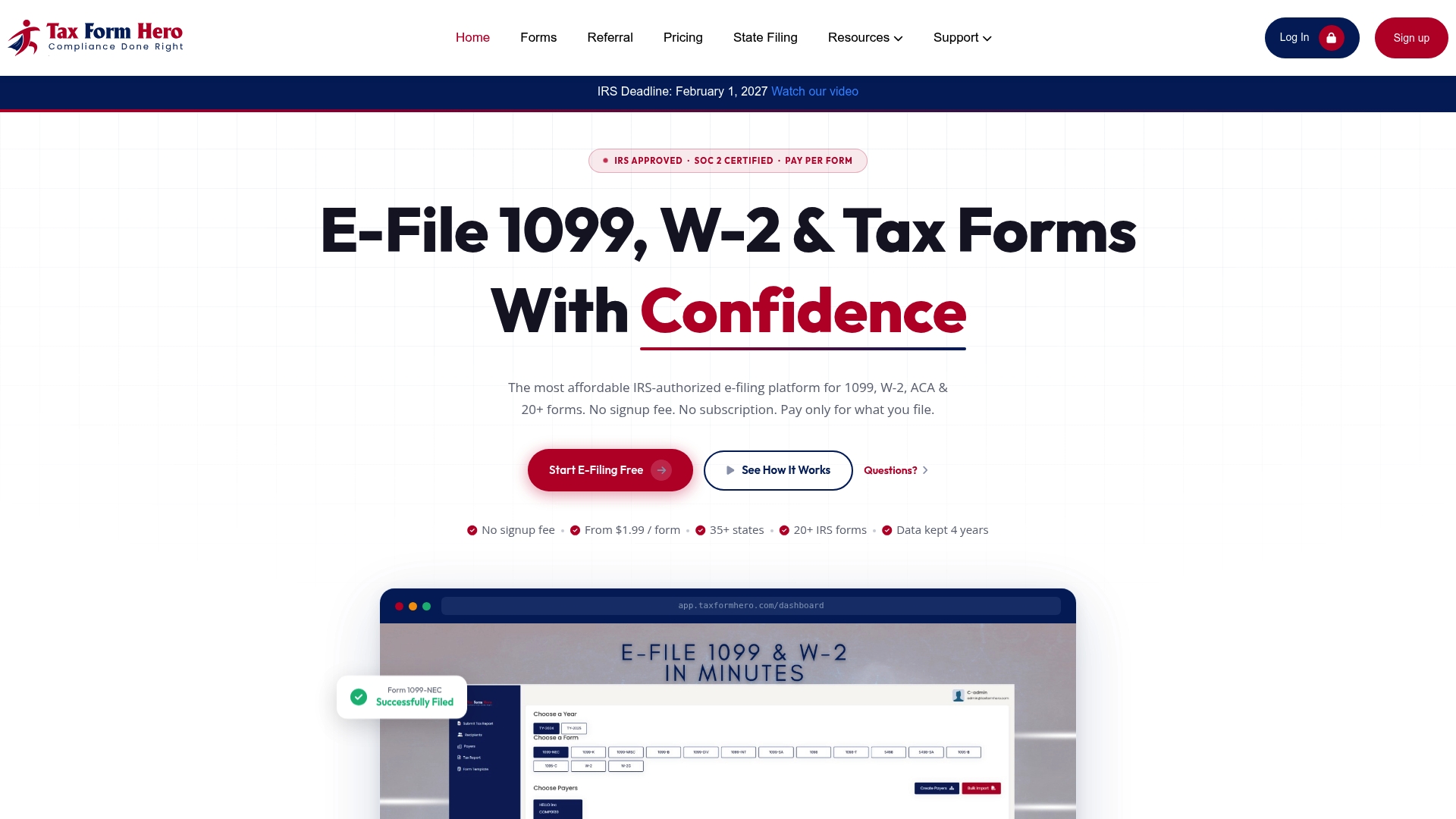
Tax Form Hero supports 1099, W-2, ACA, and more than 20 other IRS form types, all filed through a system designed to match current IRS and MeF requirements. The platform includes built-in TIN matching to catch mismatches before submission, bulk import for businesses filing dozens or thousands of forms at once, and add-on state filing coverage across 35-plus states. Data moves through 256-bit encryption, consistent with the security expectations authorized providers are required to meet. There are no signup fees or subscriptions. You pay per form, starting at $1.99. If you need to file now, start with Tax Form Hero and get your forms transmitted without chasing down a provider’s credentials first.
Sources
- Authorized IRS e-file Provider Locator Service for tax professionals | Internal Revenue Service
Recommended

File Information Returns With Confidence
TaxFormHero supports 20+ IRS information returns, including 1099 and W-2 forms, with bulk Excel import, name/TIN matching and encrypted recipient delivery.
Explore TaxFormHero