Form 1099-K is the one information return where the question is not how much you paid, but who settled the payment. A merchant acquirer reports every payee it settles card transactions for, at any amount. A payment app reports only the payees who clear a two-part test. Get that distinction wrong and you either file thousands of forms nobody needed or miss the ones the IRS expects.
This guide walks the form from the filer block to Box 8, says what each box holds and who is meant to complete it, and flags the mistake most often made in it. Everything here is for tax year 2026 — the forms you file in 2027.
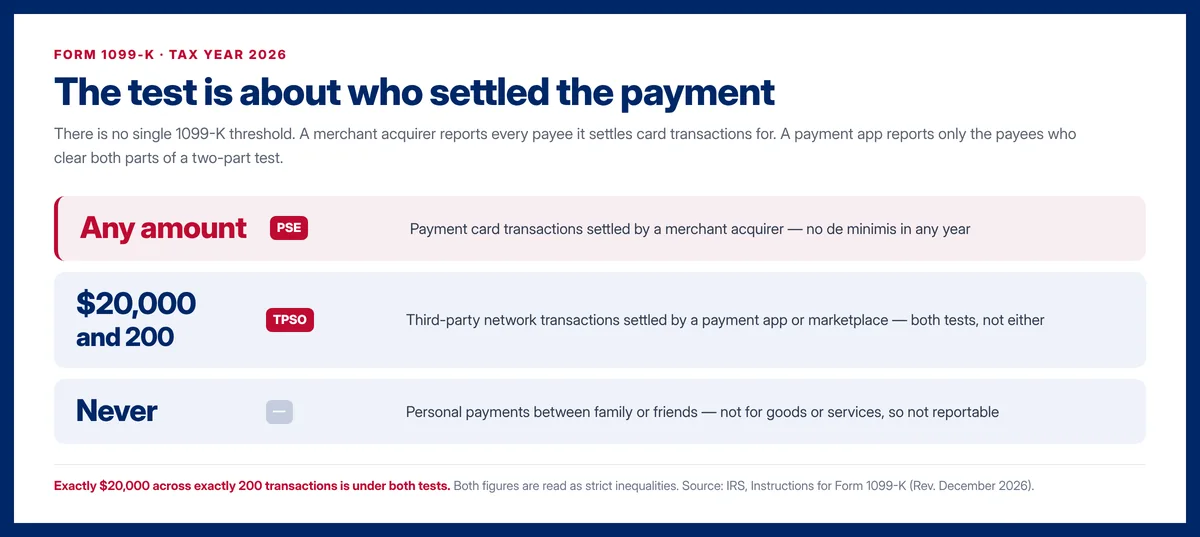
The short version
- A payment settlement entity settling payment card transactions has no de minimis. Any amount, any number of transactions, every payee.
- A third-party settlement organization reports a payee only when gross payments exceed $20,000 and the number of transactions exceeds 200. Both, not either.
- The $600 threshold with no transaction count never took effect. It is not the rule for any tax year.
- Boxes 1c and 1d are new: cash tips and the Treasury Tipped Occupation Code. The tips figure is already inside Box 1a and is broken out of it, not added to it.
- Box 1a is a gross figure. Fees, refunds and chargebacks are all still inside it, which is why it is almost never what the payee banked.
- Recipient copies are due February 1, 2027. No box on this form moves that date.
What changed on Form 1099-K for tax year 2026
Four things, and the first two are the ones that change what you type.
| Change | What it means when you fill the form in |
|---|---|
| The reporting exception was restored | The third-party network test is back to gross payments over $20,000 and more than 200 transactions. The One Big Beautiful Bill Act restored it retroactively, so it applies from 2022 onwards. |
| Box 1c, cash tips | A dollar amount already included in Box 1a, added under P.L. 119-21, section 70201. |
| Box 1d, Treasury Tipped Occupation Code | Up to two codes for the tipped occupation. A code, not an amount. |
| Address fields were split | The filer and payee address blocks are now individual entry boxes rather than one free-text block, for both the filer and the payee. |
Filing one yourself? You can e-file Form 1099-K online with TaxFormHero, an IRS-authorized e-filing platform.
Who files, and at what figure
Section 6050W puts the obligation on the entity that settles the transaction, and it splits that entity into two kinds. Which one you are decides your threshold.
| You are… | Settling… | Report a payee when… |
|---|---|---|
| A payment settlement entity (PSE) — a merchant acquirer | Payment card transactions | Always. There is no de minimis: any amount, any number of transactions |
| A third-party settlement organization (TPSO) — a payment app or online marketplace | Third-party network transactions | Gross payments exceed $20,000 and the number of those transactions exceeds 200 |
| Either | Personal payments between family or friends | Never. Not a payment for goods or services, so not reportable at all |
Both figures are read as strict inequalities. Exactly $20,000 across exactly 200 transactions is under both tests, and a payee who clears one but not the other is not reportable by a TPSO at all.
Where two entities both qualify as the payment settlement entity for the same transaction, the one that submits the instruction to transfer the funds files the form — unless they agree in writing to designate the other. The obligation returns to the first entity if the designee does not file.
What you need before you start
- The payee legal name and TIN exactly as they appear in IRS records. Run them through TIN matching before you file, not after a notice arrives.
- The gross settled amount for the year, struck before fees, refunds, chargebacks, discounts, cash equivalents and shipping.
- The same figure broken into twelve months, because boxes 5a to 5l have to sum to Box 1a.
- The count of payment transactions, excluding refunds.
- Your own filer TIN, name, address and telephone number — and, if you are an electronic payment facilitator filing on behalf of a PSE, that PSE name and phone number too.
- Any backup withholding taken during the year under section 3406.
The filer and payee blocks
Filer information
Your name, full address, telephone number and TIN. For tax year 2026 the address is entered in separate fields rather than one block, so street, city, state and ZIP each have their own box.
If you are an electronic payment facilitator or other third party filing on behalf of the payment settlement entity, you check the second filer box, and the PSE name and telephone number go in the space above the account number box. The form then shows who actually settled the payment and who physically filed it.
Payee information
The payee legal name and TIN as IRS records hold them, and the address in the same split fields. A name and number that do not agree is the single most common cause of a CP2100 notice and of backup withholding you then have to start applying.
Account number
Required when you file more than one 1099-K for the same payee, and useful on every form regardless: it is the handle you will use if a correction is ever needed.
The two rows of checkboxes
Before any figure goes on the form there are two choices to make at the top, and they are not interchangeable.
- Filer type. Check the first box if you are the PSE. Check the second if you are an EPF or other third party filing for the PSE.
- Transactions reported. Check payment card, or check third party network. If you settled both kinds for the same payee, they go on separate forms — one 1099-K cannot carry a mix.
Form 1099-K, box by box
| Box | What goes in it | Most common error |
|---|---|---|
| 1a | Gross payment card and third-party network transactions for the year. Gross means before any adjustment for credits, cash equivalents, discounts, fees, refunds or shipping | Net of fees and refunds — the figure is deliberately larger than what the payee actually received |
| 1b | The part of the Box 1a gross settled as card-not-present payment card transactions — the card was not physically present, or its number was keyed into the terminal. Typically online, phone or catalogue sales | Assumed to equal Box 1a because the payee sells online — it is card-not-present payment card activity, not every remote sale |
| 1c | Cash tips — a dollar amount already included in Box 1a — new for 2026 | Added to Box 1a rather than broken out of it, double-counting the tips |
| 1d | Treasury Tipped Occupation Code — a code, not an amount. Up to two. Where the tips came from an occupation that does not qualify, 000 goes in as one of the codes — new for 2026 | A dollar figure entered where a code belongs |
| 2 | Merchant Category Code — the four-digit MCC the card industry uses to classify the payee. A TPSO, or any filer that does not use an industry classification system for its payees, leaves this blank. Where a payee has more than one MCC, file separate forms or use the code covering the largest share of receipts | Completed by a TPSO, which should leave it blank, or a description typed in place of the four digits |
| 3 | Number of payment transactions, not counting refunds | Refunds counted, which can push a payee over the 200-transaction test who should not be reported at all |
| 4 | Federal income tax withheld — backup withholding under section 3406 on Box 1a amounts | Not withheld at all where the payee never furnished a TIN in the required manner |
| 5a–5l | The gross amount for each month of the year, January through December | The twelve months not adding up to Box 1a |
| 6 | The abbreviated name of the state | Completed for a state that is already covered by the Combined Federal/State Filing Program |
| 7 | Your state identification number | Left blank on a form that is being filed with the state |
| 8 | State income tax withheld, if any | Federal backup withholding repeated here |
Boxes 6 to 8 are optional unless you are in the Combined Federal/State Filing Program or filing on paper with a state, and they have room for two states.
The two new boxes, and the mistake they invite
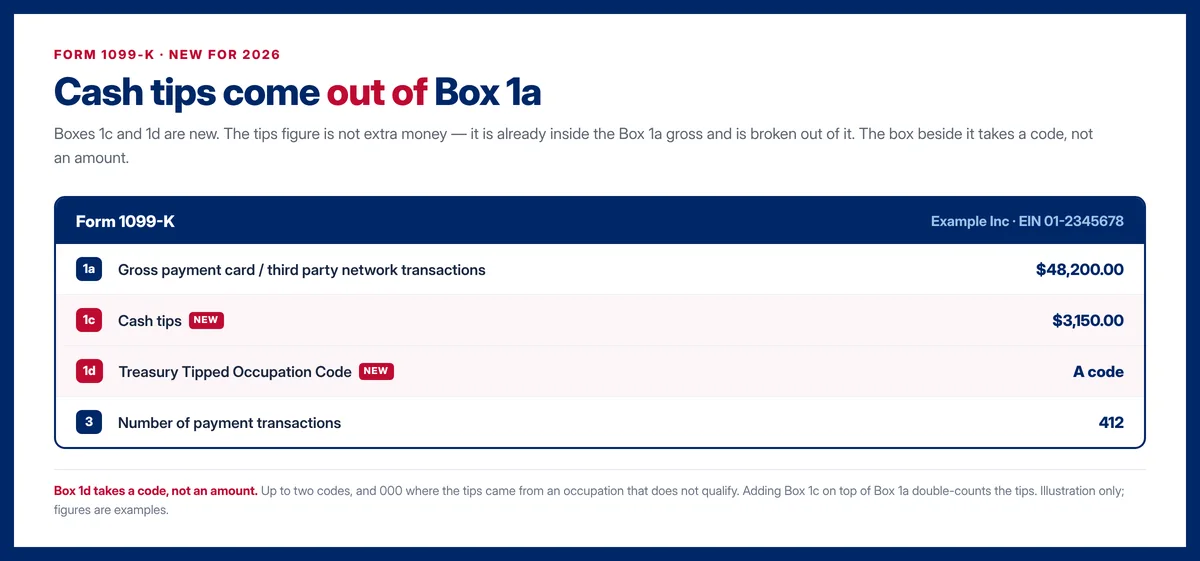
Box 1c is a subset of Box 1a. The cash tips it reports are already inside the gross figure, and the box exists so the tips can be identified, not so they can be counted a second time. Adding Box 1c on top of Box 1a overstates what the payee received by exactly the tips.
Box 1d is the box that produces the most rejected records in its first year, for a simple reason: it looks like it should take money and it does not. It takes the Treasury Tipped Occupation Code, up to two of them. If the tips came from an occupation that does not qualify, 000 goes in as one of the codes. Any dollar figure here is wrong.
The monthly boxes have to add up
Boxes 5a to 5l are the twelve months of the year, and they are not optional detail. Their sum has to equal Box 1a. A form where it does not is the kind of inconsistency that gets picked up on the payee side, usually by the payee, usually in late February.
The common cause is a month that was reconciled net while the annual figure was struck gross, or a December that was cut on the settlement date while the rest of the year was cut on the transaction date. Pick one basis and hold it across all thirteen figures.
Which deadline applies to your form
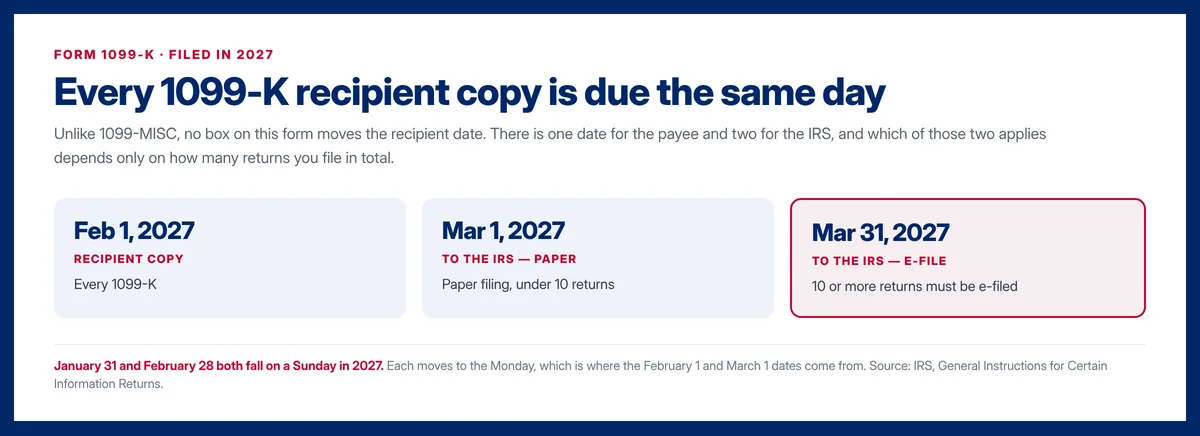
Unlike Form 1099-MISC, no box on this form moves the recipient date. Every 1099-K recipient copy for tax year 2026 is due February 1, 2027.
January 31 and February 28 both fall on a Sunday in 2027, so the recipient date and the paper date each move to the following Monday. That is where February 1 and March 1 come from.
Filing 10 or more information returns in aggregate across all types means e-filing is required, so for most 1099-K filers the date that matters is March 31, 2027. The aggregate count is across form types, not per type: 6 W-2s and 4 1099-Ks is 10 returns.
Why the figure is bigger than what the payee banked
This is the question every 1099-K filer gets in February, and it is worth being able to answer in one line: Box 1a is gross by design.
It is struck before processing fees, before refunds, before chargebacks, before discounts and before shipping. The payee sees a deposit that is several percent smaller and concludes the form is wrong. It is not. The gap between Box 1a and the bank balance is the payee reconciliation to do on their own return, and the form is deliberately silent about it.
Nothing is calculated on a 1099-K. It is a report of money settled, not a statement of income, and not a determination that any of it is taxable.
Fill one in without signing up
The walkthrough below is the real filing screen with sample data in it. Nothing is submitted and nothing is filed — it is there so you can see where each of the boxes above actually lives before you commit to anything.
Which copy goes where
| Copy | Goes to | Due |
|---|---|---|
| Copy A | The IRS | March 1, 2027 on paper, March 31, 2027 by e-file |
| Copy B | The payee | February 1, 2027 |
| Copy 1 | The state tax department, where the state requires it | As the state sets |
| Copy 2 | The payee, to file with a state return | February 1, 2027 |
| Copy C | Your own records | Keep for at least four years |
Copy A is printed in a special red ink that the IRS scanner reads. A copy downloaded and printed on an office printer is not scannable and is not an acceptable paper filing, whatever it looks like on screen.
Errors that get a return rejected or corrected
- A name and TIN that do not agree. Match them before you file. A mismatch produces a CP2100 notice and starts the B-notice process.
- A dollar amount in Box 1d. It takes a code.
- Box 2 completed by a TPSO. A payment app does not classify its payees by merchant category code and should leave the box empty.
- Refunds counted in Box 3. They are excluded, and including them can carry a payee over the 200-transaction test who is not reportable at all.
- Monthly boxes that do not sum to Box 1a.
- Card and third-party network activity on one form. They need separate forms.
- Personal payments included. Money between family or friends is not a payment for goods or services and does not belong on the form at all.
- The same payment reported twice. A payment settled by card or through a TPSO is reportable on Form 1099-K, and the payer does not also report it on a 1099-NEC or 1099-MISC.
Correcting a 1099-K you have already filed
File a corrected return as soon as you know. A wrong dollar amount is a one-step correction: file the same form again with the CORRECTED box checked and the right figure in it. A wrong payee TIN or name is a two-step correction — one return that zeroes the original and one that carries the right information — and the two have to be filed in that order.
Send the payee the corrected copy as well. A payee who has already filed a return against the first figure needs to know it moved.
Frequently asked questions
Is the 1099-K threshold $600?
No. The $600 rule with no transaction count never took effect for any tax year. The third-party network test is gross payments over $20,000 and more than 200 transactions, restored retroactively by the One Big Beautiful Bill Act, and payment card transactions have no de minimis at all.
Does a payment app have to fill in Box 2?
No. Box 2 is the Merchant Category Code, and a TPSO, or any filer that does not use an industry classification system for its payees, leaves it blank.
Do refunds count in Box 3?
No. Box 3 is the number of payment transactions not including refund transactions. Counting refunds can push a payee over the 200-transaction test who should not be reported.
Do boxes 5a to 5l have to add up to Box 1a?
Yes. The twelve monthly figures are the same gross amount broken into months, so their sum equals Box 1a. If it does not, one of the thirteen figures was struck on a different basis.
Why is Box 1a bigger than what the payee received?
Because it is gross. It is struck before fees, refunds, chargebacks, discounts and shipping. That is the intended behaviour of the box, not an error.
I paid a contractor through a payment app. Do I file a 1099-NEC?
No. A payment settled through a payment card or a third-party network is reportable on Form 1099-K by the settlement entity, and the payer does not report it again on a 1099-NEC or 1099-MISC.
When is the recipient copy due?
February 1, 2027 for tax year 2026. January 31 falls on a Sunday, so the date moves to the Monday. No box on this form changes it.
Can I download Copy A and post it?
No. The official Copy A is printed in a scannable red ink. A downloaded copy printed on an ordinary printer is not an acceptable paper filing. E-file instead, which is required anyway once you are filing 10 or more returns in aggregate.
Sources
- IRS, Instructions for Form 1099-K (Rev. December 2026)
- IRS, General Instructions for Certain Information Returns
- IRS, About Form 1099-K
- IRS, Understanding your Form 1099-K
Disclaimer:
“This content is for informational purposes only and does not constitute legal, tax, or financial advice. For advice specific to your situation, consult a qualified US attorney or CPA.”

File Information Returns With Confidence
TaxFormHero supports 20+ IRS information returns, including 1099 and W-2 forms, with bulk Excel import, name/TIN matching and encrypted recipient delivery.
Explore TaxFormHero