ACA reporting goes wrong in two places. The first is picking the form: a large employer with an insured plan files a 1095-C and no 1095-B, which is not what most people expect. The second is Part II of the 1095-C, where two codes a month decide whether the IRS reads your year as compliant or as an unexplained failure to offer coverage.
This guide walks both forms line by line, lists every offer and safe harbour code, and gives the 2026 and 2027 figures. Everything here is for tax year 2026 — the forms you file in 2027.
The short version
- 1095-B reports that coverage existed. 1095-C reports what an employer offered, month by month, and only then who enrolled.
- An employer with 50 or more full-time employees files 1095-C. If the plan is self-insured it also completes Part III; if it is insured, the carrier files the 1095-B separately.
- The furnishing deadline is March 2, 2027, not January 31. The 30-day extension is permanent.
- Neither statement has to be sent out automatically. A website notice, posted by March 2 and held until October 15, satisfies the requirement, with a copy within 30 days of a request.
- Line 14 and line 16 are read as a pair. 1H with line 16 blank is the combination that generates assessments.
- Affordability for 2026 is 9.96%. The employer penalties are $3,340 and $5,010.
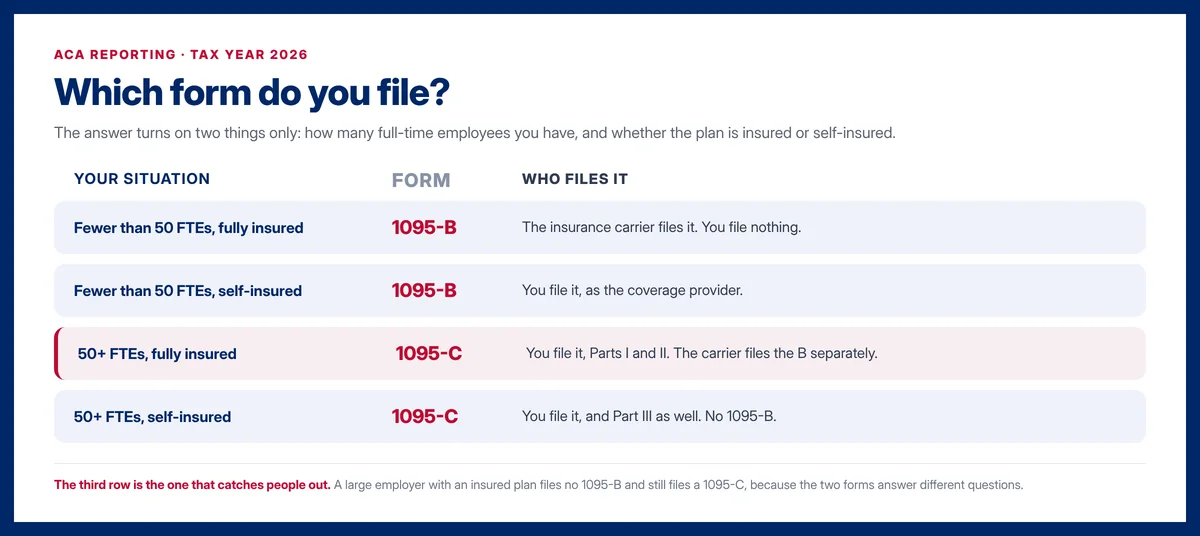
Which ACA form do you have to file?
Your full-time employee count decides which statute you report under, and the funding of the plan decides how much of the form you complete.
| Your situation | Form | Who files it |
|---|---|---|
| Fewer than 50 full-time employees, fully insured | 1095-B | The insurance carrier. You file nothing |
| Fewer than 50 full-time employees, self-insured | 1095-B | You, as the coverage provider |
| 50 or more full-time employees, fully insured | 1095-C | You, Parts I and II. The carrier files its own 1095-B |
| 50 or more full-time employees, self-insured | 1095-C | You, including Part III. No 1095-B |
| Medicaid, CHIP, Medicare, TRICARE, VA | 1095-B | The programme |
An employer with 50 or more full-time employees, counting full-time equivalents, is an Applicable Large Employer. An ALE files a 1095-C for every full-time employee, including months when it offered nothing at all. Filing only for the employees who enrolled is one of the more common and more expensive errors on this form.
TaxFormHero is an IRS-authorized e-filing platform, so you can e-file Form 1095-C online without paper or a subscription.
What is the difference between Form 1095-B and Form 1095-C?
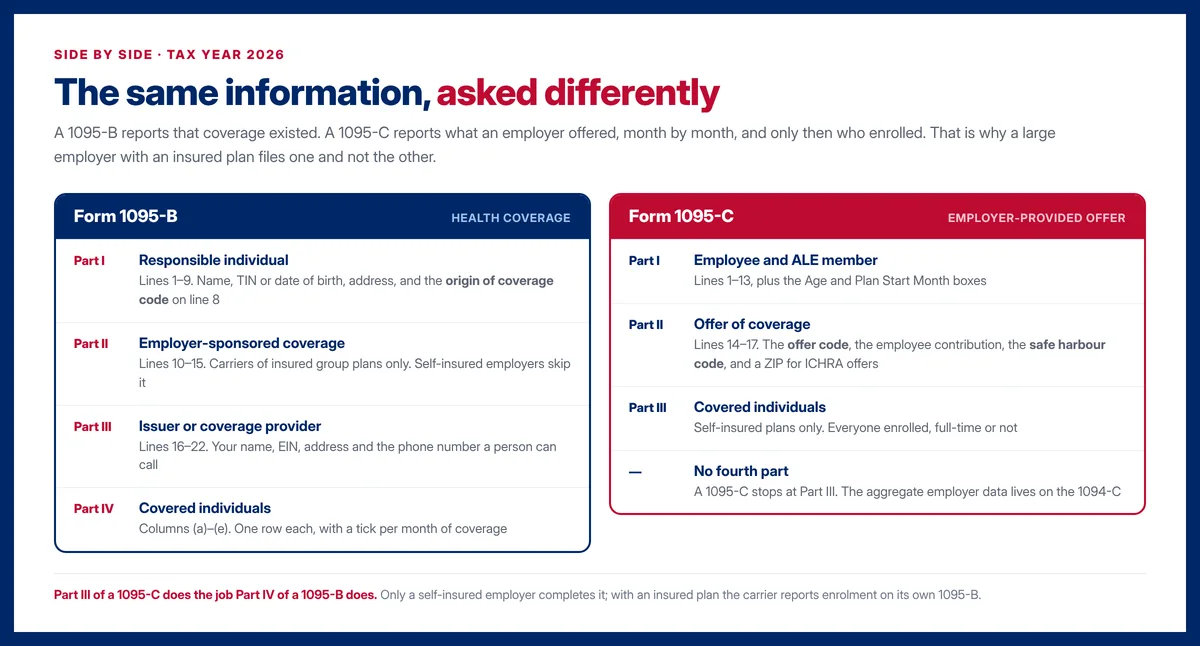
A 1095-B answers one question: did this person have minimum essential coverage, and in which months. A 1095-C answers a different one: what did this employer offer this employee, in each month, and was it affordable.
| Form 1095-B | Form 1095-C | |
|---|---|---|
| Reports under | Section 6055 | Section 6056, and 6055 when self-insured |
| Filed by | Insurers, small self-insured employers, government programmes | Applicable Large Employers |
| Transmitted with | Form 1094-B | Form 1094-C |
| Monthly codes | None | Line 14 and line 16, every month |
| Who is listed | Everyone covered | Every full-time employee, offered or not |
| Enrolment detail | Part IV, always | Part III, self-insured only |
| Drives a penalty | No employer penalty | Section 4980H(a) and (b) |
How do you complete Form 1095-B, line by line?
| Part and lines | What goes in it | Most common error |
|---|---|---|
| Part I, lines 1–7 | Name of the responsible individual, their TIN, and the mailing address. Date of birth on line 3 only where line 2 is blank | A date of birth entered as well as a TIN, when it is an alternative to one |
| Part I, line 8 | The origin of coverage code, a single letter. See the table below | Code B used for an individual coverage HRA, which takes code G |
| Part II, lines 10–15 | The sponsoring employer name, EIN and address. Completed by carriers of insured group plans only | Completed by a self-insured employer, which should skip the part entirely |
| Part III, lines 16–22 | Your own name, EIN and address as the issuer or coverage provider, with a working telephone number on line 18 | A number nobody answers — it is the line a covered individual is told to call |
| Part IV, columns (a)–(e) | One row per covered individual. Name, TIN, date of birth only if the TIN is blank, then either the all-twelve-months box or a tick for each month with at least one day of coverage | A month ticked for a part-month gap, or missed because coverage ran for only part of it — one day in a month counts |
More than six covered individuals go on Part IV continuation sheets. Those sheets are not extra Forms 1095-B and are not counted as such on the transmittal.
Line 8: origin of coverage codes
| Code | Origin of the coverage |
|---|---|
| A | Small Business Health Options Program (SHOP) |
| B | Employer-sponsored coverage, other than an individual coverage HRA |
| C | Government-sponsored programme |
| D | Individual market insurance |
| E | Multiemployer plan |
| F | Other designated minimum essential coverage |
| G | Employer-sponsored coverage that is an individual coverage HRA |
Form 1094-B, the transmittal
Short, and easy to get right. Lines 1 to 8 are your name, EIN, contact person, telephone number and address. Line 9 is the number of Forms 1095-B you are transmitting. There is nothing else on it, and there is no authoritative transmittal concept as there is on the C side.
What counts as minimum essential coverage?
Report minimum essential coverage. Do not report excepted benefits — and reporting one is not a harmless extra, because it puts a coverage month on the record for someone who may not have had minimum essential coverage at all.
| Reportable minimum essential coverage | Excepted benefits — not reported |
|---|---|
| Employer group health plans | Stand-alone dental and vision |
| Individual market and Marketplace plans | Workers compensation |
| Medicare Part A | Accident-only and disability-only cover |
| Medicaid and CHIP | Fixed indemnity policies |
| TRICARE and veterans programmes | Single-disease or specified-illness cover |
| Certain student health plans | Short-term limited duration insurance |
How do you complete Form 1095-C, line by line?
Part I is identification. Part II is the part that decides your penalty exposure. Part III only exists for self-insured plans.
| Part and lines | What goes in it | Most common error |
|---|---|---|
| Part I, lines 1–6 | Employee name, nine-digit SSN and address | A truncated SSN. The employee copy may be truncated; the copy filed with the IRS may not |
| Part I, lines 7–13 | ALE member name, EIN, address and a contact telephone number on line 10. The EIN on line 8 has to match lines 1 and 2 of your 1094-C | A parent company EIN used where the ALE member is a separate entity |
| Age box | The employee age on January 1. Required only where an individual coverage HRA was offered | Filled in for every employee, or left blank on an ICHRA offer |
| Plan Start Month | Two digits, 01 to 12. Enter 00 if no health plan was offered | Left blank. It is a required box |
| Line 14 | One Series 1 offer code for each month, or one in the All 12 Months box. Never leave it blank — use 1H for a month with no offer | Blank months, which the IRS cannot read as anything |
| Line 15 | The Employee Required Contribution: the employee share of the monthly cost of the lowest-cost self-only minimum value coverage. Where the contribution is zero, enter 0.00 and do not leave it blank | The cost of the plan the employee actually chose, or of family cover, instead of lowest-cost self-only |
| Line 16 | One Series 2 safe harbour or relief code for each month, where one applies | Left blank in a 1H month, which reads as an unexplained failure to offer |
| Line 17 | The ZIP code used to work out affordability for an individual coverage HRA offer | Omitted on an ICHRA offer, where codes 1L to 1U require it |
| Part III | Everyone enrolled in self-insured coverage, full-time or not, with the same month ticks as a 1095-B Part IV | Completed on an insured plan, where the carrier reports enrolment on its own 1095-B |
Line 15 is only completed for the months where line 14 carries a code that requires it, which in practice means any offer of minimum value coverage other than a qualifying offer. Under the Qualifying Offer method, line 15 is left blank for every month coded 1A.
What are the Series 1 and Series 2 codes on Form 1095-C?
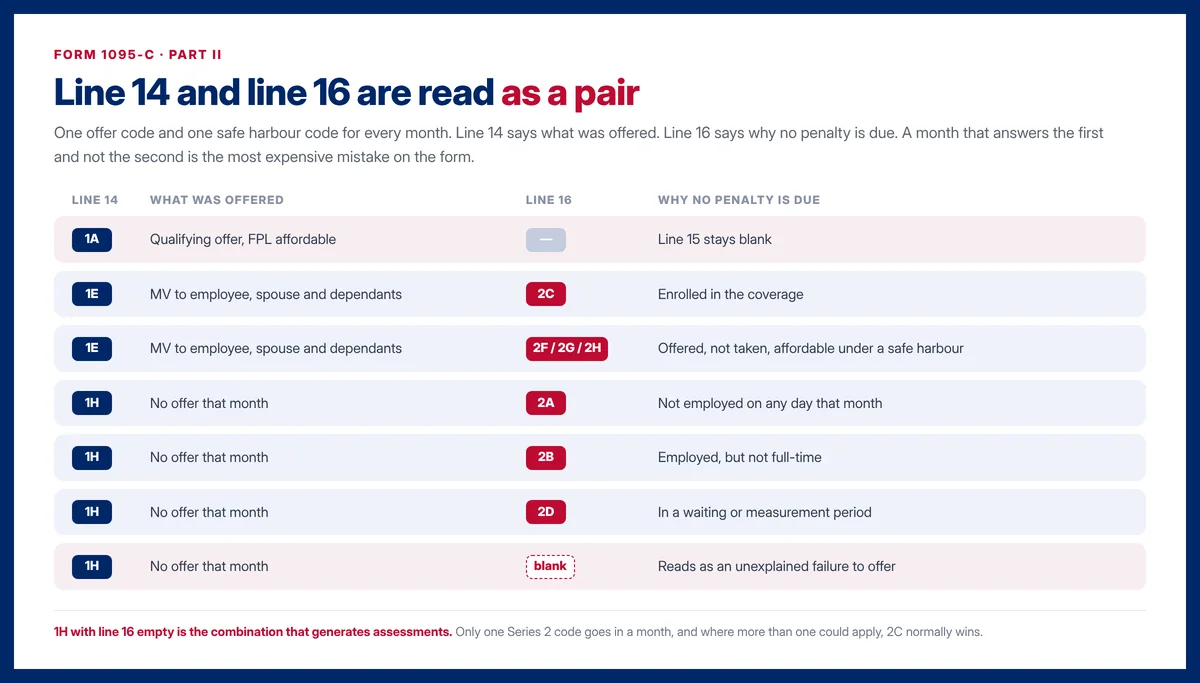
Series 1 goes on line 14 and says what was offered. Series 2 goes on line 16 and says why no penalty is due. The IRS reads them together, one pair per month.
Line 14, Series 1 offer codes
| Code | What it means | Line 15 needed? |
|---|---|---|
| 1A | Qualifying offer: minimum value, affordable on the federal poverty line safe harbour, offered to employee, spouse and dependants | No |
| 1B | Minimum value to the employee only | Yes |
| 1C | Minimum value to the employee, plus dependants but not the spouse | Yes |
| 1D | Minimum value to the employee, plus the spouse but not dependants | Yes |
| 1E | Minimum value to the employee, spouse and dependants | Yes |
| 1F | Coverage offered that does not provide minimum value | No |
| 1G | Not a full-time employee for any month, but enrolled in a self-insured plan. Used in the All 12 Months box, not month by month | No |
| 1H | No offer of coverage that month. It is not a way of recording that the employee declined | No |
| 1J, 1K | Conditional offers involving the spouse | Yes |
| 1L–1U | Individual coverage HRA offers, varying by whose affordability is tested and on which address. All of them require a ZIP code on line 17 | Yes |
Line 16, Series 2 safe harbour and relief codes
| Code | Use it when |
|---|---|
| 2A | The person was not employed on any day of that month |
| 2B | Not a full-time employee that month, or employment ended mid-month with the coverage ending too |
| 2C | Enrolled in the coverage offered. Takes priority over almost every other code when it applies |
| 2D | In a limited non-assessment period, such as a waiting period or an initial measurement period |
| 2E | Multiemployer interim relief |
| 2F | Affordable under the Form W-2 safe harbour, tested on Box 1 wages |
| 2G | Affordable under the federal poverty line safe harbour |
| 2H | Affordable under the rate of pay safe harbour |
Only one Series 2 code goes in a month. Where more than one could apply, 2C normally wins, because enrolment is the strongest answer available to the question line 16 asks.
How is affordability tested for 2026?
Coverage is affordable for tax year 2026 when the Employee Required Contribution for the lowest-cost self-only minimum value plan is no more than 9.96% of a measure of income, for plan years beginning in 2026. Because an employer cannot see household income, the regulations give three safe harbours, and you may use a different one for different reasonable categories of employee.
| Safe harbour | Tested against | Line 16 code | Worth knowing |
|---|---|---|---|
| Form W-2 | Box 1 wages for the year | 2F | Only known after year end, so it is a poor basis for setting contributions in advance |
| Rate of pay | Hourly rate times 130 hours a month, or monthly salary | 2H | The most common choice, because it can be worked out before the plan year starts |
| Federal poverty line | The mainland single FPL figure | 2G | The simplest, and the one a qualifying offer under code 1A depends on |
How do you complete Form 1094-C?
The 1094-C is not a cover sheet. One of them — the Authoritative Transmittal — carries the employer-level data the IRS uses to work out whether a penalty is due at all.
| Part and lines | What goes in it |
|---|---|
| Part I, lines 1–8 | ALE member name, EIN, address, and the name and telephone number of your IRS contact |
| Part I, lines 9–16 | Completed only by a Designated Governmental Entity filing on behalf of an ALE member |
| Part I, line 18 | The number of Forms 1095-C sent with this transmittal |
| Part I, line 19 | The Authoritative Transmittal box. Exactly one per ALE member, per year |
| Part II, line 20 | The number of Forms 1095-C filed by or on behalf of the ALE member in total |
| Part II, line 21 | Whether the ALE member was part of an Aggregated ALE Group in any month. Yes means Part IV has to be completed |
| Part II, line 22 | Offer method boxes. A is the Qualifying Offer Method and D is the 98% Offer Method. Boxes B and C are reserved and are not used |
| Part III, column (a) | Minimum Essential Coverage Offer Indicator: whether MEC was offered to at least 95% of full-time employees and their dependants that month |
| Part III, column (b) | Full-time employee count for the month, excluding anyone in a Limited Non-Assessment Period. Not required if box D is checked |
| Part III, column (c) | Total employee count, taken on one consistent measurement day each month |
| Part III, column (d) | Aggregated Group Indicator, month by month |
| Part IV | Up to 30 other Aggregated ALE Group members by name and EIN, ordered by average monthly full-time count, excluding yourself |
Lines 20 to 22 and the whole of Parts III and IV appear only on the Authoritative Transmittal. Any other 1094-C you send carries line 18 and the signature and nothing more. Filing two authoritative transmittals for one EIN, or none at all, is a rejection the AIR system will hand straight back.
What are the ACA filing deadlines for 2027?
| What | When | Notes |
|---|---|---|
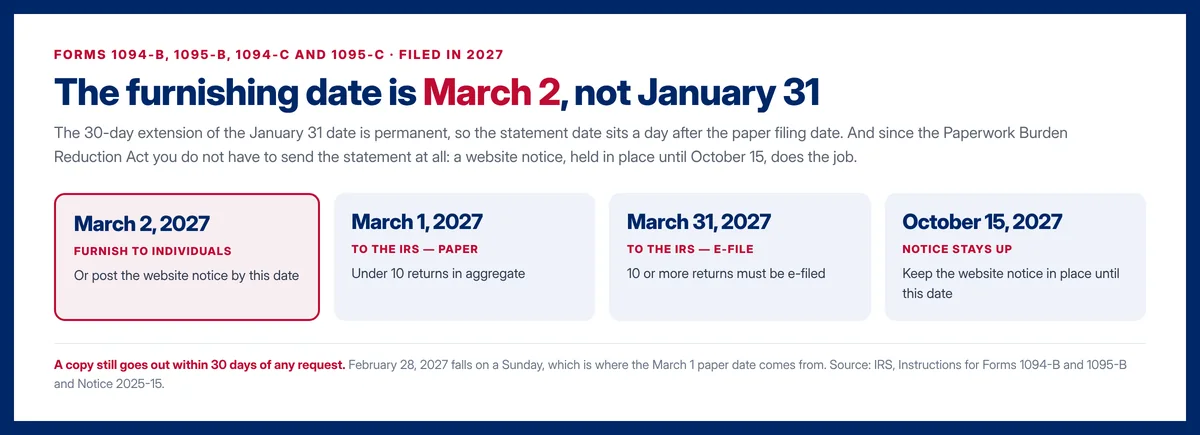
| Statement to individuals | March 2, 2027 | Or post the website notice by this date instead |
| Paper to the IRS | March 1, 2027 | February 28 falls on a Sunday. Available only under 10 returns |
| E-file to the IRS | March 31, 2027 | Required at 10 or more information returns in aggregate |
| Website notice stays up | October 15, 2027 | Same location on the site for the whole period |
| Copy after a request | Within 30 days | Or by January 31, 2027 if that is later |
The 10-return threshold is an aggregate across all information return types, not a count of ACA forms. Six W-2s and four 1095-Cs is ten returns, and both sets have to be e-filed.
Do you still have to mail Form 1095-B and 1095-C?
No. Since the Paperwork Burden Reduction Act neither statement has to be sent automatically, and the alternative is cheaper than postage.
Post a clear, conspicuous and accessible notice on your website saying that an individual may request a copy of their statement. The notice has to carry an email address, a physical address and a telephone number. It has to be up by March 2, 2027 and stay in the same place on the site through October 15, 2027. When a request comes in, furnish the statement within 30 days.
Two practical points. The notice has to be findable, not buried on a page nobody reaches, and the inbox behind it has to be monitored, because the 30-day clock starts on the request and not on the day somebody notices it.
What are the penalties for getting ACA reporting wrong?
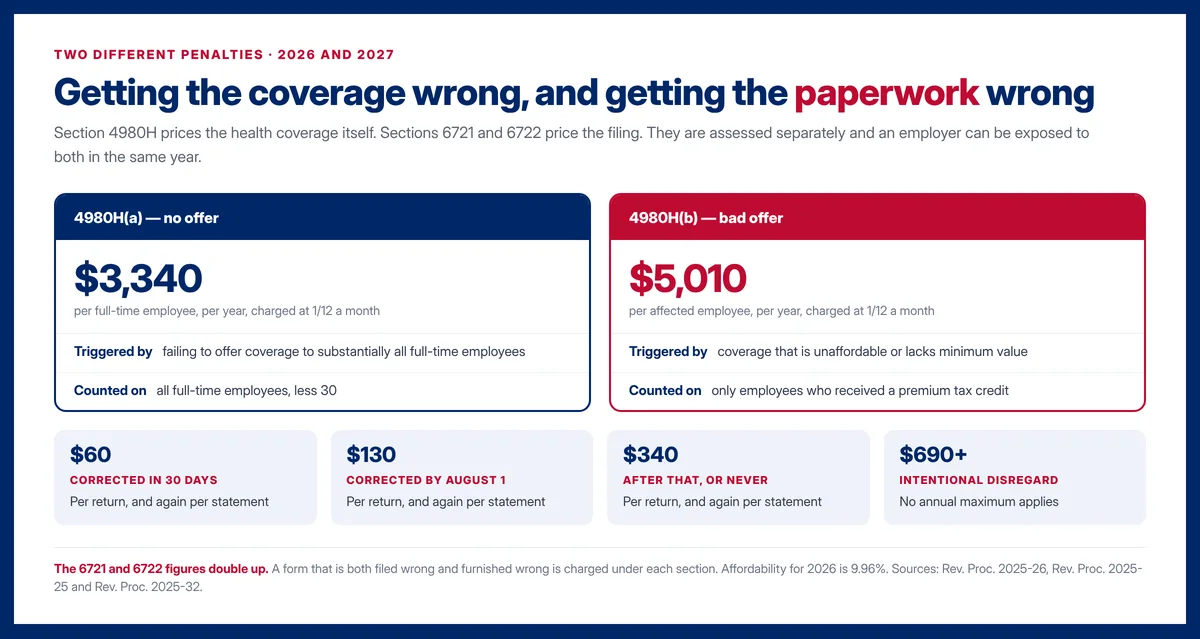
They are assessed separately, and an employer can face both in the same year.
| 4980H(a) — no offer | 4980H(b) — bad offer | |
|---|---|---|
| Triggered by | Failing to offer coverage to substantially all full-time employees | Offering coverage that is unaffordable or lacks minimum value |
| 2026 amount | $3,340 a year, charged at 1/12 a month | $5,010 a year, charged at 1/12 a month |
| Counted on | All full-time employees, less 30 | Only employees who received a premium tax credit |
| Also needs | At least one employee receiving a premium tax credit | The same |
The two are mutually exclusive in a given month, and the (b) charge can never exceed what (a) would have been.
| When it is put right | Per return under 6721 | Per statement under 6722 |
|---|---|---|
| Within 30 days | $60 | $60 |
| After 30 days, by August 1 | $130 | $130 |
| After August 1, or not at all | $340 | $340 |
| Intentional disregard | At least $690, no annual cap | At least $690, no annual cap |
The two sections stack. A form that is both filed wrong and furnished wrong is charged under each, so a single bad 1095-C left uncorrected costs $680, not $340.
Which ACA filing errors cause rejections and penalties?
- Line 14 left blank for a month. Use 1H. A blank month says nothing, and the IRS reads nothing as no offer with no explanation.
- 1H with line 16 blank. The single most expensive combination on the form. If there was genuinely no offer, line 16 has to say why no penalty is due.
- Line 15 showing the wrong figure. It is the lowest-cost self-only minimum value option, not the plan the employee chose and not family cover.
- Line 15 blank where the contribution is zero. Enter 0.00.
- Filing only for enrolled employees. An ALE files a 1095-C for every full-time employee, including those it offered nothing.
- Two authoritative transmittals, or none. Exactly one 1094-C per ALE member carries line 19.
- Part III completed on an insured plan. The carrier reports enrolment on its own 1095-B.
- Name and TIN mismatches. The commonest AIR rejection of all, and the one most easily avoided by matching before you transmit.
- Full-time equivalents left out of the ALE count. The 50-employee test counts FTEs, so part-time hours can make an employer an ALE without a single extra full-time hire.
- Excepted benefits reported. Dental, vision and the rest are not minimum essential coverage.
How do you correct a 1095-B or 1095-C you have already filed?
File a corrected return as soon as you find the error, and send the individual a corrected copy as well.
A wrong dollar amount or a wrong code is a one-step correction: the same form again with the CORRECTED box checked and the right entry in it. A wrong TIN or name is a two-step correction — one return that voids the original and one that carries the right information — and they have to go in that order.
Corrections to an Authoritative Transmittal are their own case: a 1094-C correction goes on its own, not attached to corrected Forms 1095-C. The penalty tiers above are a real incentive to move quickly; inside 30 days the charge is $60 a form rather than $340.
Do states have their own ACA reporting?
Yes, several do, and a federal filing does not satisfy them. California, Massachusetts, New Jersey, Rhode Island, Vermont and the District of Columbia run individual mandates with their own reporting, their own deadlines and, in some cases, their own transmission channel. We cover those separately in our ACA state filing requirements guide.
Frequently asked questions
Who has to file Form 1095-C?
An Applicable Large Employer: one with 50 or more full-time employees, counting full-time equivalents, in the preceding calendar year. It files a 1095-C for every full-time employee, including anyone it offered no coverage to.
Who files Form 1095-B?
Insurance carriers, small self-insured employers that are not ALEs, multiemployer plans and government programmes such as Medicaid, CHIP, Medicare, TRICARE and veterans coverage.
Do I file both 1095-B and 1095-C?
Almost never as the same entity. A large employer with an insured plan files 1095-C while the carrier files 1095-B. A large employer with a self-insured plan files 1095-C only, using Part III instead of a separate 1095-B.
What is the ACA furnishing deadline for 2027?
March 2, 2027. The 30-day extension of the January 31 date is permanent, so January 31 is not the deadline. Under the alternative method, March 2 is the date the website notice has to be posted by.
What is the difference between line 14 and line 16?
Line 14 says what coverage was offered that month. Line 16 says why no penalty is due for that month. They are read as a pair, and a 1H month with line 16 empty reads as an unexplained failure to offer.
What is the ACA affordability percentage for 2026?
9.96% for plan years beginning in 2026, set by Rev. Proc. 2025-25. It is tested on the Employee Required Contribution for the lowest-cost self-only minimum value plan.
Can I file ACA forms on paper?
Only under 10 information returns in aggregate across all types. At 10 or more you must e-file, and ACA forms go through the AIR system as XML rather than through FIRE.
What happens if I file a 1095-C late?
$60 a form if corrected within 30 days, $130 by August 1 and $340 after that, and the same again under section 6722 for the statement, so $680 a form for one that is never put right.
Sources
- IRS, Instructions for Forms 1094-B and 1095-B
- IRS, Instructions for Forms 1094-C and 1095-C
- IRS, Notice 2025-15, alternative manner of furnishing
- IRS, Rev. Proc. 2025-25, the 2026 Required Contribution Percentage
- IRS, Rev. Proc. 2025-26, the 2026 section 4980H amounts
- IRS, Rev. Proc. 2025-32, the 2027 information return penalties
- IRS, Questions and answers on employer shared responsibility provisions
Figures for tax year 2026 are taken from the revenue procedures above. The IRS had not published the tax year 2026 revisions of the ACA form instructions when this guide was written, so the line and part references follow the current published edition; we will revise this page when the 2026 instructions are released.
Disclaimer:
“This content is for informational purposes only and does not constitute legal, tax, or financial advice. For advice specific to your situation, consult a qualified US attorney or CPA.”

File Information Returns With Confidence
TaxFormHero supports 20+ IRS information returns, including 1099 and W-2 forms, with bulk Excel import, name/TIN matching and encrypted recipient delivery.
Explore TaxFormHero