
TaxFormHero stands out as the strongest AdamsTax alternative for most small and medium businesses, thanks to IRS authorization, SOC 2 certification, and per-form pricing that starts at $1.99. That combination matters because it satisfies the same compliance bar AdamsTax users expect while removing subscription costs entirely.
If TaxFormHero isn’t the right fit, the market has real depth. Worth evaluating:
- 1099Online for budget-conscious filers with modest volume
- Tax1099 for teams needing QuickBooks or Xero integration
- Avalara (Track1099) for high-volume filers who want API automation
- TaxBandits for transparent, no-surprise per-form pricing
- Yearli by Greatland for businesses filing W-2, 1099, and ACA forms together
- 1099 Pro for enterprises with complex information return needs
Industry roundups consistently name these six as the go-to substitutes when a business outgrows or abandons a legacy filer. One caveat: if you run embedded payroll with thousands of monthly filings across multiple entities, an enterprise-grade desktop platform like 1099 Pro may serve you better than any pay-per-form web tool.
Key Takeaways
TaxFormHero offers a strong combination of IRS authorization, SOC 2 certification, and pay-per-form pricing among the AdamsTax alternatives compared here.
| Point | Details |
|---|---|
| Start migration early | Begin auditing and exporting AdamsTax data at least six weeks before your filing deadline. |
| Test before cutover | Run sample e-files and verify TIN matching before trusting a new platform with live filings. |
| Weigh total cost, not sticker price | Factor in integration quality and rejection rates, not just per-form fees. |
| Ask about state filing costs upfront | Confirm whether state filing is bundled or billed as a separate surcharge. |
| TaxFormHero fits most SMB switches | Its IRS authorization, SOC 2 certification, and $1.99 starting per-form price make it a compliant, low-friction replacement for firms leaving AdamsTax. |
If you would rather not do this on paper, e-file Form W-2 online with TaxFormHero instead.
AdamsTax Alternatives Compared Side by Side
Picking a replacement comes down to five practical questions: how you pay, whether TIN errors get caught before submission, which states you can file in directly, how data moves in and out, and whether recipients get their forms without extra manual work.
| Platform | Pricing Model | TIN Matching | State Filing | Bulk Import / Integrations | Recipient Delivery | Best For |
|---|---|---|---|---|---|---|
| TaxFormHero | Pay-per-form, starts at $1.99, no subscription | Built-in TIN verification | Direct filing in 35+ states | Bulk import, dashboard uploads | Encrypted e-delivery, print & mail add-on | Small-to-mid firms and accountants wanting a compliant, pay-per-form switch |
| 1099Online | Per-form pricing | Basic matching | State filing available | Simple upload workflows | Standard delivery | Small businesses filing a modest number of returns |
| Tax1099 | Per-form with volume tiers | TIN matching included | State filing supported | QuickBooks/Xero integrations, bulk upload | E-delivery and print options | Accountants needing integration depth |
| Avalara (Track1099) | Per-form, volume discounts | Continuous API-based TIN matching | State filing supported | API integrations, bulk import | E-delivery, mail options | High-volume filers needing automation |
| TaxBandits | Transparent per-form pricing | TIN matching included | State filing options | Bulk upload support | E-delivery, print & mail | Cost-conscious teams wanting clear pricing |
| Yearli by Greatland | Per-form, bundled multi-form pricing | TIN matching available | State filing supported | Import tools for multiple form types | E-delivery, print & mail | Organizations filing W-2, 1099, and ACA together |
| 1099 Pro | Tiered/desktop licensing | TIN matching included | State filing supported | Enterprise-grade import/export | Print, mail, e-delivery | Enterprises with complex information return needs |
A few things jump out once you line these up. Pricing shape varies more than most buyers expect: comparison guides break the market into pay-as-you-go, volume-discount, and subscription or enterprise-quote models, and mixing that up during evaluation is how firms end up with surprise invoices in March.
TaxFormHero pairs IRS authorization with SOC 2 certification and per-form pricing that never requires a subscription, which makes it a straightforward like-for-like swap for AdamsTax users who want compliance without a contract.
1099Online keeps things simple. It’s built for businesses filing a modest number of returns who don’t need integrations or bulk automation, just a clean per-form process.
Tax1099 leans into workflow. Its integration with accounting platforms makes it a natural fit for firms that already live inside QuickBooks or Xero and don’t want to re-key data.
Avalara (Track1099) targets scale. Its IRS-approved e-filing and continuous TIN matching reduce rejections for filers submitting thousands of forms a season, and its API lets larger operations automate the entire pipeline.
TaxBandits wins on clarity. Per-form fees are stated up front with few surcharges, which appeals to teams that got burned by unclear pricing elsewhere.
Yearli by Greatland solves a different problem: filing W-2, 1099, and ACA forms through one vendor instead of three. If your business issues multiple form types, consolidating cuts down on duplicate data entry.
1099 Pro is built for organizations with genuinely complex reporting needs. Deep reporting tools and enterprise features make it a fit for larger operations, though it carries more complexity than most SMBs actually need.
How To Choose the Right Replacement
Not every AdamsTax alternative fits every business. Before you commit, confirm the vendor clears these non-negotiables:
- Current IRS authorization for e-filing (not just a claim on the homepage)
- Real-time or near-real-time TIN matching
- A clear path to file with your specific states, not just a generic “state filing available” label
- Bulk import that accepts your existing file format without manual reformatting
- Integration options if you run QuickBooks, Xero, or a payroll system
- Documented security certification, ideally SOC 2
- Transparent per-form fees listed publicly, not hidden behind a quote request
Once you’ve narrowed your list, book a demo and ask these questions directly:
- Do you offer real-time TIN matching, and what happens when a mismatch is found?
- Can you e-file corrections, and is there an extra fee for that?
- What are your per-form fees, and are there hidden surcharges for state filing or print & mail?
- How does bulk import handle files exported from AdamsTax?
- Is there a test or sandbox environment before I file live?
- What’s your SOC 2 or equivalent security certification status?
- How long does support take to respond during peak filing season?
- Can recipients download their forms securely, or do you mail only?
Red flags to walk away from: no test environment, pricing that requires a sales call to disclose, limited export options that lock your data in, and no TIN matching at all. A firm handling a handful of contractors should weight cost and simplicity heavily. An accounting practice managing multiple clients should weight integrations and bulk handling far more than price per form.
Pro Tip: Ask every vendor for a sample export file format before you sign anything. If your current payee data won’t map cleanly into their import template, that’s a migration headache waiting to happen, not a minor detail.
Migrating From AdamsTax Without Losing Client Data
Switching platforms mid-career is manageable if you treat it as a project, not a weekend task.
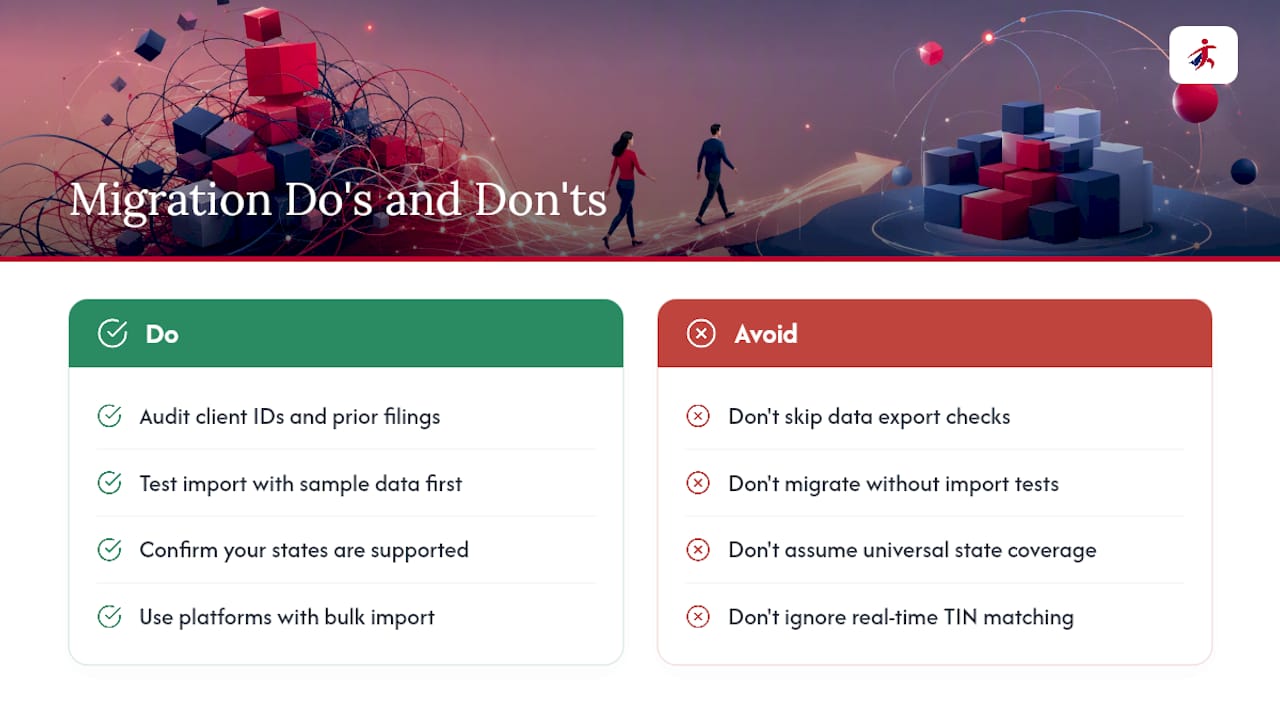
- Audit first. Export client IDs, payee records, prior-year filings, and e-file confirmation receipts from AdamsTax before you touch anything else.
- Test before you commit. Run sample filings in the new platform’s sandbox, confirm TIN matching catches errors correctly, and verify state filings process as expected.
- Reconcile after cutover. Compare totals between systems, run a rejected-filings drill to confirm your team knows the correction workflow, and schedule a short staff walkthrough before the next filing deadline.
A short export, import, and test cycle often surfaces the one incompatibility that would otherwise derail your cutover, so running it early beats discovering it in January. Keep encrypted backups of everything until you’ve confirmed a full filing cycle on the new system.
What TaxFormHero’s Credentials Mean for Your Filings
TaxFormHero backs its pitch with credentials that matter more than marketing copy: IRS authorization, SOC 2 certification, bulk import, TIN verification, state filing in 35+ states, print & mail, encrypted e-delivery, and pay-per-form pricing starting at $1.99.
Each one solves a specific problem. IRS authorization confirms the platform can legally transmit your forms to the agency. SOC 2 certification means an independent auditor reviewed the company’s data security controls, which lowers your vendor risk if you’re handling client Social Security numbers. TIN verification catches mismatches before submission, and real-time matching cuts rejection rates significantly compared to filing blind. Encrypted e-delivery keeps recipient data protected in transit, not just at rest.

TaxFormHero also provides onboarding support for firms migrating existing client data, so you’re not reconstructing years of filing history from scratch.
What a Switch Actually Costs You Over Time
Per-form price is the number vendors advertise, but it’s rarely the number that determines total cost. Subscription platforms bundle a base fee whether you file 10 forms or 1,000, which punishes small filers and rewards high-volume ones. Pay-per-form models flip that: you pay for what you use, but watch for surcharges on state filing, corrections, or print & mail that get added at checkout.
The real hidden cost is usually operational, not financial. A platform with clunky bulk import means someone on your team spends hours reformatting spreadsheets every filing season. A platform without reliable TIN matching means you’re paying twice, once for the original filing and once for the correction after a rejection notice arrives. A slightly higher per-form fee that includes solid integrations and accurate TIN checks often costs less over a full year than the cheapest sticker price with none of those features.
Volume discounts exist across most of these platforms, but the thresholds vary. If you file many forms, ask vendors where their discount tiers begin instead of assuming pricing pages include all details. And always ask whether state filing is included in the base price or billed separately. That single line item causes more billing surprises than anything else in this category.
Comparing Support Quality Across Filing Platforms
Support quality only becomes visible when something goes wrong, usually during the last week of January when everyone is filing at once. That’s the worst possible time to discover your vendor’s support team takes two days to respond.
Look for platforms that offer live chat or phone support during peak season, not just ticket queues. TaxFormHero, Tax1099, and TaxBandits all publish support channels beyond email, which matters when you’re staring down a TIN mismatch an hour before a deadline. Avalara (Track1099) leans on documentation and self-service tools given its scale, which works well for technical teams but can frustrate someone who just needs a quick answer.
Smaller platforms like 1099Online tend to offer more direct, personal support simply because they serve fewer accounts, though that can mean thinner coverage during the busiest weeks. Enterprise-oriented tools like 1099 Pro often route support through account managers rather than a general help desk, which suits larger organizations with dedicated internal IT staff but adds friction for a solo practitioner.
Before you commit to any platform, test their support responsiveness before you need it. Send a real question during a normal week and time the response. A platform that takes three days to answer a pre-sales question will not suddenly get faster in the middle of filing season.
What User Reviews Actually Reveal
Reviews of 1099 filing platforms cluster around a few recurring themes: ease of bulk upload, accuracy of TIN matching, and how painless corrections are after a rejection. Users rarely complain about per-form price directly. They complain about the hours lost when a platform’s import tool chokes on their spreadsheet format or when a correction requires starting the entire filing over.
Platforms with integration depth, like Tax1099 and Avalara (Track1099), tend to draw praise from accounting teams managing multiple clients, since a broken integration affects dozens of filings at once rather than one. Simpler platforms like 1099Online and TaxBandits get credit for straightforward workflows that don’t require a learning curve, which matters for a small business owner filing a handful of 1099-NEC forms once a year.
Treat star ratings as one signal among several rather than the deciding factor. A platform with fewer public reviews but a clear feature set and transparent pricing can still be the right fit if it matches your actual filing volume and integration needs. What matters more than rating volume is whether recent reviews mention IRS rejections, support delays, or billing surprises. Those specific complaints tell you more than an aggregate score ever will.
How Long Does Switching Platforms Take?
Most businesses can complete a full migration from AdamsTax to a new platform in one to two weeks if they start early, not during the last week of January. The audit and export phase typically takes a day or two for a small business with a few dozen payees, longer for accounting firms managing multiple client accounts with years of filing history.
Testing usually takes another few days: running sample e-files, confirming TIN matching works against your actual payee list, and verifying state filing connects correctly for every state you operate in. Firms filing in a single state move faster here than those filing across a dozen jurisdictions.
Cutover and reconciliation, the final step, often takes less time than people expect if the testing phase went well. Budget a few hours to compare totals between the old and new systems and confirm every payee record transferred correctly.
The riskiest timeline mistake is waiting until the January filing deadline is imminent to start migrating. Vendors get busy, your own team gets busy, and any data issue you discover under deadline pressure becomes a crisis instead of a minor fix. Starting the process in November or early December gives you a full buffer to catch problems before they matter.
Why the “Cheapest Per-Form Price” Advice Falls Short
Most buying advice for 1099 platforms fixates on the sticker price, and that’s the wrong starting point. The research here backs that up clearly: integration quality and TIN matching accuracy drive more real-world cost than the difference between $1.99 and $2.50 a form ever will.
What gets underestimated is how much a bad import process costs in staff hours. A firm filing 200 forms a year loses far more to a clunky bulk upload than it saves by picking the cheapest platform on the market. That’s the gap conventional advice misses: it treats price as the primary variable when reliability and support responsiveness usually decide whether a filing season goes smoothly or badly.
If you take one thing from this comparison, prioritize the migration test before you sign anything. Export a real file, import it into the new platform, and run one test e-file. That fifteen-minute exercise reveals more than any feature list or sales call. Complex filing situations still deserve a tax professional’s review, no software replaces that judgment entirely.
A Simpler Path Than Comparing Vendors One by One
Instead of running the demo gauntlet across six different platforms, TaxFormHero lets you skip straight to filing. There’s no subscription to negotiate and no sales call required to see pricing. You pay per form, starting at $1.99, and every form comes with IRS authorization and SOC 2 backed security already built in.
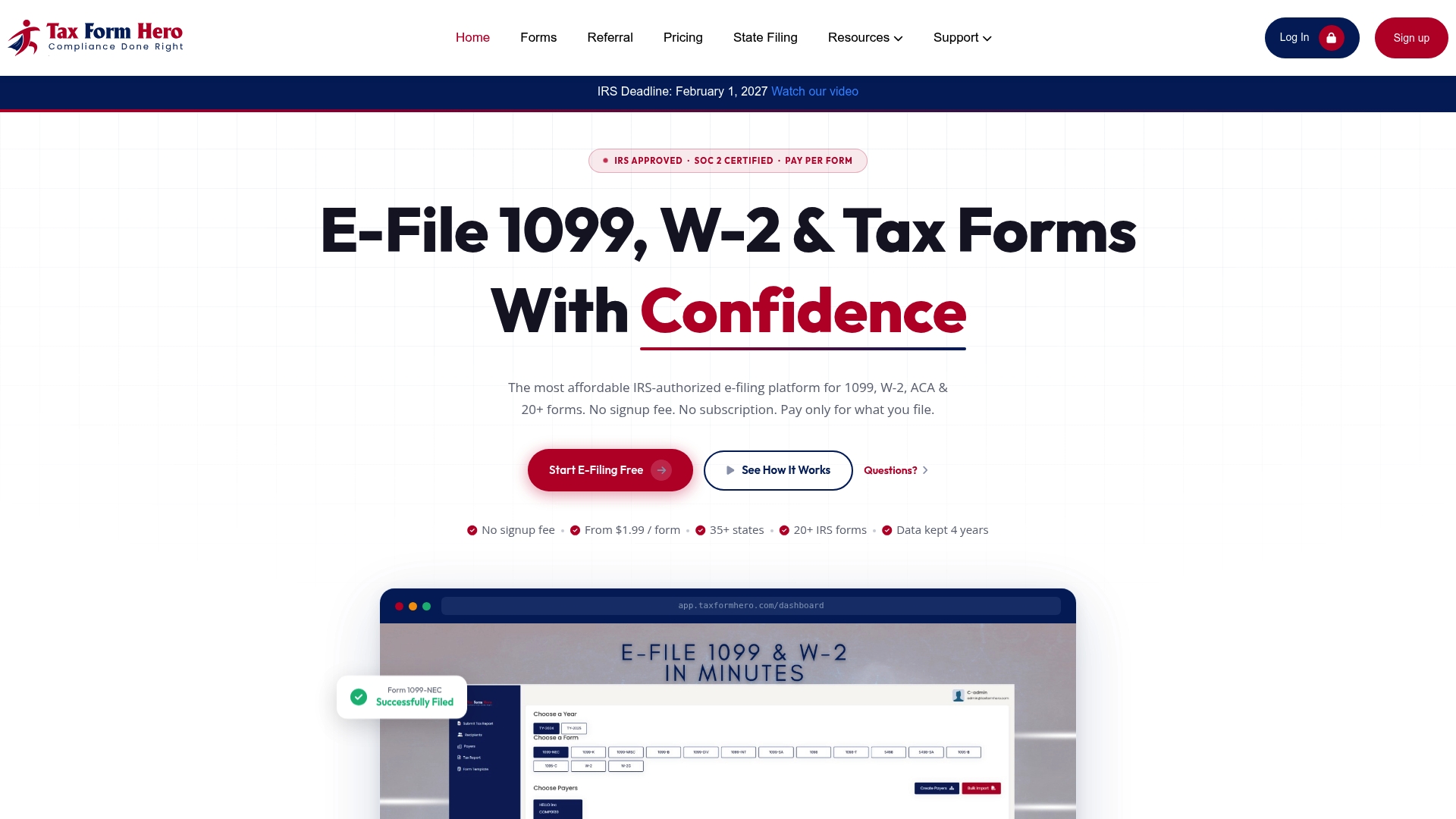
That structure matters most for firms leaving AdamsTax who don’t want to trade one long-term commitment for another. TaxFormHero’s bulk import handles the payee data you’re already exporting, its TIN verification flags mismatches before submission instead of after a rejection notice, and its state filing coverage spans 35+ states without a separate contract. Print & mail and encrypted e-delivery are available as add-ons, so recipients get their forms however your business already handles distribution.
If your evaluation checklist from this article includes IRS authorization, transparent per-form pricing, and real TIN matching, start a filing on TaxFormHero and see how your existing payee list imports before your next deadline arrives.
Frequently Asked Questions
Is TaxFormHero a good AdamsTax replacement for a small business filing under 50 forms?
Yes. Its pay-per-form pricing starting at $1.99 with no subscription fee suits businesses filing a small, predictable number of returns each year without paying for capacity they don’t use.
What’s the biggest risk when switching from AdamsTax to a new e-file platform?
Losing or misformatting historical payee data during export. Run a full audit of client IDs, prior filings, and e-file receipts before you migrate, and test the import process before you rely on it for live filings.
Do all AdamsTax alternatives support state filing?
Most of the platforms compared here, including TaxFormHero, Tax1099, Avalara (Track1099), TaxBandits, and Yearli by Greatland, offer some form of state filing support, but coverage varies by state. Confirm your specific states are included before committing.
How important is TIN matching when choosing a replacement?
Very important. Real-time TIN matching catches errors before submission, which reduces rejected filings and the administrative work of re-filing corrections later in the season.
Can accountants manage multiple clients on these platforms?
Yes. Platforms with strong bulk import and integration support, such as Tax1099, Avalara (Track1099), and TaxFormHero, are built to handle multi-client workflows without manual re-entry for each account.
Sources
- Top AdamsTax Alternatives for 2026: Better 1099 E-File Solutions
- IRS-Approved 1099 & W-9 Solution – Avalara (Track1099) | Avalara
Recommended

File Information Returns With Confidence
TaxFormHero supports 20+ IRS information returns, including 1099 and W-2 forms, with bulk Excel import, name/TIN matching and encrypted recipient delivery.
Explore TaxFormHero