1099 CSV Template: Split Files Above 250 Records Before IRIS Upload

Download the IRIS CSV template for your form and tax year, fill the required headers with correctly formatted TINs and amounts, save as CSV UTF-8, and upload. If a file runs past 250 records, split it. Official templates are form- and tax-year-specific, so a fresh download each year keeps your headers matched and your import free of avoidable errors.
TL;DR:
- IRIS imports only template columns, so copy each header exactly, map exported fields to the corresponding headers, and remove extra columns.
- Set TIN, ZIP, and date columns to Text before pasting; Excel may strip leading zeros or alter dates, and later formatting cannot restore them.
- Each file must contain one form type and one tax year, and the portal’s review page lets you inspect and remove incorrect rows before submission.
- Verify that each TIN matches its recipient’s name, then correct errors in the source spreadsheet so later exports do not repeat them.
Where do you download the official CSV template?
A reliable template to build on is the one the IRS publishes. Use these resources:
- IRIS Taxpayer Portal: choose the “Upload CSV with Form Data” option, select your form type and tax year, and download the matching template. Publication 5717 walks through this flow.
- IRS template ZIP packages: the IRS IRIS downloads page lists template formatting guidelines by tax year, such as the TY2025 package.
- Formatting guidelines inside each ZIP: every package holds the CSV templates plus form-specific instructions for each field.
Download a fresh copy each season. A template saved last year may carry old headers or rules, and the portal reads headers literally.
Need to get this filed? You can e-file Form 1099-NEC online with TaxFormHero, which is IRS-authorized and charges per form, not per month.
What columns does a 1099 CSV template contain?
Exact header names vary by form, but most 1099 templates share a common core. Expect these groups:
- Payer information: name, TIN, and address details.
- Recipient identity: recipient name and TIN.
- Recipient address: street, city, state, and ZIP.
- Account number: an optional field that helps you match filings to your own records.
- Payment amounts: form-specific columns. For a 1099-NEC, nonemployee compensation sits in Box 1, per the Instructions for Forms 1099-MISC and 1099-NEC. A 1099-MISC template carries different amount columns.
- State codes: fields for state-level reporting where the template includes them.
Only the columns in the template are imported, so extra data in your accounting export is ignored or causes a mismatch. Map each field in your export to the exact header text from the template. Copy header names directly. Do not retype or reorder them.
How should you format TINs, amounts, dates, and state codes?
Formatting is where most rejections start. Follow these rules, and confirm each against the formatting guidelines in your template ZIP:
- TINs: write an SSN as XXX-XX-XXXX and an EIN as XX-XXXXXXX. Include the hyphens when the template calls for them.
- Dollar amounts: follow the formatting guidelines in the template. Leave out the dollar sign and thousands separators if the guidelines call for it.
- Dates: follow the template’s stated date format exactly. Excel quietly reformats dates to your locale, so set date columns to Text before you enter anything.
- State codes: use two-letter USPS abbreviations where the template asks for a state.
- Critical columns: set TIN, ZIP, and date columns to Text so Excel does not strip leading zeros or convert a TIN into a number.
Pro Tip: Format the columns as Text before you paste data in. Changing the format afterward does not restore a leading zero that Excel already dropped.
How do you save a compliant CSV UTF-8 file from Excel?
Start from the freshly downloaded template, then work through these steps:
- Open the template and paste your mapped data under the existing headers without altering them.
- Set TIN, ZIP, and date columns to Text, then check that leading zeros and hyphens survived.
- Replace any formulas with their values so each cell holds final data.
- Choose File, then Save As, and select “CSV UTF-8 (Comma delimited),” the format Publication 5717 recommends.
- If the file holds more than 250 records, split it into separate files first, each with the headers intact.
Pro Tip: Avoid reopening the saved CSV in Excel, which can rewrite formats on the next save. To fix a stray character or encoding problem, edit the file in a plain text editor.
How does the IRIS upload work, and what are the limits?
Once your file is ready, the upload follows a short sequence:
- Select “Upload CSV with Form Data” in the IRIS Taxpayer Portal.
- Choose the form type and tax year, then download the template or upload your finished file.
- Keep each file to one form type and one tax year. Publication 5717 sets a cap of 250 records per file, so larger datasets must be split.
- After the upload, open the Review Form Information page. Inspect each row there and remove any records that look wrong before you submit.
For a larger bookkeeping dataset, split it into files of at most 250 records each and upload them one after another. If you are weighing IRIS against a vendor for a larger run, our guide on e-filing 10 or more 1099s explains the tradeoffs.
What upload errors come up most, and how do you fix them?
Most failures trace back to a short list of causes:
- Encoding errors: resave the file as CSV UTF-8. If the problem persists, open it in a text editor and correct the stray characters there.
- Header or column mismatch: make sure header text matches the template exactly, and delete any extra columns you added.
- TIN and name mismatches: run a TIN verification before you upload. Fix the mismatched rows, then upload again.
- Amount or date parse errors: remove currency symbols, strip thousands separators, and replace localized date styles with the template’s format.
Pro Tip: Fix errors in a copy of your source spreadsheet, not the exported CSV. That way your next export carries the correction instead of repeating the mistake.
Why do official templates and these habits reduce rejections?
The templates and specifications come straight from the agency that processes your return. Publication 1220 lays out the record-layout and file-format requirements for electronic information returns, and the IRIS template packages translate those technical rules into columns you can fill in. Following them removes the guesswork that produces format rejections.
CSV upload is a practical middle path for moderate volumes: faster than keying each form by hand, simpler than building a full A2A integration. The routine that keeps files clean is short. Download a fresh template, verify TINs, save with the right encoding, and split files that exceed the limit. Each habit closes off one of the common error types above.

A checklist I run before every upload
Before any file goes to IRIS, I check that the template is fresh, TINs are verified, critical columns are set to Text, the file is saved as CSV UTF-8, and it holds no more than 250 records. Teams that run this list every time avoid most of the rejections that cost them an afternoon.
— Nazrul
How does TaxFormHero fit into your CSV workflow?
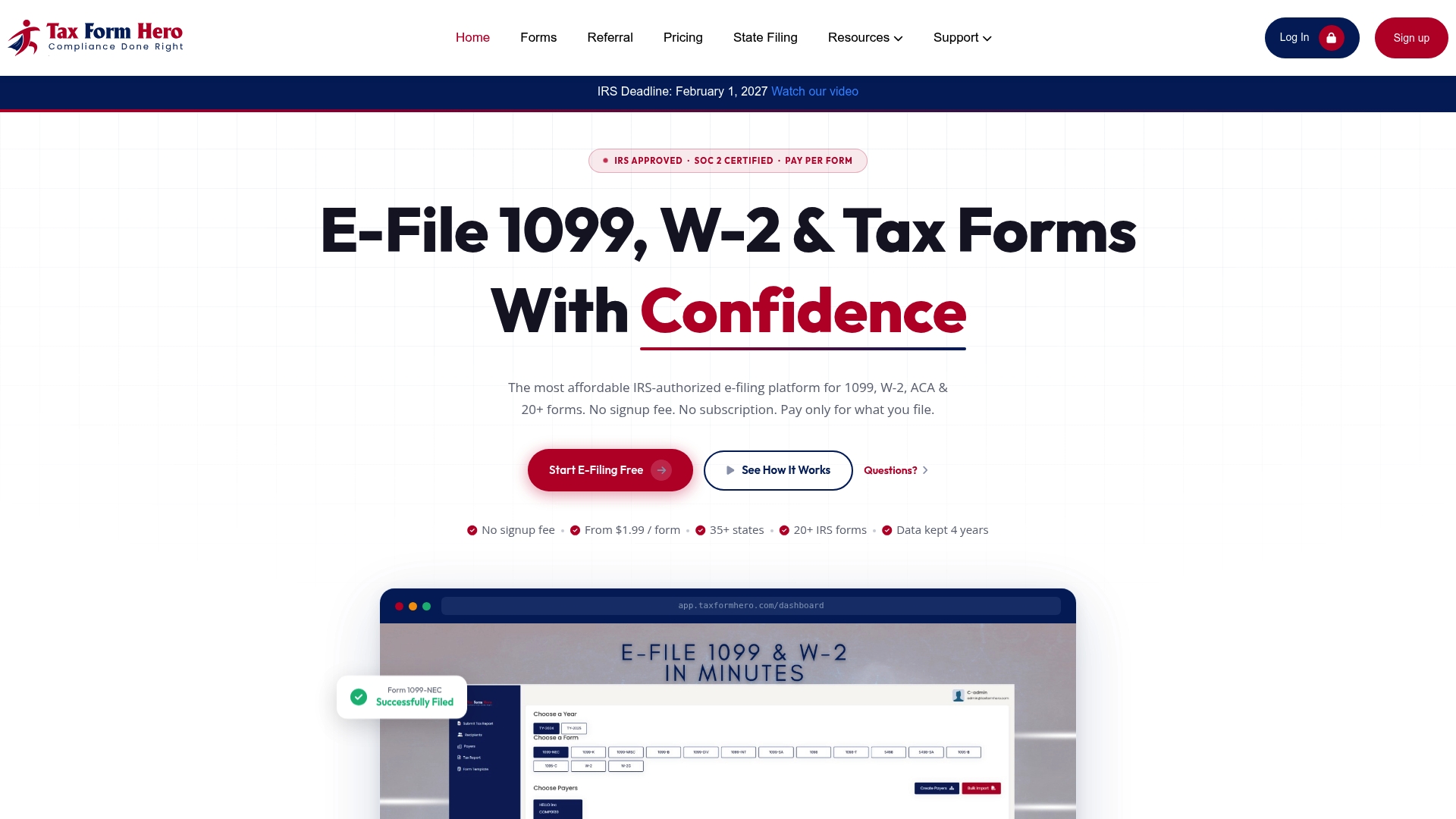
If you would rather skip the manual formatting, we built our platform around the same job. You can import recipient data from Excel or CSV templates, run TIN verification at $0.49 per check, and send recipient copies by encrypted email. Federal returns go to the IRS through IRIS A2A. We hold a SOC 2 Type I attestation, and pricing is pay-per-form with no subscription or signup fee: 1099 forms start at $1.99 each and drop at higher volumes. Start on our 1099-NEC filing page, or compare add-ons on our pricing page.
This article is general information, not a substitute for advice from a qualified financial advisor. Consult a qualified financial professional about your own circumstances before acting on anything here.

FAQ
Do I need a different CSV template for each 1099 form?
Yes. IRIS templates are specific to both the form type and the tax year. Download the template that matches the form you are filing, and repeat the process each tax year.
How many records can one CSV file hold?
IRIS limits each upload to 250 records per file, according to Publication 5717. Split larger lists into several files, each with the same headers.
What file format should I save my CSV in?
Save the file as “CSV UTF-8 (Comma delimited).” This encoding avoids most character and parsing problems at upload.
Why did my TINs lose their leading zeros?
Excel treats a TIN as a number unless the column is set to Text first. Format the column as Text before pasting data, then confirm the zeros and hyphens before saving.
Can I mix 1099-NEC and 1099-MISC records in one file?
No. Each file holds one form type and one tax year. Prepare a separate file for each form.
Sources
Recommended
- $2,000 Threshold: Generate 1099-NEC via IRIS for U.S. Contractors
- Avoid IRIS Rejects: Best 1099-MISC Software for 2026 with TIN Checks
- Avoid a 45 day TCC Delay: IRS IRIS 1099 Filing for U.S. Businesses
- 1099 Deadlines 2027: Feb 1 & Mar 31, IRIS/TCC Checklist for Small Teams

File Information Returns With Confidence
TaxFormHero supports 20+ IRS information returns, including 1099 and W-2 forms, with bulk Excel import, name/TIN matching and encrypted recipient delivery.
Explore TaxFormHero