
The IRS TIN Matching application is a free IRS e-Services tool that checks a payee’s name and taxpayer identification number (TIN) against IRS records before you file an information return. Only payers and their authorized agents can use it. You must register for e-Services first, then submit a separate TIN Matching application. This guide covers who qualifies, how access is set up, how the two matching modes differ, what each result code means, and what to do when a TIN fails.
Key Takeaways
- TIN Matching is an IRS e-Services application for payers and authorized payer agents. It is not open to individuals or to employers that only file Forms W-2.
- Access takes two steps: e-Services registration with identity verification, then a TIN Matching application submitted by your organization’s Principal.
- Interactive matching checks up to 25 name/TIN pairs and answers in seconds. Bulk matching handles up to 100,000 pairs per file, with results returned within 24 hours.
- A result of 0, 6, 7 or 8 is a match. Codes 1, 2 and 3 mean you should correct the data before you file.
- If you cannot enroll or prefer not to, a filing platform can run per-recipient TIN checks as part of your 1099 workflow.
Filing one yourself? You can e-file Form W-2 online with TaxFormHero, an IRS-authorized e-filing platform.
What the IRS TIN Matching application is
The IRS describes TIN Matching as an e-Services service that lets you validate a payee’s name and TIN combination before you submit an information return. The payee supplies the name and TIN, usually on Form W-9. You submit that pair, and the IRS tells you whether it matches its records.
The point is to catch errors early. A wrong TIN is one of the most common reasons a payer later receives a CP2100 or CP2100A notice. Running the check before filing lets you fix the record while the contractor is still easy to reach.
Publication 2108 states that the program checks whether the payee-furnished name/TIN combination matches a combination in the IRS program database. That is all it does. It does not tell you whether the person is a contractor or an employee, whether a payment is reportable, or whether the payee’s address is right.
Who can use the application
The IRS limits TIN Matching to payers and their authorized agents who submit information returns. On the IRS TIN Matching page, the payer must be listed in the IRS Payer Account File. Payers are added when they have filed Forms 1099 within the last two years to report backup withholding.
Publication 2108 (Rev. 11-2024) adds several points:
- Eligible participants are members of the third-party payor community and authorized agents making reportable payments subject to backup withholding.
- The program is not intended for individuals, firms or organizations that are not payers or authorized payer agents.
- Employers that file only Forms W-2 cannot enroll through this program.
All of this is in Publication 2108. TIN Matching also applies to U.S. persons who give you a Form W-9. It cannot be used for Form W-8 payees, who are non-U.S. individuals or entities.
In practice, a small business that pays contractors, a bookkeeping firm that files for clients, a credit union, a mortgage company or a retirement plan administrator may all have payments that qualify. Whether your organization is in the Payer Account File is the first thing to confirm.
Before you apply: e-Services registration
You cannot go straight to the TIN Matching application. IRS Publication 2108 says prospective users must complete online e-Services registration first. Publication 4389 explains that registration requires identity-verification information, a username, a password and a PIN. The IRS then mails a confirmation code, and you must enter it within 28 days.
Plan for that mailing step. If the code expires, you start the registration over. Have the information you will need ready before you begin, and use a mailing address where the person registering will actually receive IRS mail.

The Principal role matters. The Principal for the firm completes the TIN Matching application and can assign user roles. Decide who that person is before you start. A bookkeeping firm usually names an owner or partner. A corporate finance department usually names the tax or controller lead.
How to submit the application
- Confirm your payer status. Check that you file Forms 1099 that report backup-withholding payments and that your payer information is in the IRS records.
- Register for e-Services. Provide the identity-verification details, then create your username, password and PIN.
- Enter the confirmation code. Do it within 28 days of the IRS mailing.
- Submit the TIN Matching application. The Principal does this for the organization.
- Assign roles. The Principal can give other staff access as users.
- Run a small test set. Start with interactive matching on a few records so you see the result format before you load a large file.
For any step-by-step detail beyond this, the IRS pages above are the authority. Screens and requirements can change, so follow the current IRS instructions as you register.
Interactive vs. bulk matching
Once you have access, you choose between two modes. Both come from Publication 2108.
| Feature | Interactive | Bulk |
|---|---|---|
| Records per submission | Up to 25 name/TIN pairs | Up to 100,000 pairs per file |
| Input | Entered online | Semicolon-delimited .txt file |
| Delivery | Submitted in the application | Submitted through the secure mailbox |
| Response time | Immediate, generally within seconds | Within 24 hours |
| Tracking | Results on screen | Tracking number assigned; results in the secure mailbox |
| Best for | A new contractor, a handful of corrections | Year-end clean-up of a full payee list |
Use interactive matching when you onboard a payee and want an answer while you still have the W-9 in hand. Use bulk matching when you want to validate a whole list before filing season. File formatting is strict, so build the .txt file exactly as the publication describes and test with a small batch first.
What the results mean
Each record returns a code. Publication 2108 defines them as follows.
| Code | Meaning | What to do |
|---|---|---|
| 0 | Name and TIN match | Keep the record as is |
| 1 | TIN missing or not nine digits | Request a corrected W-9 |
| 2 | TIN not currently issued | Confirm the number with the payee |
| 3 | Name and TIN do not match | Check the name and TIN against the payee’s records |
| 4 | Invalid request | Fix the format and resubmit |
| 5 | Duplicate request | Review the earlier result |
| 6 | Match, TIN type unknown: found only in the SSN database | Treat as a match |
| 7 | Match, TIN type unknown: found only in the EIN/name-control database | Treat as a match |
| 8 | Match, TIN type unknown: found in both | Treat as a match |
The meanings come from Publication 2108. The “what to do” column is our practical reading, not IRS text.
A code 3 is the one you will see most often. It does not say which part is wrong, the name or the number. You work that out from the source documents.
Fixing a name and TIN mismatch
Most mismatches come from the name, not the number. People write a nickname, a married name, a shortened business name or a DBA where the IRS has a legal name.
Publication 2108 gives a rule for business payees. Use the legal name from Form SS-4 line 1, or the trade name from line 2 if a return under that name has already been filed and accepted. Ask the payee for their EIN confirmation letter or a copy of the SS-4 if the W-9 name does not work.
Entities with a special status need extra care. When a payee is an estate, for example, the name tied to the estate’s EIN is what counts, and the executor’s duties are covered in this taxable estate reporting process overview.
Name controls
The IRS does not compare every character of a name. Publication 1586 explains that matching compares the combination against files holding SSNs issued by the Social Security Administration and EINs and other TINs issued by the IRS, then compares a name control, generally up to four characters.
The same publication (Rev. 8-2026) says that if a name control is missing or incorrect on an electronically filed return, the IRS develops one from the first two name lines, up to 40 characters per line including spaces. It treats the combination as correct if the developed control matches its records. For you, the lesson is to put the legal name on the first name line and keep extra text, such as a DBA, off it.
When to run a TIN match
The IRS says to use TIN Matching to validate the name/TIN combination before you submit the information return. A workable routine:
- At onboarding. Collect a W-9, then check the name and TIN before the first payment. Our guide to W-9 collection and TIN matching walks through the process.
- Before year-end. Re-check any payee with a stale or handwritten W-9.
- Before filing. Run the final list so you correct errors while you still have time.
If you skip the check and a CP2100 or CP2100A notice arrives later, Publication 1281 says that when the information agrees with your records, you send the appropriate B Notice to the payee. The first notice includes a Form W-9. The second directs the payee to obtain IRS or SSA validation and does not include a W-9. Generally you must send it within 15 business days of the notice date or the date you received it, whichever is later. The first and second notices correspond to the first and second notice within a three-calendar-year period. Our B Notice process guide lays out the steps.
Backup withholding is the other consequence. The IRS says a payer must begin backup withholding immediately when no TIN is provided or the TIN is obviously incorrect. If a payee refuses to give a W-9, see how to handle a contractor who won’t provide a W-9.
What TIN Matching does not do
Know the limits so you do not read too much into a code 0:
- It confirms a name/TIN combination exists in IRS records. It does not confirm who is sitting in front of you.
- It does not decide whether a payment needs a 1099 or which box to use. For contractor thresholds, see our guide to the $2,000 rule for 1099-NEC.
- It does not file anything. It is a check you run before you file.
If you cannot enroll or want checks inside your filing workflow
TIN Matching enrollment is built around the IRS Payer Account File and a mailed confirmation code. Some filers do not qualify, and others want one place for the whole job.
TaxFormHero is an IRS-authorized information-return e-filing platform. You can verify a recipient’s TIN at $0.49 per check, collect W-9 forms, and prepare and file 1099, W-2 and ACA returns. Pricing is per form with no subscription or signup fee. Read more on our TIN matching and verification page, and see the add-on rates on the pricing page.
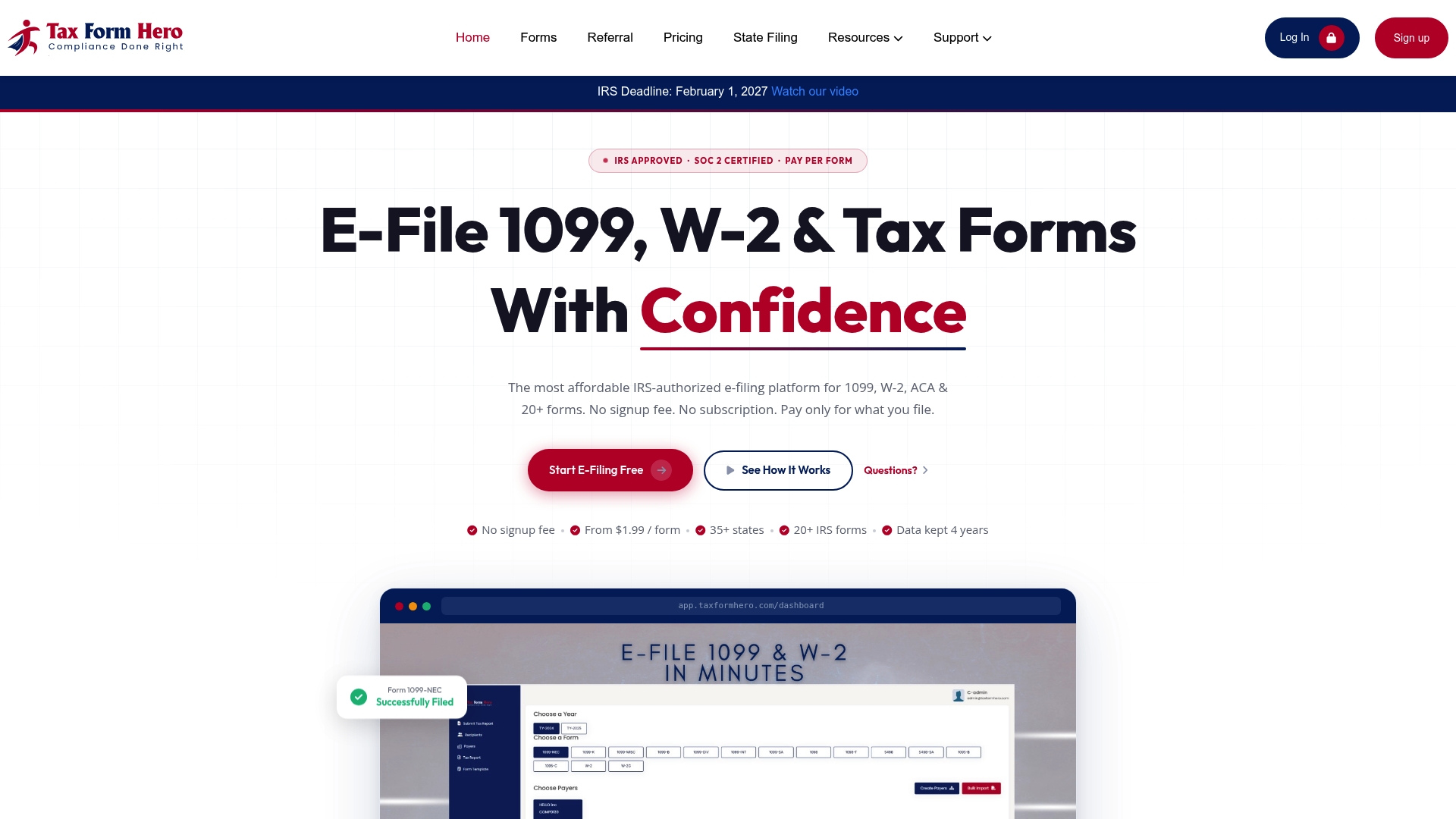
To see how recipient checks fit into a full filing, our guide to e-filing 10 or more 1099s covers IRIS and vendor options. For a longer reference on the IRS program, read our TIN matching guide for tax professionals.
Our perspective
We see the same pattern every filing season. A payer collects a W-9, files, and learns about a bad TIN months later in a CP2100 notice. By then the contractor is harder to reach and the B Notice clock is running.
We think the check belongs at the start of the workflow, at the moment a W-9 comes in. That is why our platform treats TIN verification as a per-recipient step, priced at $0.49 per check, instead of a project you do once a year.
The IRS application is a useful tool for payers who qualify and can complete e-Services registration. For firms that file for many clients, or for payers who want W-9 collection, verification and filing in one place, we built our platform to carry the whole process. You pay per form, with graduated tiers that apply only to the forms within each tier. There is no subscription and no annual contract.
Our goal is simple: fewer rejected records, fewer notices, and a recipient list you can trust on filing day.
Nazrul
FAQ
Is the IRS TIN Matching application free?
The IRS sources in this article describe TIN Matching as an e-Services service and mention no per-check fee. Your costs are the time to register and any software you use to prepare files. Check the IRS TIN Matching page for current terms.
Can an employer that only files W-2s use it?
No. Publication 2108 says employers filing only Forms W-2 cannot enroll through this program. It is for payers and authorized agents that file information returns subject to backup withholding.
How long does a TIN match take?
Interactive requests return results immediately, generally within seconds, for up to 25 name/TIN pairs. Bulk files of up to 100,000 pairs return results through the secure mailbox within 24 hours. Bulk submissions get a tracking number.
What do I do after a code 3 result?
Code 3 means the name and TIN do not match. Compare the W-9 with the payee’s records, and for a business use the legal name from SS-4 line 1. Request a corrected W-9 if needed, then run the check again.
Can I TIN match a foreign payee?
No. TIN Matching is for U.S. persons who submit a Form W-9. It cannot be used with Form W-8, which is for non-U.S. individuals or entities.
Sources
- IRS: Taxpayer Identification Number (TIN) Matching
- IRS Publication 2108 (Rev. 11-2024)
- IRS Publication 4389
- IRS Publication 1586 (Rev. 8-2026)
- IRS Publication 1281 (Rev. 12-2023)
- IRS: Backup withholding “B” program
Recommended
- IRS TIN Matching Guide for Tax Professionals: 2026
- TIN Matching & Verification
- Avoid IRIS Rejects: Best 1099-MISC Software for 2026 with TIN Checks
- W-9 Collection: Automate IRS TIN Matching Before CP2100 Notices
Disclaimer:
“This content is for informational purposes only and does not constitute legal, tax, or financial advice. For advice specific to your situation, consult a qualified US attorney or CPA.”

File Information Returns With Confidence
TaxFormHero supports 20+ IRS information returns, including 1099 and W-2 forms, with bulk Excel import, name/TIN matching and encrypted recipient delivery.
Explore TaxFormHero