
If you are a digital asset broker, filing Form 1099-DA comes down to six tasks. Confirm you are a broker. Collect each customer’s name, address and TIN. Complete the boxes the IRS requires. Get an IRIS transmitter control code (TCC). Transmit the return, then furnish the recipient copy. This guide takes each task in order and shows where filings usually go wrong. We built our filing workflow around the same sequence: collect, verify, import, transmit, deliver.
Key Takeaways
- Form 1099-DA is filed by brokers, not by customers. Customers use the form they receive to report sales on their own returns.
- Gross proceeds apply to transactions from January 1, 2025. Basis reporting for certain transactions starts with transactions on or after January 1, 2026.
- IRIS is the IRS platform for 1099 filing, and a FIRE transmitter control code cannot be used in it. Apply for an IRIS TCC early, because processing can take up to 45 days.
- Most IRIS errors are fixed with a one-step correction. A wrong name, wrong TIN or wrong form type needs a two-step correction.
- Verify TINs before you file. A name and TIN mismatch is the error that costs the most work to fix.
If you would rather not do this on paper, e-file Form 1099-DA online with TaxFormHero instead.
Who files Form 1099-DA
The filer is the broker. Under the Instructions for Form 1099-DA, a U.S. digital asset broker generally reports when it stands ready to effect sales for others, regularly offers to redeem digital assets it issued, or effects customers’ dispositions as an agent, dealer or middleman.
The IRS digital assets page says the final regulations reach brokers that take possession of the assets their customers sell. That includes:
- Operators of custodial digital asset trading platforms.
- Certain hosted wallet providers.
- Digital asset kiosks.
- Certain processors of digital asset payments (PDAPs).
The reporting requirement comes from changes to Internal Revenue Code section 6045 made by the Infrastructure Investment and Jobs Act, signed in late 2021, per the same IRS page.
Two scope points matter for your workload:
- Foreign brokers. The IRS explains in Understanding your Form 1099-DA that for 2025 the filing requirements generally apply to U.S. brokers. A customer of a foreign broker may get no 1099-DA, but must still report taxable transactions on their own return.
- Stablecoins, NFTs and PDAP sales. For certain stablecoin and NFT sales, brokers may report on an aggregate basis once sales pass the de minimis thresholds, and a separate threshold applies to PDAP sales. The IRS digital assets page states both. Check the form instructions for the current thresholds before you set up your reporting logic.
If you are a business that only accepts crypto as payment for goods, a 1099-DA is generally not your return. Payments to contractors and vendors are reported on the 1099 forms you already know, such as the 1099-NEC.
What changed: 2025 and 2026 at a glance
The IRS final regulations announcement sets the timeline. The final regulations were issued June 28, 2024. They require gross proceeds reporting for transactions effected on or after January 1, 2025, and basis reporting for certain transactions effected on or after January 1, 2026. Real estate professionals treated as brokers report the fair market value of digital assets in real estate transactions with closing dates on or after January 1, 2026.
| Transaction year | What brokers report | Filed in |
|---|---|---|
| 2025 | Gross proceeds | 2026 |
| 2026 | Gross proceeds and basis for covered transactions | 2027 |
The transaction year is the year the sale happens. The filing season is the following year. Your 2026 transactions are the first with basis reporting, so the return you file in early 2027 carries more fields than last year’s.
The IRS finalized the 2026 version of the form on January 12, 2026. KPMG’s summary notes it matched the September 2025 draft, added separate address fields to align with IRIS, and updated box 11c for aggregate proceeds from specified NFT first sales.
Basis is not required for 2025 sales. As The Tax Adviser reports, brokers begin reporting cost basis on Forms 1099-DA for 2026 transactions.
Step 1: Collect and verify recipient data
Every 1099-DA starts with the customer record: legal name, address, and TIN (a Social Security number or an EIN). Missing or wrong data here causes the most correction work later.
What to do:
- Pull name, address and TIN for every customer with a reportable disposition.
- Split the address into separate fields: street, city, state and ZIP. The 2026 form uses separate entry fields for each address component, aligned with IRIS.
- Match each TIN to the name on record.
- Flag customers with no TIN on file. Backup withholding questions follow from that gap.
Where it goes wrong: legacy systems often store one address line and one name field. If you cannot split the address cleanly, the return is not ready to import.
On our platform you can run a TIN check for $0.49 per verification, so mismatches surface before transmission and not in a rejection notice. Our TIN matching page shows how it works. We also let you organize recipient information and collect completed W-9 forms in one place.
Step 2: Complete the boxes
For sales effected after 2025, the 2026 Instructions for Form 1099-DA tell the broker to complete all unnumbered boxes except the CUSIP number box. Boxes 1a, 1b, 1c, 1e and 1f must be completed, with narrow exceptions: 1e when an optional reporting method is used, and 1f when box 11c is completed.
| Box | What goes in it |
|---|---|
| 1a | Nine-character DTIF digital token identifier, or 999999999 if the asset is not registered |
| 1b | Full name of the digital asset |
| 1c | Number of units, to 18 decimal places |
| 1d | Date acquired (MM/DD/YYYY), for covered securities |
| 1e | Date sold or disposed |
| 1f | Gross proceeds, reduced by transaction costs |
| 1g | Adjusted basis, for covered securities |
| 1h | Accrued market discount, for covered securities that are debt instruments |
| 1i | Wash sale loss disallowed |
DTIF stands for Digital Token Identifier Foundation. Box 3a is completed if the sale resulted from exercising an option. Boxes 3b, 4, 5, 7, 8, 9, 14, 15 and 16 are completed only if applicable. Boxes 12a and 12b report the units and date for custodial transfers in.
Covered and noncovered assets
A covered security is one for which the broker must report basis. For a noncovered security, the broker may check box 9 and leave boxes 1d, 1g, 1h, 1i and 6 blank. The IRS instructions state that a broker who checks box 9 is not subject to section 6721 or 6722 penalties for failing to report basis correctly. Without box 9 checked, penalties can apply to boxes 1d, 1g, 1h, 1i, 2 and 6 even for a noncovered security.

The practical rule: decide covered or noncovered per transaction before you build the import file, and set box 9 from that decision.
Unit precision
Box 1c takes units to 18 decimal places. Spreadsheets round silently. If your data passes through Excel, format the units column as text so no digits are dropped. Our Excel and CSV bulk import is built for thousands of records per file, so large customer bases are loaded in one pass.
Step 3: Get an IRIS transmitter control code
The IRS is retiring the FIRE system. According to the Virginia Department of Accounts summary, Tax Year 2026 and Filing Season 2027 is the targeted retirement date. IRIS becomes the mandatory platform for 1099s starting with the 2026 tax year, with returns filed from January 2027.
That summary also says existing FIRE users should complete an IRIS Application for a TCC, a FIRE TCC cannot be used for IRIS, and processing can take up to 45 days. A broker who waits until January can miss its filing window.
EY describes the two IRIS intake channels in its overview of the platform:
- Taxpayer portal. Web-based, with manual entry or CSV upload of up to 250 returns at a time. Each user must have a U.S. TIN and be authenticated through ID.me.
- Application-to-Application (A2A). For software providers and larger filers, using automated submission of up to 100 megabytes per submission.
For a broker with thousands of customers, the 250-return portal limit means batching. A2A avoids that, and it is the route our platform uses to transmit supported 1099 returns to the IRS through IRIS.
Step 4: Transmit the return
Once data is verified and boxes are complete:
- Build the file or enter records in the filing tool.
- Run validation before you submit. Check for blank required boxes, malformed dates and invalid TIN formats.
- Transmit to IRIS through the portal or A2A.
- Read the acceptance or rejection status. Fix rejected records and resubmit.
Our separate broker workflow guide for IRIS rejects covers the rejection patterns in more depth. For the wider picture on reconciling digital asset reports, see our overview of digital asset reporting rules.
Step 5: Furnish recipient copies and meet deadlines
The recipient statement is a separate duty from the IRS filing. The IRS General Instructions for Certain Information Returns say Forms 1099-B and 1099-DA statements to recipients were due February 17, 2026, for the 2025 year. That is earlier than most 1099s. The same instructions set the e-filing deadline for forms to the IRS at March 31, 2026.
Those dates apply to 2025 transactions. Exact dates move each year with weekends and holidays, so read the current General Instructions and the IRS Guide to Information Returns before you set your 2027 calendar. The pattern holds: recipient statements in mid-February, IRS e-filing at the end of March.
For electronic delivery, the IRS has proposed rules, per its newsroom release. Brokers may follow them for statements furnished on or after January 1, 2027. They require enhanced electronic notice and delivery steps and customer access to the statements. Keep proof of consent and delivery. Our guide to 1099 electronic delivery covers consent and the audit trail.
We send recipient copies by encrypted email, priced at $0.19 per form, or by USPS First-Class Mail, priced at $1.69 per form for print and mail. You can also download recipient PDF copies for free. See E-Delivery for the delivery option.

Penalty relief for 2025
Under Notice 2024-56, the IRS will not impose section 6721 and 6722 penalties on brokers for 2025 sales, provided they make good faith efforts to file accurate, timely returns and statements. The same notice says backup withholding under section 3406 is not required on digital asset sales brokers effect during 2025. This relief covers 2025 only. Plan 2026 transactions as a full-compliance year.
Step 6: Correct errors
When you find a mistake after filing, IRS Publication 5717 (Rev. 9-2026) sets the method. For IRIS filings, most errors take a one-step correction, unless the wrong form was submitted.
| Error | Correction |
|---|---|
| Incorrect payment amount | One step: submit a corrected return |
| Incorrect code or indicator value | One step |
| Form that should not have been filed | One step: enter 0 for all amounts |
| Incorrect name or TIN | Two steps: zero out all money amounts, then submit a new original |
| Incorrect form type | Two steps |
Corrections to IRIS returns go through the IRIS portal, and you must send recipients statements showing the corrections. For paper corrections, the same publication describes two error types. Type 1 covers an incorrect name, address, amount, code or checkbox and needs one return marked with an X in the CORRECTED box. Type 2 covers wrong form type, incorrect name and address together, or an incorrect or missing TIN, and needs two returns. Include the same account number on both the original and the corrected return so the IRS can match them.
How 1099-DA differs from 1099-B
Both are broker forms and they follow similar mechanics. Form 1099-B reports proceeds from securities and certain contracts. Form 1099-DA is built for digital assets and has fields for token identifiers, units to 18 decimals, and transfer-in data that securities forms do not. Both have the same early recipient-statement deadline, per the IRS General Instructions cited above. If your firm handles both asset types, you file each on its own form.
Filing 1099-DA with TaxFormHero
We are an IRS-authorized e-filing platform with pay-per-form pricing. There is no subscription, signup fee or annual contract. The 1099 schedule is graduated, so each tier prices only the forms inside it:
| 1099 forms | Price per form |
|---|---|
| First 150 | $1.99 |
| 151 to 500 | $0.99 |
| 501 to 1,000 | $0.60 |
| Above 1,000 | $0.45 |
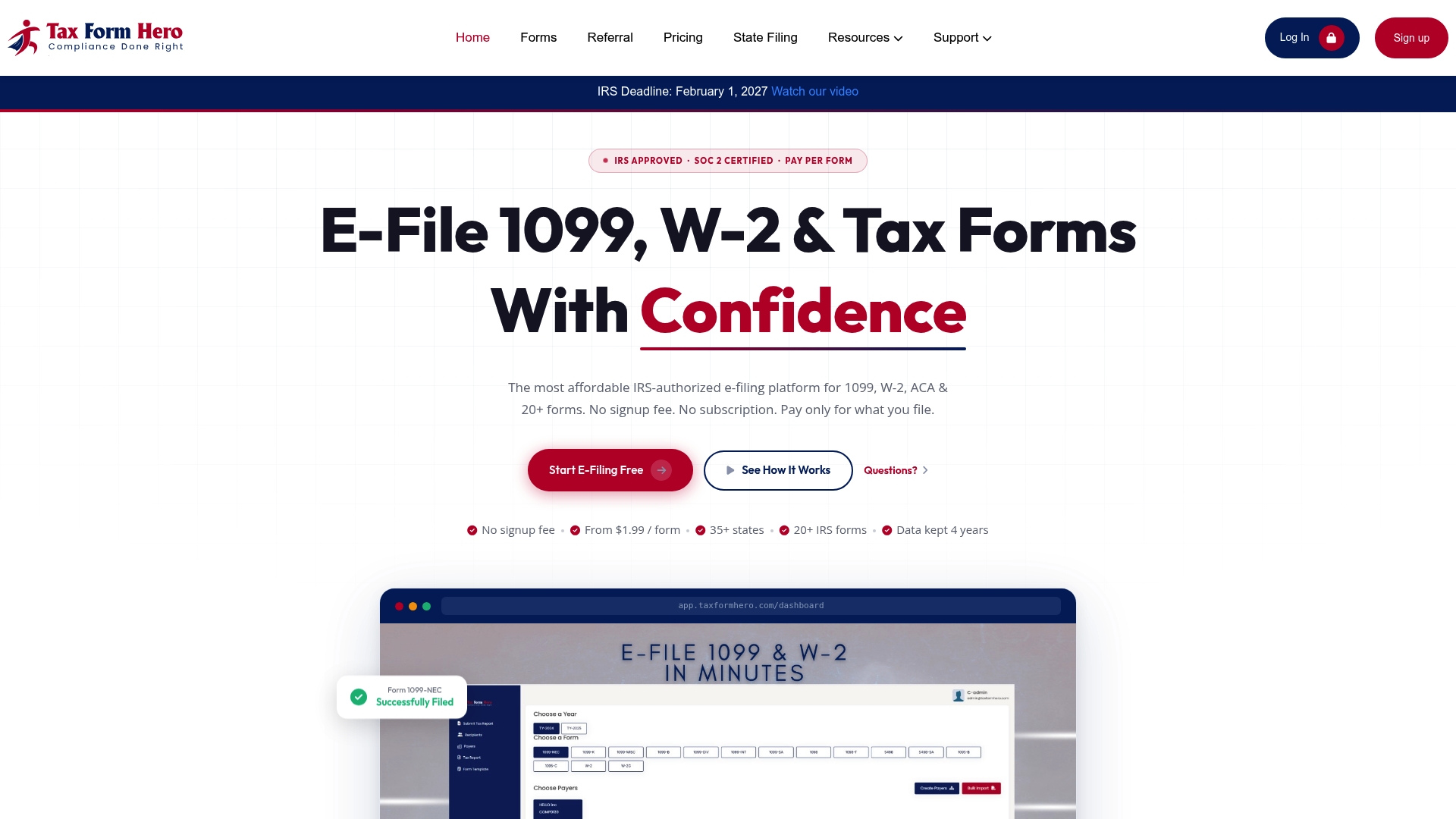
Add-ons are priced per form: state filing at $0.99, print and mail at $1.69, encrypted e-delivery at $0.19, and TIN matching at $0.49 per verification. State filing is available for 41+ states and Washington, D.C. Combined Federal/State Filing states carry no additional state filing charge. You can import records from Excel or CSV and manage multiple payer accounts. Our SOC 2 Type I attestation covers the platform. See the full pricing page or start from TaxFormHero.
For larger filers with many payers, the enterprise filing page explains how we handle volume.
Our perspective
Most 1099-DA failures we expect are data failures, not form failures. A name that does not match a TIN, an address squeezed into one field, a unit count rounded by a spreadsheet: each one is a rejection or a two-step correction waiting to happen.
That is why we put verification before transmission. You check the TIN, you load the records in bulk, you see what is wrong while it is still cheap to fix, and then you send the return through IRIS.
Pricing should be as easy to predict as the workflow. We charge per form with graduated tiers, so a broker with 1,200 returns pays the lower rate only on the forms past each threshold, and nothing for a subscription it did not use.
The IRIS transition adds pressure on small teams. Apply for the TCC early, clean the data now, and treat the 2026 tax year as the first full year of basis reporting.
Nazrul
FAQ
Who has to file Form 1099-DA?
U.S. digital asset brokers do. That includes custodial trading platforms, certain hosted wallet providers, digital asset kiosks and certain payment processors, per the IRS. Customers do not file the form. They use it to report their own sales.
What is the deadline for Form 1099-DA?
For 2025 transactions, recipient statements were due February 17, 2026, and e-filed returns were due March 31, 2026, per the IRS General Instructions. The dates shift slightly each year, so confirm the current ones in the IRS instructions before the 2027 season.
Can I still use FIRE to file?
The IRS has targeted Tax Year 2026 and Filing Season 2027 for FIRE’s retirement, with IRIS becoming mandatory for 1099s. A FIRE TCC cannot be used in IRIS. Apply for an IRIS TCC well ahead of your filing date.
What if a customer’s TIN is wrong?
A wrong name or TIN needs a two-step correction in IRIS: zero out the money amounts, then submit a new original. Verifying the TIN before you file avoids the extra work.
Sources
- Instructions for Form 1099-DA (2026)
- 2026 Instructions for Form 1099-DA (PDF)
- IRS: Digital assets
- IRS: Understanding your Form 1099-DA
- IRS: Final regulations and related guidance for reporting by brokers
- KPMG: IRS Issues Final 2026 Version of Form 1099-DA
- The Tax Adviser: Navigating the Form 1099-DA reporting maze
- Virginia Department of Accounts: What’s New for Calendar/Tax Years 2025 and Beyond
- EY: New IRS online platform for filing information returns
- IRS: General Instructions for Certain Information Returns
- IRS: Proposed regulations on electronic 1099-DA statements
- IRS Notice 2024-56
- IRS Publication 5717
Recommended
- 2025–2026 1099 Digital Asset Rules: How U.S. Filers Reconcile Reports
- How to File 1099 Forms: A 2026 Small Business Guide
- How to E-File Form 1099-S: A Step-by-Step Guide
- File 10+ 1099s? Skip Form 1096 in 2026 for U.S. Payers
Disclaimer:
“This content is for informational purposes only and does not constitute legal, tax, or financial advice. For advice specific to your situation, consult a qualified US attorney or CPA.”

File Information Returns With Confidence
TaxFormHero supports 20+ IRS information returns, including 1099 and W-2 forms, with bulk Excel import, name/TIN matching and encrypted recipient delivery.
Explore TaxFormHero