Save on 1099 Filing for U.S. Small Firms: TaxFormHero Over 1099Online

We recommend a transparent, pay-per-form e-filing platform with IRS authorization and IRIS A2A support for most small businesses and accounting firms. 1099Online suits very low-volume, single-form filers who want the lowest possible upfront cost. The decision mainly comes down to form volume, state filing needs, and whether built-in TIN matching and SOC 2 attestation matter to your workflow.
TL;DR:
- Most small businesses and accounting firms should prefer a transparent, pay-per-form e-filing platform supported by IRS authorization and IRIS A2A for reliable transmission.
- Bulk electronic filing becomes mandatory once submitting 10 or more forms per year, making IRIS A2A support crucial for high-volume filers.
- Platforms like TaxFormHero, Avalara, and Tax1099 offer varying automation levels, form coverage, and support for state filings, with pricing structured around volume to suit different needs.
- Verifying IRS authorization, SOC 2 compliance, and TIN matching capabilities is essential to prevent rejections and ensure data security during filing.
- For small batches or infrequent filing, the free IRS IRIS Taxpayer Portal may suffice, but larger or recurring needs favor the transparency and compliance guarantees of paid platforms.
Which 1099 e-file platforms should you consider?
We built this shortlist around what actually matters when you pick a filing platform: pricing transparency, form coverage, state filing reach, and how the platform transmits returns to the IRS. Each entrant below fits a different buyer profile.
- TaxFormHero: our pay-per-form platform supports 1099-NEC, 1099-MISC, 1099-K, W-2, and 20+ IRS information-return forms, with no subscription or signup fee. We transmit federal returns through IRIS A2A and hold a SOC 2 Type I attestation. Add-on services, including state filing, print and mail, encrypted e-delivery, and TIN matching, are priced per form rather than bundled into a flat package.
- 1099Online: this platform is commonly recommended as a budget option for filers who only need to submit a handful of forms once a year. It fits a buyer who wants a simple, no-frills intake flow without add-on services layered in.
- Tax1099: this vendor built integrations with QuickBooks and Xero, which matters if your recipient data already lives inside an accounting platform and you want to avoid manual re-entry.
- Avalara (Track1099): this platform targets high-volume filers with API automation, which suits companies that need to push thousands of forms through a programmatic workflow rather than a manual upload.
- TaxBandits: this vendor offers a general feature set aimed at small businesses that want a straightforward filing experience without specialized integrations or enterprise tooling.
- Yearli by Greatland: this platform handles 1099 and W-2 forms together, which fits payroll and HR teams that already manage employee records and want one vendor for both employee and contractor filings.
- 1099 Pro: this is longstanding software for 1099 preparation with flexible deployment options, including on-premises installs, which suits accounting firms or software integrators with specific infrastructure requirements.
Each of these platforms solves the same core problem: getting information returns to the IRS and to recipients correctly and on time. The differences show up in pricing structure, how much manual setup each requires, and what happens when your volume changes year to year.
Need to get this filed? You can e-file Form W-2 online with TaxFormHero, which is IRS-authorized and charges per form, not per month.
How do these platforms compare on pricing, forms, and compliance?
The table below lines up the decision axes that matter most when you are choosing a filing platform: cost structure, form coverage, state reach, TIN verification, integrations, delivery, and the compliance credentials behind the transmission.
| Platform | Best for | Pricing model | Forms supported | State filing | TIN matching | Integrations | Security & compliance |
|---|---|---|---|---|---|---|---|
| TaxFormHero | Small businesses and accounting firms needing transparent per-form pricing | Pay-per-form, graduated tiers, pricing available on website | Various IRS forms including 1099-NEC, 1099-MISC, W-2, and more | 41-plus states and D.C., state filing optional | TIN matching available | Excel/CSV bulk import supported | IRS-authorized, SOC 2 Type I, IRIS A2A |
| 1099Online | Very low-volume, single-form filers | Low-cost, volume-limited | Core 1099 forms | Limited | Not a core feature | Basic manual entry | Not publicly detailed |
| Tax1099 | Teams using QuickBooks or Xero | Per-form with tiered add-ons | 1099 series, W-2 | Available | Available | QuickBooks, Xero | IRS-authorized |
| Avalara (Track1099) | High-volume filers needing automation | API-based, volume pricing | 1099 series, W-2, ACA | Available | Available | API, ERP integrations | IRS-authorized |
| TaxBandits | Small businesses wanting standard features | Per-form pricing | 1099 series, W-2, ACA | Available | Available | Basic import tools | IRS-authorized |
| Yearli by Greatland | Payroll and HR teams | Bundled and per-form options | 1099 series, W-2 | Available | Available | Payroll system links | IRS-authorized |
| 1099 Pro | Firms needing flexible deployment | Software license or per-form | 1099 series, W-2 | Available | Available | Flexible, deployment-dependent | IRS-authorized |
The biggest practical split in this group is transmission method. Platforms that support IRIS A2A can push large batches of returns straight through automated channels, which matters once your volume climbs past a few hundred forms. The IRS requires electronic filing once you submit 10 or more information returns in a calendar year, a threshold that pulls most small businesses out of paper filing entirely.
The IRS also offers a free IRIS Taxpayer Portal for manual entry or CSV upload, which can handle up to 100 returns at a time without any vendor fees at all. For a business filing a small batch of forms once a year, that free portal is worth comparing against any paid platform before you commit to one.
How do you choose the right platform for your situation?
Match the platform to your actual filing pattern rather than to whichever vendor ranks first in a search. Work through this checklist with your own numbers in hand:
- Count your annual form volume across all form types, not just 1099-NEC, since combined totals affect whether you need bulk import and graduated pricing.
- Confirm which states you need to file in and whether your top candidate’s rate for state filing is itemized or bundled into a flat package.
- Check whether TIN matching is available and what it costs per check, since this affects how many CP2100 style notices you avoid later.
- Verify recipient delivery options, including whether encrypted e-delivery is available as an alternative to printed mail.
- Ask whether the platform integrates with your accounting software through CSV import, API, or a direct connector.
When you talk to a vendor directly, ask these specific questions: Does the platform support all 41-plus states you file in, or only a subset? Is federal transmission handled through IRIS A2A, and has the vendor completed ATS testing? What is the per-check cost and volume limit for TIN matching? What is the platform’s response time during peak filing weeks in January?
Watch for a few red flags during evaluation: no stated IRS authorization anywhere on the vendor’s site, pricing that is not disclosed until checkout, no bulk import option for recipient data, and no encryption mentioned for e-delivered recipient copies. Any one of these should slow you down.
Pro Tip: Ask any vendor for their IRS Transmitter Control Code status and their most recent SOC attestation type before you enter recipient data, since both are quick ways to confirm the platform is authorized to transmit on your behalf.
What does 1099 filing actually cost once you add it up?
Per-form pricing only makes sense once you run real numbers through it. The 1099 tiers are graduated, meaning each tier prices only the forms that fall inside it rather than repricing the entire order once a threshold is crossed.
| Form count | Rate per form | Total base cost |
|---|---|---|
| 25 forms | $1.99 (first 150 tier) | $49.75 |
| 250 forms | $1.99 x 150 + $0.99 x 100 | $397.50 |
| over 1,000 forms | $1.99 x 150 + $0.99 x 100 + additional tiered pricing for higher volumes | approximately $991.50 |
Add-ons apply per form on top of the base rate, with pricing details available on the pricing page. A 250-form batch that also needs state filing and e-delivery adds roughly $295 on top of the base cost. For a deeper walkthrough of how these tiers stack up against flat-rate competitors, see our breakdown of cheap 1099-NEC filing options.
Pay-per-form pricing tends to win for businesses with variable or seasonal volume, since there is no annual contract to justify. A subscription model can make more sense only when a filer consistently processes high volumes year after year and the platform’s subscription rate undercuts the per-form total at that scale, something worth modeling with your own historical form counts before committing either way.

What security and compliance signals actually matter?
A handful of trust signals separate a platform you can rely on during filing season from one that leaves you exposed to rejected files or data exposure.
- IRS authorization and IRIS A2A transmission mean your returns move through the IRS’s official intake system, which reduces the risk of a file being rejected for a transmission error.
- SOC 2 Type I attestation confirms a vendor’s controls around data security were evaluated at a point in time, relevant because recipient files carry Social Security numbers and EINs.
- TIN matching before filing helps you catch a mismatched name and number before the IRS does, which can prevent a CP2100 or CP2100A notice later.
- Encrypted e-delivery protects recipient copies in transit, an important detail since those copies contain the same sensitive payee information as the federal filing itself.
The IRS requires electronic filing once a business submits 10 or more information returns in a year, a rule that pulls most active 1099 issuers into e-filing by default. You can verify a vendor’s authorization status and review SOC attestation summaries directly from the vendor’s own compliance pages, and cross-check IRS program participation against IRS.gov before entering recipient data anywhere.
How do you migrate to a new filing platform without losing data?
Switching platforms mid-year or at the start of a new filing season takes a bit of planning, especially if you are moving hundreds of recipient records at once.
- Export your current recipient data as CSV or Excel and check it against the new platform’s import template before uploading.
- Map each field carefully, since mismatched columns for TIN, address, and payment amount are the most common import errors.
- Run a TIN match on a sample batch first to catch naming or number errors before a full-volume transmission.
- Complete any required ATS testing if you are connecting through IRIS A2A, since new transmitters need a Transmitter Control Code and testing before live filing.
- Submit the final transmission, then confirm recipient delivery through print, mail, or encrypted e-delivery.
Timeline expectations vary by volume: low-volume filers (150 forms or fewer) can usually complete the switch in a single sitting, medium volumes (150 to 1,000) often take a day or two to map and test properly, and high-volume filers (over 1,000 forms) should budget a week or more to account for TCC setup and A2A testing. Our step-by-step walkthrough covers the full import and transmission flow in more detail.
What should you expect from support and the day-to-day filing experience?
Support quality matters most in the weeks before the January filing deadline, when a stuck import or a rejected TIN match can cost you time you do not have.
- Support channels vary by vendor, from live chat and email to phone support and dedicated account managers for higher-volume accounts.
- Documentation and guided flows for CSV import, IRIS A2A testing, and recipient delivery reduce the number of support tickets you need to file in the first place.
- Recipient copy previews let you catch a formatting or data error before it reaches a payee’s inbox or mailbox.
- Bulk correction tools matter once you discover an error across dozens of recipient records, since re-entering each one manually is slow and error-prone.
A platform that handles IRS correspondence well also matters if you receive a notice after filing. If you need to fax a correction or respond to an IRS letter, resources like PerPageFax’s IRS fax number directory can save time tracking down the right contact.
What do customer reviews actually tell you about these platforms?
Reviews across this category tend to cluster around a few recurring themes: how smooth the import process felt, whether support responded quickly during peak filing weeks, and whether the final transmission went through without rejection. Established vendors with years of filings behind them, including Tax1099, Avalara (Track1099), and 1099 Pro, tend to draw reviews that focus on integration depth and enterprise reliability. Smaller or newer platforms draw reviews focused more narrowly on price and ease of first-time use.
Reviews are a useful signal, but they rarely tell you whether a platform matches your specific volume, state filing needs, or integration requirements. A platform with a strong review base for enterprise API work is not necessarily the right pick for a five-person business filing 40 contractor forms once a year, and the reverse is also true. We recommend treating published reviews as one input alongside the practical checklist earlier in this article: your form count, your state obligations, and whether you need TIN matching or encrypted delivery built in. Checking a vendor’s own compliance and authorization pages directly, rather than relying on review summaries alone, gives you a more reliable picture of whether the platform can actually handle your filing before you commit recipient data to it.

Why we recommend TaxFormHero for most filers
I’ve spent time comparing how these platforms structure pricing, transmission, and compliance, and the pattern that stands out is how often vendors bundle costs in ways that are hard to compare until checkout. Graduated, pay-per-form pricing, IRS authorization, SOC 2 Type I attestation, and IRIS A2A support provide small businesses and accounting firms a clear, itemized basis for comparison before they commit any recipient data.
That said, a vendor recommendation only holds for the buyer it fits. A business filing a handful of forms once a year may find the free IRS IRIS Taxpayer Portal or a stripped-down low-cost option like 1099Online perfectly adequate, since neither TIN matching nor state filing add-ons carry much weight at that scale. The right platform depends on your volume and your compliance needs, not on which vendor ranks highest in a search.
— Nazrul
Ready to file? Here’s how to start with TaxFormHero
We built TaxFormHero around one idea: you should know exactly what a filing will cost before you enter a single recipient record. No subscription, no signup fee, and pricing that only charges you for the tier your forms actually fall into.
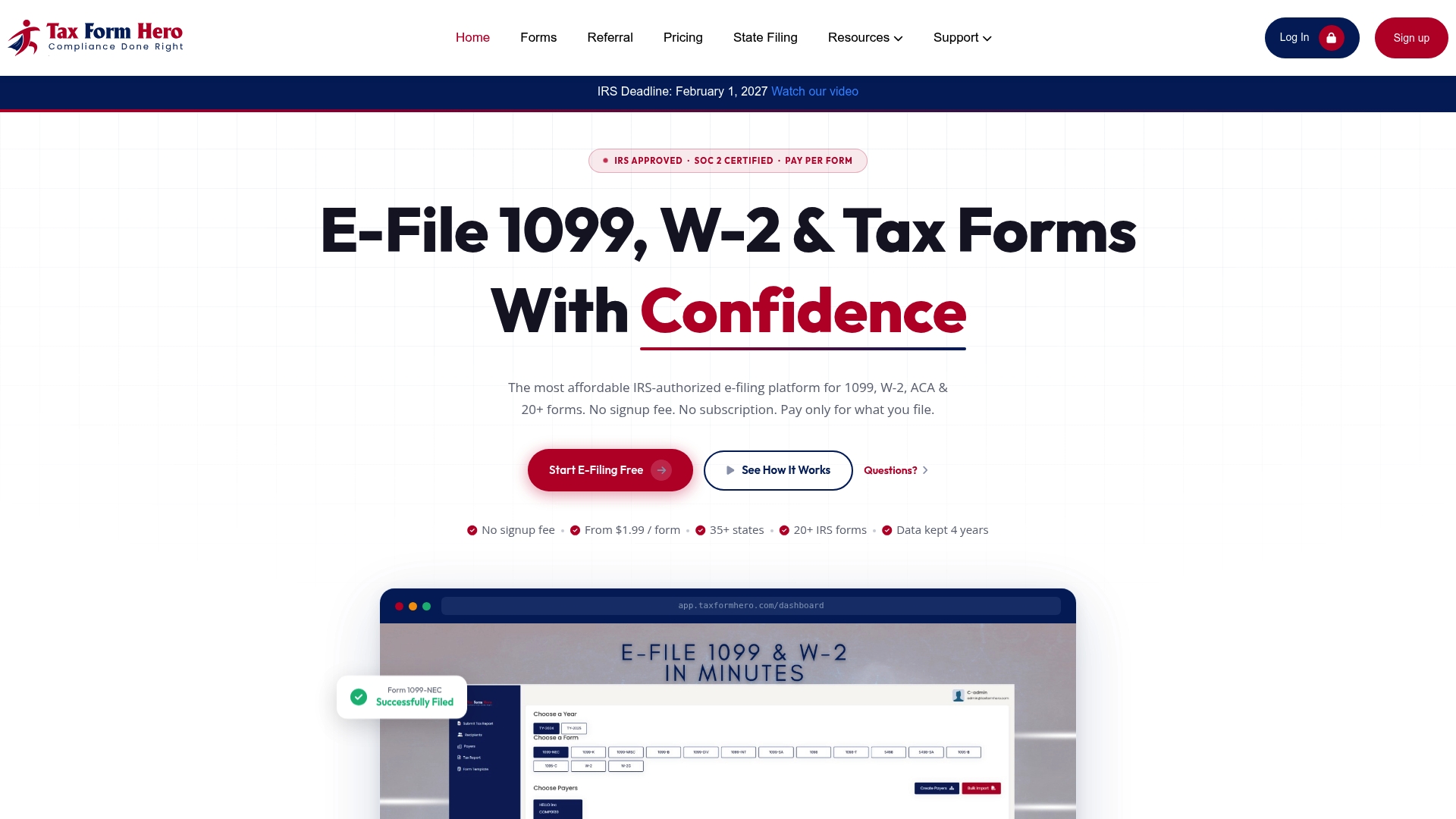
If you are ready to move forward, these are the most direct next steps:
- Start your 1099-NEC filing directly, with per-form pricing from $1.99.
- Check exact add-on costs for state filing, print and mail, and e-delivery before you commit to a full batch.
- Walk through the step-by-step filing process if this is your first time importing recipient data.
- Review our comparison of Tax1099 and TaxBandits if you want another data point before deciding.
A small sample import, even just a handful of recipients, is a practical way to see how the platform handles TIN matching and delivery before you commit your full recipient list.
This article is general information, not a substitute for advice from a qualified financial advisor. Consult a qualified financial professional about your own circumstances before acting on anything here.
FAQ
Is Tax1099.com a legit site?
Tax1099 is an established, IRS-authorized e-filing vendor that has operated in this space for years and offers integrations with accounting platforms like QuickBooks and Xero. As with any filing vendor, confirm current IRS authorization and review its published security attestations before submitting recipient data.
What is the difference between a 1099 form and a tax return?
A 1099 form reports income paid to a person or business during the year, such as nonemployee compensation, and is filed by the payer with the IRS and furnished to the recipient. A tax return is the document the recipient files to report their total income, including amounts shown on any 1099 forms they received, and to calculate tax owed.
Can you file taxes without the actual 1099 form?
Yes, a taxpayer can file their own tax return without having the physical 1099 form in hand, since the return reports income the taxpayer already knows they earned. The IRS also receives a copy of each 1099 filed on a taxpayer’s behalf, so missing a physical copy does not exempt that income from being reported.
What is the difference between IRS Form 1040 and Form 1099?
Form 1040 is the individual income tax return filed to report total income and calculate tax owed for the year. Form 1099 is an information return filed by a business or payer to report payments made to a nonemployee, contractor, or other recipient, which is then included on the recipient’s individual tax return.
Recommended
- Best Small Business 1099 Software: What to Use in 2026
- Estimate Your 1099 Efile Cost for U.S. Businesses (Starts at $1.99)
- Best Pay-Per-Form 1099 Filing Platforms for 2026
- Cheaper 1099-NEC Filing Online: From $1.99 per Form for Small Business

File Information Returns With Confidence
TaxFormHero supports 20+ IRS information returns, including 1099 and W-2 forms, with bulk Excel import, name/TIN matching and encrypted recipient delivery.
Explore TaxFormHero