
A Washington small business reports contractor payments to the IRS, not to the state. Washington has no corporate or personal income tax, but federal 1099 rules apply to you the same way they apply in every state. For payments made in 2026, you report nonemployee compensation of $2,000 or more per recipient on Form 1099-NEC. The work is in collecting clean recipient data, meeting the deadline and sending copies on time. TaxFormHero is built for that workflow: bulk import, TIN verification and recipient delivery, billed per form.
Key Takeaways
- 1099 reporting is a federal obligation. Washington’s income-tax-free status does not remove it.
- For payments made in 2026, the 1099-NEC threshold is $2,000. It was $600 for earlier years.
- Collect a Form W-9 from every contractor before the first payment. It gives you the name, TIN and entity type you need in January.
- Paying 10 or more information returns means you must e-file.
- Washington’s business tax is the B&O tax. It affects your contractors’ own registration, not what you put on a 1099.
Need to get this filed? You can e-file Form 1099-NEC online with TaxFormHero, which is IRS-authorized and charges per form, not per month.
Does Washington Have a State 1099 Requirement?
The 1099 itself is a federal information return. You prepare it from your own payment records and send it to the IRS and to the recipient. The state’s role is different: Washington taxes business gross receipts instead of income.
The Department of Revenue explains that most businesses owe Business and Occupation (B&O) tax on gross income, with the rate set by the type of business activity. That page is written for contractors who receive a 1099-MISC. It says they are engaged in business in Washington and must register with the Department of Revenue if they must collect sales tax, have gross income of $12,000 or more per year, owe other taxes or fees to the department, or need a city license.
For you as the payer, this has two practical effects:
- Your contractors may be registered businesses with their own B&O reporting. Your 1099 must still match what you paid them.
- If you pay contractors who live or worked in other states, those states may have their own 1099 rules. Check each state’s rules before you file. TaxFormHero supports state filing in 41+ states and Washington, D.C., at $0.99 per form, and Combined Federal/State Filing states carry no additional state-filing charge.
The B&O picture is also changing. Grant Thornton reports that the small-business B&O credit rises to $125 a month for nonservice businesses and $375 a month for service businesses, and that the annual taxable income threshold for filing a B&O return rises from $125,000 to $250,000. Talk to a Washington CPA about how this applies to your own returns. It has no effect on the numbers you report on a 1099.
Which Payments Need a 1099
The IRS sets four conditions for reporting nonemployee compensation. All four must be true:
- You paid someone who is not your employee.
- The payment was for services in the course of your trade or business.
- The payee is an individual, partnership, estate or, in some cases, a corporation.
- Your payments to that person total at least the threshold during the year.
A Seattle marketing agency that pays a freelance designer $4,500 over the year meets all four. A Spokane café that pays a catering company organized as a corporation usually does not, because payments to incorporated businesses are generally excluded, with exceptions for medical and legal services.
The $2,000 threshold
For payments made before 2026, the threshold was $600. For payments made in 2026 it is $2,000. Brotman Law notes that the One Big Beautiful Bill Act made this change, so a contractor paid $2,000 or more in 2026 needs a form and a copy by the January 31, 2027 deadline, subject to the weekend shift described below. Keep tracking every contractor from the first dollar. Totals add up quickly across invoices, and a contractor at $1,900 in November can cross the line in December.
Our guide to the $2,000 rule for paying contractors covers the cases around the line.
1099-NEC or 1099-MISC
The IRS uses 1099-NEC for services performed by someone who is not your employee, including parts and materials, cash payments for fish, and payments to attorneys. It uses 1099-MISC for rents, royalties, prizes and awards, medical and health care payments, crop insurance proceeds and other specified payments. A Washington landlord paying a property manager’s fee for services and a separate rent payment to another owner may use both forms in one year. Our comparison of 1099-NEC and 1099-MISC walks through the boxes.

If some of your payments go through a card processor or payment app, the processor reports them on 1099-K. That is a different obligation, explained in our piece on 1099-K versus 1099-NEC.
What about LLCs?
An LLC does not automatically remove your reporting duty. Sedna explains that a single-member LLC that has not elected corporate taxation is reported under the owner’s name and SSN or EIN, while an LLC that elected S-corp or C-corp taxation is generally exempt from 1099-NEC reporting. The W-9 tax classification decides. Our guide to single-member LLC reporting has examples.
A frequent question from the contractor side is whether a 1099 worker needs an LLC at all. They do not: Doola explains that a sole proprietor can sign contracts, invoice clients and collect 1099 income under their own name. Some larger clients ask for an entity, but that is a client preference, not a tax rule. Your task as the payer is the same either way: get the W-9 and report by its classification.
Collect the W-9 Before the First Payment
A completed Form W-9 is the foundation of an accurate 1099. Ledger and File explains that it gives you the contractor’s legal name, taxpayer identification number and entity type, which is everything needed to issue the return at year end. Sedna lists the fields that matter: the legal name as shown on the tax return, any business name, the federal tax classification, the address and the TIN (an SSN or EIN).
A workable routine for a small business:
- Request the W-9 when you onboard the contractor, before the first invoice is paid. Builders and trades in particular benefit from collecting W-9s before payment as a standing rule.
- Check that the legal name and TIN are both filled in and that the entity type is marked.
- Store the form with the contractor’s record, not in an email thread.
- Ask for a fresh W-9 if the contractor changes name, entity type or address.
Name and TIN mismatches are the most common reason a return needs correcting. TaxFormHero offers TIN matching at $0.49 per verification, so you can verify a name and TIN combination before the return is filed rather than after.
Deadlines for the 2026 Tax Year
In a normal year, Form 1099-NEC is due to both the IRS and the recipient by January 31. Form 1099-MISC goes to recipients by January 31 and to the IRS by February 28 on paper or March 31 electronically.
For the payments you made in 2026, January 31, 2027 falls on a Sunday. QuickBooks reports that the 1099-NEC deadline shifts to February 1, 2027 for both recipients and the IRS, and that 1099-MISC is due to recipients on February 1 and to the IRS on March 31, 2027 if filed electronically.
The weekday shift changes from year to year, so confirm the current dates on the IRS page before you plan your calendar. Work backward from the earliest date: finish W-9 checks in December, reconcile payments in early January, and leave several days to correct anything that surfaces.
| Form | Recipient copy | IRS copy |
|---|---|---|
| 1099-NEC | January 31 (next business day if a weekend) | January 31 (same rule) |
| 1099-MISC | January 31 | February 28 paper, March 31 electronic |
| 1099-K | January 31 | February 28 paper, March 31 electronic |
When You Must E-File
The IRS requires electronic filing if you have 10 or more information returns in total. That count includes all types: a business with 6 contractor 1099s and 5 W-2s has 11 and must e-file. Paper filers must send Form 1096 as a summary. As the IRS explains, Form 1096 is not required when filing electronically. Our explainer on Form 1096 and e-filing covers what changes.
TaxFormHero is IRS-authorized, and supported 1099 returns are transmitted to the IRS through IRIS A2A. W-2 and W-2c forms go to the Social Security Administration, and ACA returns use the IRS AIR system. You can enter recipients one at a time or import thousands of records from an Excel template. That matters if you are an accounting firm filing for many Washington clients: you can manage multiple payer accounts in one place.
For the full requirement, see our guide to 1099 e-filing requirements.

Delivering Recipient Copies
Filing with the IRS is half the job. The contractor must also receive a copy by the same January deadline. With TaxFormHero you can send recipient copies by encrypted email at $0.19 per form, or by USPS First-Class Mail through print and mail at $1.69 per form. Recipients can also download their PDF copies for free.
Keep proof of when you furnished each copy. A late or missing recipient copy is a separate problem from a late IRS filing, as the next section explains.
Penalties and Corrections
Two separate penalties can hit one form: one for failing to file with the IRS (Section 6721) and one for failing to furnish the statement to the recipient (Section 6722). Jupid’s 2026 guide notes that a single form filed late with no recipient copy can draw both. Amounts are per form and rise the later you file.
Publication 1099 defines a small business for penalty purposes as one with average annual gross receipts of $5 million or less over the three most recent tax years, and small businesses face lower maximum penalties. The publication also lists exceptions, including reasonable cause, inconsequential errors, and a de minimis rule for corrections.
Three habits reduce the risk:
- Verify TINs before filing, not after an IRS notice.
- File early enough to correct errors inside the deadline window.
- Keep W-9s and payment ledgers for every form you issue.
What Filing Costs
Per-form pricing makes the cost easy to forecast. TaxFormHero charges $1.99 per 1099 form for the first 150 forms, $0.99 for forms 151 to 500, $0.60 for forms 501 to 1,000 and $0.45 above 1,000. The tiers are graduated, so each price applies only to the forms inside that tier. There is no subscription, signup fee or annual contract.
A worked example: a Tacoma contractor with 12 freelancers and a TIN check on each recipient pays $1.99 × 12 = $23.88 for the forms, $0.49 × 12 = $5.88 for TIN matching, and $0.19 × 12 = $2.28 for encrypted e-delivery. That totals $32.04. Add state filing at $0.99 per form where a state return applies. See the full price list for every add-on.
Our View: Get the Data Right First
Most 1099 problems we think about start months before January. A missing W-9, a TIN typed from memory or a contractor paid under two names all become corrections later. We designed TaxFormHero around that reality: recipient information is organized in one place, TIN verification runs before you file, and Excel or CSV import means a list that already exists in your books does not need retyping.
We also believe a small business should pay for what it files and nothing more. That is why our pricing is per form and graduated, with no subscription to carry through the months when you file nothing. A Washington business with eight contractors and one with eight hundred use the same platform and the same process.
The Washington difference is mostly about what you do not have to do. With no state income tax, the work is a federal return done carefully and delivered on time. We aim to make that part short.
Nazrul
Ready to Prepare Your Returns
If you have your W-9s and payment totals, you can move straight to preparation. TaxFormHero is an IRS-authorized platform that handles 1099-NEC at $1.99 per form for the first 150 forms, with optional state filing, print and mail, encrypted e-delivery and TIN matching. It also connects to Xero and Zoho Books if your payments already live there. Start from our small business 1099 page or go directly to 1099-NEC.
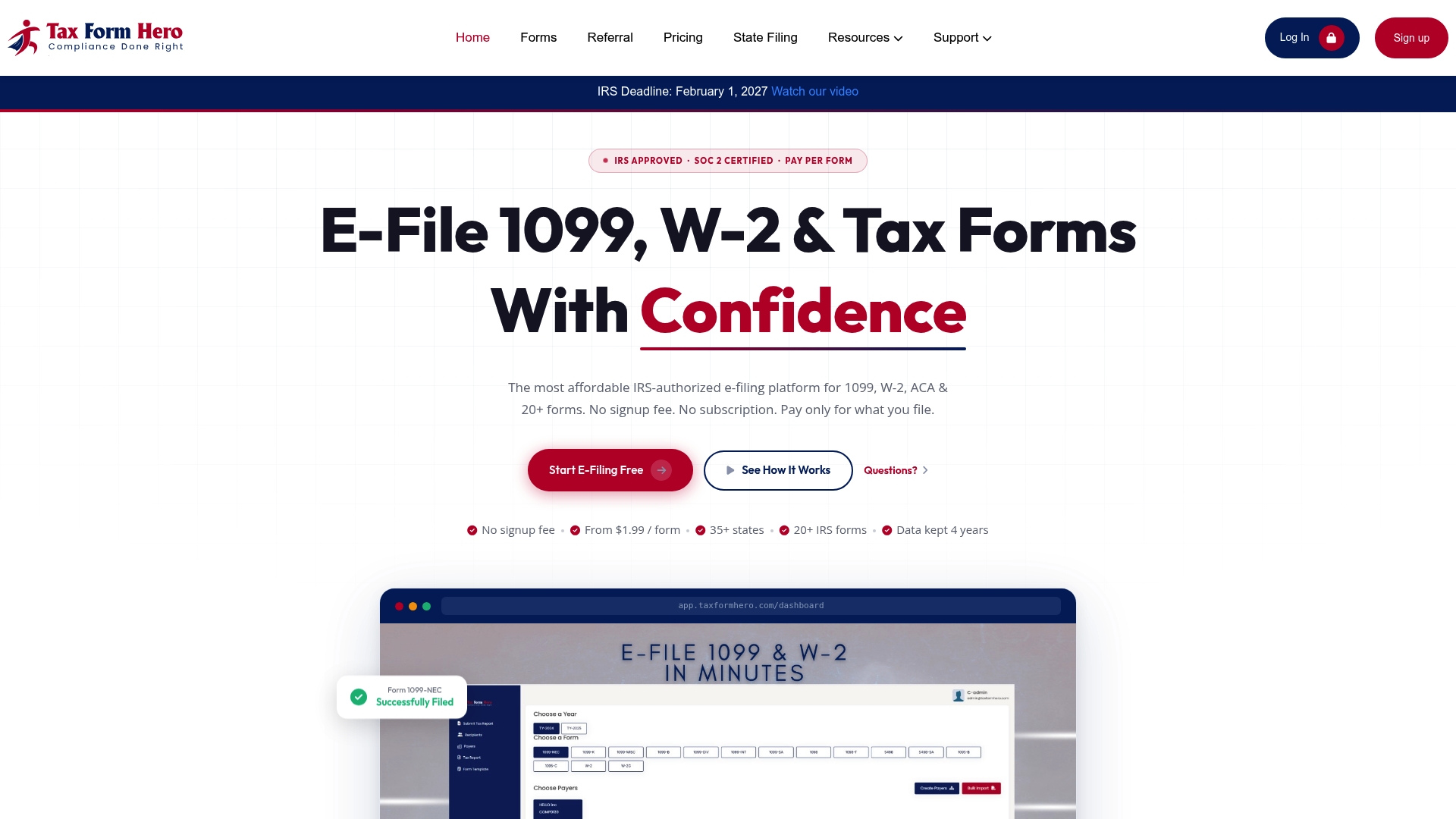
For W-2 and ACA returns, the TaxFormHero home page lists those services from $2.99 per form.
FAQ
Do Washington businesses pay income tax?
No. Washington has no corporate or personal income tax. Businesses generally pay B&O tax on gross income instead. A separate 9.9% tax on individual income above $1 million is scheduled to begin January 1, 2028, and it does not change 1099 reporting for a small business.
Does my Washington contractor need an LLC to receive a 1099?
No. A sole proprietor can work and receive 1099 income under their own name. What matters to you is the tax classification on the W-9. Report according to that form and the type of payment, as Surhires explains.
When must a contractor register with the Washington Department of Revenue?
Per the Department of Revenue, a contractor who gets a 1099-MISC is engaged in business and must register if they must collect sales tax, have gross income of $12,000 or more per year, owe other taxes or fees to the department, or need a city license. That is the contractor’s duty, not yours.
Do I need to file a 1099 for a payment under $2,000?
For 2026 payments, nonemployee compensation below $2,000 to a recipient does not require a 1099-NEC under the IRS threshold. Keep the payment records and W-9 anyway, because totals can cross the line during the year.
Sources
- IRS: Am I required to file a Form 1099 or other information return?
- IRS: Reporting payments to independent contractors
- IRS: A guide to information returns
- IRS: Publication 1099 (2026)
- Washington Department of Revenue: 1099-MISC Income
- Washington Department of Revenue: Business tax structure
- Washington Department of Revenue: Income tax
- Grant Thornton: Washington enacts B&O and retail sales tax changes
- Brotman Law: Paying Contractors in Cash
- Sedna: Form W-9
- Doola: LLC for Contract Work
- Ledger and File: What to collect from a contractor
- Surhires: 1099 or LLC for Freelancers
- Jupid: 1099 Filing Deadlines and Penalties 2026
- Designflow: Collect W9s Before Payment
Recommended
- 1099 Reporting for Texas Small Businesses: 2026 Rules
- 1099 Requirements for New York Businesses: 2026 Guide
- 1099 Deadlines 2026: What Small Businesses Must Know
- 1099-MISC State Reporting: Who Needs a Copy and When
Disclaimer:
“This content is for informational purposes only and does not constitute legal, tax, or financial advice. For advice specific to your situation, consult a qualified US attorney or CPA.”

File Information Returns With Confidence
TaxFormHero supports 20+ IRS information returns, including 1099 and W-2 forms, with bulk Excel import, name/TIN matching and encrypted recipient delivery.
Explore TaxFormHero