
A Texas business reports payments on Form 1099 under federal rules only. Texas has no state income tax, so there is no separate state 1099 return to file with the Comptroller. For payments you make in 2026, the Form 1099-NEC and 1099-MISC reporting threshold is $2,000. Returns for those payments are due in early 2027, and if you file 10 or more returns of any type you must file them electronically.
This guide covers who gets a 1099, which form applies, what the deadlines are, how e-filing works for Texas payers and what happens if you file late or wrong.
Key Takeaways
- Texas has no state-level 1099 filing step. Your obligation is to file with the IRS and furnish copies to recipients.
- For payments made in 2026, the 1099-NEC and 1099-MISC threshold is $2,000, up from $600. Royalties are the exception, at $10.
- Payments to incorporated businesses generally need no 1099, except for legal and medical or health care services.
- File 10 or more information returns of any kind and you must e-file. Start your IRIS Transmitter Control Code (TCC) application early.
- Penalties for returns due in 2026 run from $60 to $340 per form, and $680 for intentional disregard.
Need to get this filed? You can e-file Form 1099-NEC online with TaxFormHero, which is IRS-authorized and charges per form, not per month.
What the IRS requires of a Texas payer
Federal law applies to every Texas business the same way it applies elsewhere. The IRS requires anyone engaged in a trade or business, including corporations, partnerships, individuals, estates and trusts, to file information returns for reportable transactions and furnish statements to the other party. A 1099 is the most common of these.
Two conditions decide whether you must file. The payment must be made in the course of your trade or business, and the amount paid to that person during the year must meet the reporting threshold. Personal payments are not reportable. Paying a neighbor to mow your home lawn does not trigger a 1099. Paying a landscaper for your office property does, if the amount meets the threshold and the landscaper is not incorporated.
In Texas, many 1099 recipients are independent contractors, freelancers, oilfield and construction subcontractors, landlords and professional service providers. The same rules apply to all of them.
Which 1099 form applies to which payment
The IRS guidance on who must file a Form 1099 splits the common payments between two forms.
| Form | What it reports | Typical Texas example |
|---|---|---|
| 1099-NEC | Nonemployee compensation for services, cash payments for fish, payments to attorneys | A contractor, consultant or freelance designer |
| 1099-MISC | Rents, royalties, other income, medical and health care payments, crop insurance proceeds, fish purchased for resale, Section 409A deferrals and similar items | Office rent paid to an individual landlord, mineral or other royalties |
| 1099-K | Payment card and third-party network transactions | Reported by the payment processor, not by you |
If you are unsure about a specific payment, our comparison of 1099-NEC and 1099-MISC walks through the decision. If a vendor was paid by credit card, debit card or a platform such as a payment app, the payment settlement entity reports it on Form 1099-K. Those payments are not reported by you on a 1099-MISC or 1099-NEC. The difference is covered in 1099-K vs 1099-NEC.
Other payments can call for Forms 1099-INT, 1099-DIV or 1099-R. Most small Texas businesses deal mainly with 1099-NEC and 1099-MISC.
The $2,000 threshold for 2026 payments
For payments made before 2026, the 1099-NEC threshold was $600. For payments made in 2026, the threshold is $2,000. Industry sources attribute the change to the One Big Beautiful Bill Act, which raised the 1099-NEC and 1099-MISC threshold for payments made after December 31, 2025. Our own breakdown of the 1099-NEC threshold change and the Tax Year 2026 changes cover what else is new this year.
Three points trip up Texas payers:
- Royalties stay low. The IRS instructions say royalty payments of $10 or more go on Form 1099-MISC. The $2,000 figure does not apply to them.
- The threshold is about your filing duty, not the recipient’s tax. A subcontractor who earns $1,500 from you still owes tax on it. You are simply not required to file an information return for it.
- Do not apply $2,000 to Form 1099-K. The 1099-K threshold is a separate, higher test of $20,000 and more than 200 transactions, and both conditions must be met.
The threshold is measured per payee across the whole year. Add up every payment to the same person or unincorporated business, then compare the total to $2,000. Our guide to calculating nonemployee compensation shows which amounts count.
Who gets a 1099, and who does not
The IRS says you are not required to file for a payment to an incorporated business unless the payment is for medical or legal services. Apply it like this.
Usually gets a 1099:
- Sole proprietors and independent contractors paid $2,000 or more for services
- Single-member LLCs taxed as sole proprietors
- Partnerships and unincorporated businesses paid $2,000 or more for services
- Attorneys and law firms, including when they are incorporated
- Medical and health care providers, including when they are incorporated
- Individual landlords, where rents reach the applicable threshold
Usually does not get a 1099:
- A vendor taxed as a C corporation or S corporation, if the payment is not for legal or medical services
- Payments for merchandise or products, as opposed to services
- Personal payments unrelated to your business
- Payments made by credit card or through a payment app, which are reported on Form 1099-K by the processor
The corporation exception is the one Texas owners misread most. A Texas LLC is not automatically a corporation for tax purposes. Check the vendor’s entity classification on its Form W-9 before you decide to skip the 1099.
Collect a W-9 before you pay
The W-9 gives you the legal name, tax classification, address and taxpayer identification number (TIN) you need to complete the return. Ask for it at onboarding, before the first invoice is paid. Chasing a contractor in January is slower and riskier.
A missing or wrong TIN matters beyond the form itself. Backup withholding at 24% can apply when a payee does not provide a correct TIN, when the IRS notifies you that a TIN is incorrect, or when the payee does not certify that they are not subject to backup withholding. You can reduce mismatches by checking names and TINs when you collect the W-9. Our TIN matching and verification tool does that check for $0.49 per verification.
Does Texas require a separate state 1099 filing?
No state-level 1099 return is required in Texas. Because Texas has no individual state income tax, businesses do not file state 1099 returns with the Texas Comptroller of Public Accounts. Federal rules still apply in full. In practice, your duty is complete when the returns reach the IRS and the recipients have their copies.
There are two practical consequences:
- You do not need a state-filing add-on for Texas-only payers and recipients.
- If you pay contractors who live in other states, check those states’ rules. Some have their own filing or withholding requirements. Our state thresholds checklist is a starting point.
Federal deadlines for 2026 payments
The dates below come from the IRS instructions for Forms 1099-MISC and 1099-NEC.
| Form | Recipient copy | IRS filing |
|---|---|---|
| 1099-NEC | January 31 | January 31, paper or electronic |
| 1099-MISC | January 31 | February 28 on paper, March 31 electronically |
When a due date falls on a Saturday, Sunday or legal holiday, the deadline moves to the next business day. For payments made in 2026, January 31, 2027 is a Sunday, so the 1099-NEC deadline moves to Monday, February 1, 2027. Confirm the date each year on the IRS site. Our 1099-NEC deadline guide covers the timeline in more detail.
The 1099-NEC has no extra filing window for electronic filers. It is due January 31 either way, so build your contractor list in December.
When you must e-file, and how IRIS works
The rule is simple. If you must file 10 or more information returns during the year, you must e-file. The count is not per form type. Four 1098s and six 1099-As add up to ten, and you must e-file. A Texas business with eight contractors on 1099-NEC and two W-2s to report is in the same position, because the 10-return test counts across form types as the IRS describes it.

Beginning with tax year 2026 filings, IRIS will be the only IRS intake system. It includes the Taxpayer Portal and the A2A (application-to-application) method. To file through A2A you need a Transmitter Control Code. The TCC application can take up to 45 days, so apply well before January.
If you are under 10 returns, paper is still allowed. Be careful with the forms, though. Copy A downloaded from the IRS website is for information only and cannot be scanned, and a penalty may be imposed for filing forms that cannot be scanned. Official scannable forms can be ordered at IRS.gov/EmployerForms. Copy B and the other black-ink copies can be printed and given to recipients.
Corrections follow the original method. A corrected return must be filed electronically if the original was required to be filed electronically.
Penalties for late or incorrect 1099s
The IRS charges separate penalties for failing to file a correct return on time and for failing to give correct statements to payees. For returns and statements due in 2026, the per-form amounts are:
| When the correct return is filed | Penalty per form |
|---|---|
| Within 30 days of the due date | $60 |
| After 30 days, on or before August 1 | $130 |
| After August 1, or never filed | $340 |
| Intentional disregard | $680, with no maximum |
Annual caps apply, and they differ for small and large businesses. Amounts are adjusted over time, so check the IRS page for the year you file. Penalties can be waived or abated when you show reasonable cause. Professional guidance describes this as acting in a responsible manner before and after the failure.
The cheapest protection is an early process. Collect W-9s up front, keep a payment ledger by vendor and file before the deadline. If you find an error after filing, correct it promptly rather than waiting for an IRS notice.
A year-round routine for Texas payers
- At onboarding: get a W-9 from every contractor and vendor. Record the entity type.
- During the year: tag each payment by vendor and by type, such as services, rent, royalties or legal fees. Exclude card and payment app payments.
- In October or November: total each vendor to date and compare against $2,000. Flag royalty payees at $10.
- In December: verify TINs and confirm mailing addresses. Apply for your IRIS TCC now if you plan to file through A2A and do not have one.
- In January: file 1099-NEC with the IRS and furnish recipient copies by the due date. For layout help, see our box-by-box 1099-NEC guide.
Small payers can also read how to pay contractors with 1099s under the $2,000 rule, and why missed 1099s are easy to create when thresholds change.
Our perspective on 1099 compliance in Texas
Most Texas payers we hear from are not worried about the form. They are worried about the process: getting a W-9 on time, matching the name to the TIN, and filing before January 31 without a spreadsheet mistake.
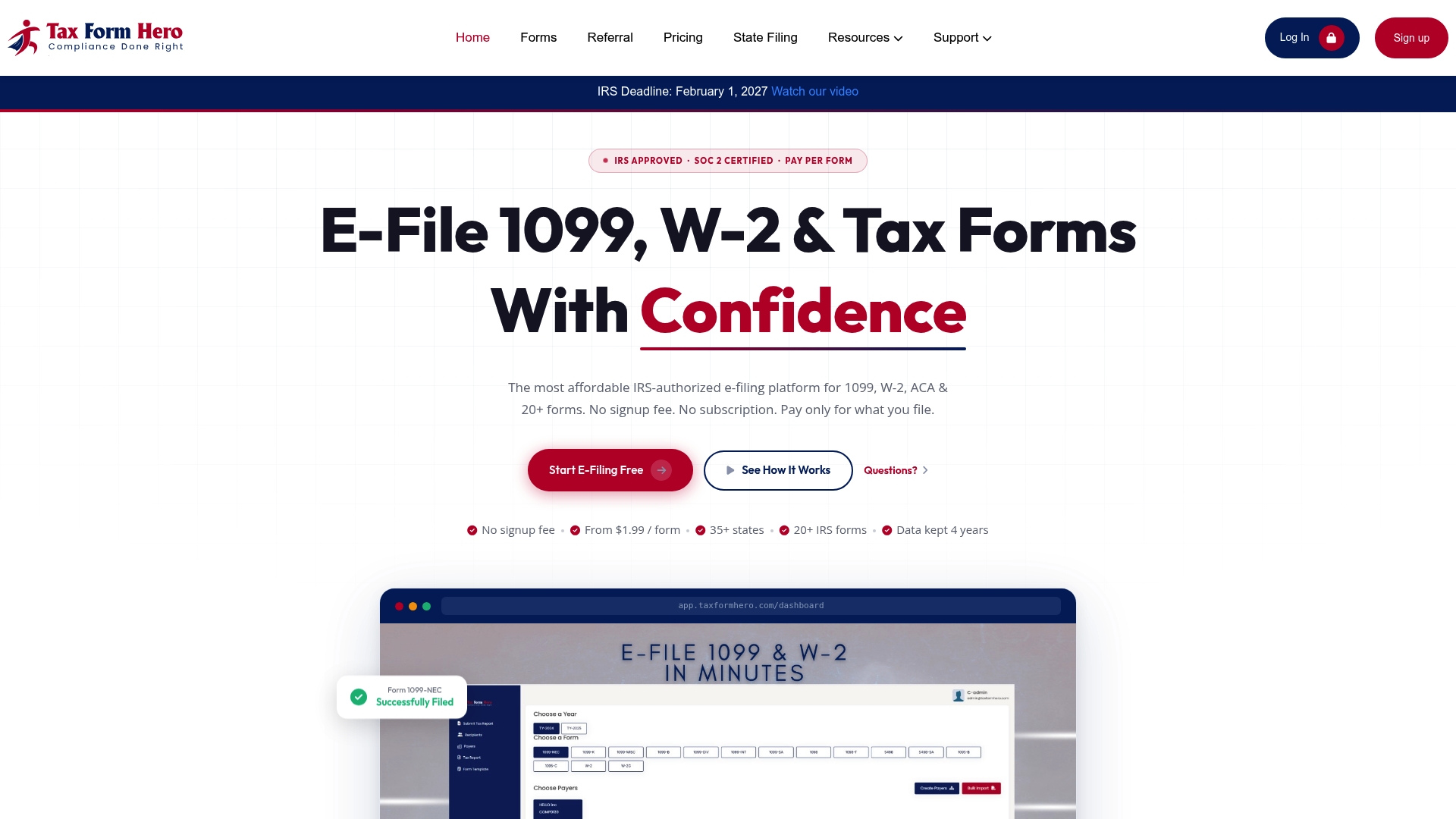
We built TaxFormHero around that. It is an IRS-authorized e-filing platform, so 1099 returns are transmitted to the IRS through IRIS A2A. You enter recipients one at a time or import thousands of records from an Excel or CSV template. TIN matching, encrypted e-delivery and print and mail for recipient copies sit in the same workflow, and data is protected with 256-bit encryption.
Pricing is also meant to be predictable. You pay per form, with no subscription, signup fee or annual contract, and the price tiers are graduated, so each rate applies only to the forms in its tier. A business with 20 contractors and a firm with 2,000 recipients both pay only for what they file.
Our advice is to do the verification work in the fall, when there is time to fix a bad TIN, and to treat the e-file requirement as a given once you reach 10 returns.
Nazrul
File your 1099s with TaxFormHero
If you have decided to file this season, TaxFormHero’s small business 1099 filing is built for the workflow described above. For 1099 forms, the first 150 forms cost $1.99 each, forms 151 to 500 cost $0.99 each, forms 501 to 1,000 cost $0.60 each, and forms above 1,000 cost $0.45 each. Optional services are priced per form: encrypted e-delivery is $0.19 and print and mail is $1.69. Full details are on the pricing page.
Because Texas has no state 1099 filing requirement, Texas-only payers can skip the state filing add-on. Firms with larger client lists can look at the enterprise filing option.
FAQ
Do I have to issue a 1099 to a business?
Only in some cases. You generally do not need to file for a payment to an incorporated business, unless the payment is for medical or legal services. Unincorporated businesses, such as sole proprietors and many LLCs, are treated like individuals and get a 1099 if the year’s total meets the threshold.
How much does a Texas business have to pay a contractor before filing a 1099-NEC?
For payments made in 2026, the threshold is $2,000 for services. The 1099-NEC for those payments is due to recipients and the IRS by January 31, 2027, moved to the next business day because that date is a Sunday. Payments made before 2026 used the old $600 threshold.
Can I download and print a 1099 form?
You can print Copy B and the other black-ink copies for recipients. The Copy A you download from the IRS is for information only and cannot be scanned, so do not use it for paper filing. Order official forms from the IRS, or e-file.
Does Texas require me to file 1099s with the state?
No. Texas has no individual state income tax, so businesses do not file state 1099 returns with the Comptroller. You file with the IRS and give recipients their copies. Contractors in other states may be covered by those states’ rules.
Sources
- IRS: Am I required to file a Form 1099 or other information return?
- IRS: A guide to information returns
- IRS: Instructions for Forms 1099-MISC and 1099-NEC
- IRS: Publication 1099, General Instructions for Certain Information Returns
- IRS: Form 1099-NEC
- IRS: Information return penalties
- Texas Comptroller: USAS Procedures for 1099 Reporting
- Accounting Crunchers: New 1099 Rules 2026
- Corpay: 1099-NEC for Construction Subcontractors
- CloudBookkeeping: 1099 Vendor Compliance Texas
- EisnerAmper: Failure to File Forms 1099 Correctly
- Beancount: Backup Withholding in 2026
Recommended
- 1099 Reporting for Texas Small Businesses: 2026 Rules
- 1099 Deadlines 2026: What Small Businesses Must Know
- How to File 1099 Forms: A 2026 Small Business Guide
- The 1099 Compliance Checklist Every Business Needs
Disclaimer:
“This content is for informational purposes only and does not constitute legal, tax, or financial advice. For advice specific to your situation, consult a qualified US attorney or CPA.”

File Information Returns With Confidence
TaxFormHero supports 20+ IRS information returns, including 1099 and W-2 forms, with bulk Excel import, name/TIN matching and encrypted recipient delivery.
Explore TaxFormHero